dual personalities

“We bring you…a tinsel and spun-candy world of reckless beauty and mounting laughter and whirling thrills”*

by chuckofish

Today is the birthday of Cecil B. DeMille (August 12, 1881 – January 21, 1959)–American film director and film producer in both silent and sound movies, Academy Award winner and Episcopalian.

demille

Only a fourth of his movies were talkies, but they include some mighty good ones.

I recently watched The Plainsman (1936) with Gary Cooper as Wild Bill Hickok and Jean Arthur as Calamity Jane. (I blogged about Calamity Jane back on May 1 and it took three months to get the DVD from Netflix–harumph.)

It is a very enjoyable movie, mostly because of its two stars. However, James Ellison, who plays the important role of Buffalo Bill, is kind of weak–good looking but no spark.

01b_1936 Plainsman, The (Ellison)

Gary Cooper, Helen Burgess and James Ellison

The difference between him and Gary Cooper is an object lesson in why some people become movie stars and others don’t.

DeMille doesn’t fool around with political correctness in this film: the Indians are the bad guys and they are scary. There is a lot of tension in the fast-paced, but historically incorrect plot. And the cinema technology is impressive. Although mostly shot on a sound stage, the impression of depth and three-dimensional action is suggested by the use of a screen, where previously filmed activity is projected, behind the primary shot. It is very clever and effective. Indeed, I was impressed by this 1936 film–so much more engaging than our computer-generated “action” pictures of today.

Anyway…join me, won’t you, in toasting old Cecil B. tonight! And if you can get your hands on a copy of The Plainsman, take a look.

I’ll also lift a glass to Robin Williams who died on Monday. I’ll blog about him later. Rest in peace.

Into paradise may the angels lead thee; and at thy coming may the martyrs receive thee, and bring thee into the holy city Jerusalem.
–BCP, Burial of the Dead, Rite I

*The Greatest Show on Earth (1952)

Would you like to swing on a star? Carry moonbeams home in a jar…

by chuckofish

MCC girl scout campI worked hard this weekend around the house and on my bathroom project, so I regret that I did not have the strength of mind or body to write a lengthy blog post.

Instead, here is a summery picture of our dear mother (third from the left, middle row) when she was a camp counselor at the Newburgh, NY Girl Scout camp, Palisades Interstate Park, New York circa 1943. (She wrote all that information on the back of the picture,  but did not include a date!)

Our mother loved the Girl Scouts and she loved summer camp. I’m sure she was disappointed that my dual personality and I attended a school that did not have a GS troop. She would have loved being an adult scouter. Although on second thought, times had changed by then, and I think she would have hated all that cookie-selling business. It was really camp that she loved.

Oh well, c’est la vie.

“Come Down to Kew in Lilac Time”

by chuckofish

It’s not lilac time, but Kew is still beautiful. My DH just returned from a research trip to the National Archives at Kew in London and while he was there, he had the chance to go through the beautiful gardens where he took many a photo. His trip there put me in mind of our mother, who had an abiding (alas, unfulfilled) desire to go to Kew Gardens, inspired by a poem, which I believe was Alfred Noyes’s “The Barrel Organ.” The poem is long, so I will not include the whole thing, but here’s part of it punctuated with pictures of Kew (some taken by my DH).

There’s a barrel-organ carolling across a golden street
    In the City as the sun sinks low;
And the music’s not immortal; but the world has made it sweet
    And fulfilled it with the sunset glow;
And it pulses through the pleasures of the City and the pain
    That surround the singing organ like a large eternal light;
And they’ve given it a glory and a part to play again
    In the Symphony that rules the day and night.
And the music’s not immortal; but the world has made it sweet
    And fulfilled it with the sunset glow;
And it pulses through the pleasures of the City and the pain
    That surround the singing organ like a large eternal light;
And they’ve given it a glory and a part to play again
    In the Symphony that rules the day and night.2014-07-28 10.47.31
The cherry-trees are seas of bloom and soft perfume and sweet perfume,
    The cherry-trees are seas of bloom (and oh, so near to London!)
And there they say, when dawn is high and all the world’s a blaze of sky
    The cuckoo, though he’s very shy, will sing a song for London.
Kew
Go down to Kew in lilac-time, in lilac-time, in lilac-time;
   Go down to Kew in lilac-time (it isn’t far from London!)
And you shall wander hand in hand with love in summer’s wonderland;
   Go down to Kew in lilac-time (it isn’t far from London!)
The Dorian nightingale is rare and yet they say you’ll hear him there
    At Kew, at Kew in lilac-time (and oh, so near to London!)
The linnet and the throstle, too, and after dark the long halloo
    And golden-eyed tu-whit, tu-whoo, of owls that ogle London.
Kew-Gardens
There’s a barrel-organ carolling across a golden street
    In the City as the sun sinks glittering and slow;
And the music’s not immortal; but the world has made it sweet
And enriched it with the harmonies that make a song complete
In the deeper heavens of music where the night and morning meet,
    As it dies into the sunset-glow;
And it pulses through the pleasures of the City and the pain
    That surround the singing organ like a large eternal light,
And they’ve given it a glory and a part to play again
    In the Symphony that rules the day and night.
2014-07-28 12.38.31
            And there, as the music changes,
                  The song runs round again.
             Once more it turns and ranges
                  Through all its joy and pain,
             Dissects the common carnival
                  Of passions and regrets;
             And the wheeling world remembers all
                  The wheeling song forgets.
             Once more La Traviata sighs
                  Another sadder song:
             Once more II Trovatore cries
                  A tale of deeper wrong;
             Once more the knights to battle go
                  With sword and shield and lance
             Till once, once more, the shattered foe
                  Has whirled into—a dance!
Come down to Kew in lilac-time, in lilac-time, in lilac time;
    Come down to Kew in lilac-time (it isn’t far from London!)
And you shall wander hand and hand with love in summer’s wonderland;
    Come down to Kew in lilac-time (it isn’t far from London!

Mother never got to Kew (and for that matter, neither have I), but I know she would have loved it. She did love a garden! Take some time this busy weekend to enjoy your garden or take a walk somewhere beautiful, and, if you are so inclined, read the whole poem,  “The Barrel Organ”.

Have a great weekend! [Sorry about the horrible tiny font on the poem. Try as I might (and I did to the point of wanting to smash my computer), I could not get this to work]

Happy birthday, Dustin Hoffman, or “Mrs. Krabappel, are you trying to seduce me?”

by chuckofish

simpsons-07-dustin-hoffman

Happy birthday to Dustin Hoffman, born August 8, 1937, who has had a long and illustrious career in film, stage and television. Known for his versatile portrayals of “antiheroes and vulnerable characters”, he has been nominated seven times and won two Oscars–for Kramer vs. Kramer (1979) and Rain Man (1988).

My favorite Hoffman role is Mr. Bergstrom in The Simpsons (Season 2, episode 19). It’s the one where Lisa has a crush on her substitute teacher (Hoffman), who seemingly represents everything that Homer is not. Meanwhile, Bart decides to run for class president, and becomes the overwhelming favorite. Mr. Bergstrom teaches Lisa that LIFE is indeed worth living and that “for the record, there were a few Jewish cowboys. Big guys, who were great shots, and spent money freely.” Anyway, Mr. Bergstrom is a wonderful character and it is a great episode–one that nearly brought me to tears the first time I saw it. It is definitely one of my all-time favorite top 5 episodes. (Yes, I have a top 5.) Maybe even top two.

Here’s a clip with all Dustin’s parts in the episode:

http://www.simplydustinhoffman.com/apps/videos/videos/show/15221415

Yes, you can see that Mr. Bergstrom holds a special place in my heart:

IMGP1068

Obviously my movie pick for this Friday is any one of Dustin Hoffman’s movies. Since Tootsie is the only one we own (The OM is a big fan of Toot-see), I will probably be watching it. (I may have Papillon–since it co-stars Steve McQueen–but I’ll have to check.)

You were waiting for this, I know...

You were waiting for this, I know…

Have a great weekend!

“Simplicity is the greatest adornment of art”*

by chuckofish

In case you missed it, Albrecht Dürer (1528), Matthias Grünewald (1529), and Lucas Cranach the Elder (1553), artists, were remembered on the Episcopal Church calendar on Tuesday.

You may recall, that in the turbulent sixteenth century, as the Renaissance and the Reformation changed the cultural, social, political and religious face of northern Europe from medieval to modern, these three artists were emblematic of those revolutions. You can read about them here.

Ever since I was a child I have been a big fan of Albrecht Dürer. I seem to remember that we had several of his woodcuts and engravings (watercolors?) in the collection of the Saint Louis Art Museum, but when I searched their online catalogue I could not find any. (What’s up with that?))

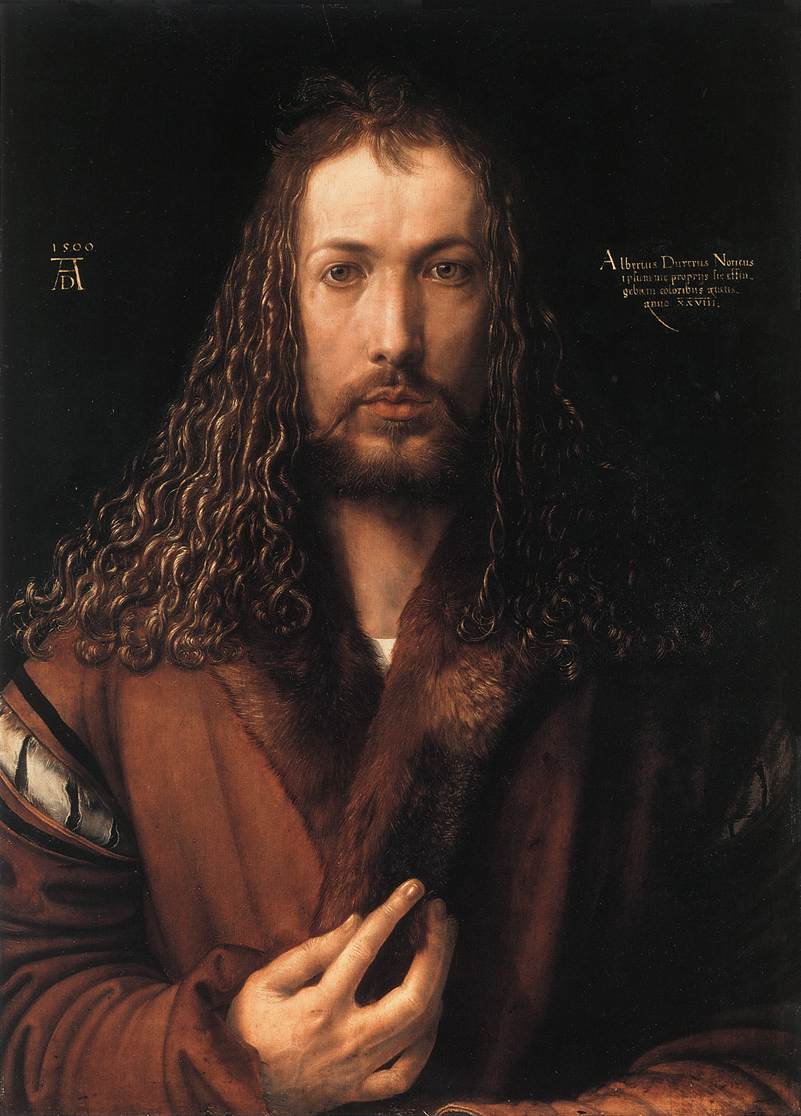
Durer_selfporitrait

He was good looking too!

Anyway, Albrecht Dürer was born in Nuremberg and is generally regarded as the greatest German artist of the Renaissance. “His talent, ambition and sharp, wide-ranging intellect earned him the attention and friendship of some of the most prominent figures in German society.” He became official court artist to Holy Roman Emperors Maximilian I and his successor Charles V. In Nuremberg, a vibrant center of humanism and one of the first cities to officially embrace the principles of the Reformation, Dürer had access to some of Europe’s outstanding theologians and scholars, including Erasmus, Philipp Melanchthon and his good friend Willibald Pirkheimer–each of whom he made portraits.

praying_hands_albrecht_durer

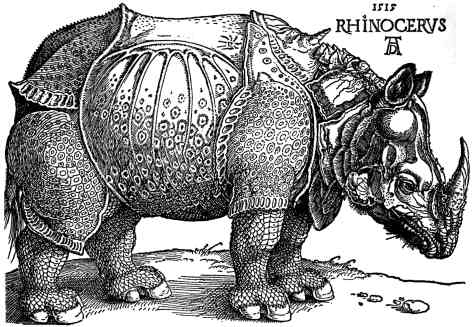
Hundreds of surviving drawings, letters and diary entries document his travels through Italy and the Netherlands, attesting to his insistently scientific perspective and demanding artistic judgment.

Dürer_-_Rhinoceros

Albrecht_Dürer05

little_owl

Dürer attended the Augustinian Church in Nuremberg and was heavily influenced by the teachings of Luther and the emphasis on Christ’s passion as the only key to forgiveness from sin. When Luther disappeared after the Diet of Worms and few knew whether he was living or dead, Dürer offered a prayer:

“If we have lost this man, who has written more clearly than any that has lived for 140 years, and to whom Thou hast given such a spirit of the Gospel, we pray Thee, O Heavenly Father, that Thou wouldst again give Thy Holy Spirit to another . . . O God, if Luther is dead, who will henceforth deliver the Holy Gospel to us with such clearness?

Of course, unknown to Dürer at the time, Luther was very much alive and had been placed in hiding by his friends to protect him from capture by the imperial or papal forces.

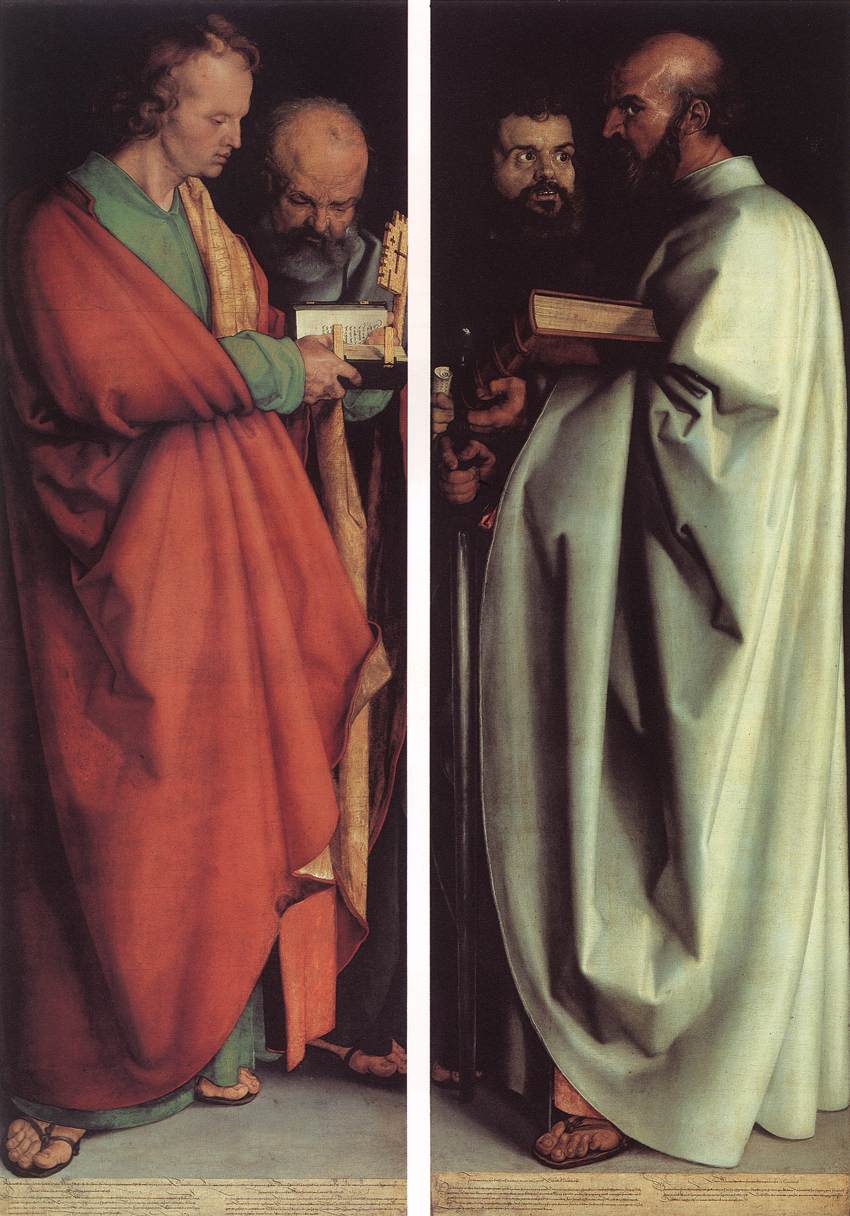
In 1525 Nuremberg became a Protestant city. The following year Dürer made a present to the Nuremberg City Council of The Four Holy Men — Saints John, Peter, Mark and Paul. Below the painting Dürer wrote, “All worldly rulers in these dangerous times should give good heed that they receive not human misguidance for the Word of God, for God will have nothing added to His Word nor taken away from it. Hear therefore these four excellent men, Peter, John, Paul, and Mark and their warning.”

The Four Holy Men, 1526. Oil on lindenwood

The Four Holy Men, 1526. Oil on lindenwood

We give thanks to you, O Lord, for the vision and skill of Albrecht Dürer, Matthias Grünewald and Lucas Cranach the Elder, whose artistic depictions helped the peoples of their age understand the full suffering and glory of your incarnate Son; and we pray that their work may strengthen our faith in Jesus Christ and the mystery of the Holy Trinity; for you live and reign, one God, for ever and ever. Amen.

* Albrecht Dürer

‘Tis the season, eh?

by chuckofish

Okay, now, it’s only the first week of August and this is what I saw in the grocery store yesterday.

halo2

Hello. Halloween is nearly three months away. I’m just saying.

I am so not ready for this, folks.

Trying to live in the present as usual.

The right instructions

by chuckofish

Farmer with a Pitchfork by Winslow Homer

Farmer with a Pitchfork by Winslow Homer


“You mustn’t wish for another life. You mustn’t want to be somebody else. What you must do is this:
‘Rejoice evermore.
Pray without ceasing.
In everything give thanks.’
I am not all the way capable of so much, but those are the right instructions.”

–Wendell Berry, Hannah Coulter

Happy Birthday, Wendell Berry  (born August 5, 1934)–American novelist, poet, environmental activist, and farmer!


The very top of summer

by chuckofish

“The first week of August hangs at the very top of summer, the top of the live-long year, like the highest seat of a Ferris wheel when it pauses in its turning. The weeks that come before are only a climb from balmy spring, and those that follow a drop to the chill of autumn, but the first week of August is motionless, and hot. It is curiously silent, too, with blank white dawns and glaring noons, and sunsets smeared with too much color.”

–Natalie Babbitt, Tuck Everlasting

How was your weekend? Mine went super fast, starting with my Friday night when, after an exhausting day, I sat down to watch Cat Ballou and promptly fell asleep. No great loss, but there went my Friday night!

Saturday I went to a baby shower-(!)-given by the friend of the first soon-to-be-a-grandma of my friends.

presents

Time marches on–relentlessly.

I watched a good documentary about the Ghost Army in WWII suggested by my dual personality.

279003_10151029668546330_282941993_o

The documentary tells about a 1944 secret U.S. Army unit that was set up in order to misdirect the Nazis. The weapons used included inflatable tanks and specially made sound effects records. Their mission was to use deceit to fool the enemy into thinking there were troops where there were none. It worked to an amazing degree. Fascinating!

I worked on my DIY project in an upstairs bathroom–removing wallpaper and glue. The worst. My career as a hand model is officially over.

I continued to read about Ned Kelly and started a memoir of a pioneer Presbyterian minister who established the first protestant church on the western slope (in Lake City, CO).

IMGP1066

Ned Kelly, as portrayed by the wonderful Peter Carey is an engaging enough character, but the rest of the Australian population, in particular the Irish element, are rather dreadful. I will persevere because Carey writes so well. Unfortunately we all know it will end badly for our anti-hero and there is nothing Kelly can do about it. Oh well.

The Rev. George Darley was truly an amazing man. He ministers to his flock, leads temperance meetings, raises money, conducts funerals for all sorts of characters, and treks back and forth over the San Juan mountains in all kinds of terrible weather. And he has a sense of humor:

“Before going far my swearing acquaintance seemed disposed to enliven the hard ride of almost sixty miles by having some fun at ‘the Parson’s’ expense. He finally called out: ‘Parson, this is not the road to heaven.’ Being already loaded, I answered: ‘No, but there are plenty of such men as you on like trails going to hell, and I am doing what I can to save them.’ That ended his attempts to have fun at the ‘Parson’s’ expense.”

Have a great week!


Всё гениальное просто (Genius is simplicity)

by chuckofish

This week I’ve spent a lot of time looking at wallpaper for my very tiny front hall/foyer. I’ve found so many cool things, including this lovely William Morris paper from W.A.S. Benson.

william morris

For some reason, this got me thinking about one of my favorite illustrators, Ivan Bilibin, a Russian who worked during the first half of the 20th century (this is how my mind works). Born in St. Petersburg, Bilibin is famous for his illustrations of Russian fairy tales. I don’t know what this one is about, but it looks pretty creepy.

ivan_bilibin_vasilisa.jpg

I love his patterns and textiles,

andrew-shooter-and-strelchiha-1900(1)

his lighting,

Ivan_Bilibin_012

colors, and soft lines.

this was a stage set he designed

this was a stage set he designed

And let’s not forget that pervasive Russian melancholybilibin4

and (kind of ominous) romance.

ivan-bilibin-maria-marevna-1351091050_bHis border designs are also cool, don’t you think?

As a young man, Bilibin studied art in St. Petersburg before traveling into the wastes of northern Russia, where the folk tales, wooden architecture, and people captured his imagination. Here he is as a debonaire young man in 1901.

Debonaire in 1901

Poor Mr. Bilibin’s life did not end well,  however.  Although he left Russia for Paris during the Revolution,  homesickness drove him back — just in time for WWII. He died during the siege of Leningrad and was buried in a mass grave (you can read all about it on Wikipedia).

Here’s to the memory of Ivan Bilibin, whose simple genius transformed peasant stories into beautiful paintings.

“To amuse oneself in order that one may exert oneself…seems right; for amusement is a sort of relaxation, and we need relaxation because we cannot work continuously.” *

by chuckofish

Winslow Homer's "The Nooning"

Winslow Homer’s “The Nooning”

It is August. The year is more than half over!  The goals I have set for my summer are looming.

All that said, I still try to take each day as it comes and enjoy the moment. I suggest you do the same.

Here are a few things to think about this weekend:

“Part of the inner world of everyone is this sense of emptiness, unease, incompleteness, and I believe that this in itself is a word from God, that this is the sound that God’s voice makes in a world that has explained him away. In such a world, I suspect that maybe God speaks to us most clearly through his silence, his absence, so that we know him best through our missing him.”

(Frederick Buechner, Secrets in the Dark: A Life in Sermons)

“If there is anywhere on earth a lover of God who is always kept safe, I know nothing of it, for it was not shown to me. But this was shown: that in falling and rising again we are always kept in that same precious love.”

(Julian of Norwich)

“I have found that I even have to pray for the willingness to give up the stuff I hate most about myself. I have to ask for help, and sometimes beg. That’s the human condition. I just love my own guck so much. Help. Then I try to be a good person, a better person than I was yesterday, or an hour ago. In general, the Ten Command­ments are not a bad place to start, nor is the Golden Rule. We try not to lie so much or kill anyone that day. We do the footwork, which comes down mostly to paying attention and try­ing not to be such a jerk. We try not to feel and act so entitled. We let others go first.

How can something so simple be so pro­found, letting others go first, in traffic or in line at Starbucks, and even if no one cares or notices? Because for the most part, people won’t care—they’re late, they haven’t heard back from their new boyfriend, or they’re fixated on the stock market. And they won’t notice that you let them go ahead of you.

They take it as their due.

But you’ll know. And it can change your whole day, which could be a way to change your whole life. There really is only today, al­though luckily that is also the eternal now. And maybe one person in the car in the lane next to you or in line at the bank or at your kid’s baseball game will notice your casual generos­ity and will be touched, lifted, encouraged—in other words, slightly changed for the better— and later will let someone else go first. And this will be quantum.”

(Anne Lamott, Help, Thanks, Wow)

Clay Boone: I think we’ll go to St. Louis.

Cat: St. Louis?

Clay Boone: Yeah, St. Louis! City on the Missouri, railhead of the Santa Fe, jump off for the Oregon Trail – producers of beef, beer, shoes and, ah, good times.

(Cat Ballou, 1965)

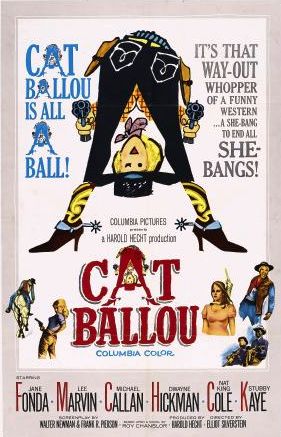
Cat_Ballou_Poster

Cat Ballou will be shown on TCM tonight as part of their all-Jane Fonda-all day program. I remember going to see it at the movies back in 1965 and I thought it was pretty great. Of course, I was nine. It is not a great movie, but I am kind of in the mood for such silliness. Lee Marvin, of course, won an Oscar for his portrayal of Kid Shelleen/Tim Strawn.  I’m sure Richard Burton, Laurence Olivier, Rod Steiger, and Oskar Werner–who were also nominated that year–weren’t laughing. If you look at the nominees/winners, you’ll see it was a really weak year.

Anyway, it’s been a busy week and I am ready for my weekend! Have a good one.

*Aristotle