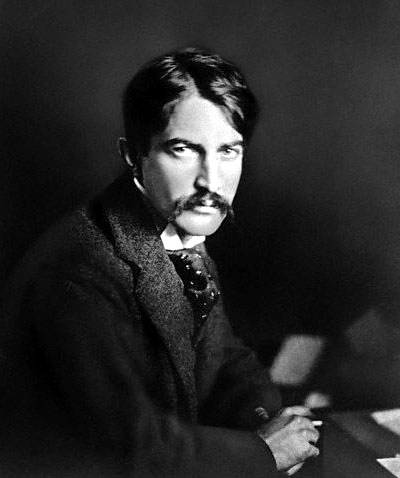
Stephen Crane (November 1, 1871 – June 5, 1900) was an American novelist, short story writer, poet and journalist. He wrote The Red Badge of Courage when he was 24 and died at 28.
It rained. The procession of weary soldiers became a bedraggled train, despondent and muttering, marching with churning effort in a trough of liquid brown mud under a low, wretched sky. Yet the youth smiled, for he saw that the world was a world for him, though many discovered it to be made of oaths and walking sticks. He had rid himself of the red sickness of battle. The sultry nightmare was in the past. He had been an animal blistered and sweating in the heat and pain of war. He turned now with a lover’s thirst to images of tranquil skies, fresh meadows, cool brooks — an existence of soft and eternal peace.
Over the river a golden ray of sun came through the hosts of leaden rain clouds.
Anne Tyler is another of my most favorite read-again authors. I have read all of her books and look forward to the next one, scheduled to be published in 2012:
If Morning Ever Comes (1964), The Tin Can Tree (1965), A Slipping-Down Life (1970), The Clock Winder (1972), Celestial Navigation (1974), Searching for Caleb (1975), Earthly Possessions (1977), Morgan’s Passing (1980), Dinner at the Homesick Restaurant (1982), The Accidental Tourist (1985), Breathing Lessons (1988), Saint Maybe (1991), Ladder of Years (1995), A Patchwork Planet (1998), Back When We Were Grownups (2001), The Amateur Marriage (2004), Digging to America (2006), Noah’s Compass (2010), The Beginner’s Goodbye (forthcoming April 2012)
My favorite is Dinner at the Homesick Restaurant (also the one she thinks is her best). Here is a passage:
He rifled through the pages, glimpsing buttonhole stitch and watermelon social and set of fine furs for $22.50. “Early this morning,” he read to his mother, “I went out behind the house to weed. Was kneeling in the dirt by the stable with my pinafore a mess and the perspiration rolling down my back, wiped my face on my sleeve, reached for the trowel, and all at once thought, Why I believe that at just this moment I am absolutely happy.”
His mother stopped rocking and grew very still.
“The Bedloe girl’s piano scales were floating out her window,” he read, “and a bottle fly was buzzing in the grass, and I saw that I was kneeling on such a beautiful green little planet. I don’t care what else might come about, I have had this moment. It belongs to me.”
That was the end of the entry. He fell silent.
“Thank you, Ezra,” his mother said. “There’s no need to read any more.”
Today is the birthday of author Conrad Richter (October 13, 1890—October 30, 1968). Richter is one of my favorite writers, one I go back to over and over again. In fact, I just recently re-read The Waters of Kronos (1960) for the third or fourth time. He won the National Book Award for this book, and I highly recommend it. Unfortunately, Richter will probably be best remembered for A Light in the Forest because it was made into a movie by Walt Disney in 1958. It starred James MacArthur and Fess Parker.
They still teach this book in some middle schools, but he is not a “young adult writer” and he should not be relegated to that particular pigeon hole.
Louis Bromfield described Richter’s work this way: “He has that gift – the first and most important in a novelist – of creating for the reader a world as real as the one in which he lives, a world which the reader enters on the first page and in which he remains until the last.” (It should be noted that Louis Bromfield is not that kind a writer, but I’m glad he could recognize the gift in others.) Anyway, I whole-heartedly recommend The Awakening Land trilogy (The Trees, The Fields, The Town) as well as A Company of Strangers, The Free Man, A Simple Honorable Man, and The Waters of Kronos.
For a moment Sayward reckoned that her father had fetched them unbeknownst to the Western ocean and what lay beneath was the late sun glittering on green-black water. Then she saw that what they looked down on was a dark, illimitable expanse of wilderness. It was a sea of solid tree-tops broken only by a gash where deep beneath the foliage an unknown stream made its way. As far as the eye could reach, this lonely forest sea rolled on and on till its faint blue billows broke against an incredibly distant horizon.
–from The Trees (1940)