dual personalities

Tag: spirituality

Tout va bien

by chuckofish

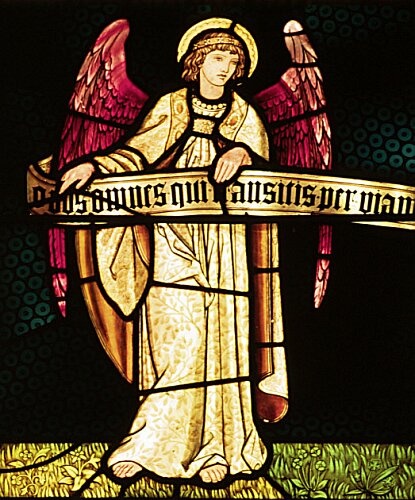
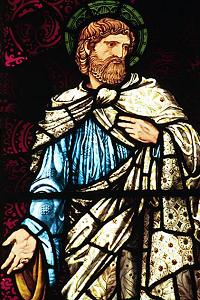
Saint Paul by Burne-Jones

The First Lesson appointed for use on the Feast of Brigid (today) is one of my favorites:

Consider your own call, brothers and sisters: not many of you were wise by human standards, not many were powerful, not many were of noble birth. But God chose what is foolish in the world to shame the wise; God chose what is weak in the world to shame the strong; God chose what is low and despised in the world, things that are not, to reduce to nothing things that are, so that no one might boast in the presence of God. He is the source of your life in Christ Jesus, who became for us wisdom from God, and righteousness and sanctification and redemption, in order that, as it is written, “Let the one who boasts, boast in the Lord.”
1 Corinthians 1:26-31

Frederick Buechner writes that when he first met St. Paul and these lines, he “had the feeling that I knew something of what he was talking about. Something of the divine comedy we are all of us involved in. Something of grace.”

God turns everything upside down.

And god forbid that we should take ourselves too seriously.

Tout va bien

by chuckofish

“My child, the troubles and temptations of your life are beginning, and may be many; but you can overcome and outlive them all if you learn to feel the strength and tenderness of your Heavenly Father as you do that of your earthly one. The more you love and trust Him, the nearer you will feel to Him, and the less you will depend on human power and wisdom. His love and care never tire or change, can never be taken from you, but may become the source of lifelong peace, happiness, and strength. Believe this heartily, and go to God with all your little cares, and hopes, and sins, and sorrows, as freely and confidingly as you come to your mother.”

Louisa May Alcott (from Little Women)

(I found this quote on the wonderful blog Hay Quaker. Check it out!)

A new year’s discipline

by chuckofish

Gratitude … goes beyond the “mine” and “thine” and claims the truth that all of life is a pure gift. In the past I always thought of gratitude as a spontaneous response to the awareness of gifts received, but now I realize that gratitude can also be lived as a discipline. The discipline of gratitude is the explicit effort to acknowledge that all I am and have is given to me as a gift of love, a gift to be celebrated with joy.
-Henri J. M. Nouwen

Westward leading, still proceeding

by chuckofish

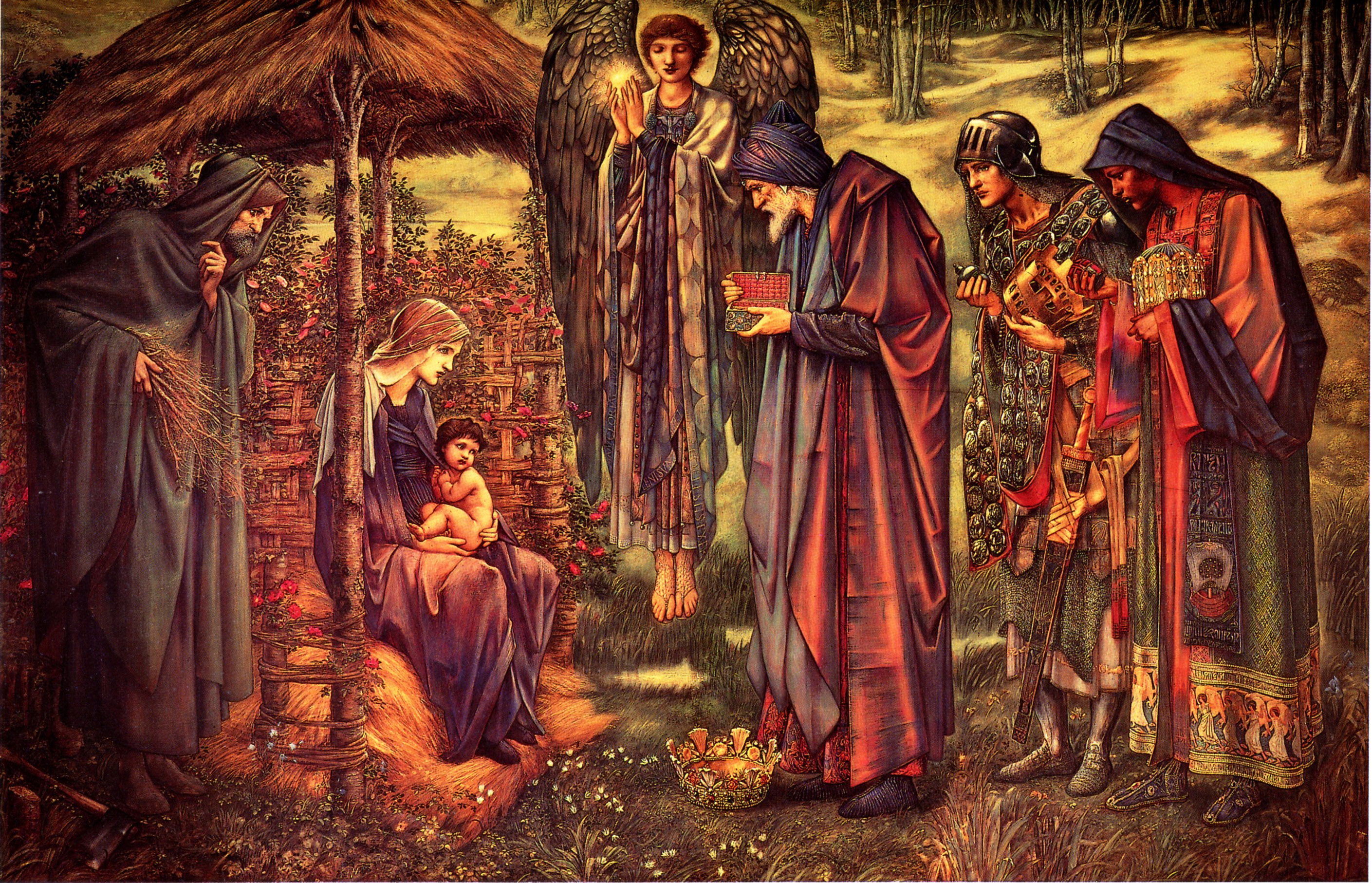
The Star of Bethlehem by Edward Burne-Jones

“And when they were come into the house, they saw the young child with Mary his mother, and fell down, and worshipped him: and when they had opened their treasures, they presented unto him gifts; gold, and frankincense and myrrh.” (Matthew 2:11 KJV)

I love that angel, don’t you?

God was man in Palestine

by chuckofish

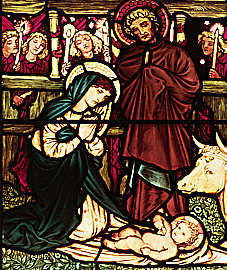
Christmas
by John Betjeman

The bells of waiting Advent ring,
The Tortoise stove is lit again
And lamp-oil light across the night
Has caught the streaks of winter rain
In many a stained-glass window sheen
From Crimson Lake to Hookers Green.

The holly in the windy hedge
And round the Manor House the yew
Will soon be stripped to deck the ledge,
The altar, font and arch and pew,
So that the villagers can say
‘The church looks nice’ on Christmas Day.

Provincial Public Houses blaze,
Corporation tramcars clang,
On lighted tenements I gaze,
Where paper decorations hang,
And bunting in the red Town Hall
Says ‘Merry Christmas to you all’.

And London shops on Christmas Eve
Are strung with silver bells and flowers
As hurrying clerks the City leave
To pigeon-haunted classic towers,
And marbled clouds go scudding by
The many-steepled London sky.

And girls in slacks remember Dad,
And oafish louts remember Mum,
And sleepless children’s hearts are glad.
And Christmas-morning bells say ‘Come!’
Even to shining ones who dwell
Safe in the Dorchester Hotel.

And is it true? And is it true,
This most tremendous tale of all,
Seen in a stained-glass window’s hue,
A Baby in an ox’s stall ?
The Maker of the stars and sea
Become a Child on earth for me ?

And is it true ? For if it is,
No loving fingers tying strings
Around those tissued fripperies,
The sweet and silly Christmas things,
Bath salts and inexpensive scent
And hideous tie so kindly meant,

No love that in a family dwells,
No carolling in frosty air,
Nor all the steeple-shaking bells
Can with this single Truth compare –
That God was man in Palestine
And lives today in Bread and Wine.

Thy daily stage of duty run

by chuckofish

Awake, my soul, and with the sun
thy daily stage of duty run;
shake off dull sloth, and joyful rise
to pay thy morning sacrifice.

Lord, I my vows to thee renew;
disperse my sins as morning dew;
guard my first springs of thought and will,
and with thyself my spirit fill.

Direct, control, suggest, this day,
all I design or do or say;
that all my powers, with all their might,
in thy sole glory may unite.

Praise God, from whom all blessings flow;
praise him, all creatures here below;
praise him above, ye heavenly host:
praise Father, Son, and Holy Ghost.

–Thomas Ken

Now here’s a poem we have probably all known forever and taken for granted. What a great morning prayer and hymn! If you are alone and cannot sing it as a round, sing it anyway. You’ll be glad you did.

And while we’re at it, let’s give a high five to Bishop Thomas Ken (1637–1711) who wrote it. (Ken is honored with a feast day on the liturgical calendar of the Episcopal Church (USA) on March 20.)

They don’t write ’em like this anymore.

P.S. This is our 100th blog post! Yay for us!

Stand ye still, and ye shall see the salvation of the Lord

by chuckofish

Tonight I went to our service of Advent Lessons and Carols at Grace Episcopal Church. We sang all the great Advent hymns, including (56) O Come, O Come, Emmanuel, (66) Come Thou Long Expected Jesus, and (265) our all-time favorite, Gabriel’s Message, the one about “thou lowly maiden Mary, most highly favored lady.”

There were eight lessons, scripture readings from the old and new testaments, and a variety of carols sung by the Choir of Men and Women, the St. Nicholas Boys Choir, the St. Cecelia Girls Choir, and the (adorable) St. Patrick Training Choir. This AND a homily from the visiting Rt. Revd. Stephen Dokolo, Bishop of the Diocese of Lui, Southern Sudan, who looked like a Masai warrior without a spear. Very impressive indeed.

The highpoint for me was when fourth grader Brigid strode across the choir, bowing before the altar, and proceeded up to the lectern to read the second lesson. Clearly enjoying herself, radiantly self-confident, she smiled and read Isaiah 40:1-8: “Comfort, O comfort my people, says your God” better than most adults are able. She never stumbled over such stumbling blocks as “recompense” or “constancy”. She read with conviction, “‘Cry out!’ And I said, ‘What shall I cry?'” She brought to mind Linus in A Charlie Brown Christmas.

I am particularly fond of Brigid and her siblings because daughter #2 has been babysitting them for many years and so I have a tangential, proprietary attachment to them. They give me faith in the next generation.

So onward through Advent: Look toward the east, O Jerusalem, and see the joy that is coming to you from God.

The holy within

by chuckofish

Thomas Raymond Kelly (1893-January 17, 1941) was an American Quaker educator. He taught and wrote on the subject of mysticism. His books are widely read, especially by people interested in spirituality.

Kelly’s life was full of disappointment. In 1936, after years of teaching jobs across the country, he was finally offered a position in the philosophy department at Haverford College. His dissertation for his second Ph.D. (from Harvard) was published, and all he still needed to do was pass the oral defense of that dissertation. Then he lived out the nightmare of every Ph.D. candidate: he lost his memory during his oral exam. Harvard not only failed him on the defense, they also informed him that he would never be allowed a second chance.

His son wrote, “There is no exact record of what happened in the following weeks, but it is certain that sometime during the months of November or December, 1937, a change was wrought within the very foundation of his soul. He described it as being ‘shaken by the experience of Presence — something that I did not seek, but that sought me ….’ Stripped of his defenses and human self-justification, he found, for the first time, a readiness to accept the outright gift of God’s Love, and he responded with unlimited commitment to that leading. His teaching colleague Douglas Steere, who spent uncounted hours walking Kelly through his grief, later wrote of his healing: ‘He moved toward adequacy. A fissure in him seemed to close, cliffs caved in and filled up a chasm, and what was divided grew together within him. Science, scholarship, method remained good, but in a new setting’.” (Jerry R. Flora: “Searching for an Adequate Life: The Devotional Theology of Thomas R. Kelly”, Spirituality Today, Spring 1990)

Kelly received word on January 17, 1941 that Harper and Brothers wanted to meet with him to discuss the publication of a devotional book. “Today will be the greatest day of my life,” he told his wife. He died of a heart attack later that same day while drying the dinner dishes. Three months later his friend Steere submitted five of Kelly’s devotional essays to the publisher along with a biographical sketch of Kelly. The book was published under the title A Testament of Devotion.

There is a divine Abyss within us all, a holy Infinite Center, a Heart, a Life who speaks in us and through us to the world. We have all heard this holy Whisper at times. At times we have followed the Whisper, and amazing equilibrium of living set in. But too many of us have heeded the Voice only at times. We have not counted this Holy Thing within us to be the most precious thing in the world. We have not surrendered all else, to attend to it alone.

Let me repeat, most of us, I fear, have not surrendered all else, in order to attend to the Holy Within.

–from A Testament of Devotion

Life is sad and mysterious. Terrible things happen. Read this book by Thomas Kelly. It is full of good stuff.
A morning prayer

by chuckofish

Now that the daylight fills the sky,
we lift our hearts to God on high,
that, he, in all we do or say,
would keep us free from harm this day:

Our hearts and lips may he restrain;
keep us from causing others pain,
that we may see and serve his son,
and grow in love for everyone.

From evil may he guard our eyes,
our ears from empty praise and lies;
from selfishness our hearts release,
that we may serve, and know his peace.

–John Mason Neale
#4 The Episcopal Hymnal 1982

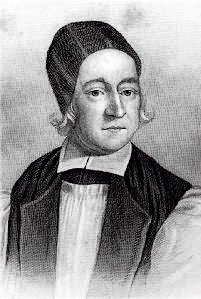
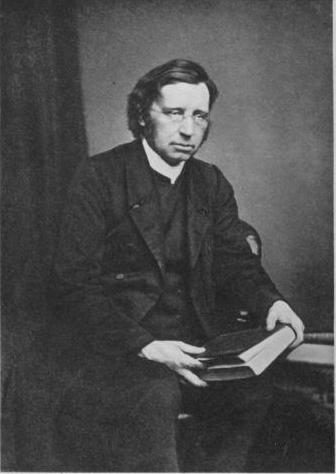
I must say that this hymn/prayer is a wonderful and worthy way to start one’s day. It is one of the lesser known hymns of the great hymn writer John Mason Neale, Anglican priest and scholar, who was educated at Sherborne School, Dorset, and Trinity College, Cambridge, where (despite being said to be the best classical scholar in his year) lack of ability in mathematics prevented him taking an honours degree. Neale was named after the Puritan cleric and hymn writer John Mason (1645–1694), of whom his mother Susanna was a descendant.

A dour looking guy, probably still bitter about those low math scores.

Neale’s most enduring and widely known legacy is probably his contribution to the Christmas repertoire, most notably “Good Christian Men, Rejoice” and his original legendary Boxing Day carol, “Good King Wenceslas”. He was also responsible for much of the translation of the Advent hymn “O come, O come, Emmanuel”, based on the “O Antiphons” for the week preceding Christmas and his hymn “A Great and Mighty Wonder” (translated from the Greek of St Germanus).

Since Neale died on the Festival of the Transfiguration, he is commemorated by the Anglican churches on the following day, 7 August. He is also commemorated in the Calendar of Saints of the Evangelical Lutheran Church in America as a hymn writer on 1 July with Catherine Winkworth.

Well, that’s one way to look at it.

by chuckofish

On the spiritual journey, there is usually someone in our family, business or community whom we cannot endure, someone who has a genius for bringing out the worst in us. No matter what we do, we cannot seem to improve the relationship. They have not done anything to cause it. God simply uses them to reflect back to us what our problem is. Thus the person who gives us the most trouble may be our greatest gift from God.

–Thomas Keating