dual personalities

Tag: poetry

An’ The Raggedy Man, he knows most rhymes, An’ tells ’em, ef I be good, sometimes

by chuckofish

Today is the birthday of James Whitcomb Riley (October 7, 1849 – July 22, 1916) who was an American writer, poet, and best-selling author, frequently referred to as the “Hoosier Poet.”
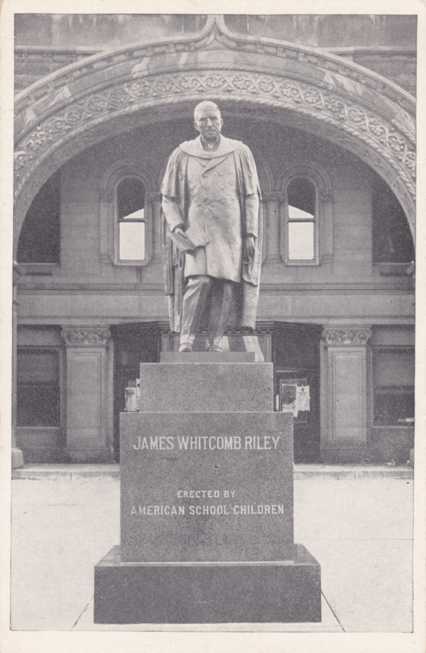
Statue in Greenfield, Indiana

Statue in Greenfield, Indiana

I suppose no one reads his poems anymore. (Although–surprise!– his books are still in print.)

I remember my mother reading them aloud to us with great gusto. There was Little Orphant Annie

Little Orphant Annie’s come to our house to stay,
An’ wash the cups an’ saucers up, an’ brush the crumbs away,
An’ shoo the chickens off the porch, an’ dust the hearth, an’
sweep,
An’ make the fire, an’ bake the bread, an’ earn her board-
an-keep;
An’ all us other childern, when the supper-things is done,
We set around the kitchen fire an’ has the mostest fun,
A-listenin’ to the witch-tales ‘at Annie tells about,
An’ the Gobble-uns ‘at gits you
Ef you
Don’t
Watch
Out!

and The Raggedy Man

O The Raggedy Man! He works fer Pa;
An’ he’s the goodest man ever you saw!
He comes to our house every day,
An’ waters the horses, an’ feeds ’em hay…

Indeed, they were fun to read and fun to listen to. That is no doubt why Riley was among the most popular writers of the late nineteenth and early twentieth century.

So join me in a toast to the forgotten Hoosier poet, James Whitcomb Riley. (Perhaps with one of these.)

I leave you with this picture of another famous Hoosier reading some JWR poetry for fun and personal enrichment.

dean riley

Enjoy your Wednesday–and don’t let the Gobble-uns git you!

A floating sense of doom

by chuckofish

107-Christ the Comforter

“God knows we have our own demons to be cast out, our own uncleanness to be cleansed. Neurotic anxiety happens to be my own particular demon, a floating sense of doom that has ruined many of what could have been, should have been, the happiest days of my life, and more than a few times in my life I have been raised from such ruins, which is another way of saying that more than a few times in my life I have been raised from death – death of the spirit anyway, death of the heart – by the healing power that Jesus calls us both to heal with and to be healed by.”

― Frederick Buechner, Secrets in the Dark: A Life in Sermons

I can surely relate to what Frederick Buechner is saying here, although I wouldn’t classify it as neurotic anxiety exactly. I just have always had a morbid imagination, always thinking about what might happen, especially concerning loved ones.

At the evensong service on Sunday the choir sang an anthem based on a poem by Robert Herrick (1591–1674):

In the hour of my distress,

When temptations me oppress,

And when I my sins confess,

Sweet Spirit, comfort me!


When I lie within my bed,

Sick in heart and sick in head,

And with doubts discomforted,

Sweet Spirit, comfort me!


When the house doth sigh and weep,

And the world is drown’d in sleep,

Yet mine eyes the watch do keep,

Sweet Spirit, comfort me!

I was reminded that people back in the seventeenth century lay in bed at night and obsessed over problems too. I must say that I do find comfort in that.

And as I always say to the boy after one of our overwrought discussions of current events, God is in control. It is good to remember that.

The evensong service ends with the wonderful prayer for mission:

Keep watch, dear Lord, with those who work, or watch, or weep this night, and give thine angels charge over those who sleep. Tend the sick, Lord Christ; give rest to the weary, bless the dying, soothe the suffering, pity the afflicted, shield the joyous; and all for thy love’s sake. Amen.

You can’t go wrong with this prayer at bedtime. Keep it on your bedside table. Envision those angels watching over you and your loved ones. It helps to dissipate that floating sense of doom.

Mid-week meditation

by chuckofish

StoneWall

September’s Baccalaureate
A combination is
Of Crickets—Crows—and Retrospects
And a dissembling Breeze

That hints without assuming—
An Innuendo sear
That makes the Heart put up its Fun
And turn Philosopher.

–Emily Dickinson

Yes, September is here.

DSCN1507And I have a very cute calendar page for this month, don’t I?

How rewarding to know Mr. Smith

by chuckofish

Well, here’s something interesting. William Jay Smith, the author of more than fifty books of poetry, translation, children’s books, and literary criticism, has died. He was 97 and had had a distinguished career spanning fifty-two years.

smith_wj

He served in the US Naval Reserves during World War II, and afterward met and married the poet Barbara Howes and completed graduate study at Columbia University, at Oxford University as a Rhodes Scholar, and at University of Florence. He taught and lectured at many colleges and universities, including Williams and Hollins. He served as Consultant in Poetry to the Library of Congress (the position now called Poet Laureate) from 1968 to 1970, and he had been a member of the Academy of Arts and Letters since 1975.

Furthermore, he grew up outside St. Louis and graduated from Washington University! I am ashamed to say I had never heard of him until I got the email about a distinguished alum dying.

So here in his honor is a poem he wrote about “Mr. Smith”

How rewarding to know Mr. Smith,
Whose writings at random appear!
Some think him a joy to be with
While others do not, it is clear.

His eyes are somewhat Oriental,
His fingers are notably long;
His disposition is gentle,
He will jump at the sound of a gong.

His chin is quite smooth and uncleft,
His face is clean-shaven and bright,
His right arm looks much like his left,
His left leg it goes with his right.

He has friends in the arts and the sciences;
He knows only one talent scout;
He can cope with most kitchen appliances,
But in general prefers dining out.

When young he collected matchboxes,
He now collects notebooks and hats;
He has eaten roussettes (flying foxes),
Which are really the next thing to bats!

He has never set foot on Majorca,
He has been to Tahiti twice,
But will seldom, no veteran walker,
Take two steps when one will suffice.

He abhors motorbikes and boiled cabbage;
Zippers he just tolerates;
He is wholly indifferent to cribbage,
And cuts a poor figure on skates.

He weeps by the side of the ocean,
And goes back the way that he came;
He calls out his name with emotion–
It returns to him always the same.

It returns on the wind and he hears it
While the waves make a rustle around;
The dark settles down, and he fears it,
He fears its thin, crickety sound.

He thinks more and more as time passes,
Rarely opens a volume on myth.
Until mourned by the tall prairie grasses,
How rewarding to know Mr. Smith!

Happy Thursday, y’all!

“Whereon it is enough for me, Not to be doing, but to be!”*

by chuckofish

beachview

What heed I of the dusty land
And noisy town?
I see the mighty deep expand
From its white line of glimmering sand
To where the blue of heaven on bluer waves shuts down!

In listless quietude of mind,
I yield to all
The change of cloud and wave and wind
And passive on the flood reclined,
I wander with the waves, and with them rise and fall.

–from “Hampton Beach” by John Greenleaf Whittier

Tomorrow I am off to Florida to meet up with daughters #1 and #2 for a week on the beach. The OM has flaked on us due to work commitments, so we will eat and drink what we please and binge watch “Freaks and Geeks” if we so desire.

Although daughter #2 will have her laptop, I will not be online. So I’ll see you in a week or so. Keep us travelers in your prayers.

beach2

*From “A Day of Sunshine” by Henry Wadsworth Longfellow

“A good man, full of the Holy Spirit and faith.” *

by chuckofish

paul-barnabas

Today the Episcopal Church observes the feast day of St. Barnabas, the early Christian fondly nicknamed Son of Encouragement (Acts 4:37). He befriended Saul of Tarsus after his conversion and introduced him to the skeptical leaders back in Jerusalem: “But Barnabas took him, brought him to the apostles, and described for them how on the road he had seen the Lord, who had spoken to him, and how in Damascus he had spoken boldly in the name of Jesus.” (Acts 9:27)

After that he and Paul (formerly Saul) undertook several missionary journeys together.

Willem de Poorter's "St. Paul and Barnabas in Lystra"

Willem de Poorter’s “St. Paul and Barnabas in Lystra”

Eventually the two disagreed about whether to take Barnabas’ cousin/nephew John Mark, whom Paul thought was a quitter, on another trip. The dispute ended with Paul taking Silas as his companion and journeying through Syria and Cilicia, while Barnabas took John Mark to visit Cyprus.

You see, even back then, church people were arguing and separating and going off in a huff. Why should we be surprised when this happens today?

Acts 15:38

Acts 15:38

I always liked old Barnabas. I’m sure he had to put up with a lot from Paul, who wasn’t always the easiest person/apostle to get along with. I always thought it was sad that their friendship ended the way it did. I’m sure we can all take a lesson from it.

St. Barnabas, with John his sister’s son,
Set sail for Cyprus; leaving in their wake
That chosen Vessel, who for Jesus’ sake
Proclaimed the Gentiles and the Jews at one.
Divided while united, each must run
His mighty course not hell should overtake;
And pressing toward the mark must own the ache
Of love, and sigh for heaven not yet begun.
For saints in life-long exile yearn to touch
Warm human hands, and commune face to face;
But these we know not ever met again:
Yet once St. Paul at distance overmuch
Just sighted Cyprus; and once more in vain
Neared it and passed;–not there his landing-place.

–Christina Rossetti

*Acts 11:24

O Pioneers!

by chuckofish

The Sign of the Arrow called Tuesday to say that daughter #1’s ornament–which she had dropped off in April when she was home–was ready to pick up and so I stopped by after work.

photo

Isn’t it great? The Pioneer is the mascot of our local high school. He is a manly pioneer with a coonskin cap. For me he always evokes Walt Whitman and his:

COME, my tan-faced children,

Follow well in order, get your weapons ready;

Have you your pistols? have you your sharp-edged axes? Pioneers! O Pioneers!

Anyway, I had to share.

Windows open

by chuckofish

May is white clouds behind pine trees

Puffed out and marching upon a blue sky.

May is green as no other,

May is much sun through small leaves,

May is soft earth,

And appleblossoms,

and windows open to a south wind.

–Amy Lowell

I found this poem torn out of a magazine and stuck in my mother’s notebook about gardens where she had painstakingly copied out poems about gardens and bible quotations and other quotes.

Also stuck in it was this photo:

farm family

You can click on it to enlarge the picture.

Her mother and grandfather are on the right. They are visiting their relatives (the Wheeler-Rand-Smiths) who owned the farm. My mother is the little dark-haired girl with the baby carriage and her older sister Susanne is to the right. I don’t know whose baby my grandmother is holding, because her youngest daughter was born in 1933 and this must be 1928-29, judging from my mother’s age (3?). The other women and the blonde children are members of the family (the Frohawks) who lived on the farm and farmed it.

My mother spent her summers on this farm in North Charlestown, N.H. and, boy, did she love it and the Frohawks. At that time, the farm had been in her family for 150 years. We heard about it all the time growing up. I would have liked to spend my summers there, but it had been sold after the war and was gone with the wind.

Sigh.

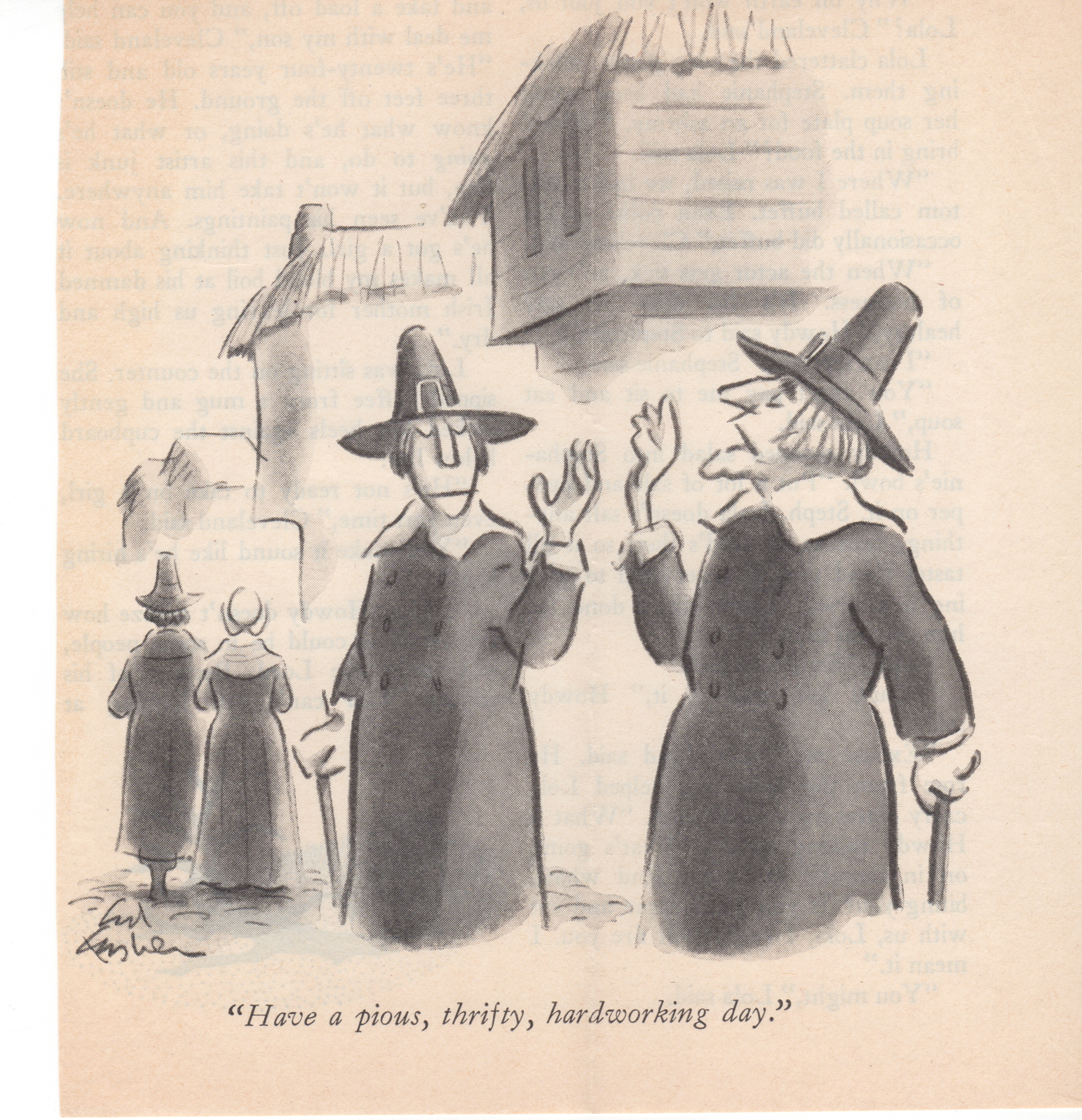
Anyway, also tucked into the notebook was this cartoon, which I am sure I had sent her.

puritans 1

It is still my mantra. So have a pious, thrifty, hardworking day…and weekend!

Festina lente

by chuckofish

Fred Ndercher, 1922, "Spring Landscape" in the St. Louis Mercantile Library collection

Nothing is so beautiful as Spring –

When weeds, in wheels, shoot long and lovely and lush;

Thrush’s eggs look little low heavens, and thrush

Through the echoing timber does so rinse and wring

The ear, it strikes like lightnings to hear him sing;

The glassy peartree leaves and blooms, they brush

The descending blue; that blue is all in a rush

With richness; the racing lambs too have fair their fling.

What is all this juice and all this joy?

A strain of the earth’s sweet being in the beginning

In Eden garden. – Have, get, before it cloy,

Before it cloud, Christ, lord, and sour with sinning,

Innocent mind and Mayday in girl and boy,

Most, O maid’s child, thy choice and worthy the winning.

“Spring” by Gerard Manley Hopkins

A friend at work brought this poem to my attention by stopping by my office and quoting, “What is all this juice and all this joy?” He was alluding to the beautiful spring day of course. We have certainly enjoyed an exceptionally beautiful spring with long strings of crisp, clear days in the high 60s. Carpe diem, I say–but I am glued to a desk. Sigh.

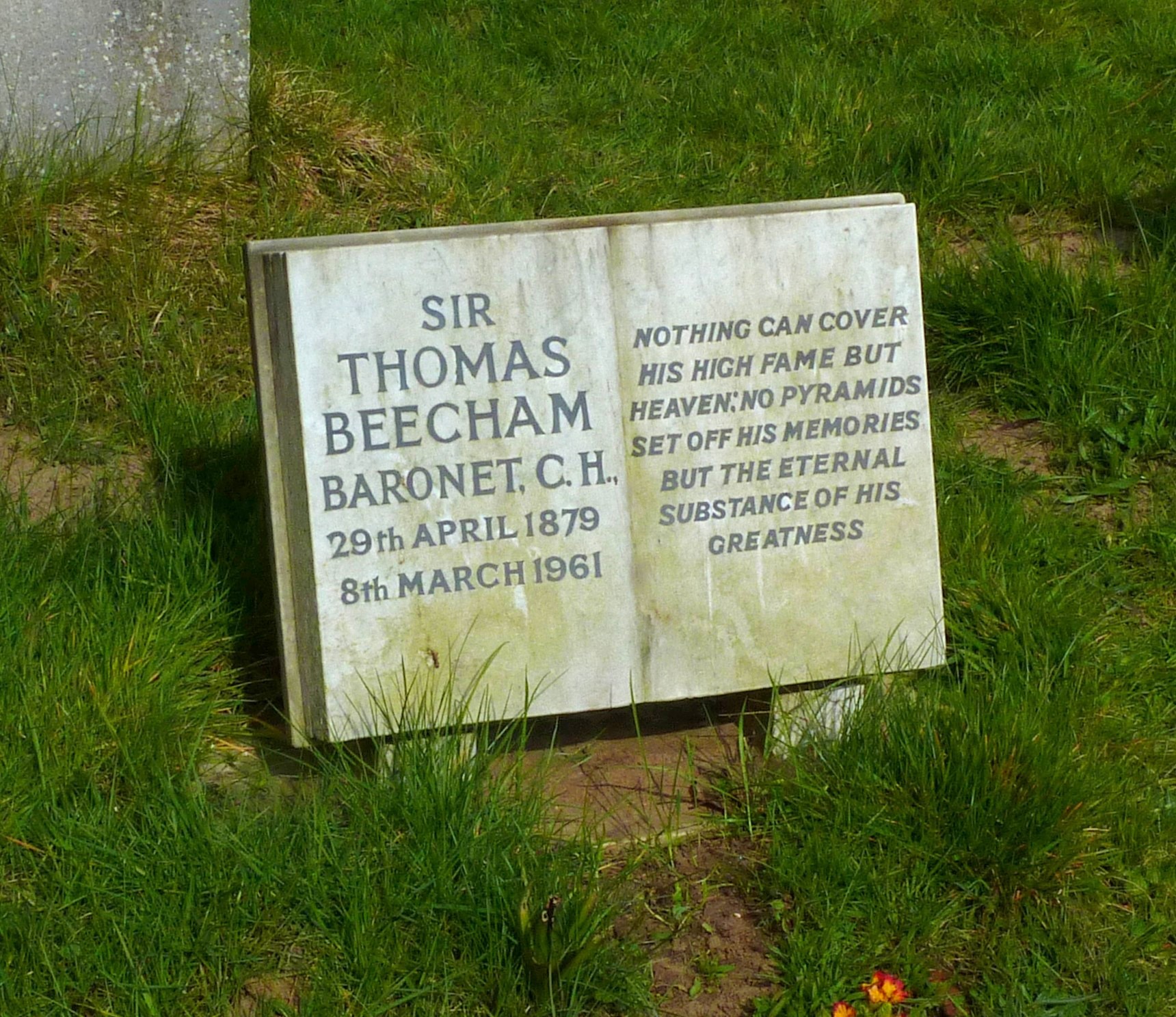
Anyway, it is also the birthday today of Sir Thomas Beecham (29 April 1879 – 8 March 1961) who, you will recall, was an English conductor and impresario best known for his association with the London Philharmonic and the Royal Philharmonic orchestras.

170px-Thomas_Beecham_1919_cartoon

From the early 20th century until his death, Beecham was a major influence on the musical life of Britain and, according to the BBC, was Britain’s first international conductor. If you are like me and my dual personality, you were brought up on Sir Thomas Beecham’s recordings. True, some may have considered him low-brow for saying things like, “I would give the whole of Bach’s Brandenburg Concertos for Massenet’s Manon, and would think I had vastly profited by the exchange.” But I can’t say I disagree with him.

I remember in particular an LP titled “Beecham Bon-Bons” which included popular favorites by Faure, Delius, Sibelius, Ralph Vaughan Williams and the like.

beecham

I wiled away many an hour with Beecham’s music in the background. So a toast to Sir Thomas Beecham! And I think I’ll look him up on eBay and see what I can find.

Beecham's grave in

Beecham’s grave in Surrey

By the way, the painting at the top of the page is by St. Louis artist Frank Nudercher (July 19, 1880 – October 7, 1959)–“Spring Landscape” in the St. Louis Mercantile Library collection. Nudercher is sometimes referred to as the “dean of St. Louis artists.” You can read about him here.

Dear March–Come in

by chuckofish

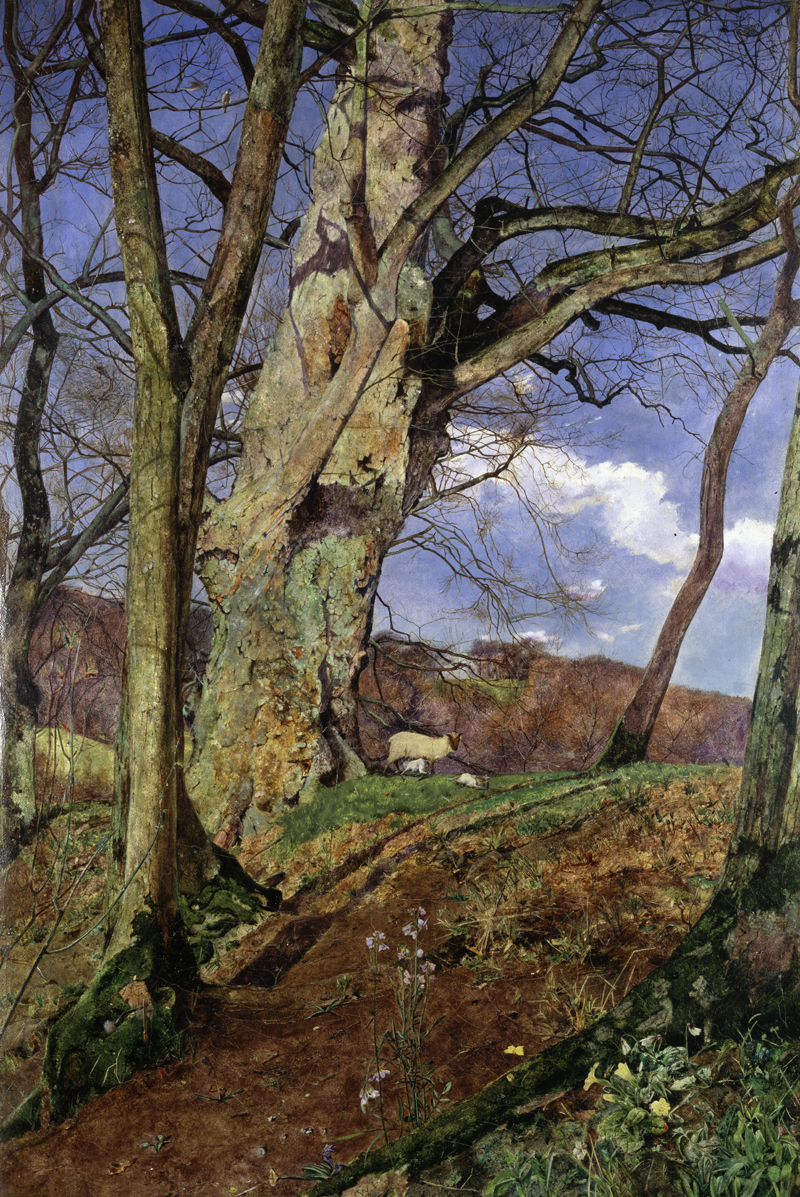
John William Inchbold (1830--1888)

Dear March — Come in —
How glad I am —
I hoped for you before —

Put down your Hat —
You must have walked —
How out of Breath you are —
Dear March, Come right up the stairs with me —
I have so much to tell —

I got your Letter, and the Birds —
The Maples never knew that you were coming — till I called
I declare — how Red their Faces grew —
But March, forgive me — and
All those Hills you left for me to Hue —
There was no Purple suitable —
You took it all with you —

Who knocks? That April.
Lock the Door —
I will not be pursued —
He stayed away a Year to call
When I am occupied —
But trifles look so trivial
As soon as you have come

That Blame is just as dear as Praise
And Praise as mere as Blame —

(Emily Dickinson)

The painting is “A Study, In March”  by John William Inchbold (1830–1888)