What is good about Good Friday?
by chuckofish
As a child and, if I’m honest, long after, I always wondered why it wasn’t called Bad Friday. Because, as Randy Alcorn explains, “out of the appallingly bad came what was inexpressibly good. And the good trumps the bad, because though the bad was temporary, the good is eternal.”
So let us today contemplate the great love of Christ in facing the wrath of God for us. A good place to start is by reading Jonathan Edward’s sermon on Christ’s Agony. Originally preached sometime in 1739, Edwards’ sermon provides a deep analysis of Luke 22:44 and Christ’s agonizing prayer in the Garden of Gethsemane. It is really great, but takes a long time to read, so you better get started.
There are two things that render Christ’s love wonderful: 1. That he should be willing to endure sufferings that were so great; and 2. That he should be willing to endure them to make atonement for wickedness that was so great.
…It was the corruption and wickedness of men that contrived and effected his death; it was the wickedness of men that agreed with Judas, it was the wickedness of men that betrayed him, and that apprehended him, and bound him, and led him away like a malefactor; it was by men’s corruption and wickedness that he was arraigned, and falsely accused, and unjustly judged. It was by men’s wickedness that he was reproached, mocked, buffeted, and spit upon. It was by men’s wickedness that Barabbas was preferred before him. It was men’s wickedness that laid the cross upon him to bear, and that nailed him to it, and put him to so cruel and ignominious a death. This tended to give Christ an extraordinary sense of the greatness and hatefulness of the depravity of mankind.
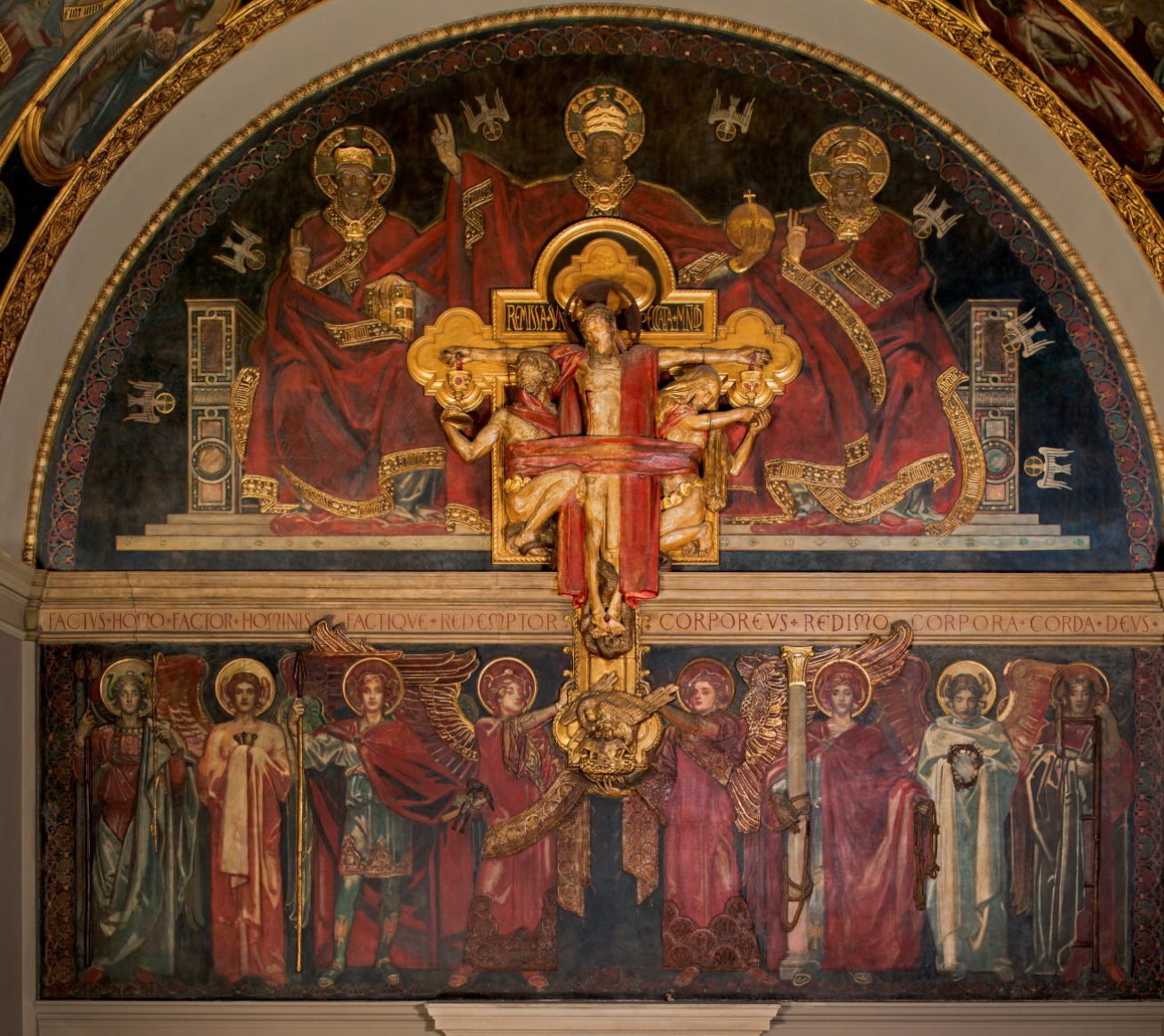
The picture at the top is “Dogma of the Redemption”; Trinity and Crucifix, Frieze of Angels by John Singer Sargent in the Boston Public Library. At the top of this large half-moon lunette, three crowned figures representing the Holy Trinity share a single red robe, the trim of which bears the Latin word Sanctus, or “Holy,” in repeated gild relief. At center in high plaster relief is the figure of Christ on the cross, flanked by Adam at left and Eve at right. At the base of the cross sits a pelican, considered the sacrificial bird in medieval depictions for its tendency to pluck its own skin in order to provide food for its young when no other nourishment is available. Running along the bottom of the lunette is the Frieze of Angels, figures in primary tones holding symbols of the Passion of Christ, including the spear, pincers, hammer, nails, pillar, scourge, reed, sponge, and crown of thorns.
Side note: the image of a pelican is carved into the front of the pulpit of our church.

Have a blessed Easter. Go to church!
 dual personalities
I like the pelican. I did not know that!
I’ll make sure to ask the kids why they think it’s called Good Friday. I’m interested to hear what they say
Yes, me too!