“I look on such things as rather vulgar”
by chuckofish
To paraphrase Anne who has such a way with words, I hope that 2024 is not the year I so relentlessly roll my eyes that I develop some kind of horrendous facial tic that makes it impossible for me to show myself in public. I mean, ye gods, what a clown show!
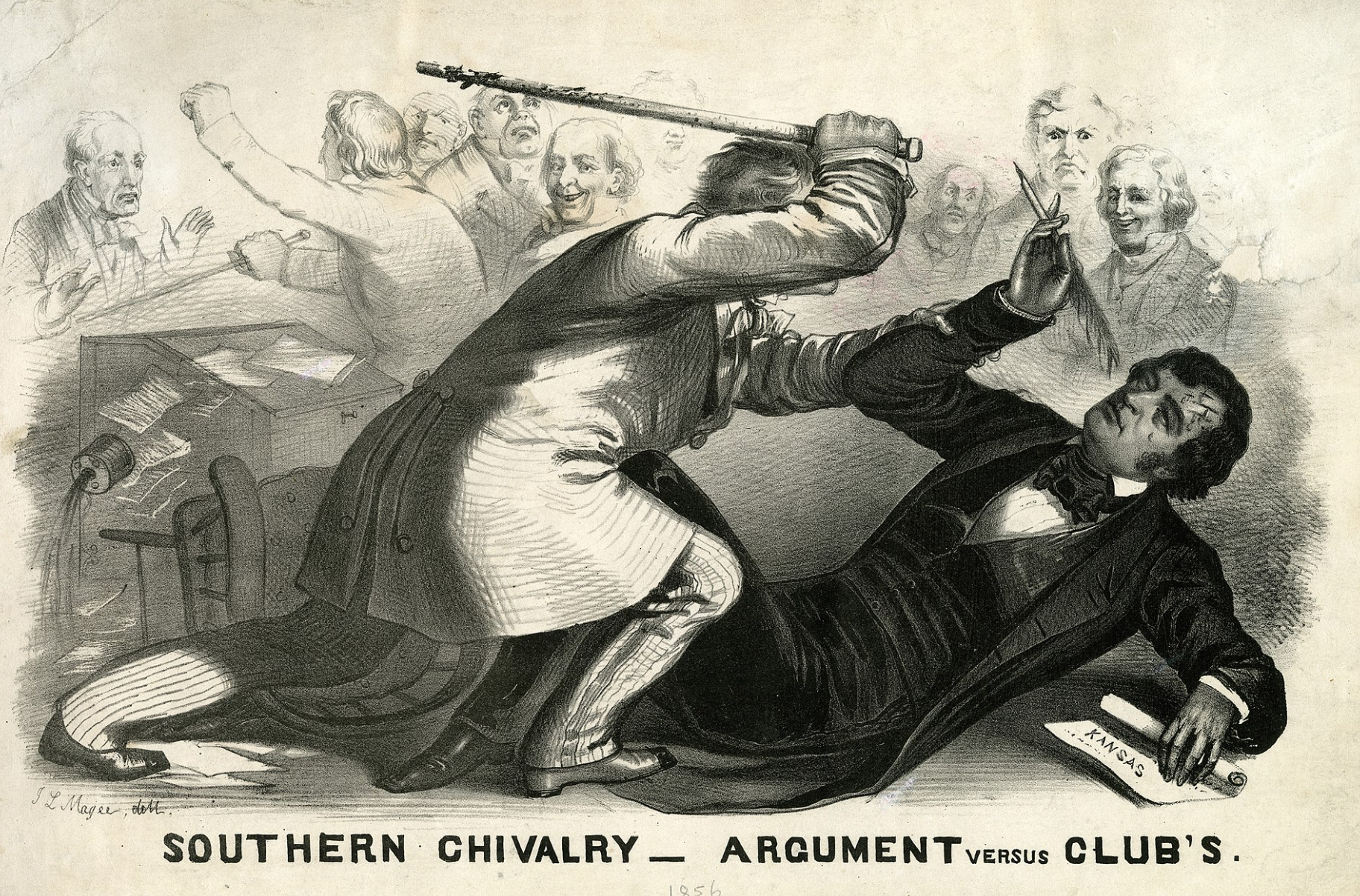
However, as always, it is good to keep our perspective. History teaches us that politics have always been thus. Think of Julius Caesar being literally back-stabbed to death by his friends. Think of Charles Sumner being caned on the floor of the U.S. Senate chamber by Representative Preston Brooks, a pro-slavery Democrat from South Carolina in 1856.
The Bible teaches us that we, indeed, live in a fallen world.
I was recently reminded of all this when researching B. Gratz Brown, an early Governor of Missouri, who hailed from Kentucky but lived for a long time in Kirkwood, Missouri.
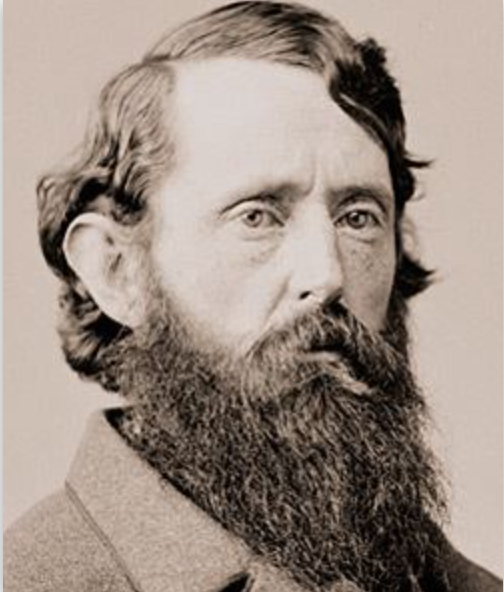
He limped because of an injury he incurred when dueling with his political foe Thomas C. Reynolds, the standard-bearer for the anti-Benton Democrats.
Ella Cecil Bodley, whose diary reveals many of the ordinary incidents of life in early Kirkwood, was not much taken with politics. In her July 21, 1858 entry she notes, “There was a barbeque in Kirkwood yesterday, with a good deal of speechifying. Cousin Frank Blair and Mr. Breckenridge and Mr. Barrett and Mr. Goal all made a speech, some of them two. I did not go to the barbeque for several reasons. Firstly, I look on such things as rather vulgar and I don’t like to go among strangers much, then it was very hot and I did not care to hear the speeches.”
I can relate to Ella, can’t you?
In 1858 Frank Blair was the most powerful politician in Missouri and at that barbeque was probably speaking in behalf of another cousin, B. Gratz Brown, who was running for re-election to the legislature. “Cousin Gratz” is mentioned many times in Ella’s diary–his visits to their home in Kirkwood, his romance and marriage to Mary Brown and his resignation as Editor of the influential Missouri Democrat.
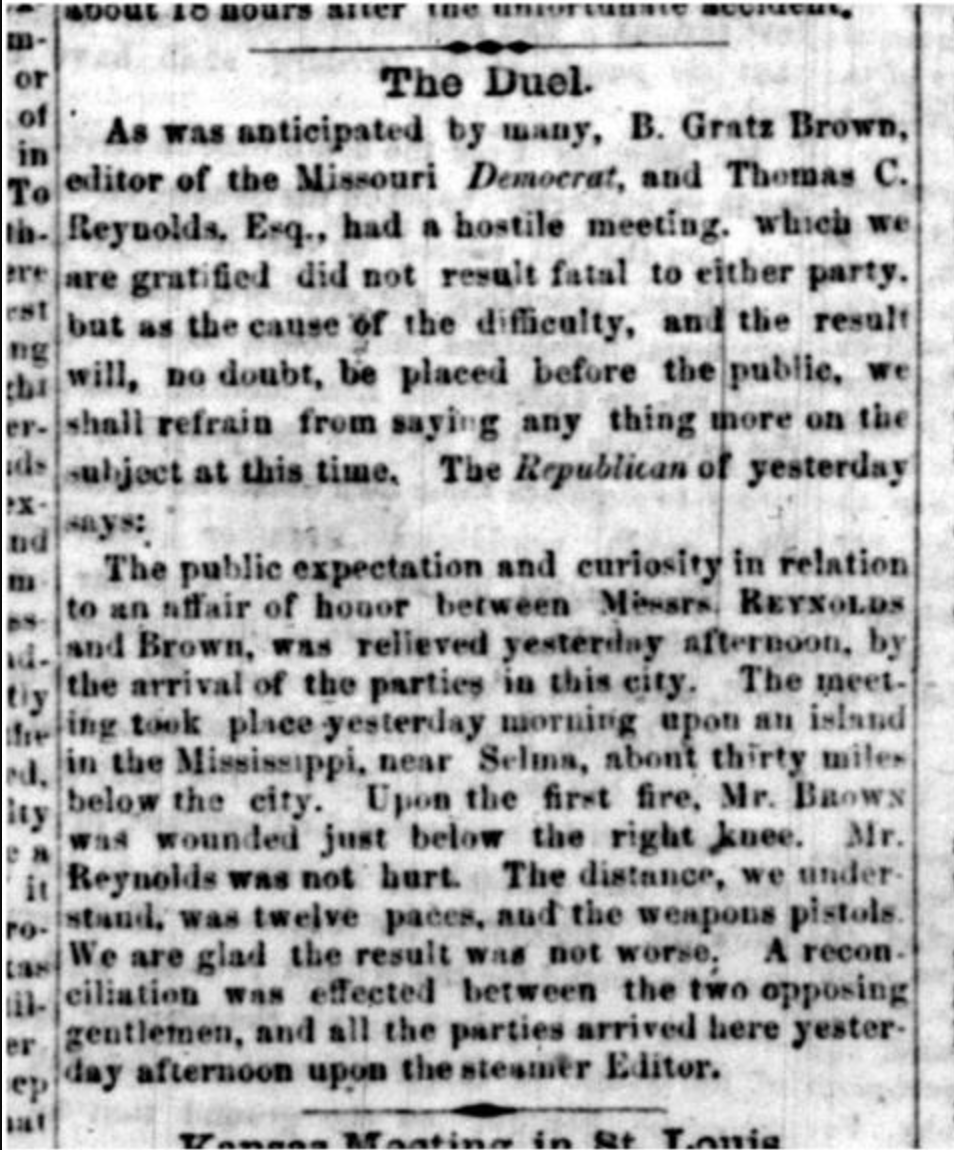
In 1856 the Democratic party in St. Louis was split and Frank Blair was running for congress against Thomas C. Reynolds, who had no hope of beating Blair, but whose campaign was designed to help Trusten Polk’s race for Governor. Brown was running for the state legislature in support of Benton and Blair. In the heat of the campaign he wrote an editorial in his paper that was very offensive to Reynolds and Reynolds gave an equally strong reply in a competing newspaper. The editorial sparring continued until Reynolds challenged Brown to a duel.
Though illegal, dueling was not uncommon in those days in St. Louis, especially among newspaper editors. Most affairs of honor were settled on Bloody Island, a strip of land in the middle of the Mississippi River just below St. Louis, but the prominence of these two combatants demanded a more secure place to eliminate interference. The seconds decided on Selma Hall, the country home of Ferd Kennett, which was on the river forty miles below St. Louis.
When the smoke cleared, Brown was bent over, clutching his thigh and falling to the ground, the ball having split the bone just below his knee. Painfully wounded, Brown was carried on to the first boat passing up the river. When the boat reached the Levee that afternoon, a large crowd had already gathered and a squad of police prepared to arrest the survivor. When it was determined that the duel had not taken place in Missouri, no arrests were made.
Both men were only about 30 years old at the time. Reynolds was elected Lieutenant-governor of Missouri in 1860, but when the war started, he went south with Governor Claiborne Jackson and Gen. Sterling Price. When Jackson died, Reynolds became the Confederate Governor of Missouri in exile. When Lee surrendered, he went to Mexico with General Joe Shelby before ultimately returning to St. Louis to become a prominent attorney.
Gratz Brown became a U.S. Senator, the Governor of Missouri and ran for Vice-President of the U.S. on the Greeley-Brown ticket in 1872. He limped the rest of his life.
Eye roll.
 dual personalities
Fascinating! It is good to learn more about Missouri history. I confess that I know little.
An interesting story!
History is wild and usually provides some healthy perspective.