“The skeleton of the whale furnishes but little clue to the shape of his fully invested body.”*
by chuckofish
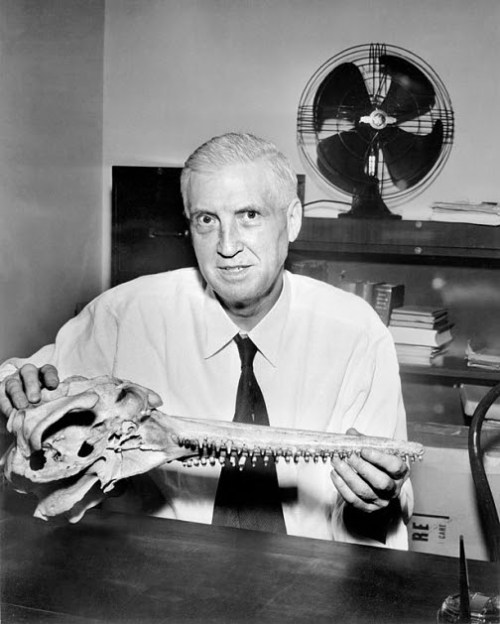 Today is the birthday of Remington Kellogg (October 5, 1892 –May 8, 1969)–a fascinating fellow who was an American naturalist and a director of the United States National Museum. Born and raised in Davenport, Iowa, he attended the University of Kansas where he pursued his lifelong interest in wildlife. From there he went to the University of California–Berkeley. While serving in the Army in France during WWI, Kellogg still found time to collect specimens, which he sent back to Berkeley and the University of Kansas. He was discharged in July 1919 and returned to Berkeley to complete his doctorate, transferring from zoology to study vertebrate paleontology.
In 1928 Kellogg became assistant curator at the United States National Museum and in 1941 became curator. At the museum he devoted time to studying primitive whales from the Eocene and early Oligocene of North America. In 1948 he was appointed director of the Museum and in 1958 was made assistant secretary of the Smithsonian Institution. He was elected to the National Academy of Sciences in 1951.
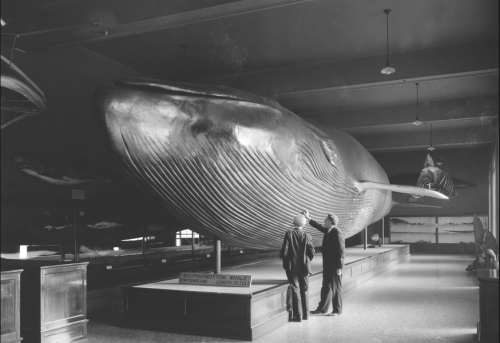
Whales have been at the heart of Smithsonian research since 1850. It was Museum director Remington Kellogg who wanted a “scientifically accurate” model and pushed for the research to make one.

So a toast to Remington Kellogg (what a great name!) and to Herman Melville while we’re at it.
“Speak, thou vast and venerable head,” muttered Ahab, “which, though ungarnished with a beard, yet here and there lookest hoary with mosses; speak, mighty head, and tell us the secret thing that is in thee. Of all divers, thou hast dived the deepest. That head upon which the upper sun now gleams, has moved amid this world’s foundations. Where unrecorded names and navies rust, and untold hopes and anchors rot; where in her murderous hold this frigate earth is ballasted with bones of millions of the drowned; there, in that awful water-land, there was thy most familiar home. Thou hast been where bell or diver never went; hast slept by many a sailor’s side, where sleepless mothers would give their lives to lay them down. Thou saw’st the locked lovers when leaping from their flaming ship; heart to heart they sank beneath the exulting wave; true to each other, when heaven seemed false to them. Thou saw’st the murdered mate when tossed by pirates from the midnight deck; for hours he fell into the deeper midnight of the insatiate maw; and his murderers still sailed on unharmed — while swift lightnings shivered the neighboring ship that would have borne a righteous husband to outstretched, longing arms. O head! thou hast seen enough to split the planets and make an infidel of Abraham, and not one syllable is thine!
Have a good “hump” day!
*Moby-Dick, Herman Melville
 dual personalities
two things–that whale skeleton is FASCINATING and remember when we saw the blue whale the Natural History Museum? Awesome!
I love that language: “this frigated earth”, “the deeper night of the insasiate maw” — it’s gorgeous! And whale are awesome. I teared up when we saw Minke, Finback, and Balugas up off the coast of Canada way back when. What amazing creatures.