The day is cold, and dark, and dreary;
It rains, and the wind is never weary;
The vine still clings to the mouldering wall,
But at every gust the dead leaves fall,
And the day is dark and dreary.
My life is cold, and dark, and dreary;
It rains, and the wind is never weary;
My thoughts still cling to the mouldering past,
But the hopes of youth fall thick in the blast,
And the days are dark and dreary.
Be still, sad heart, and cease repining;
Behind the clouds is the sun still shining;
Thy fate is the common fate of all,
Into each life some rain must fall,
Some days must be dark and dreary.
–Henry Wadsworth Longfellow
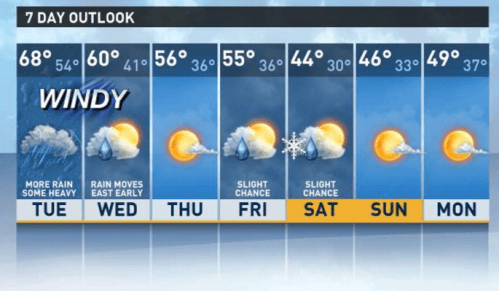
November rain, when it goes on for days, cannot help but bring a person’s spirits down. But I like old Longfellow’s thinking on this subject. When did we stop reading him? He’s kind of great.
Henry was one of those handsome mid-century American writers we are so fond of. Read more about this poet here.
Anyway, please note that there is a slight chance of snow on Saturday! It won’t be long until the weather media is whipping us up into a stock-up-on-bread-and-milk frenzy.
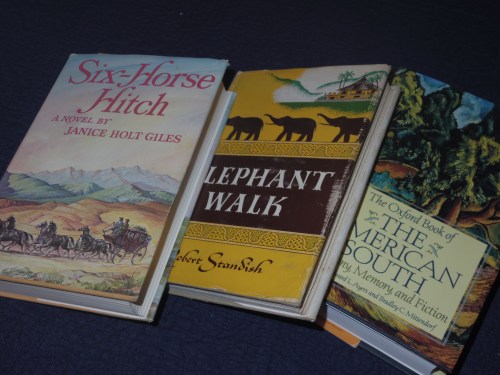
Over the weekend I went to a couple of good estate sales where I picked up several good books.
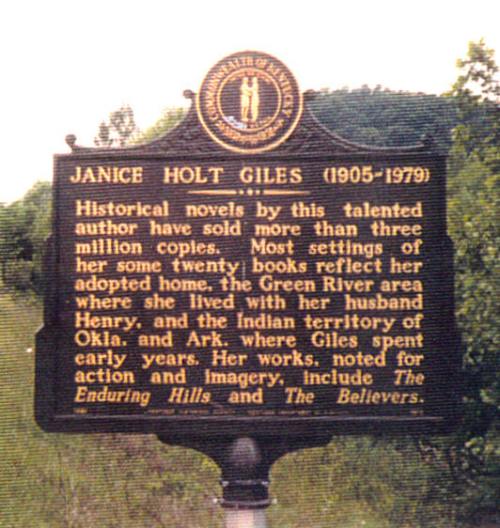
I was happy to see the book by Janice Holt Giles. Chances are you have never heard of her, but she was a popular mid-range author in the 1950s-70s. She never got rich from her writing, but she was able to support herself, and that is saying something.
Janice Holt was born in Arkansas in 1905. As a child she moved to Indian Territory (Oklahoma) where her parents were both teachers. She grew up with books and music and went to college. When her first marriage ended, she and her daughter moved to Louisville, Kentucky where Janice worked for Dr. Lewis Sherrill, Dean of the Presbyterian Seminary.
On a trip to visit family in 1943, Janice happened to share a 40-hour bus ride with Henry Giles, a soldier on his way to a new assignment. In two days on the bus they became such good friends that they corresponded throughout the rest of the war while Henry was in Europe. When he returned from active duty in 1945—although they had not seen each other since the bus ride—they married immediately. Henry was 11 years her junior.
After a year in Louisville, Henry could not bear the big city any longer, and the couple moved to Adair County, KY, living on Henry’s family land. Janice, as I recall, had quite a lot to adapt to–no indoor plumbing for one thing–but love will conquer all. Janice wrote and Henry farmed.
I always thought they must have been a very interesting pair. Their unusual romance and life together is the stuff of good fiction. Indeed, some of her earliest books have a strong autobiographical flavor.
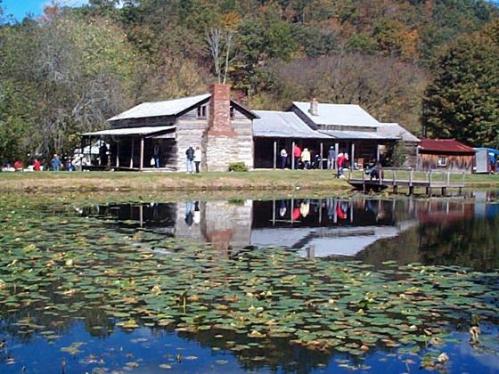
Anyway, I was interested to discover, while checking Holt out on the internet, that the Janice Holt Giles and Henry Giles Society was established in 1996 to preserve the literary legacy of Janice and Henry Giles and to restore their log home.
Their home is now open to the public, June-October on Saturday and Sunday.
Every year there is an arts and crafts fair in early October, and I am thinking of adding this event to my calendar for 2016. The OM’s family is from Kentucky and I have long wanted to investigate the Bluegrass State.
In the meantime I am reading The Six-Horse Hitch and enjoying it very much. She is a thorough researcher and she always knows her subject. If you are interested, I recommend you check out some of her other books. The Piney Woods trilogy, consisting of The Enduring Hills (1950), Miss Willie (1951), and Tara’s Healing (1952), though not as famous as, say, Catherine Marshall’s Christy, is just as good. I have not read all of the Kentucky trilogy, but I have read Hannah Fowler (1956) and thought it excellent.
Reading historical fiction, especially about American pioneers, is for me a good escape from today’s Modern Problems.
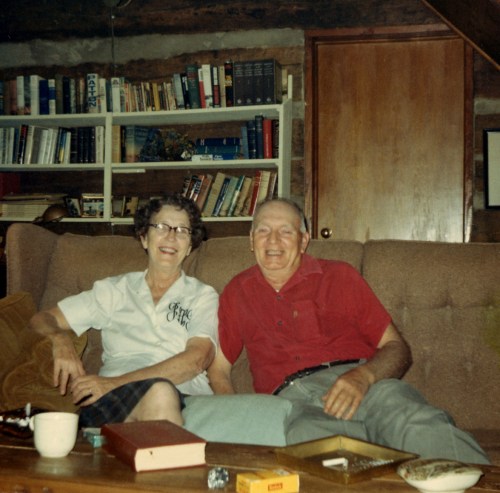
(Photos are from the Janice Holt Giles and Henry Giles Society website.)
So in church on Sunday the readings were all apocalyptic. I do not believe in coincidence, so it was just awesomely appropriate. We had the book of Daniel and the letter to the Hebrews and we had the gospel of Mark with the Destruction of the Temple and Signs of the End Times.
And as he came out of the temple, one of his disciples said to him, “Look, Teacher, what wonderful stones and what wonderful buildings!” 2 And Jesus said to him, “Do you see these great buildings? There will not be left here one stone upon another, that will not be thrown down.”
3 And as he sat on the Mount of Olives opposite the temple, Peter and James and John and Andrew asked him privately,4 “Tell us, when will this be, and what will be the sign when these things are all to be accomplished?” 5 And Jesus began to say to them, “Take heed that no one leads you astray. 6 Many will come in my name, saying, ‘I am he!’ and they will lead many astray. 7 And when you hear of wars and rumors of wars, do not be alarmed; this must take place, but the end is not yet. 8 For nation will rise against nation, and kingdom against kingdom; there will be earthquakes in various places, there will be famines; this is but the beginning of the birth-pangs.
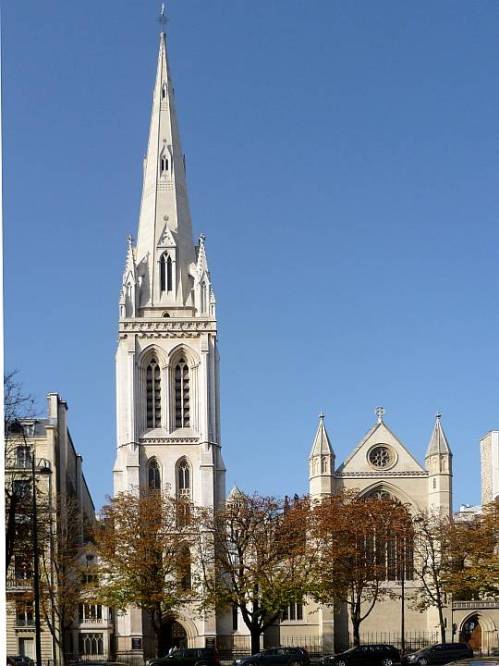
I was the intercessor and we had a special prayer en français for the people of Paris. I was afraid I would have to read it along with the Prayers of the People, but the rector had asked a former French teacher to do it. I read the translation. After 12 years of French in school, I could have faked it, but I was relieved that I did not have to do so.
The rector, who spent a couple of years earlier in his ministerial career at the American Cathedral in Paris,
gave a personal and heartfelt sermon related to the terrorist attacks and to the lessons actually assigned for the day. We sang “Oh, God, our help in ages past” (#680) . Old Isaac Watts is hard to beat for keeping things in perspective.
Gunpowder, Treason and plot. I see no reason why gunpowder treason should ever be forgot!” So goes the children’s rhyme commemorating the foiling of Guy Fawkes’s plot to blow up British Parliament in 1605. As you can imagine, it was a big deal in England and celebrations started a lot of traditions, especially bonfires at which Guy Fawkes and the Pope (or villain of the moment) were burned in effigy.
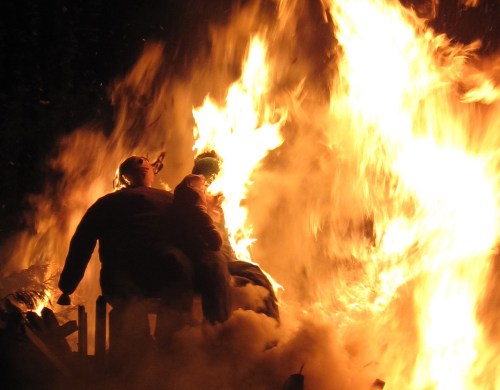
Down in Devon, where my in-laws live, they not only celebrate with a huge bonfire, but also by piling tar barrels onto a sledge, setting them on fire, and dragging them burning through town. Time was when they simply lit the barrels at the top of one the many hills in the village and sent them careening down, but parked cars and other fire hazards eventually called for the sledge modification.
The tar barrel carnival is this weekend and son #2 will be there working with a team of photographers and filmmakers (including his step-granddad) to capture the conflagration. Exciting as Hatherleigh’s tar barrels look, they have nothing on nearby Ottery St. Mary’s tar barrel tradition. Follow this link and watch the short documentary (be sure to watch the whole thing). It’s priceless.
Can you imagine anyone doing that here? Call the fire department! Call social services! Oh, my. Let this be a lesson for us this Saturday. Traditions are important to maintain. It is also important to let our kids test themselves. And, yes, a certain amount of risk is fine. Let us also respond to terrorism with the same united will and assurance that the English did in 1605.
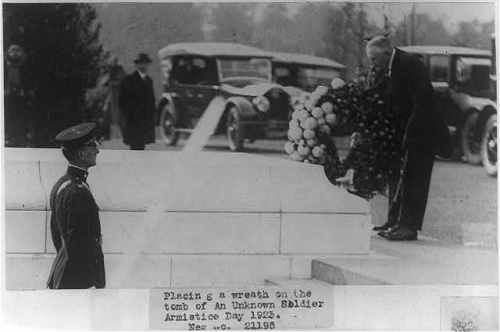
Today in 1921 the Tomb of the Unknown Soldier was dedicated by President Warren G. Harding at Arlington Cemetery.
And today is Veterans Day. So we remember American veterans, known and unknown.
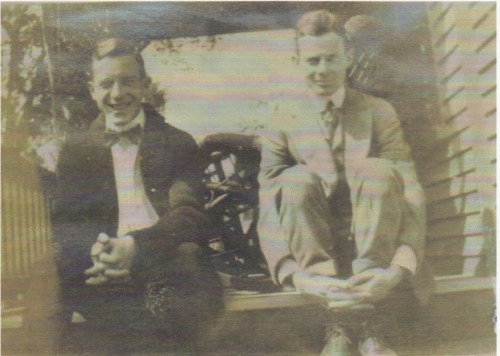
Guy Russell Chamberlin and Arthur Newell Chamberlin at home in Burlington, Vermont pre-WWI
Here’s to two brothers who went to war–one came back and the other did not.
We’ll toast our grandfather Arthur and his brother Guy, our father Newell, all our other ancestors who served their country, and indeed, all veterans.
O Lord God of Hosts, stretch forth, we pray thee, thine almighty arm to strengthen and protect the [military] of our country. Support them in the day of battle, and in the time of peace keep them safe from all evil; endue them with courage and loyalty; and grant that in all things they may serve without reproach; through Jesus Christ our Lord. Amen.
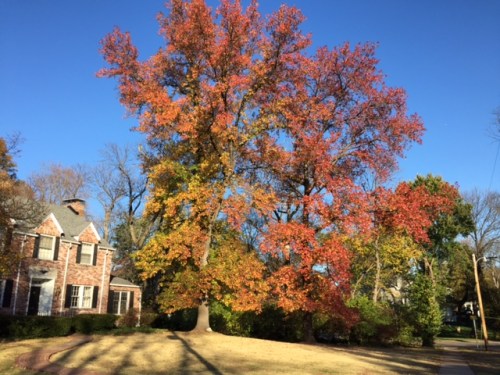
These are the days to take long walks and savor all that blue sky and colorful autumn flora and crisp fall temperatures. Until the shadows lengthen and the evening comes…at 5:00 p.m.!
For those of us who work from 9 to 5, it means we come home in the near-dark and our evenings seem so much shorter! No walks. It seems like we eat dinner, watch something, read, and go to bed.
Well, c’est comme ça. Lately I have been watching Sons of Anarchy (2008-2014)–the show about a motorcycle club that operates both illegal and legal businesses in the small town of Charming, CA. It has a good cast headed up by the very appealing Charlie Hunnam
(an English actor), Katey Sagal and Ron Perlman.
So far in season one, they are developing interesting and three-dimensional characters–the guys in the MC are pretty great–so we’ll see if I can hang in there despite a good amount of (you can imagine) violence.
I do love watching shows on Netflix without commercials. (I had to laugh when Castiel, the angel on Supernatural, in response to someone asking what he was doing while recovering from nearly dying, said, “I’ve been binge-watching the first season of The Wire.”)
On the book front, I am reading All the Light We Cannot See by Anthony Doerr, which won the Pulitzer Prize in 2015.
Set in occupied France during WWII, the novel moves back and forth in time, centering on a blind French girl and a German boy whose paths eventually cross. It is excellent. Sometimes “highly acclaimed, multiple award-winning” authors actually deserve the accolades.
How was your weekend? Mine was quite enjoyably low-key.
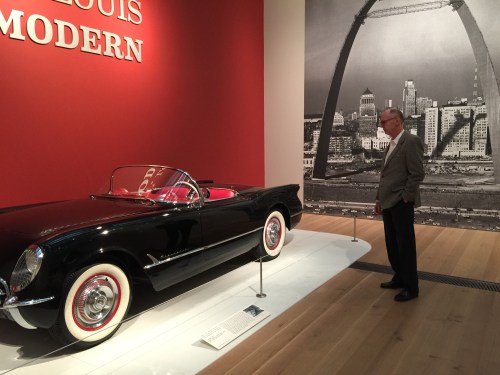
On Saturday evening the OM and I went to the members’ preview of the new exhibit “St. Louis Modern” at the SLAM.
Luckily, he found something right away to admire.
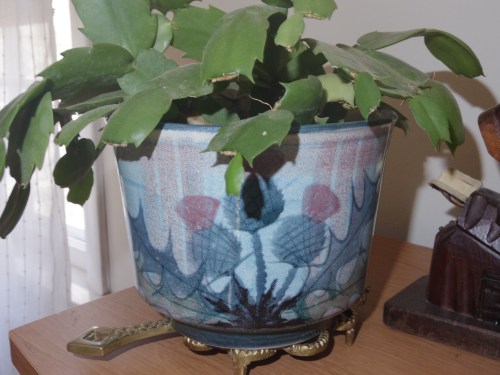
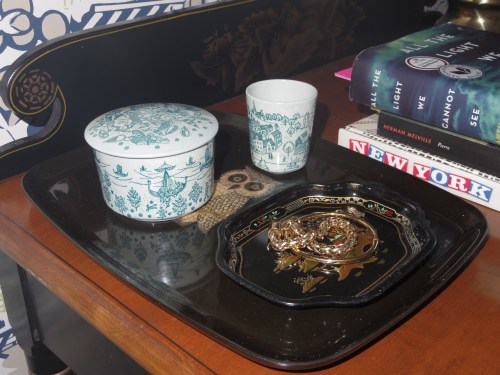
As readers of this blog know, my own home is filled with antiques and reproductions. My taste certainly leans toward 18th and 19th century American style. I am, however, a great appreciator of mid-century modern–i.e. the 20th century stuff of my youth. The aforementioned exhibit was full of the contents of some pretty great Bernoudy and Armstrong and Dunn homes and offices and included the design products of Charles Eames, Russel Wright, Eliel Saarinen, et al. It prompted me to look around my own house and find the odds ‘n ends of this period that I love.
I mean who doesn’t love mid-century modern pottery and china?
Church on Sunday was enjoyable–the only blip being when our female assisting priest referred in her sermon to Beethoven’s “Erotica” symphony instead of the “Eroica”. Talk about your Freudian slip! I refrained from correcting her after the service, because I hate people who do that. You know–the ones who look for typos to point out in newsletters etc. Like they’re being helpful. I always say, “I know everyone thinks I’m perfect, but really I’m not!”
One hundred and thirty years ago today, workers drove in the last spike to complete the trans-Canadian railway. Gordon Lightfoot commemorated the event in this wonderful song.
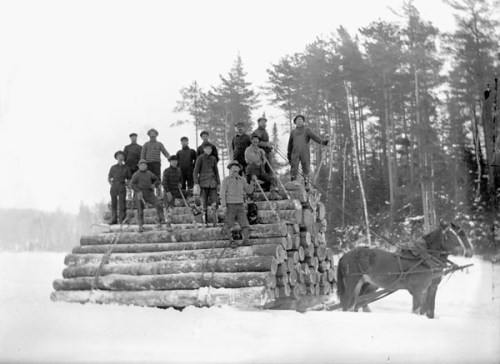
After hearing it again, I got thinking of family history, and while our Scottish great-grandfather did not work on the railway, he did work lumber. You can read my earlier post here. It was hard, dangerous work, and sometimes very cold.
I’ve always been curious about Daniel’s employer, the Robinson-Edwards lumber company. Recently, I discovered that the company was based in Ottawa. In fact, W.C. Edwards, the company’s vice-president, also served on the Canadian Senate. A New York Times article, “Canadian Lumberman’s Mistake about Victoria’s Successor”, that I found here had this to say:
Senator and Mrs. W.C. Edwards of Ottawa were the recent guests of Mr. and Mrs. D.W. Robinson. Senator Edwards is Vice-President of the Robinson-Edwards Lumber Company and has extensive lumber interests in Canada. He was appointed Senator last Winter and has been prominent in political affairs in Canada for years. The following story about Senator Edwards is circulating in the lumberman’s papers.
W.C. Edwards, one of the newly appointed Senators, is a lumberman who operated far up the Gatineau River, and he tells this story in the Toronto Globe of a shantyman who had spent a couple of seasons working for him in the bush and was coming out again shortly after the death of Queen Victoria
At Maniwaki the shantyman made his first stop on the way down and in a chat with the hotel keeper asked what was the news since he had gone to the woods. “Oh, there’s nothing much new. I s’pose you heard up there that the Queen was dead?” “No, you don’t tell me that the Queen was dead. I’m sorry to hear that. She was a good woman, the Queen, and a good Queen too. Well, we’ll all die sometime, even the Queen.” After a respectful pause, he asked, “And who’s got the job now? Who’s the head now?”
“Oh, Edward’s the king now. It’s King Edward for the last three months.”
“Edwards the King! Well, well, you don’t tell me Edwards the King. He’s a big man in the lumber business but I never expected to hear of him become the King. What a pull that man Edwards must have with Laurier!”
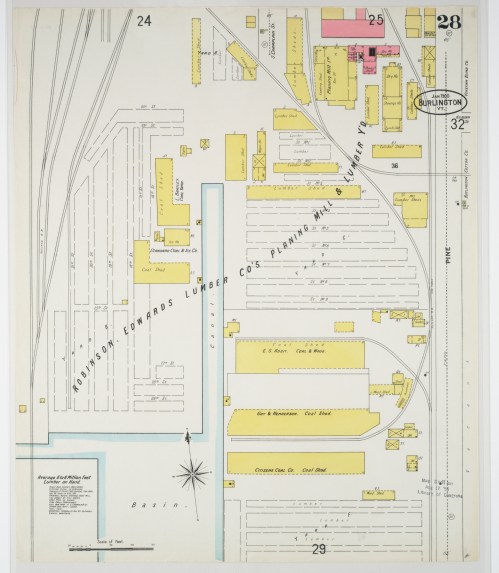
It’s a charming story, but Edwards proved to be a typical politician out for his own glory and power. Anyway, by the time that story was written, my great-grandfather was company treasurer in Burlington, Vermont, during the logging heyday when there were vast lumberyards on the Lake Champlain shore. According to one source, “there is not a single extant building as a visible reminder of the immense lumber industry” of the period. Well, time marches on. At the height of its production, the company was huge.
Burlington 1900_029
That’s the fire insurance map of the sawmill. But all good things must come to an end, and the industry and company were in decline during the 1920s. Here’s what my great-grandfather wrote to my great-aunt Hazel on December 19, 1928:
My dear Hazel,
Xmas will soon be here, time goes quickly. It just seems to me that everybody is saying I must hurry on, for we are all on the dead jump and everything does seem to move too fast. I hope this festive season makes it happier for you. It is a treat to see everybody rushing here and there buying presents, and it must be wonderful if one could know how much is being spent in dollars and cents. Mama has got all her parcels done up, and I have finished with mine, and that is sending a check for uncle Kenneth. I always regret the smallness of my donation, and I always wish it was larger. I hope I have not reached the time when I must reduce, ill health and our present business will do that. It may come soon now. Our people at Ottawa evidently want to close the business here. They have said to continue until April 1, after that I don’t’ know but I keep on smiling just the same. I am enclosing a small check, hoping it will be of some service. Last year I was richer and had more to do with. I wish you would get well. The future ought to look good to you. We all have our blessings and I am sure if we would only stop and count them there would be many. Please remember us to Harry, and to you our hearts go out wishing all good things this coming year. Keep up your courage and all will be well. Wishing you a happy New Year and Merry Xmas.
Yours very affectionately, Pa
The company did, indeed, go out of business, and my great-grandfather lost his job. Here is what he wrote to my grandfather about it in a letter dated February 6, 1929.
My dear Bunker,
I received your letters and thank you very much for the same. I left my reading glasses at home, and have a hard time to write with the temporary set I have here. I was glad to get your prices for my duty, although I don’t think he will order until spring. Regarding the Brett affair, I do not know what to say. My advice on the spur of the moment would be to stay where you are for several reasons. The principal one is that I will be out of a job on April 1. I will then have to look elsewhere. I have received my notice to walk out then — that is April 1st. Your mother says she cannot go out of Burlington, so you see I am tied down. Anyway I have to work in order to live, and Burlington is a poor place to work out a new job. Mr. Smith still stays on, and all invoices are to be made at Ottawa. He is to be agent for W. C. Edwards and Co. Now then, how am I [to manage?] If I was able to lend or loan money in a new business [it would be fine]. I am up against it, as I am not in shape to be knuckled down at any job and I have not the means to carry on. Still I have hopes that I will be able to make it a go on a smaller wage. If I can only keep your mother and myself from having to go on you fellows, I will be tickled. Just now everything is blue and is not bright. I hope you will never experience anything such as I am going into. I cannot explain things in a letter but will when I see you, which I hope will not be long. Mother is keeping fairly well but this notice of quitting the job has been a great blow to her. Please remember me to Catherine and the children. I hope they are well.
Yours very faithfully, Pa
The poor man, who was in his seventies by this time, had worked hard all his life — most of it with the Robinson-Edwards company. Those were the days before retirement benefits or social security, and clearly W.C. Edwards didn’t feel the need to reward loyalty. My great-grandfather died May 1st, 1929 — just a month after he stopped working.
This November we have many things for which to be grateful — our jobs and our hardworking ancestors chief among them.
*Gordon Lightfoot, “The Canadian Railroad Trilogy”















 dual personalities