Happy Birthday Virginia Woolf, part II…on a (slightly) happier note
by chuckofish
I confess that this dualpersonality is not a huge fan of Virginia Woolf. However, a passage from Orlando, which struck a note with house-loving me, describes the fate of Knole Park in Kent, which is a bigger house than anyone but a Renaissance monarch should live in (and Henry VIII did own it for a while) and looks like this:

It ended up belonging to the Sackville-Wests and Virginia Woolf, a friend of Vita Sackville-West, spent a lot of time there. In Orlando her main character
…passed down the gallery whose floor was laid with whole oak trees sawn across. Rows of chairs with all their velvets faded stood ranged against the wall holding their arms out for Elizabeth, for James, for Shakespeare it might be, for Cecil, who never came.
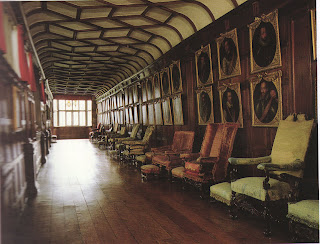
the brown gallery at Knole House
The sight made her gloomy. She unhooked the rope that fenced them off. She sat on the Queen’s chair; she openeed a manuscript book lying on Lady Betty’s table; she stirred her fingers in the aged rose leaves; she brushed her short hair with King James’ silver brushes; she bounced up and down upon his bed (but no king would ever sleep there again, for all Louise’s new sheets) and pressed her cheek against the worn silver counterpane that lay upon it.
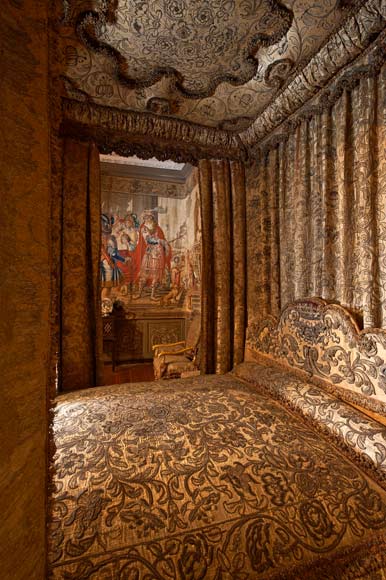
King James' bed Knole house
But everywhere were little lavender bags to keep the moth out and little printed notices, “Please do not touch”, which, though she had put them there herself, seemed to rebuke her. The house was no longer hers entirely, she sighed. It belonged to time now; to history; was past the touch and control of the living. Never would beer be spilt here anymore, she thought…or holes burnt in the carpet. Never two hundred servants come running and brawling down the corridors with warming pans and great branches for the great fire-places. Never would ale be brewed and candles made and saddles fashioned and stone shaped in the workshops outside the house. Hammers and mallets were silent now. Chairs and beds were empty; tankards of silver and gold were locked in glass cases. The great wings of silence beat up and down the empty house.
Now I don’t much care about the goings-on of aristocrats and the American in me finds those English estates (and, indeed, many of our own) over the top, but I can’t help feeling sorry for any house that has become a museum even as I’m glad it’s been preserved. I think Virginia Woolf perfectly understood that and beautifully described the way the past lingers in an empty house. So Happy Birthday, Virginia!
 dual personalities
A great post! And I agree completely about those houses.
P.S. I corrected your spelling of “Woolf”–two o’s!
Oops! As you know, spelling was never my forte. Thanks for fixing it.
Agreed, aunt Sarah, I love those houses so much. Its one of those things that we Americans can admire and appreciate about the English, but accept that it isnt American. I consider myself an anglophile of sorts but it just wouldnt seem ok here in America. The houses are so important to history and many are basically owned by the National Trust now because theyre too expensive to operate. Compton Wynyates, however, is NOT open to the public… My distant relation, the Earl of Northhampton (the wealthiest buddhist in Britain, as my mom often notes) does not care much about the public experiencing history I guess…
Well, I certainly wouldn’t want the public traipsing through my home. Ugh, the very thought makes me shudder.