dual personalities

Tag: writers

A singular elegance

by chuckofish

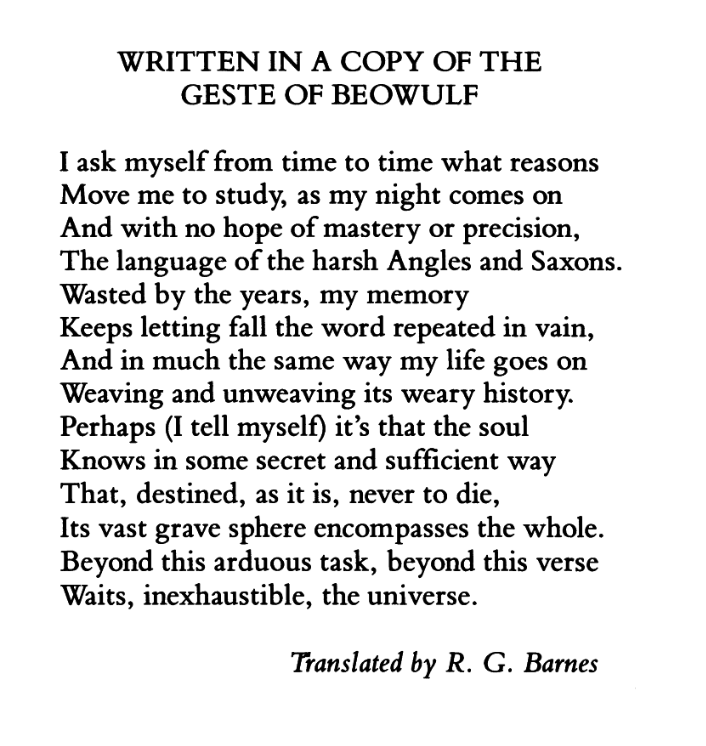
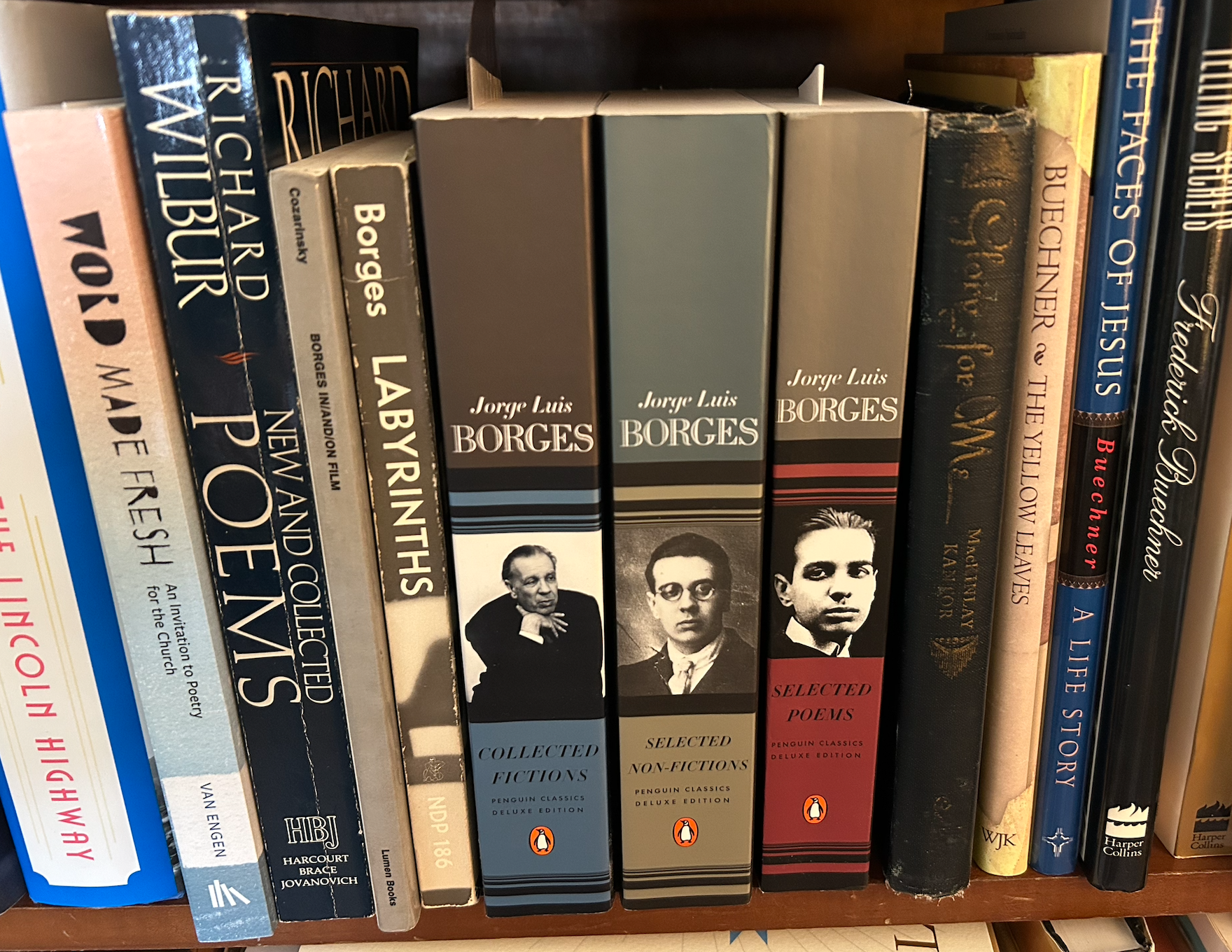
I forgot to mention that Sunday was the birthday of Jorge Luis Borges, the great Argentine essayist, poet and translator. As you know, he is a favorite of mine.

I will toast him tonight and read some poetry.

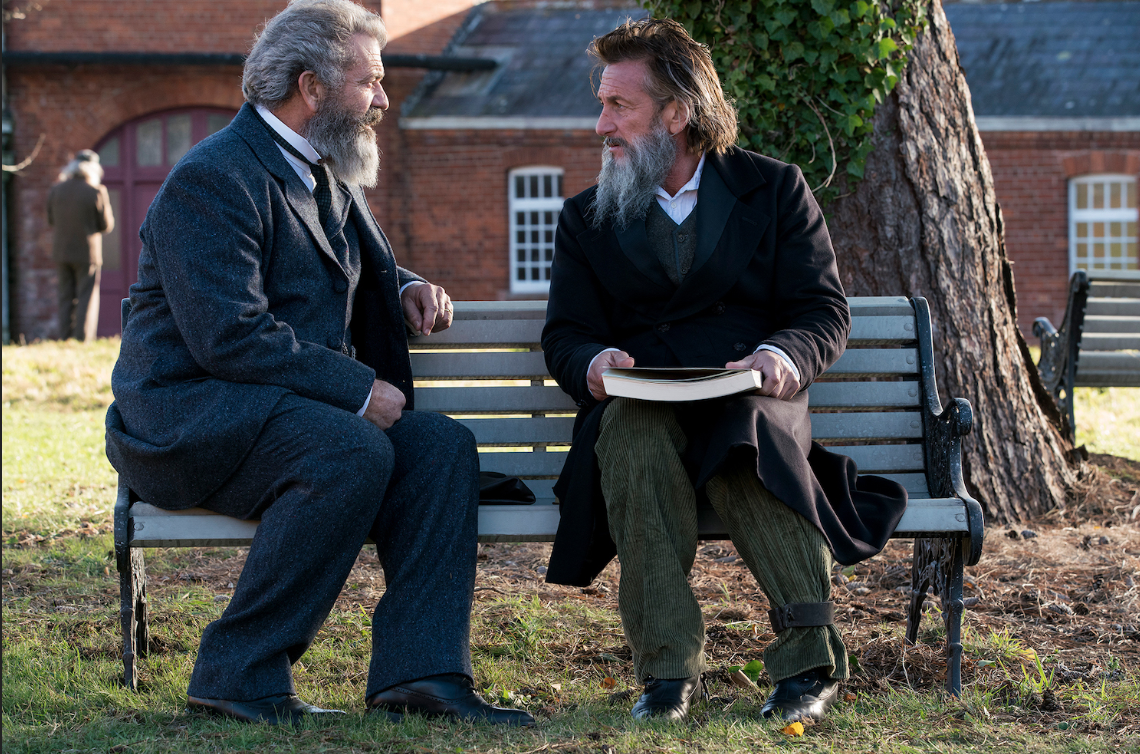
I watched a good movie the other night, one recommended by my DP several years ago. The Professor and the Madman (2019) is the true story of professor James Murray, who in 1879 became director of an Oxford University Press project, The New English Dictionary on Historical Principles, and the man who became his friend and colleague, W.C. Minor, an American doctor who submitted more than 10,000 entries while he was confined at Broadmoor Criminal Lunatic Asylum at Crowthorne after being found not guilty of murder due to insanity.  

Mel Gibson plays the Professor and Sean Penn is the Madman. They are both excellent.

This is not a film that would appeal to a large audience, but I liked it. Despite the fact that it takes place in large part in an insane asylum and a university, it is full of interesting, intelligent and kindly people. The only real cruelty is perpetrated by well-meaning doctors trying to advance medical understanding. There is even a Christian message.

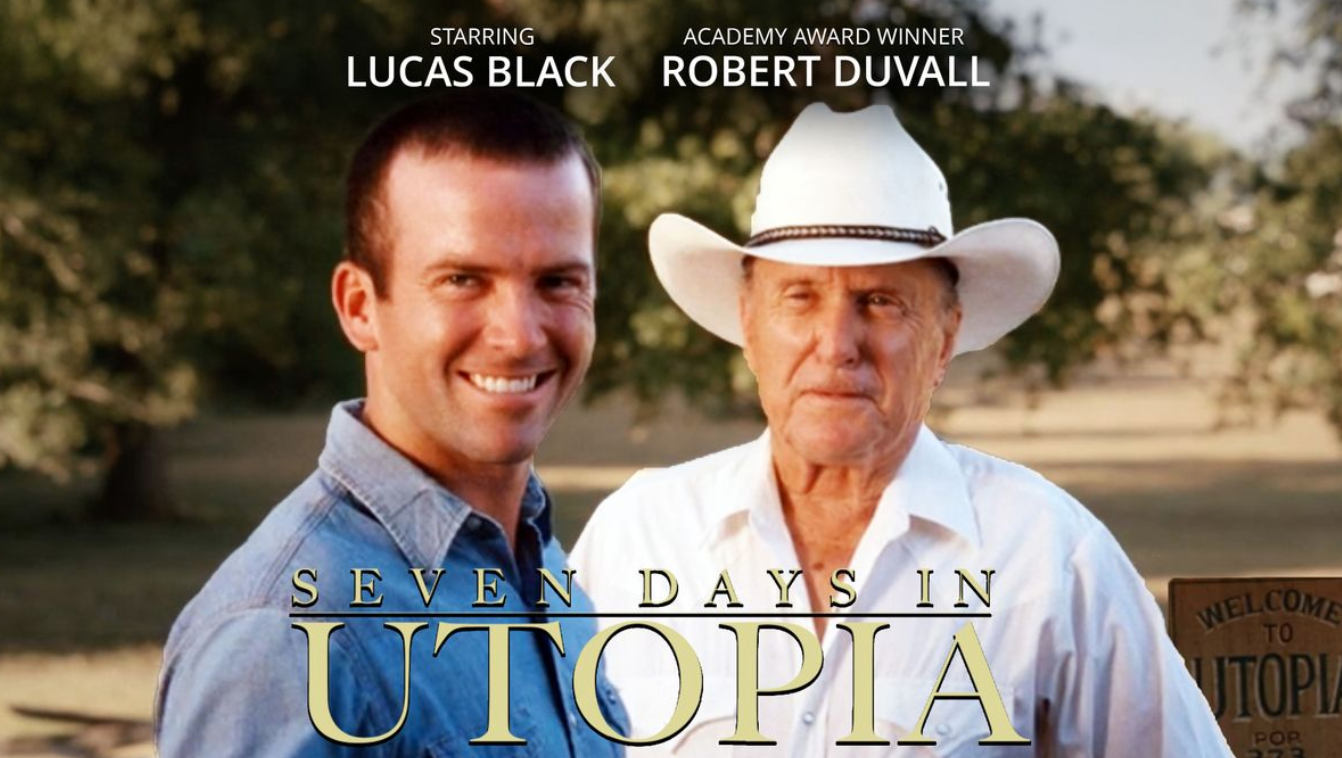
I also re-watched Seven Days in Utopia (2011) starring Robert Duval and Lucas Black, two more favorites of mine. It tells the story of Luke Chisholm, a young professional golfer, who, after melting down during a tournament and shooting 80 in the final round, crashes his car into a fence and finds himself stuck in Utopia, Texas while his car is repaired. He meets retired golfer Johnny Crawford and learns from him how to move on with his life and career. It also has a Christian message.

This movie is actually rated G!

I am currently re-reading Death Comes for the Archbishop by Willa Cather. It is a great book, so beautifully written.

“Under his buckskin riding-coat he wore a black vest and the cravat and collar of a churchman. A young priest, at his devotions; and a priest in a thousand, one knew at a glance. His bowed head was not that of an ordinary man,—it was built for the seat of a fine intelligence. His brow was open, generous, reflective, his features handsome and somewhat severe. There was a singular elegance about the hands below the fringed cuffs of the buckskin jacket. Everything showed him to be a man of gentle birth—brave, sensitive, courteous. His manners, even when he was alone in the desert, were distinguished. He had a kind of courtesy toward himself, toward his beasts, toward the juniper tree before which he knelt, and the God whom he was addressing.”

So read a poem, watch a good movie, re-read a favorite book, and praise God from whom all blessings flow.

Midweek thoughts

by chuckofish

At the suggestion of daughter #1 I am re-reading The Daughter of Time by Josephine Tey. It is very good and the type of literary mystery written by an intelligent and educated author, which you rarely run across these days.

“Did no one, any more, no one in all this wide world, change their record now and then? Was everyone nowadays thirled to a formula? Authors wrote so much to a pattern that their public expected it. The public talked about “a new Silas Weekly” or “a new Lavinia Fitch” exactly as they talked about “a new brick” or “a new hairbrush.” They never said “a new book by” whoever it might be. Their interest was not in the book but in its newness. They knew quite well what the book would be like.”

The Daughter of Time was chosen by the Crime Writers’ Association in 1990 as the greatest crime novel of all time(!). After this, I will try to find some of her other books to read.

I wonder if Hilary Mantel read this book–because Tey brings Sir Thomas More to task for writing the “definitive” history of Richard III based soley on hearsay. He was actually five years old when everything transpired. He was not a witness. Did this book get her thinking about Thomas More? Did she come to the conclusion that Thomas More was a monster and not a saint….Interesting.

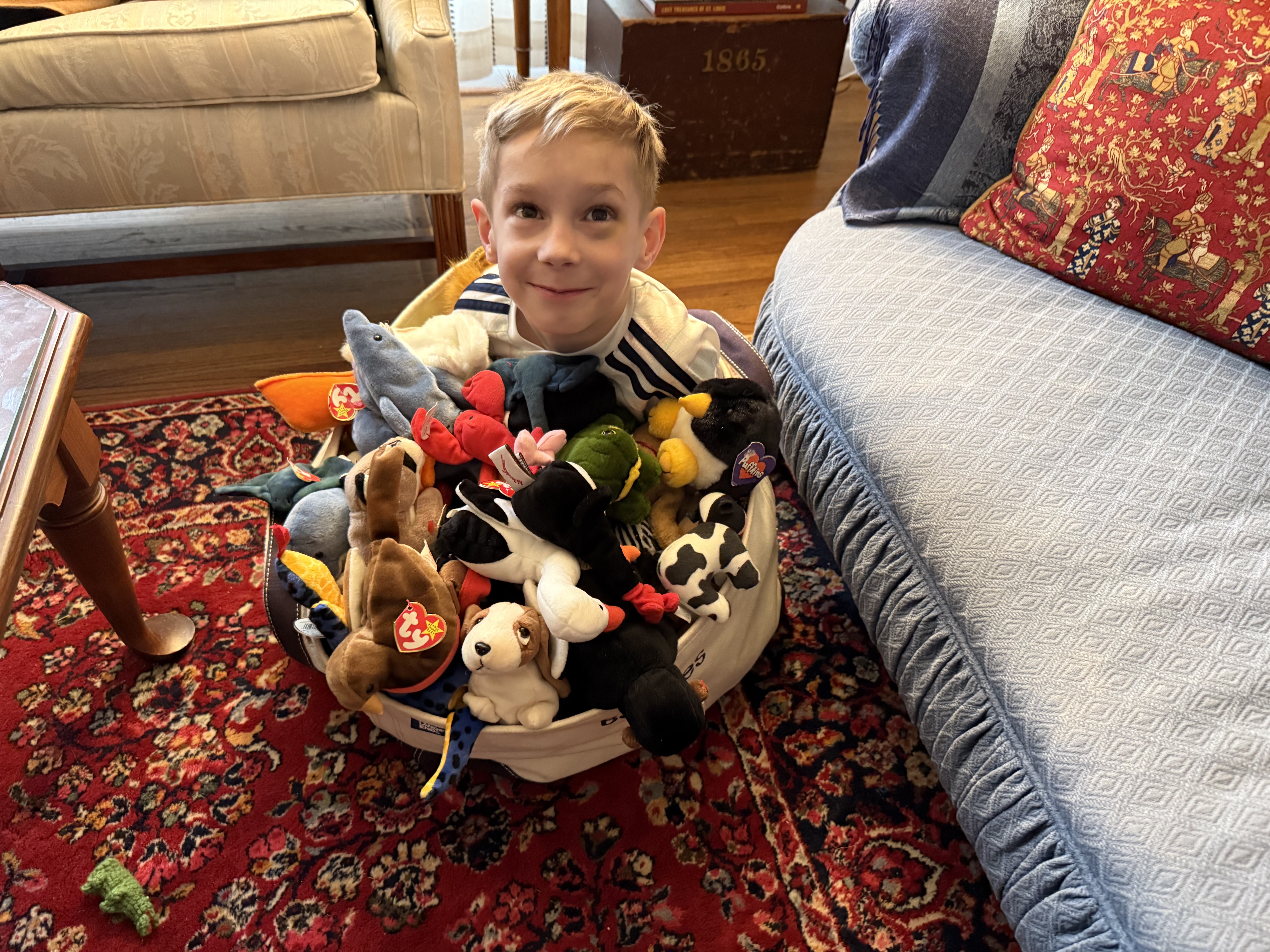
Well, the bud and his dad came over yesterday afternoon and we had a gab fest and the bud jumped in with the Beanie Babies for a rollicking good time…

We discussed movies and books and the state of the world.

I liked this one from Tim Challies. “God’s plan all along has been to use ordinary leaders to accomplish extraordinary things.”

And this made me laugh (and cry)…

Hang in there!

“Raise a glass to the King! For He has dealt most kindly with us; raise a glass to the King!”*

by chuckofish

We are in the deep freeze–it was around 10 degrees all day yesterday. We got some snow, but nothing compared to south of us. We hunkered down.

I read some more of Signal 32 by MacKinlay Kantor–I ordered a used copy online. It is a hard-boiled police procedural from 1950, probably written to make some money, but it is, as you can imagine, better than the average from that genre. It is about two uniform cops in NYC who go about their daily business, sort of like a post-WWII Adam-12. In 1948 the Acting Commissioner of Police authorized Kantor to proceed on all police activities, accompanying the patrolmen in their work. Kantor learned the life of a policeman through first-hand experience. It is pretty grim and stark and emphasizes (like the TV show) all the bad stuff policemen have to deal with on a daily basis.

I did my homework for my bible study–Exodus 4. It is a lot of work! But it is good to have challenging work to do. My brain needs the exercise!

This is a very cool video from the John 10:10 Project about penguins:

And I really liked this “drinking hymn”* which Anne posted in memory of her friend, a Reformed Episcopal Church (Anglican) priest, who died. I’m not quite sure what my PCA brothers would make of this–Would they do this at one of their men’s retreats?

Raise a glass to the King, boys! Raise a glass to the King!

For He has dealt most kindly with us; raise a glass to the King!

One more time!

Flyover Tuesday

by chuckofish

Well, here we are in February. Yesterday we broke a record from back in the 1880s–reaching the temperature of 76 degrees! I made my usual Monday trip to the grocery store and swung by the P.O. It is a soggy mess out there, but I am not complaining.

Today we toast the wonderful writer MacKinlay Kantor, who was born on this day in 1904 in Webster City, Iowa. He wrote a lot of short stories for popular and pulp magazines before publishing his first historical novel, Long Remember, in 1934. Kantor was a war correspondent with the British RAF during WWII and also served as a gunner in the U.S. Air Force. After his service he became a screenwriter in Hollywood. His verse novel about three American servicemen returning to civilian life, Glory for Me, was adapted for the screen, becoming the Academy Award-winning film The Best Years of Our Lives (1946). He won the Pulitzer Prize for Andersonville, based on the notorious Confederate prisoner-of-war camp in Georgia where nearly 13,000 Union soldiers died, in 1955. I would re-read it, but I’m not sure I can handle such total depravity right now.

Anyway, I have been an admirer of Kantor for a long, long time and I recommend his books (and movies made from his books).

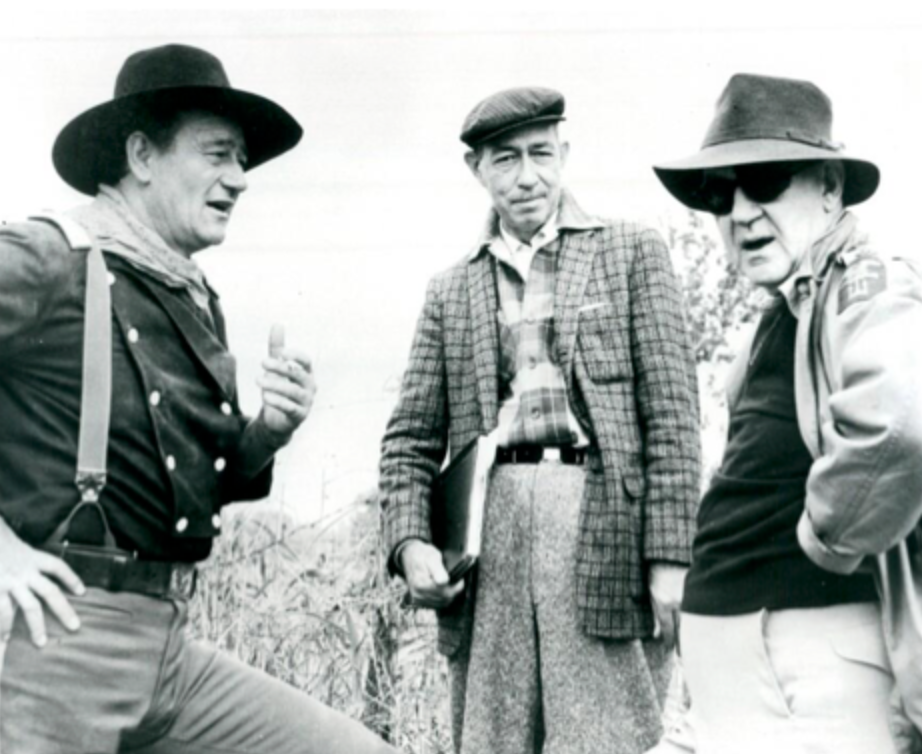
At the moment I am reading another historical novel by another American writer who wrote short stories for magazines while working in a hardware store in his hometown of Bloomington, IL. Harold Sinclair also wrote a few well-received novels, but The Horse Soldiers was his only bestseller. I have my father’s old signed copy from 1955 and I am enjoying it. Of course, the movie version starring John Wayne and William Holden is a favorite of mine. Here’s a picture of the author with John Wayne and the director John Ford.

We also toast country singer Clint Black, who was born on this day in 1962. He was born in New Jersey, but grew up in Katy, Texas. We always think of him as the secret twin of George W. Bush.

Quite the resemblance, don’t you think?

Speaking of twinsies, the prairie girls are enjoying the warmer weather too…

Enjoy your day!

In which I do not recommend several novels

by chuckofish

Every few years, I (daughter #2) decide to read a number of acclaimed and/or recommended contemporary novels in quick succession. This is usually a bad decision, but for some reason I feel a need to know the current state of fiction. Long story short: disappointing. And yet, long story long, I have a lot to say!!

I will write here about various themes and takeaways so that you might choose to avoid the work of reading these (award-winning!!!) tomes. Several of them were, like my previous reading material, 400+ pages long! I plan to end on a positive, note, though, because I successfully landed on a wonderful palate cleanser and treat. A quick rundown:

Donna Tartt, The Goldfinch (2013)
Kevin Wilson, Nothing to See Here (2019)
Elizabeth Strout, Tell Me Everything (2024)
Claire Lombardo, Same As It Ever Was (2024)
Anthony Doerr, Cloud Cuckoo Land (2021)
Daniel Mason, North Woods (2023)
Amor Towles, Table for Two (2024)
Amor Towles, Rules of Civility (2011) (re-read)

To start with the negative, Same As It Ever Was joins seemingly so many contemporary novels in representing the hardships of the modern mother. This novel truly repeated, over and over again, that the young mother was “having a hard time,” even though she boasts various privileges that make life (and certainly parenting) easier. (I put “having a hard time” in quotation marks because I literally mean that sentence was repeated ad nauseam.) Though I found the particulars of this character’s “hardships” grating, it was actually the hand-wringing tone of it all that was so frustrating. It reminded me of Elizabeth Strout’s first “pandemic novel” (Oh William!) in which Lucy Barton actually wrings her hands nonstop. (In Tell Me Everything, it is somehow still pandemic-esque in Maine, and Lucy hasn’t really calmed down.) Both Lucy and the protagonist of Lombardo’s novel are constantly wondering if their children like them, while unapologetically behaving in ways that don’t exactly merit being liked (by their inexplicably-devoted husbands, friends, or children).

Kevin Wilson’s novel is not really worth mentioning — it bordered on a “beach read.” That said, this odd novel about the nanny of children who spontaneously combust is the only contemporary work I read last year in which someone has the experience of loving children unconditionally, 24 hours a day, even when it is hard to care for them. How lovely that it isn’t their mother (deceased, of course) or stepmother, but a nanny!

I did enjoy Cloud Cuckoo Land, in spite of its slow start and the challenge of learning three+ different timelines and narratives. I gave it credit for its relentless love of libraries, language, and literature, and its optimism about people and the world broadly (even with a climate activist/terrorist plotline!). Of course, these were the qualities that were semi-derided by a New Yorker review, which, more interestingly, linked Doerr and Donna Tartt: both authors won both the Pulitzer Prize for Fiction and the Carnegie Medal for Excellence in Fiction in 2015 and 2014, respectively. My critique of Doerr’s novel was that it was almost absurdly clever, and as it careened toward its conclusion, I knew it was going to wrap up into a neatly-tied bow. This guy really tried hard with the novel, and it showed. But whereas Doerr seemed invested in justice (poetic and otherwise) as well as redemption, Tartt concludes that good and bad actions are basically all relative, and that individuals should simply do what makes them happy. We can explain away all our sins. I hate to admit it, but I was legitimately shocked. I did not love the main character enough to feel happy about how The Goldfinch ended.

I knew that Daniel Mason’s North Woods, which is apparently based on Nathaniel Hawthorne’s notebooks and is based in western Massachusetts, would drive me nuts. And it did. While the novel, which spans several centuries, was well-researched in ecology and nature (tree spores! fungi! beetles!), its treatment of people was a little too cute. Spinster sisters, prison pen pals, true crime reporters. Sure. But you know I felt a line was crossed when the author spent a section on fictionalized versions of Herman Melville and Nathaniel Hawthorne. I could tell you exactly which notebook entries of Hawthorne’s were referenced, which short story of Melville’s was ripped off — and I didn’t appreciate it. If I want to enjoy literary (and even scientific!) scenes of bucolic Massachusetts forests, I can (and will!) return to Henry David Thoreau.

Doerr, Tartt, and Mason clearly did their research for their novels, and it showed. It was all a little too effortful. By contrast, Amor Towles is capable of writing a smart character who is well-read and quick-witted, without showing off how well-read and quick-witted he is. Accordingly, both Table for Two and Rules of Civility were such a pleasure to read. And you know what’s funny? Walden is a bit of a plot point in one of the novel’s central relationships: she says it’s her desert island book; he reads it with pencil in hand; he leaves it behind at the relationship’s conclusion. Throughout all this, it comes naturally that the narrator shares how Thoreau’s writing applies to the scene at hand:

There is an oft-quoted passage in Walden, in which Thoreau exhorts us to find our pole star and to follow it unwaveringly as would a sailor or a fugitive slave. It’s a thrilling sentiment–one so obviously worthy of our aspirations. But even if you had the discipline to maintain the true course, the real problem, it has always seemed to me, is how to know in which part of the heavens your star resides.

But there is another passage in Walden that has stayed with me as well. In it, Thoreau says that men mistakenly think of truth as being remote–behind the farthest star, before Adam and after the reckoning. When in fact, all these times and places and occasions are now and here. In a way, this celebration of the now and here seems to contradict the exhortation to follow one’s star. But it is equally persuasive. And oh so much more attainable.

I don’t regret reading a number of misses — it just reminds me who I am. I read these novels and I think, these must be for people who are deeply confused. Life is hard, and they don’t know why. They are happy to hear that other people think life is hard. They have neither a pole star, nor a sense of the now and here. And I like to think: I have both.
The snow levels all things

by chuckofish

Well, the sun came out yesterday and we enjoyed blue skies. Unfortunately the temperature peaked in the mid-twenties and nothing melted. Our driveway did get plowed on Tuesday night so we were free to leave, but I was not moved to do so.

I read Thoreau’s A Winter Walk.

But now, while we have loitered, the clouds have gathered again, and a few straggling snow-flakes are beginning to descend. Faster and faster they fall, shutting out the distant objects from sight. The snow falls on every wood and field, and no crevice is forgotten; by the river and the pond, on the hill and in the valley. Quadrupeds are confined to their coverts, and the birds sit upon their perches this peaceful hour. There is not so much sound as in fair weather, but silently and gradually every slope, and the gray walls and fences, and the polished ice, and the sere leaves, which were not buried before, are concealed, and the tracks of men and beasts are lost. With so little effort does nature reassert her rule and blot out the traces of men. Hear how Homer has described the same. “The snow-flakes fall thick and fast on a winter’s day. The winds are lulled, and the snow falls incessant, covering the tops of the mountains, and the hills, and the plains where the lotus-tree grows, and the cultivated fields, and they are falling by the inlets and shores of the foaming sea, but are silently dissolved by the waves.” The snow levels all things, and infolds them deeper in the bosom of nature, as, in the slow summer, vegetation creeps up to the entablature of the temple, and the turrets of the castle, and helps her to prevail over art.

Inspired by HDT, I donned my winter wear and sallied forth to walk around my yard. Not a whole lot going on. Saw some rabbit tracks. I came back in and then struggled mightily to get my Hunter boots off. Good grief, Charlie Brown.

In winter we lead a more inward life. Our hearts are warm and cheery, like cottages under drifts, whose windows and doors are half concealed, but from whose chimneys the smoke cheerfully ascends. The imprisoning drifts increase the sense of comfort which the house affords, and in the coldest days we are content to sit over the hearth and see the sky through the chimney top, enjoying the quiet and serene life that may be had in a warm corner by the chimney side, or feeling our pulse by listening to the low of cattle in the street, or the sound of the flail in distant barns all the long afternoon. No doubt a skilful physician could determine our health by observing how these simple and natural sounds affected us. We enjoy now, not an oriental, but a boreal leisure, around warm stoves and fireplaces, and watch the shadow of motes in the sunbeams.

Christmas goals

by chuckofish

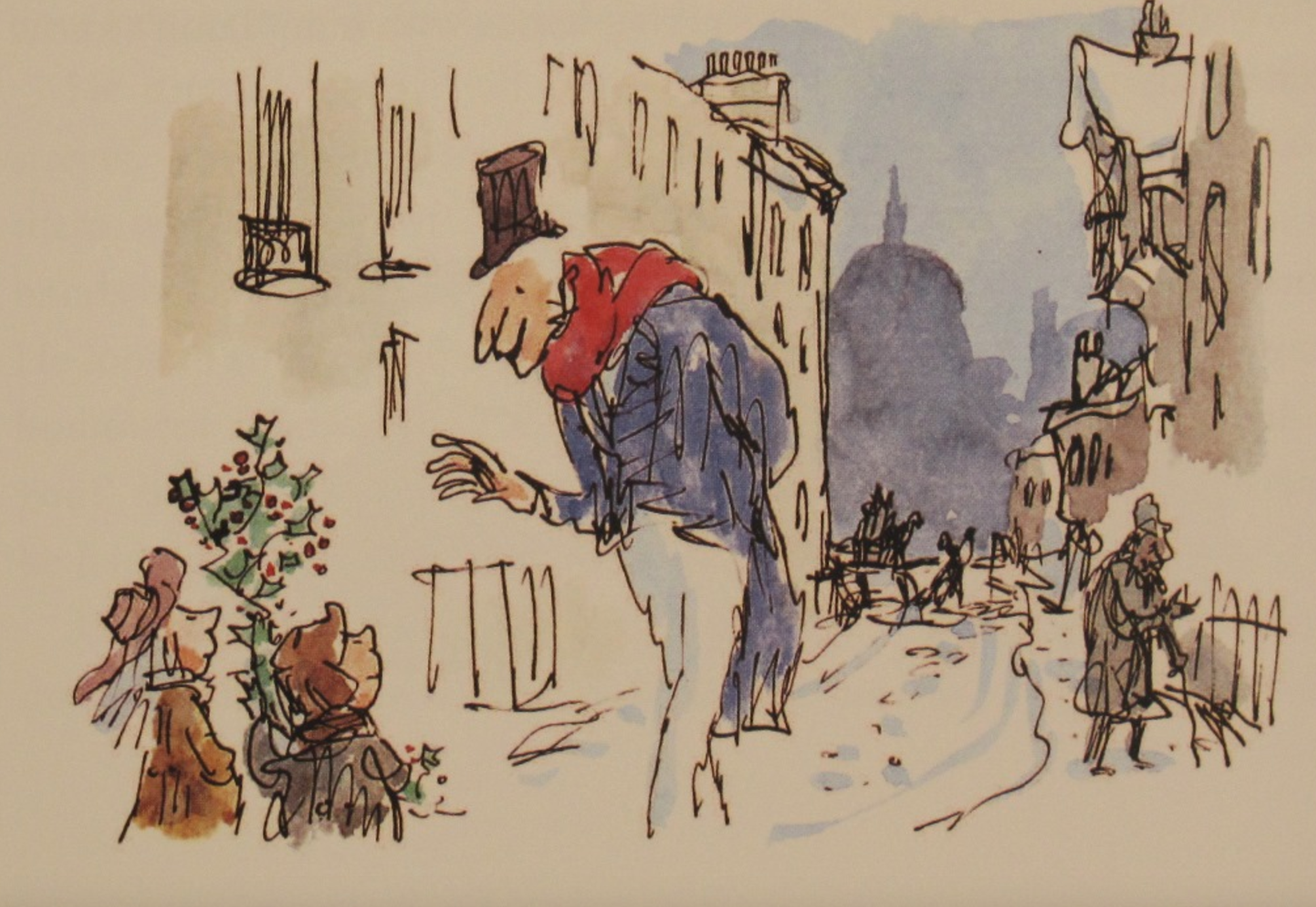
“He went to the church, and walked about the streets, and watched the people hurrying to and for, and patted the children on the head, and questioned beggars, and looked down into the kitchens of homes, and up to the windows, and found that everything could yield him pleasure. He had never dreamed of any walk, that anything, could give him so much happiness.”

–Charles Dickens, A Christmas Carol, 1843

So much happiness!

The drawing is by Quentin Blake (b. 1932), illustrator, Quentin Blake’s A Christmas Carol, 1995

“An’ weary winter comin fast”*

by chuckofish

Yesterday was such a dark, gloomy, rainy November day! Lots of leaves came down. Being Monday, I had a lot to do. C’est la vie. I was happy to see that the Prairie Girls were using their time to good advantage.

Oh Mylanta, cuteness overload.

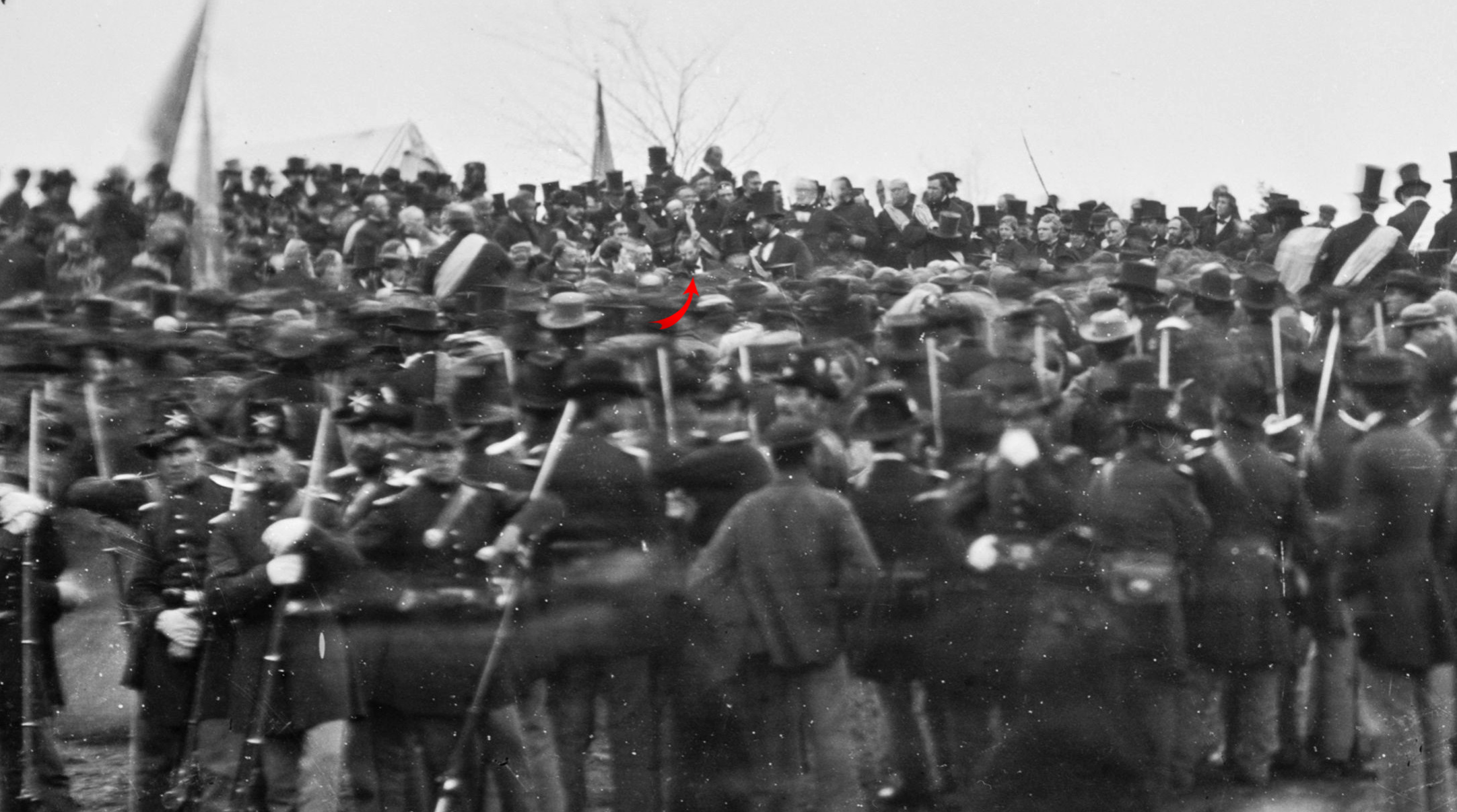
Today we remember President Abraham Lincoln, who gave the Gettysburg Address at the dedication ceremony for the military cemetery at Gettysburg, PA on this day in 1863. Let’s just take a few minutes and read it:

Four score and seven years ago our fathers brought forth on this continent, a new nation, conceived in Liberty, and dedicated to the proposition that all men are created equal.

Now we are engaged in a great civil war, testing whether that nation, or any nation so conceived and so dedicated, can long endure. We are met on a great battle-field of that war. We have come to dedicate a portion of that field, as a final resting place for those who here gave their lives that that nation might live. It is altogether fitting and proper that we should do this.

But, in a larger sense, we can not dedicate—we can not consecrate—we can not hallow—this ground. The brave men, living and dead, who struggled here, have consecrated it, far above our poor power to add or detract. The world will little note, nor long remember what we say here, but it can never forget what they did here. It is for us the living, rather, to be dedicated here to the unfinished work which they who fought here have thus far so nobly advanced. It is rather for us to be here dedicated to the great task remaining before us—that from these honored dead we take increased devotion to that cause for which they gave the last full measure of devotion—that we here highly resolve that these dead shall not have died in vain—that this nation, under God, shall have a new birth of freedom—and that government of the people, by the people, for the people, shall not perish from the earth.

Of course, not everyone at the time thought that it was a great speech. The Democrat-leaning Chicago Times observed, “The cheek of every American must tingle with shame as he reads the silly, flat and dishwatery utterances of the man who has to be pointed out to intelligent foreigners as the President of the United States.” Yes, times have not changed. Especially within the ranks of our so-called intellectual elites.

*Robert Burns, “To a Mouse”

That pile of broken mirrors

by chuckofish

This week was a scorcher, but par for the flyover course. The forecast for the long weekend is optimistic so we’ll see.

Daughter #2 and her family escaped to Michigan, but they encountered a huge storm halfway through their vacay which knocked out the electricity to 400,000 people and their running water!

C’est la vie. Before the weather catastrophe, my brother and sister-in-law drove over for a short visit…

…and caught up with the comings and goings of Pete the Cat et al.

Yes, the month is winding down. I will toast Jorge Luis Borges again and suggest you read this short story about a man whose father tells him he had “Lunch with Borges” once. It reminded me of my father telling me he sat on Gertrude Stein’s lap as an infant. We know our parents so little really.

As in dreams
behind high doors there is nothing,
not even emptiness.
As in dreams
behind the face that looks at us there is no one.
Obverse without a reverse,
one-sided coin, the side of things.
That pittance is the boon
tossed to us by hastening time.
We are our memory,
we are that chimerical museum of shifting shapes,
that pile of broken mirrors.

This is an interesting reflection on Peer Gynt, showing how a troll becomes a troll. “In 2024, we live in a world of trolls. What is the name for cowardly people who leave hateful comments on the internet? Trolls. Our family’s word for road-ragers? Road trolls. Peer Gynt is a story for today.”

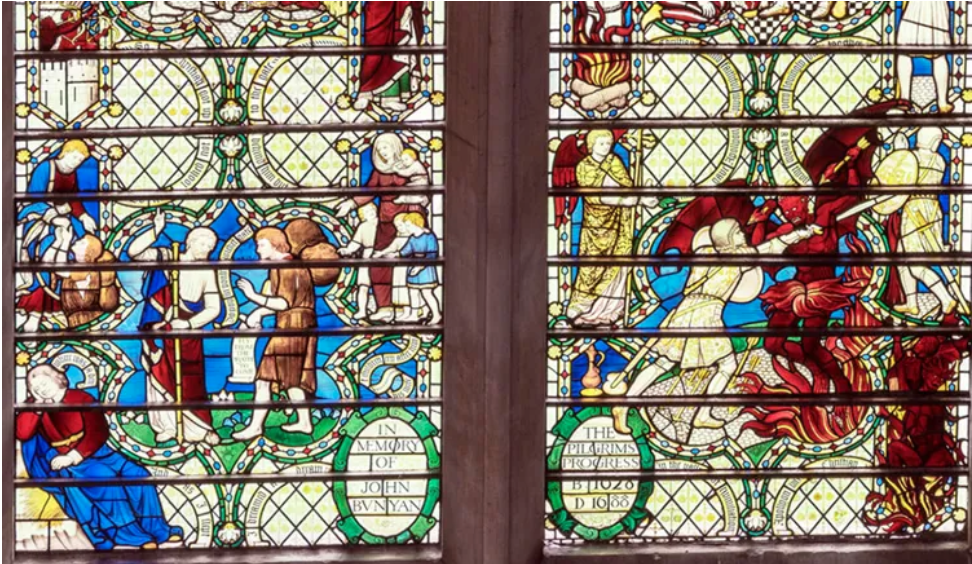
And here’s a heads up that the Church of England remembers John Bunyan with a Lesser Festival on 30 August. I was glad to see that a memorial window to Bunyan was unveiled in the west aisle of the north transept of Westminster Abbey in January 1912. It was erected by public subscription and designed by J. Ninian Comper and shows eight main scenes from the first part of Bunyan’s most famous work The Pilgrim’s Progress. The inscription reads: In memory of John Bunyan. The Pilgrim’s Progress. B.1628. D.1688.

“You are not yet out of reach of the gunshot of the Devil. You have not yet resisted unto death in your striving against sin. Let the Kingdom be always before you, and believe with certainty and consistency the things that are yet unseen. Let nothing that is on this side of eternal life get inside you. Above all, take care of your own hearts, and resist the lusts that tempt you, for your hearts `are deceitful above all things, and desperately wicked.’ Set your faces like a flint; you have all the power of Heaven and earth on your side.”

“In writing a novel, when in doubt, have two guys come through the door with guns.”

by chuckofish

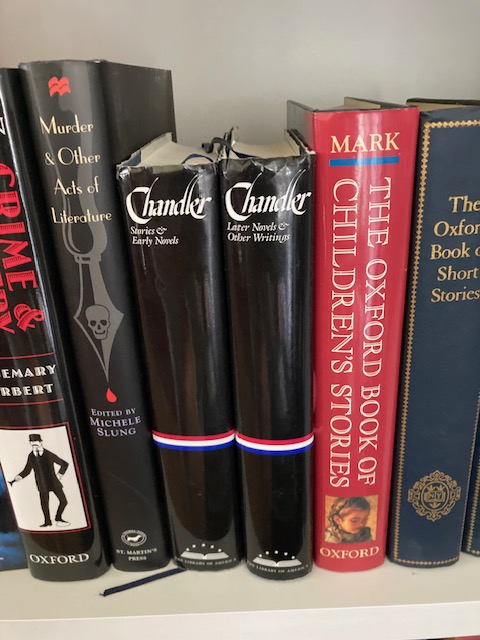
Today we celebrate the birthday of the great detective fiction writer Raymond Chandler (1888-1959). He is generally considered to have invented the private detective character and his Philip Marlowe is, indeed, one of the great characters of fiction. Almost all of his novels have been made into movies, none of them, unfortunately, the equal of the original book.

“He was worth looking at. He wore a shaggy borsalino hat, a rough gray sports coat with white golf balls on it for buttons, a brown shirt, a yellow tie, pleated gray flannel slacks and alligator shoes with white explosions on the toes. From his outer breast pocket cascaded a show handkerchief of the same brilliant yellow as his tie. There were a couple of colored feathers tucked into the band of his hat, but he didn’t really need them. Even on Central Avenue, not the quietest dressed street in the world, he looked about as inconspicuous as a tarantula on a slice of angel food.”

–Farewell, My Lovely

In other words, it’s best to read the books. Which I am in the mood to do.