dual personalities

Tag: William James

“Most people never run far enough on their first wind to find out they’ve got a second”

by chuckofish

“I am done with great things and big things, great institutions and big success, and I am for those tiny, invisible molecular moral forces that work from individual to individual, creeping through the crannies of the world like so many rootlets, or like the capillary oozing of water, yet which if you give them time, will rend the hardest monuments of man’s pride.”

–William James

Today is the birthday of William James (January 11, 1842 – August 26, 1910) who was an American philosopher and psychologist and a teacher (among his students at Harvard were Theodore Roosevelt, W.E.B. Du Bois, Gertrude Stein, and George Santayana). He was also the brother of Henry James. His godfather was Ralph Waldo Emerson! He went in the spring of 1865 on a scientific expedition up the Amazon River with Louis Agassiz! He is considered to be one of the major figures associated with the philosophical school known as pragmatism,  and is also cited as one of the founders of functional psychology.

Although I cannot say I have read widely in his work or am an expert on William James, I aways liked him.

“Keep the faculty of effort alive in you by a little gratuitous exercise every day. That is, be systematically ascetic or heroic in little unnecessary points, do every day or two something for no other reason than that you would rather not do it, so that when the hour of dire need draws nigh, it may find you not unnerved and untrained to stand the test. So with the man who has daily inured himself to habits of concentrated attention, energetic volition, and self-denial in unnecessary things. He will stand like a tower when everything rocks around him, and when his softer fellow-mortals are winnowed like chaff in the blast.”

440px-William_James_b1842c.jpg

What a good face.

He always seemed to have a lot of common sense. And he understood the importance of just being kind.

So I will toast William James tonight. Join me, right?

540_1476496465.jpg

The humble James plot in Cambridge Cemetery
Mid-week pep talk

by chuckofish


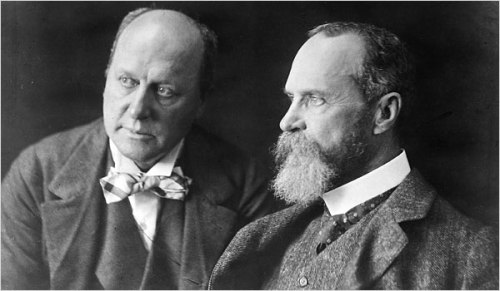
Henry and William James, brothers, early 20th century

Henry and William James, brothers, early 20th century

“Now, my dear little girl, you have come to an age when the inward life develops and when some people (and on the whole those who have most of a destiny) find that all is not a bed of roses. Among other things there will be waves of terrible sadness, which last sometimes for days; irritation, insensibility, etc., etc., which taken together form a melancholy. Now, painful as it is, this is sent to us for an enlightenment. It always passes off, and we learn about life from it, and we ought to learn a great many good things if we react on it right. (For instance, you learn how good a thing your home is, and your country, and your brothers, and you may learn to be more considerate of other people, who, you now learn, may have their inner weaknesses and sufferings, too.) Many persons take a kind of sickly delight in hugging it; and some sentimental ones may even be proud of it, as showing a fine sorrowful kind of sensibility. Such persons make a regular habit of the luxury of woe. That is the worst possible reaction on it. It is usually a sort of disease, when we get it strong, arising from the organism having generated some poison in the blood; and we mustn’t submit to it an hour longer than we can help, but jump at every chance to attend to anything cheerful or comic or take part in anything active that will divert us from our mean, pining inward state of feeling. When it passes off, as I said, we know more than we did before. And we must try to make it last as short a time as possible. The worst of it often is that, while we are in it, we don’t want to get out of it. We hate it, and yet we prefer staying in it—that is a part of the disease. If we find ourselves like that, we must make something ourselves to some hard work, make ourselves sweat, etc.; and that is the good way of reacting that makes of us a valuable character. The disease makes you think of yourself all the time; and the way out of it is to keep as busy as we can thinking of things and of other people—no matter what’s the matter with our self.”

–William James, (January 11, 1842 – August 26, 1910), American philosopher and psychologist