I have never cared for all the Easter Bunny nonsense surrounding Easter. Even as a child I thought it was stupid and detracted in an inappropriate way from the seriousness of Christ’s sacrifice and the celebration of His resurrection. But I enjoyed the candy and let’s be honest–I really want to make these Peeps concoctions. The wee bud would ❤️ them.
And now I have to get back to Kierkegaard…
“Christ was crucified because he would have nothing to do with the crowd (even though he addressed himself to all). He did not want to form a party, an interest group, or a mass movement, but wanted to be what he was, the truth, which is related to the single individual. Therefore everyone who will genuinely serve the truth is by that very fact a martyr. To win a crowd is no art; for that only untruth is needed, nonsense, and a little knowledge of human passions. But no witness to the truth dares to get involved with the crowd.”
–Soren Kierkegaard
And if you were wondering what’s the use of reading if you forget everything anyway… Here’s the answer.
P.S. Look for a post from my long-lost DP tomorrow!
I am reading Isaiah now in my daily reading plan and it is full of wonderful things. The author gets right down to business in chapter one:
Alas, sinful nation, A people laden with iniquity, A brood of evildoers, Children who are corrupters! They have forsaken the Lord, They have provoked to anger The Holy One of Israel, They have turned away backward.
Again we are reminded, it has always been thus. It is my policy (mostly) not to comment on current events and I am not going to now. No, I’ll just share that I ordered a new needlepoint pillow kit to work on while I listen to my favorite podcasts while I attempt to block out everything that’s going on.
This is how I deal with the gathering gloom.
And we remember what Stephen Charnock wrote back in the 17th century:
“Some rude and rough stones were taken out of Nero’s palace; some that were servants to the most abominable tyrant, and the greatest monster of mankind; one that set Rome on fire, and played on his harp while the flames were crackling about the city; ripped up his mother’s belly to see the place where he lay; would any of the civiller sort of mankind be attendants upon such a devil? Yet some of this monster’s servants became saints. Phil. 4:22. “All the saints salute you, chiefly they that are of Caesar’s household.” To hear of saints in Nero’s family, is as great a prodigy as to hear of saints in hell.”
So we’ll just continue to keep watch in our garden of cucumbers.
Happy birthday, Soren Kierkegaard, and happy Cinco de Mayo, which is the yearly celebration commemorating the anniversary of Mexico’s victory over the French Empire at the Battle of Puebla in 1862. That is the reason for drinking margaritas on May 5–in case you were wondering. The day gained nationwide popularity here in America in the 1980s due to advertising campaigns by beer, wine, and tequila companies. Today Cinco de Mayo generates beer sales on par with the Super Bowl.
Meanwhile, it’s almost the weekend! Have fun hanging out…
We know it is November because the Christmas Cactus is throwing out buds like crazy! So excitiing!
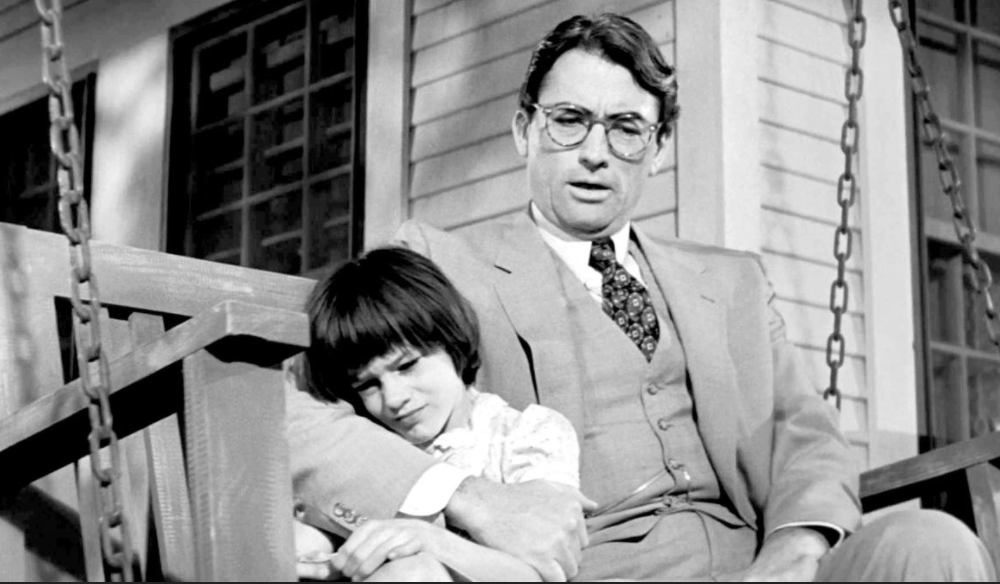
In other news, I was talking to the boy one day last week and we were discussing my blogpost about my Top 10 favorite/best films. He asked me why I hadn’t included To Kill a Mockingbird (1962) and I said, Oh my gosh, because I forgot it! It definitely belongs in the Top 10, maybe Top 5.
So I’ll have to revise my Top 10 and move To Have and Have Not down to 11-15. Sheesh. I am getting old. He also questioned my exclusion of The Professionals (1967) and I said it would definitely be in the top 20 list. So I guess I will start working on a Top 11-20 list. We are such nerds. But I am thankful that I have a son with whom I can discuss movies.
Since it is Veterans Day, which we should all acknowledge, I propose to watch one of my favorite war movies. I looked up on the AFI website to see if they had a top 100 war movies list, but they do not. In fact, there are only six war movies in their top 100 list! Of course, only one of them is a favorite of mine: #37 The Best Years of Their Lives (1946).
The other five are: #52 From Here to Eternity (1953); #54 All Quiet on the Western Front (1930); $79 The Deer Hunter (1978); #83 Platoon (1986); #89 Patton (1970). Not terrible movies, but not favorites of mine.
No, I would suggest watching one of these WWII movies in memory of WWII Guy: They Were Expendable (1945); 12 O’Clock High (1949); Air Force (1943); or The Great Escape (1962).
If you’re not in the mood for WWII, I suggest: Drums Along the Mohawk (1939); SheWore a Yellow Ribbon (1949); The Horse Soldiers (1959); The Sand Pebbles (1966); or Glory (1989).
I ain’t much about no prayin’, now. I ain’t never had no family, and… Well, I just… Y’all’s the onliest family I got. I love the 54th. Ain’t even much a matter what happens tomorrow, ’cause we men, ain’t we?
Today the Lutheran Church celebrates the feast day of Soren Kierkegaard, the Danish writer, philosopher and theologian, who died on this day in 1855. That is interesting considering Kierkegaard was extremely critical of the practice of Christianity as a state religion, particularly the Church of Denmark. But I’m okay with old Soren, so let us pray one of his prayers:
O Lord, calm the waves of this heart; and calm its tempests. Calm yourself, O my soul, so that the divine can act in you. Calm yourself, O my soul, so that God is able to repose in you, so that his peace may cover you. Yes, Father in Heaven, often have I found that the world around me cannot give me peace, O but make me feel that you are able to give me peace. Let me know the truth of your promise, that the whole world may not take away your peace. Amen.
Today is Soren Kierkegaard’s birthday (May 5, 1813 – November 11, 1855). Old Soren has always been a favorite of mine.
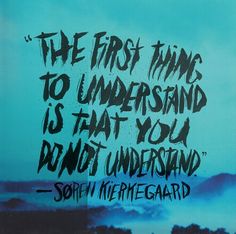
It is the duty of the human understanding to understand that there are things which it cannot understand, and what those things are. Human understanding has vulgarly occupied itself with nothing but understanding, but if it would only take the trouble to understand itself at the same time it would simply have to posit the paradox.
–Journals, 1847
Kierkegaard is like Thoreau or Emerson in that people take quotes out of context and think he is great (and that they are great for thinking so).
I have no doubt that he would hate that. Let’s try reading one of his books–the whole thing.
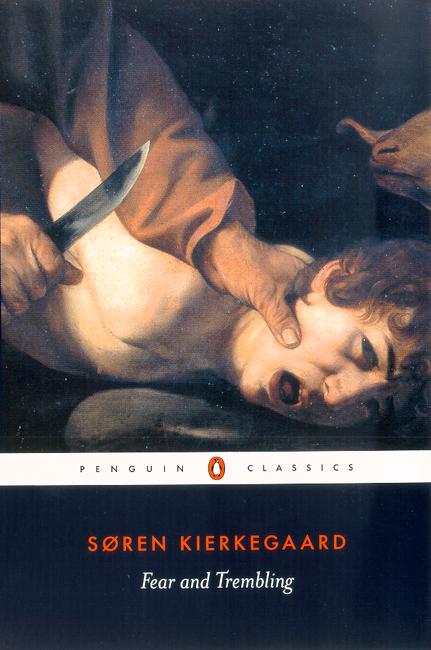
“Then faith’s paradox is this: that the single individual is higher than the universal, that the single individual determines his relation to the universal through his relation to God, not his relation to God through his relation through the universal…Unless this is how it is, faith has no place in existence; and faith is then a temptation.”
Well, at the very least I will toast him tonight. Join me, won’t you?
P.S. Why is Kierkegaard not listed on the Episcopal calendar of saints? If it were up to me, he would be.
“Above all, do not lose your desire to walk. Every day, I walk myself into a state of well-being and walk away from every illness. I have walked myself into my best thoughts, and I know of no thought so burdensome that one cannot walk away from it. But by sitting still, and the more one sits still, the closer one comes to feeling ill. Thus if one just keeps on walking, everything will be all right.”
― Søren Kierkegaard
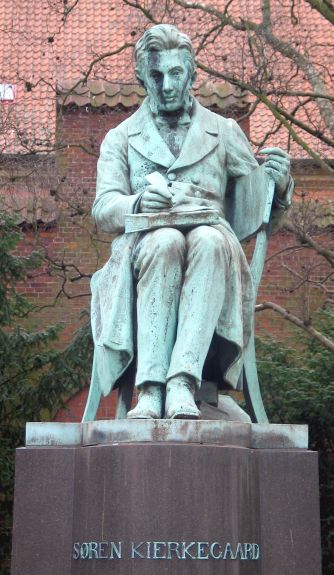
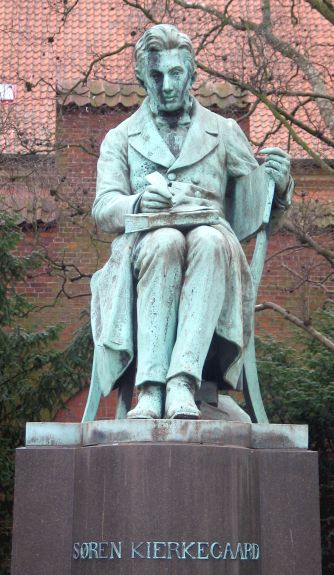
Søren-Kierkegaard-Statue im Garten der Königlichen Bibliothek in Kopenhagen.
I have been a big fan of Kierkegaard since I was in college and read:
“I have just now come from a party where I was its life and soul; witticisms streamed from my lips, everyone laughed and admired me, but I went away — yes, the dash should be as long as the radius of the earth’s orbit ——————————— and wanted to shoot myself.”
(Journal, 1836)
His writings about the authentic individual and his criticism of modern Christendom appealed to me.
Yes, he was an existentialist and a Christian. I could relate.
“It is the duty of the human understanding to understand that there are things which it cannot understand, and what those things are. Human understanding has vulgarly occupied itself with nothing but understanding, but if it would only take the trouble to understand itself at the same time it would simply have to posit the paradox.”








 dual personalities