dual personalities

Tag: Religion

Incarnate words

by chuckofish
c27680bed2c1e89b93a9c348781deb04.jpg

If God speaks anywhere, it is into our personal lives that he speaks. Someone we love dies, say. Some unforeseen act of kindness or cruelty touches the heart or makes the blood run cold. We fail a friend, or a friend fails us, and we are appalled at the capacity we all of us have for estranging the very people in our lives we need the most. Or maybe nothing extraordinary happens at all — just one day following another, helter-skelter, in the manner of days. We sleep and dream. We wake. We work. We remember and forget. We have fun and are depressed. And into the thick of it, or out of the thick of it, at moments of even the most humdrum of our days, God speaks. But what do I mean by saying that God speaks? He speaks not just through the sounds we hear, of course, but through events in all their complexity and variety, through the harmonies and disharmonies and counterpoint of all that happens. As to the meaning of what he says, there are times that we are apt to think we know. Adolf Hitler dies a suicide in his bunker with the Third Reich going up in flames all around him, and what God is saying about the wages of sin seems clear enough. Or Albert Schweitzer renounces fame as a theologian and musician for a medical mission in Africa, where he ends up even more famous still as one of the great near-saints of Protestantism; and again we are tempted to see God’s meaning as clarity itself. But what is God saying through a good man’s suicide? What about the danger of the proclaimed saint’s becoming a kind of religious prima donna as proud of his own humility as a peacock of its tail? What about sin itself as a means of grace? What about grace, when misappropriated and misunderstood, becoming an occasion for sin? To try to express in even the most insightful and theologically sophisticated terms the meaning of what God speaks through the events of our lives is as precarious a business as to try to express the meaning of the sound of rain on the roof or the spectacle of the setting sun. But I choose to believe that he speaks nonetheless, and the reason that his words are impossible to capture in human language is of course that they are ultimately always incarnate words. They are words fleshed out in the everydayness no less than in the crises of our own experience.

–Frederick Buechner, The Sacred Journey

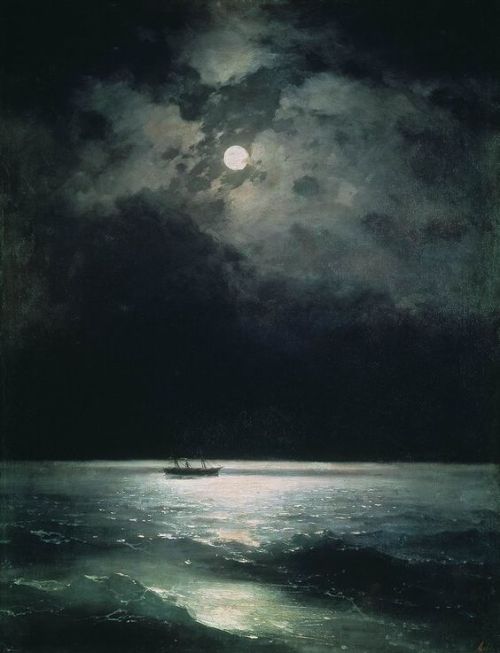
 The painting is  The Black Sea at Night by Ivan Aivazovsky
To watch or not to watch

by chuckofish

As you know, I have been blogging about great movies to watch during Lent. But really, when you think about it, most “religious” movies are pretty bad.

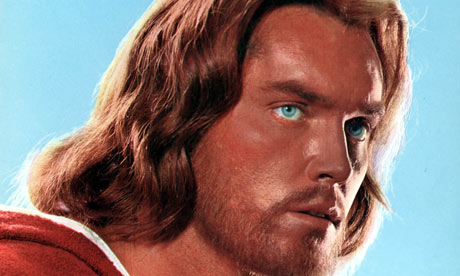
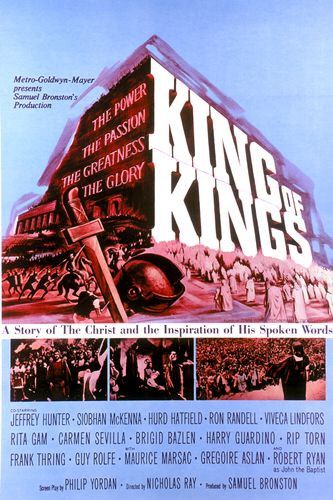
Case in point: King of Kings (1961), directed by Nicholas Ray and starring Jeffrey Hunter as the Son of God. Now when the dual personalities were little girls, we loved this movie. We thought Jeffrey Hunter was the perfect Jesus. Granted, the music by Miklos Rozsa is great and Jeff does have beautiful blue eyes, but really now, this rendition is hardly “the life of Christ intelligently told and beautifully filmed,” as the movie poster promises. The journeyman screenwriter Philip Yordan, who actually won an Oscar for another potboiler Broken Lance in 1955, was way out of his league. The gospel here is presented as a biblical Rebel Without a Cause, strictly trying to appeal to a teen crowd with Jesus as a dreamy all-American quarterback hero.

And as far as actual screen time, Barabbas, memorably played by Harry Guardino as a New York thug, gets way more than poor, sincere Jeffrey Hunter as Jesus. The respected Irish actress Siobhan McKenna is just ghastly as the Virgin Mary promising to “intercede” with her son for the lovelorn Mary Magdalen. It is just awful. I must admit that I kind of like Robert Ryan as John the Baptist, who has a certain disgusted look on his face that I can relate to. And he gets all the good lines: (to Herodias, played by the fashion model Rita Gam) “Woman, is not your cup of abominations full enough?” This movie is full of abominations.

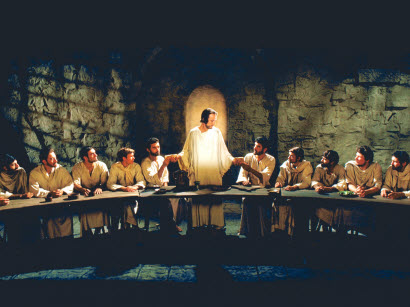
Then there’s The Greatest Story Ever Told (1965), the second to last movie directed by the great George Stevens.

It was a major fail for him. It is based on a book by Fulton Oursler who wrote the story of Jesus with the expressed intention of trying to “make it as interesting as a serial story in a popular magazine.” Well, there you have it. This movie is deadly dull and deathly serious, while at the same time poor Max Von Sydow as Jesus is unintentionally humorous as he says his lines with a Swedish accent. “BapTIZE me, Yon,” he says to Charlton Heston (as John the Baptist) who manages to keep a straight face. This movies is chock full of famous actors and actresses in cameo roles–everyone from Pat Boone to Sidney Poitier and Shelley Winters got into the act. Even David McCallum, at the height of his Ilya Kuryakin fame, plays Judas. This is all very distracting. One is always trying to figure out who is who. Oh look, it’s Angela Landsbury! Blerg. It is just awful.

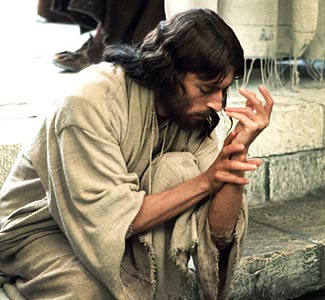
There are a few good ones. I really like the Franco Zeffirelli mini-series, Jesus of Nazareth (1977), which is an appropriately reverent and close adaption of the Gospels of Matthew, Mark and Luke. Anthony Burgess (of all people) did a fine job with the screenplay. There is no “He betook himself to Jerusalem” hokey narration like in King of Kings. He does not try to improve on the scriptures, taking much of the dialogue straight from them and the actors make it work. All the actors are excellent, especially the English actor Robert Powell as Jesus.

To watch the whole thing takes all week, so we better get started!

(The best movie about Jesus is the one where ironically his face is never seen–Ben Hur. This movie deserves its own post, so stay tuned.)