Ray Bradbury, widely considered one of the greatest writers of science fiction and fantasy, died a few days ago. He was 91 years old. Last weekend I watched the John Huston 1956 version of Moby-Dick. The screenplay was written by Ray Bradbury!
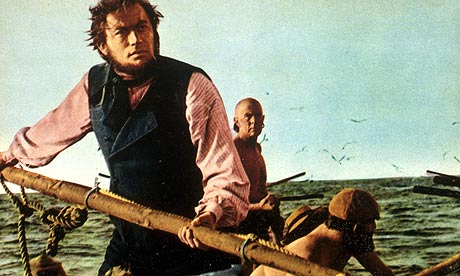
In an interview in the Paris Review Bradbury talked about writing this screenplay:
I had fallen in love with John Huston’s work when I was in my twenties. I saw The Maltese Falcon fifteen times, and The Treasure of the Sierra Madre scores of times. When I was twenty-nine I attended a film screening and John Huston was sitting right behind me. I wanted to turn, grab his hand, and say, I love you and I want to work with you. But I held off and waited until I had three books published, so I’d have proof of my love. I called my agent and said, Now I want to meet John Huston. We met on St. Valentine’s night, 1951, which is a great way to start a love affair. I said, Here are my books. If you like them, someday we must work together. A couple of years later, out of the blue, he called me up and said, Do you have some time to come to Europe and write Moby-Dick for the screen? I said, I don’t know, I’ve never been able to read the damn thing. So here I was confronted with a dilemma: Here’s a man that I love and whose work I admire. He’s offering me a job. Now, a lot of people would say, Grab it! Jesus, you like him, don’t ya? I said, Tell you what, I’ll go home tonight and I’ll read as much as I can, and I’ll come back for lunch tomorrow. By that time I will know how I feel about Melville. Because I’ve had copies of Moby-Dick around the house for years. So I went home and I read Moby-Dick. Strangely enough, a month earlier I’d been wandering around the house one night and picked up Moby-Dick and said to my wife, I wonder when I’m going to read this thing? So here I am sitting down to read it.
I dove into the middle of it instead of starting at the beginning. I came across a lot of beautiful poetry about the whiteness of the whale and the colors of nightmares and the great spirit’s spout. And I came upon a section toward the end where Ahab stands at the rail and says: “It is a mild, mild wind, and a mild looking sky; and the air smells now, as if it blew from a far-away meadow; they have been making hay somewhere under the slopes of the Andes, Starbuck, and the mowers are sleeping among the new-mown hay.” I turned back to the start: “Call me Ishmael.” I was in love! You fall in love with poetry. You fall in love with Shakespeare. I’d been in love with Shakespeare since I was fourteen. I was able to do the job not because I was in love with Melville, but because I was in love with Shakespeare. Shakespeare wrote Moby-Dick, using Melville as a Ouija board.
The day I went to see Huston I asked, Should I read up on the Freudians and Jungians and their interpretations of the white whale? He said, Hell no, I’m hiring Bradbury! Whatever is right or wrong about the screenplay will be yours, so we can at least say the skin around it is your skin.
So after I’d read the book multitudinous times, I wrote the beginning on the way to Europe on the boat, and that stayed. But everything else was so difficult. I had to borrow bits and pieces from late in the book and push them up front, because the novel is not constructed like a screenplay. It’s all over the place, a giant cannonade of impressions. And it’s a play too. Shakespearean asides, stage directions, everything.
I got out of the bed one morning in London, walked over to the mirror and said, I am Herman Melville. The ghost of Melville spoke to me and on that day I rewrote the last thirty pages of the screenplay. It all came out in one passionate explosion. I ran across London and took it to Huston. He said, My God, this is it.
Ray Bradbury never went to college. He was a self-taught, much-read writer. In that same Paris Review interview he explained, “I discovered me in the library. I went to find me in the library. Before I fell in love with libraries, I was just a six-year-old boy. The library fueled all of my curiosities, from dinosaurs to ancient Egypt. When I graduated from high school in 1938, I began going to the library three nights a week. I did this every week for almost ten years and finally, in 1947, around the time I got married, I figured I was done. So I graduated from the library when I was twenty-seven. I discovered that the library is the real school.”
Rest in peace, Ray, and may light perpetual shine upon you. “O Father, mortal or immortal, here I die. I have striven to be Thine, more than to be this world’s. Yet this is nothing. I leave eternity to Thee. For what is man, that he should live out the lifetime of his God?”
(If you would like to read the Paris Review interview in its entirety, it is here. It’s worth the effort.)

 dual personalities