dual personalities

Tag: quotes

“The skeleton of the whale furnishes but little clue to the shape of his fully invested body.”*

by chuckofish
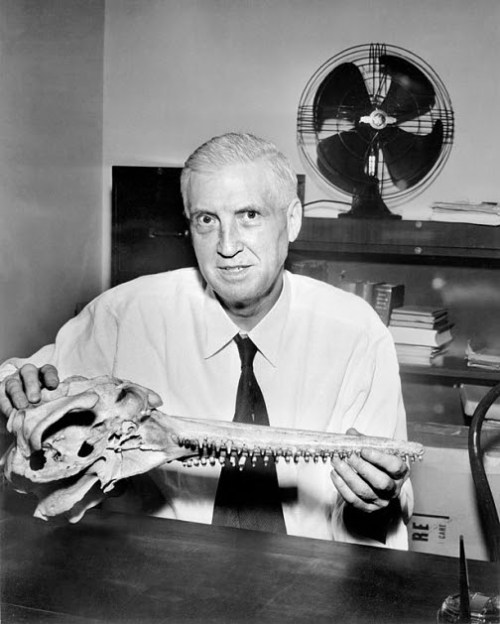
kellogg-photoToday is the birthday of Remington Kellogg (October 5, 1892 –May 8, 1969)–a fascinating fellow who was an American naturalist and a director of the United States National Museum. Born and raised in Davenport, Iowa, he attended the University of Kansas where he pursued his lifelong interest in wildlife. From there he went to the University of California–Berkeley. While serving in the Army in France during WWI, Kellogg still found time to collect specimens, which he sent back to Berkeley and the University of Kansas. He was discharged in July 1919 and returned to Berkeley to complete his doctorate, transferring from zoology to study vertebrate paleontology.
6a01156e4c2c3d970c01b8d0d4c2a7970c

In 1928 Kellogg became assistant curator at the United States National Museum and in 1941 became curator. At the museum he devoted time to studying primitive whales from the Eocene and early Oligocene of North America. In 1948 he was appointed director of the Museum and in 1958 was made assistant secretary of the Smithsonian Institution. He was elected to the National Academy of Sciences in 1951.

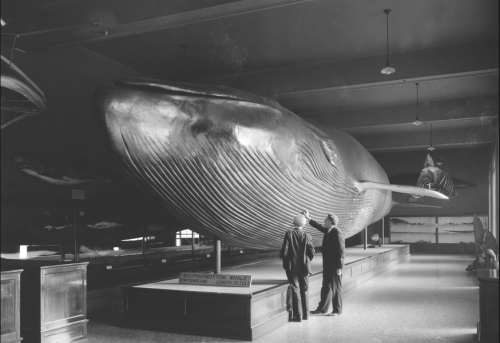
Whales have been at the heart of Smithsonian research since 1850. It was Museum director Remington Kellogg who wanted a “scientifically accurate” model and pushed for the research to make one.

2002-12150

So a toast to Remington Kellogg (what a great name!) and to Herman Melville while we’re at it.

“Speak, thou vast and venerable head,” muttered Ahab, “which, though ungarnished with a beard, yet here and there lookest hoary with mosses; speak, mighty head, and tell us the secret thing that is in thee. Of all divers, thou hast dived the deepest. That head upon which the upper sun now gleams, has moved amid this world’s foundations. Where unrecorded names and navies rust, and untold hopes and anchors rot; where in her murderous hold this frigate earth is ballasted with bones of millions of the drowned; there, in that awful water-land, there was thy most familiar home. Thou hast been where bell or diver never went; hast slept by many a sailor’s side, where sleepless mothers would give their lives to lay them down. Thou saw’st the locked lovers when leaping from their flaming ship; heart to heart they sank beneath the exulting wave; true to each other, when heaven seemed false to them. Thou saw’st the murdered mate when tossed by pirates from the midnight deck; for hours he fell into the deeper midnight of the insatiate maw; and his murderers still sailed on unharmed — while swift lightnings shivered the neighboring ship that would have borne a righteous husband to outstretched, longing arms. O head! thou hast seen enough to split the planets and make an infidel of Abraham, and not one syllable is thine!

Have a good “hump” day!

*Moby-Dick, Herman Melville

“The race is not always to the swift, nor the battle to the strong, but that’s the way to bet.”

by chuckofish

Today is the birthday of Damon Runyon (October 4, 1880 – December 10, 1946)–American newspaperman and author. He is most remembered today for writing the stories which inspired the broadway musical Guys and Dolls. 

Sportswriter Damon Runyon

Here are some things about him you probably didn’t know:

He was born in Manhattan–but in Manhattan, Kansas. He grew up in Pueblo, Colorado. His father and grandfather were newspaper editors.

In 1898, when still in his teens, Runyon enlisted in the U.S. Army to fight in the Spanish-American War.

He was the Hearst newspapers’ baseball columnist for many years, beginning in 1911, and his knack for spotting the eccentric and the unusual, on the field or in the stands, is credited with revolutionizing the way baseball was covered.

One year, while covering spring training in Texas, he met Pancho Villa in a bar and later accompanied the unsuccessful American expedition into Mexico searching for Villa.

Runyon died in New York City in 1946, at age 66. His body was cremated, and his ashes were illegally scattered from a DC-3 airplane over Broadway by Captain Eddie Rickenbacker. The family plot of Damon Runyon is located at Woodlawn Cemetery in the Bronx.

His stories are still in print and I am going to read them. His gangsters seem much more appealing than our 21st-century ones.

You can do it!

by chuckofish

screen-shot-2016-09-28-at-6-50-38-pm

This made me LOL.

Also it got me thinking about support and encouragement, which are all very well and good, but lest we forget, here’s a word from Ralph Waldo Emerson on self-reliance:

“Whatever you do, you need courage. Whatever course you decide upon, there is always someone to tell you that you are wrong. There are always difficulties arising that tempt you to believe your critics are right. To map out a course of action and follow it to an end requires some of the same courage that a soldier needs. Peace has its victories, but it takes brave men and women to win them.”

And a poem by Mary Oliver to get you moving:

THE FOURTH SIGN OF THE ZODIAC (PART 3)

I know, you never intended to be in this world.
But you’re in it all the same.

So why not get started immediately.

I mean, belonging to it.
There is so much to admire, to weep over.

And to write music or poems about.

Bless the feet that take you to and fro.
Bless the eyes and the listening ears.
Bless the tongue, the marvel of taste.
Bless touching.

You could live a hundred years, it’s happened.
Or not.
I am speaking from the fortunate platform
of many years,
none of which, I think, I ever wasted.
Do you need a prod?
Do you need a little darkness to get you going?
Let me be as urgent as a knife, then,
and remind you of Keats,
so single of purpose and thinking, for a while,
he had a lifetime.

Have a good weekend. October will be here tomorrow! The last quarter of the year is upon us. Let us make good use of it.

“That was the most awkward Wednesday he ever remembered.”*

by chuckofish

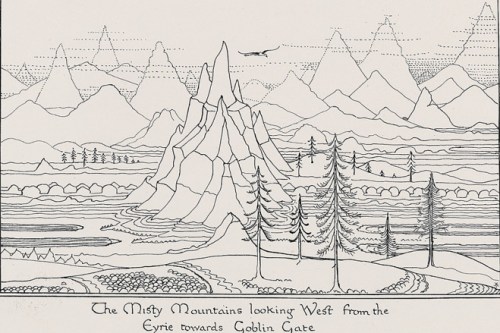
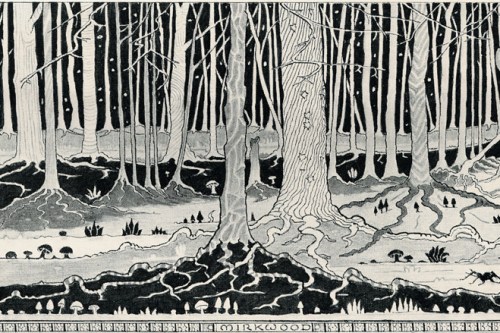
The Hobbit by J.R.R. Tolkien was published 79 years ago on September 21, 1937 to wide critical acclaim. As you know, it is recognized as a classic in children’s literature. And lots of people other than J.R.R. Tolkien have made a lot of money on various movie adaptions.

hobbit_cover

“Now it is a strange thing, but things that are good to have and days that are good to spend are soon told about, and not much to listen to; while things that are uncomfortable, palpitating, and even gruesome, may make a good tale, and take a deal of telling anyway.”

ob-ur521_hobbit_h_20120921172948

“There are no safe paths in this part of the world. Remember you are over the Edge of the Wild now, and in for all sorts of fun wherever you go.”

ob-ur539_hobbit_h_20120921180320

It might be time to dig out a copy and re-read The Hobbit. Well, we’ll see. Hope your Wednesday isn’t too awkward.

*The Hobbit, of course. The illustrations pictured are by the author.


“My ransomed soul he leadeth”*

by chuckofish

I had a rather long to-do list this weekend, and I checked off most everything on it. This included getting my hair cut, going to several estate sales, going to Lowe’s, cleaning up my closet, doing a little yard work, and going to church. Pretty typical.

[Daughter #1 celebrated her birthday in NYC with daughter #2. They had fun (see picture) and cake!]

img_8281

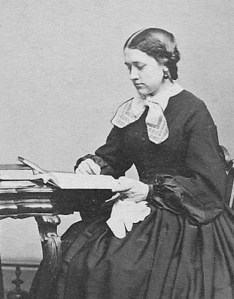
I started reading The Lamplighter by Maria Susanna Cummins, which daughter #2 sent me. (Sentimental novels of the mid-19th century are a concentration of her doctoral studies.)

maria_susanna_cummins

Published in 1854, The Lamplighter, Cummins’s first novel, was an immediate best-seller, selling 20,000 copies in twenty days. The work sold 40,000 in eight weeks, and within five months it had sold 65,000. At the time it was second in sales only to Harriet Beecher Stowe’s Uncle Tom’s Cabin. It sold over 100,000 copies in Britain and was translated into multiple different languages.

I am enjoying it immensely. Although Nathaniel Hawthorne may have sneered at it, there is a reason so many people gobbled it up. It is well-written, diverting and instructive, and to the average person struggling along in the daily grind, uplifting.

[Gerty’s] especial favorite was a little work on astronomy, which puzzled her more than all the rest put together, but which delighted her in the same proportion; for it made some things clear, and all the rest, though a mystery still, was to her a beautiful mystery, and one which she fully meant some time to explore to the uttermost. And this ambition to learn  more, and understand better, by and by, was, after all, the greatest good she derived. Awaken a child’s ambition, and implant in her a taste for literature, and more is gained than by years of school-room drudgery, where the heart works not in unison with the head.

Agreed.

At church the Gospel lesson was about Christ eating with sinners and the Pharisees grumbling about it. The Apostle Paul reminded us that Christ Jesus came into the world to save sinners, he foremost among them. In the OT lesson, God changed his mind, at Moses’ prompting, and forgave the slackers in the wilderness. Most of us are grumbling Pharisees ourselves, and it is good to be reminded of it. It is good to be reminded of it weekly and to say this prayer of confession:

Most merciful God,
we confess that we have sinned against you
in thought, word, and deed,
by what we have done,
and by what we have left undone.
We have not loved you with our whole heart;
we have not loved our neighbors as ourselves.
We are truly sorry and we humbly repent.
For the sake of your Son Jesus Christ,
have mercy on us and forgive us;
that we may delight in your will,
and walk in your ways,
to the glory of your Name. Amen.

We will forget soon enough and once again be grumbling Pharisees.

Later today the OM and I are driving to Indianapolis where the boy is having surgery tomorrow at Indiana University Hospital. All trace of his cancer is gone, but there is still a tumor and they will remove it. If all goes well, we will return on Wednesday. Please keep us all in  your prayers.

*Hymn 410

Poetry amid the jarring notes of day

by chuckofish

440px-john_greenleaf_whittier_bpl_ambrotype_c1840-60-crop
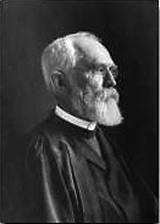
John Greenleaf Whittier (1807 – September 7, 1892) was an American Quaker poet and Abolitionist. One of the “Fireside Poets” of the 19th century, he is hardly read anymore, of course. Whittier, California is named after him and also Whittier College. (Please note: The school mascot is “The Poet.”)

A number of his poems have been turned into hymns, including  Dear Lord and Father of Mankind, taken from his poem “The Brewing Soma”.  You may recall that Whittier was also one of the founding contributors of the magazine Atlantic Monthly and was supportive of women writers, including Sarah Orne Jewett, who dedicated one of her books to him.

You probably know more of his poems than you think. Remember–“Blessings on thee, little man, Barefoot boy, with cheek of tan!”

And how about Barbara Frietchie?

“Up from the meadows rich with corn,
Clear in the cool September morn,

The clustered spires of Frederick stand
Green-walled by the hills of Maryland.”

Here is a favorite of mine; read the entire thing and enjoy.

I mourn no more my vanished years
Beneath a tender rain,
An April rain of smiles and tears,
My heart is young again.

The west-winds blow, and, singing low,
I hear the glad streams run;
The windows of my soul I throw
Wide open to the sun.

No longer forward nor behind
I look in hope or fear;
But, grateful, take the good I find,
The best of now and here.

I plough no more a desert land,
To harvest weed and tare;
The manna dropping from God’s hand
Rebukes my painful care.

I break my pilgrim staff, I lay
Aside the toiling oar;
The angel sought so far away
I welcome at my door.

The airs of spring may never play
Among the ripening corn,
Nor freshness of the flowers of May
Blow through the autumn morn.

Yet shall the blue-eyed gentian look
Through fringed lids to heaven,
And the pale aster in the brook
Shall see its image given;–

The woods shall wear their robes of praise,
The south-wind softly sigh,
And sweet, calm days in golden haze
Melt down the amber sky.

Not less shall manly deed and word
Rebuke an age of wrong;
The graven flowers that wreathe the sword
Make not the blade less strong.

But smiting hands shall learn to heal,–
To build as to destroy;
Nor less my heart for others feel
That I the more enjoy.

All as God wills, who wisely heeds
To give or to withhold,
And knoweth more of all my needs
Than all my prayers have told.

Enough that blessings undeserved
Have marked my erring track;
That wheresoe’er my feet have swerved,
His chastening turned me back;

That more and more a Providence
Of love is understood,
Making the springs of time and sense
Sweet with eternal good;–

That death seems but a covered way
Which opens into light,
Wherein no blinded child can stray
Beyond the Father’s sight;

That care and trial seem at last,
Through Memory’s sunset air,
Like mountain-ranges overpast,
In purple distance fair;

That all the jarring notes of life
Seem blending in a psalm,
And all the angles of its strife
Slow rounding into calm.

And so the shadows fall apart,
And so the west-winds play;
And all the windows of my heart
I open to the day.

(1859)

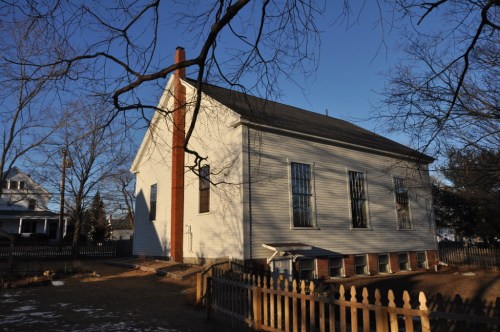
Lovely, lovely, lovely. Also lovely is the Amesbury, MA Friends Meeting House. The simple 1.5 story wood frame building was constructed in 1850, with our poet Whittier serving on the building committee. We are told it is currently a thriving congregation, with Meeting for Worship every Sunday at 10 a.m. The facing bench displays a small plaque that reads, “Whittier’s Bench.”

amesburyma_friendsmeetinghouse_1

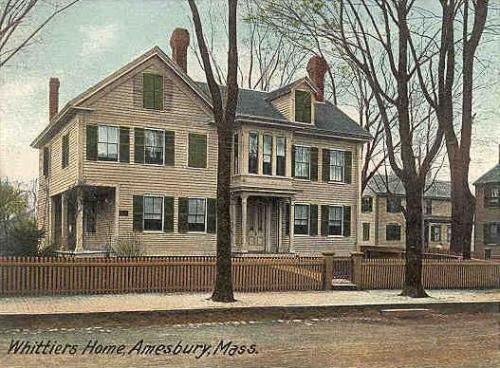
I have never been to Amesbury, but it appears to be a nice place.

whittiers_home_amesbury_ma

Besides Whittier, our ancestor Josiah Bartlett lived there,

josiah_bartletts_statue_amesbury_ma

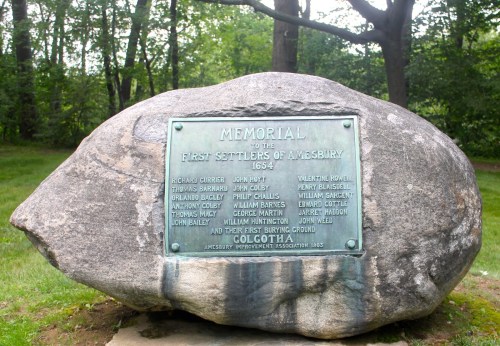
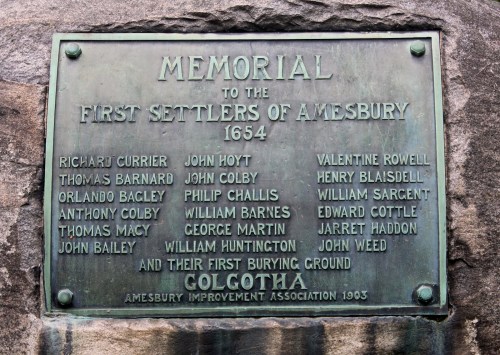
as did Mary Baker Eddy and Robert Frost. And there is this:

amesbury

amesbury-first-settlers

I need to check this place out. Have a good Thursday.

“My comfort and salvation, Lord, shall surely come from Thee.”*

by chuckofish

Today on the Episcopal Church calendar we remember with a lesser feast the life of William Porcher Dubose (April 11, 1836 – August 18, 1918) .

dubose

Dubose served as a Confederate soldier and chaplain in Virginia and was captured and imprisoned at Fort Delaware. During Reconstruction he was an Episcopal minister in Abbeville and Winnsboro, S.C., and became a theologian at the University of the South in Sewanee, Tennessee in 1871. Indeed, according to the Standing Commission on Liturgy and Music, he was “probably the most original and creative thinker the American Episcopal Church has ever produced…He was not widely traveled, and not widely known, until, at the age of 56, he published the first of several books on theology that made him respected, not only in his own country, but also in England and France.”

You can read more about him here. Read the comments section for a long-winded, back-and-forth argument about whether Dubose should be disqualified from the Calendar because of his Confederate ties and his “support” of the KKK during Reconstruction and on and on. Or don’t bother. Whatever.

Here is a quote from a letter written by Dubose to his first wife Annie toward the end of the Civil War where he admits his imperfections:

“I have just commenced today our reading of the Old Testament.  I will have to skip all the intervening chapters and begin afresh at the lesson for the day.  You must read by the lessons and also keep in mind during the week the Collect, Epistle, and Gospel. It will be sweet to know that we are reading and thinking together.  My traveling etc. threw me a little off my balance and I am just recovering again.  How is it that we will so often stray away from God when it is so sweet to be near Him and so full of discomfort and wretchedness to be far from Him?  If our hope rested on our own faithfulness how miserable we’d be!  But blessed be God, it rests upon His faithfulness and not ours.  Is not God’s patience and forbearance a mystery!  I am almost tempted sometimes to feel that it is useless to try Him again.  I have been so often faithless to my most sacred vows.  Then I feel I cannot live without Him and I always find Him more ready to receive me.  Oh how I wish I could be more consistent and steadfast.  The hymn beginning ‘Jesus my strength, my hope’ is a very sweet one to me.”  

I have no doubt that God is patient with and forebears even self-righteous comment-writers of the 21st century.

*Jesus, my Strength, my Hope, Charles Wesley, 1742

“On the banks of the Wabash, far away”*

by chuckofish

“That month he developed the habit every night of picking up the Bible the last thing before he went to bed and reading a few verses, and from thinking a prayer and from thinking thanksgiving, he advanced to the place where he boldly, in the silence and serenity of the little room, got down on his knees and prayed the prayer of thanksgiving. Then he followed it by the prayer of asking. He found himself asking God to take care of all the world, to help everyone who needed help; to put the spirit and courage into every heart to fare forth and to attempt the Great Adventure on its own behalf… Then he arose, in some way fortified, a trifle bigger, slightly prouder, more capable, more of a man than he had been the day before. He had asked for help and he knew that he was receiving help, and he knew that never again would he be ashamed to face any man, or any body of men, and tell them that he had asked for help and that help had been forthcoming, and that the same experience lay in the reach of every man if he would only take the Lord at His word; if he would only do what all men are so earnestly urged to do–believe.”

― Gene Stratton-Porter, The Keeper of Bees 

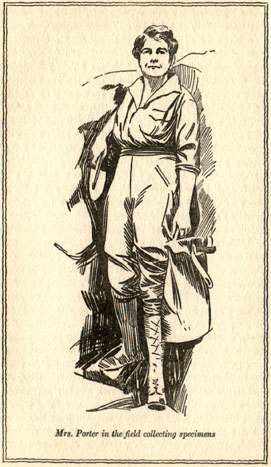
Today is the birthday of Gene Stratton-Porter (August 17, 1863 – December 6, 1924) who was an American author, naturalist, and nature photographer.

GSP_Portrait_01_-_Front_4X6

She wrote several best-selling novels–Freckles, A Girl of the Limberlost, and The Harvester–which are set in the wooded wetlands and swamps of the disappearing central Indiana ecosystems. She knew and loved these, and documented them extensively.  Her works were translated into several languages, including Braille, and she was estimated to have had 50 million readers around the world. Many of her books are still in print.

I have to admit I have never read any of her books, but I have always heard of them–especially The Girl of the Limberlost, which has to be one of the all-time best titles ever. Indeed, Stratton-Porter is one of Indiana’s best known authors and she really put Geneva, Indiana on the map by writing about the Limberlost swamp. Besides writing best-selling novels, she was an amateur naturalist who studied the bird life of the upper Wabash and recorded her observations. She was also a pioneer photographer, taking pictures of the birds she studied and loved.

13-80

Stratton-Porter’s two Indiana residences, “Limberlost Cabin” in Geneva, Indiana

152632-004-F99F26E4

and the “Cabin at Wildflower Woods” in Rome City, Indiana

download (1)

were both designated Indiana State Historic Sites in 1946 and listed on the National Register of Historic Places. They are operated by the Indiana State Museum and Historic Sites Corporation as house museums.

She also had a honkin’ big house in Bel Air, California (she was in the movie business too), but I’m going to limit myself to exploring more of the Hoosier State. Road trip, anyone?

*Indiana state song by Paul Dresser

In a gadda da vida, baby

by chuckofish

Weekends that follow a weekend when one of my daughters has visited are always a little sad. You know, she was here and we were doing that, and now she is not here.  And it was a rainy weekend to boot!

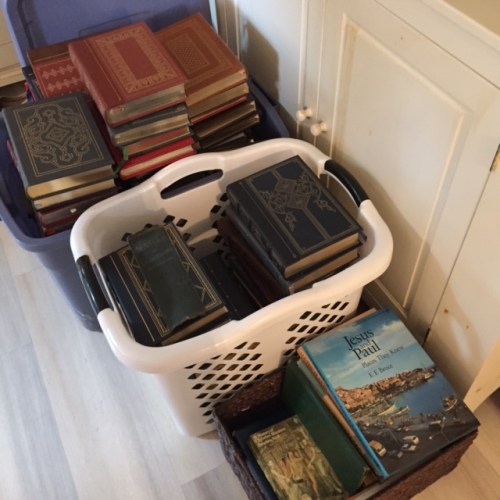
But I am not one to sit in a slough of despond, so I got busy. Since Gary is coming back this week to paint the living room and paper the dining room, I had to put away all the dishes in my china cabinet and pack up various shelves full of dishes etc. And there were also a lot of very dusty books to move. Good grief what a job!

IMG_2119

I suppose it is a good job to do every once in awhile (and should no doubt be done more frequently) in order to dust off the books and be reminded what we have!

I also got a new pair of Tom’s on sale which made me happy.

IMG_2118

I read the second lesson in church, a good long one from Hebrews (11:29–12:2) about how we are surrounded by a cloud of witnesses, something I believe in strongly. The Gospel was from Luke (12:49–56) where Jesus is at his politically-incorrect best, calling everyone a hypocrite and saying he “came to bring fire to the earth, and how I wish it were already kindled!” Our lady priest reminded us that there is no room for compromise in the Gospel and that the sweet Jesus people like to imagine is a fiction. (I think Zooey had something to say about that to Franny.)

Our organist/choirmaster has been on vacation for several weeks and so the organist substitute was the lady who always reminds me of Helen Feesh on the Simpsons.

Helen

I mean seriously.

I left right after the service and got back to work taking down drapes (more dust) and such.

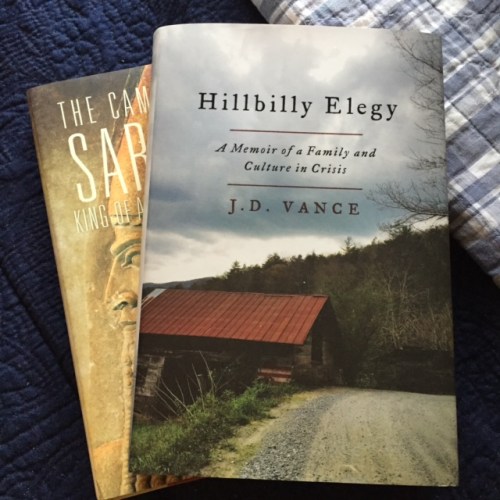
Over the weekend I read Hillbilly Elegy by J.D. Vance, which my dual personality had recommended. Now I recommend it to you. Hard to put down.

FullSizeRender

In the middle of the night when I couldn’t sleep I picked up a book by Eudora Welty and was reminded how really great she is.

It is our inward journey that leads us through time–forward or back, seldom in a straight line, most often spiraling. Each of us is moving, changing, with respect to others. As we discover, we remember; remembering, we discover; and  most intensely do we experience this when our separate journeys converge. Our living experience at those meeting points is one of the charged dramatic fields of fiction. (One Writer’s Beginnings)

Sigh. Now it is Monday and it’s back to the salt mines–have a good week!

Throwback Thursday

by chuckofish

Mary CC.jpeg

This picture of our mother circa 1930 at “The Farm” in New Hampshire should bring a smile to your face.

And we could all use that, right?

“I wish I could leave you certain of the images in my mind, because they are so beautiful that I hate to think they will be extinguished when I am. Well, but again, this life has its own mortal loveliness. And memory is not strictly mortal in its nature, either. It is a strange thing, after all, to be able to return to a moment, when it can hardly be said to have any reality at all, even in its passing. A moment is such a slight thing. I mean, that its abiding is a most gracious reprieve.”

―Marilynne Robinson, Gilead