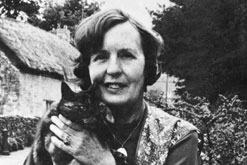
Recently I was re-reading the wonderful If You Want to Write: A Book about Art, Independence and Spirit by the wonderful Brenda Ueland, written back in 1937. She was a journalist, editor, freelance writer, and teacher of writing.
She graduated from Barnard College in 1913–I wonder if she knew our grandmother Mira Sargent, who graduated in 1914? Hmm. Another layer to the story.
Anyway, her book about writing is wonderful. Even the footnotes are great.
Yes, I am all against anxiety, worry. There are many people, you can see, who consider worry a kind of duty. Back of this I think it is the subconscious feeling that Fate or God is mean or resentful or tetchy and that if we do not worry enough we will certainly catch it from Him.
But they should remember that Christ said that we should cast off anxiety so that we could “seek first the Kingdom of Heaven and His righteousness” (i.e., live creatively, greatly, in the present) “and all these things” (beauty, happiness, goodness, talent, food and clothing) “will be added unto you.” Of course He is right.
That “Of course He is right” tells you a lot. Even if you are not interested in writing, you should check out this book.
But at last I understood from William Blake and Van Gogh and other great men, and from myself–from the truth that is in me (and for which I have at last learned to declare and stand up for, as I am trying to persuade you to stand up for your inner truth)–at last I understood that writing was this: an impulse to share with other people a feeling or truth that I myself had. Not to preach to them, but to give it to them if they cared to hear it. If they did not–fine. They did not need to listen. That was all right too.
She would have loved to blog.
Yes, I have been watching the Olympics–what else would I do in the quadrennial summer of 2012? And it hasn’t been easy, considering that here in our flyover state we are bombarded relentlessly by repetitive and snarky political ads during the Olympic coverage. Aye carumba.
Furthermore, I must admit, I have not been impressed with NBC. (Don’t get me started on Bob Costas.) And I hate all the purple and magenta. I guess William and Kate the Great and the U.S. swimming team and Misty May Treanor make up for all this. And this little lady:
Go, Gabby!
Thanks again to Naeem Callaway for the visual message.
“So you got yourself in another jam.”
“Oh, you heard about it.”
“Brother I sit here all day on my fanny and I don’t look as if I had a brain in my head. But you’d be surprised what I hear…”
(The Big Sleep)
BTW, I heard from a couple of people at the wedding festivities that they were reading Moby Dick after reading our blog. Also someone told me she had gone out and bought Matterhorn and read it after reading about it on the blog. This warms my heart. Keep up the good work, readers! And let us know what you are reading.
I am a New Englander by birthright and a Midwesterner by acclimation. My ancestors were all Yankee-bred.
Chamberlins from Vermont, Sargents and Putnams from Massachusetts, Rands from New Hampshire, Wheelers from Connecticut, Tukeys from Maine. The Houghs and Carnahans from Pennsylvania are the farthest south we go.
We boast no southerners in this family, but nevertheless, I feel drawn to the South. Some of its culture repels me: the pseudo aristocracy-Gone-With-the-Wind delusions, their misguided Robert E. Lee-sense of honor, slavery. But like I said, there is much to recommend it as well.
For one thing, there is the grand literary tradition exemplified by Faulkner, Welty, Capote, Harper Lee, Reynolds Price et al. They do not romantisize, even here:
It’s all now you see. Yesterday won’t be over until tomorrow and tomorrow began ten thousand years ago. For every Southern boy fourteen years old, not once but whenever he wants it, there is the instant when it’s still not yet two o’clock on that July afternoon in 1863, the brigades are in position behind the rail fence, the guns are laid and ready in the woods and the furled flags are already loosened to break out and Pickett himself with his long oiled ringlets and his hat in one hand probably and his sword in the other looking up the hill waiting for Longstreet to give the word and it’s all in the balance, it hasn’t happened yet, it hasn’t even begun yet, it not only hasn’t begun yet but there is still time for it not to begin against that position and those circumstances which made more men than Garnett and Kemper and Armistead and Wilcox look grave yet it’s going to begin, we all know that, we have come too far with too much at stake and that moment doesn’t need even a fourteen-year-old boy to think This time. Maybe this time with all this much to lose than all this much to gain: Pennsylvania, Maryland, the world, the golden dome of Washington itself to crown with desperate and unbelievable victory the desperate gamble, the cast made two years ago; or to anyone who ever sailed a skiff under a quilt sail, the moment in 1492 when somebody thought This is it: the absolute edge of no return, to turn back now and make home or sail irrevocably on and either find land or plunge over the world’s roaring rim.
Intruder in the Dust (1948)
And, of course, there is the gospel-enriched music: from Hank Williams to Dolly Parton and Lyle Lovett—almost all of my favorites and some of my soul mates.
Yes, I love the American South. I even subscribe to Garden & Gun magazine, which purports to reflect “the Soul of the South.” Well, I will say they have interesting articles about the likes of Padgett Powell and Wendell Berry and Olivia Manning.
And I dream of a Tennessee Mountain Home, don’t you?
Here is Dolly singing about her Tennessee Mountain Home. (Listening to this song on an old compilation CD of “Mom’s Favorites” made by daughter #1 back in the day prompted this post.)
Have I mentioned that I really want a Magnolia (Magnolia grandiflora) tree?
“Dixon was alive again. Consciousness was upon him before he could get out of the way; not for him the slow, gracious wandering from the halls of sleep, but a summary, forcible ejection. He lay sprawled, too wicked to move, spewed up like a broken spider crab on the tarry shingle of the morning. The light did him harm, but not as much as looking at things did; he resolved, having done it once, never to move his eyeballs again. A dusty thudding in his head made the scene before him beat like a pulse. His mouth had been used as a latrine by some small creature of the night, and then as its mausoleum. During the night, too, he’d somehow been on a cross-country run and then been expertly beaten up by secret police. He felt bad.”
From Lucky Jim by Kingsley Amis (Chapter six)
Oh, I laughed out loud as I typed this!
Lucky Jim, published in 1954, was Kingsley Amis’s first novel, and won the Somerset Maugham Award for fiction. Set sometime around 1950, the book follows the exploits of the eponymous Jim Dixon, a reluctant medieval history lecturer at an unnamed provincial English university. Christopher Hitchens described it as the funniest book of the second half of the 20th century. The New Yorker said in their review that it was a “highly unusual first novel by a young English writer who is endowed with, and in control of, more than his share of talent, humor, and human sympathy.” Well. It is very funny.
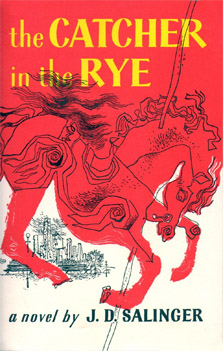
The Catcher in the Rye by J.D. Salinger was published on July 16 in 1951. It has been translated into almost all of the world’s major languages. Around 250,000 copies are sold each year, with total sales of more than 65 million books. I am one of its biggest fans and have been since I first read it in the 10th grade. I was one of those teenagers that identified with Holden Caulfield and forty years later I still do. I love him and his creator as much as any fictional character and author out there.
“The part that got me was, there was a lady sitting next to me that cried all through the goddam picture. The phonier it got, the more she cried. You’d have thought she did it because she was kindhearted as hell, but I was sitting right next to her, and she wasn’t. She had this little kid with her that was bored as hell and had to go to the bathroom, but she wouldn’t take him. She kept telling him to sit still and behave himself. She was about as kindhearted as a goddam wolf. You take somebody that cries their goddam eyes out over phony stuff in the movies, and nine times out of ten they’re mean bastards at heart. I’m not kidding. ” (Chapter 18)
How right is that?