“Now learn,” she commanded herself, “learn at last that anywhere you may expect grace.” And she was filled with happiness like a girl at this new proof that the traits she lived for were everywhere, that the world was ready.”
“The multitude of books is a great evil. There is no measure or limit to this fever of writing; everyone must be an author; some out of vanity to acquire celebrity; others for the sake of lucre or gain.”
–Martin Luther, Table Talk (1569)
Sadly, four hundred and fifty years later, this is still the case. I can hardly bear to go into a big bookstore these days. It is too depressing to see the mess that is produced.
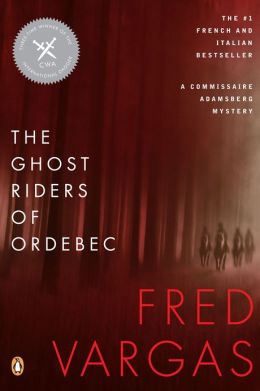
However, there are still some bright lights out there. I see that there is a new Fred Vargas mystery coming out in June.
I do love Commissaire Adamsberg, the chief of police in Paris’s seventh arrondissement!
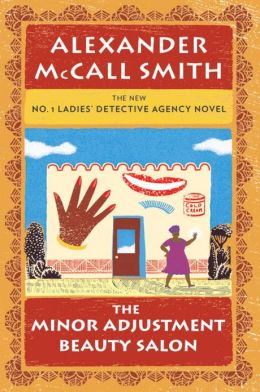
And there is a new Alexander McCall Smith #1 Ladies Detective Agency book coming out in November.
I like the title of this new one!
Hilary Mantel is working feverishly to finish the third and final installment of her Thomas Cromwell trilogy–one fears before she is too ill to write. Ugh.
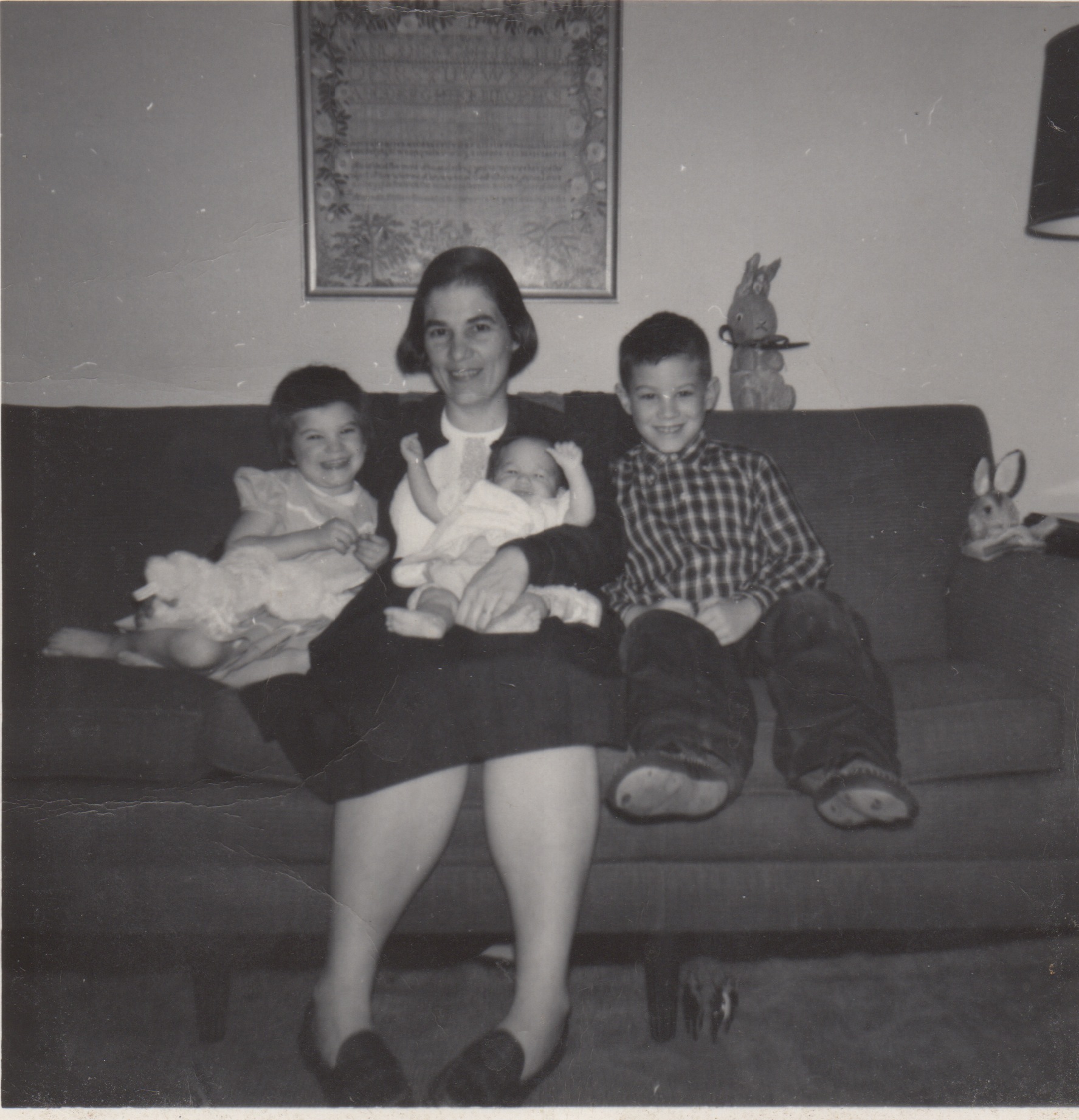
Mother’s Day approaches. This is a bittersweet holiday for me, since it has been 25 years since I had a mother with whom to celebrate.
But the blogosphere has been a-buzz with “What has your mother taught you?” posts, and I think it is still a valuable exercise to consider this question. And, of course, I do love lists. So here are some of the things that my mother taught me:
Keep it simple.
Holidays call for parties. Parties are always best when there are favors.
When you act like a lady, people treat you like a lady.
Going out for lunch is the best.
Going for a drive can help you take your mind off your problems.
Talk to children like adults.
Children like routine and boundaries, but try to be spontaneous once in awhile.
Furniture should not “match” and “suites” of furniture are indeed tacky. If you have antiques, they will not all be from the same period. It is okay to mix it up a little!
Hugging is good.
Children owe their parents nothing. They did not ask to be born. (She was the opposite of a Jewish mother.) Of course, this attitude makes you realize you owe your parents everything.
She was a bit of a snob, but she hated the expression “white trash”. No person is trash.
You never really know a person until you’ve walked around in their shoes for awhile.
Be Kind. Be kind. Be kind.
She must have been disappointed by my mean-girl persona at times, but I think she understood that it was a jungle at my private school. I remember once I complained about the girl who sat in the assigned desk in front of me (in first grade no less), who would turn around and put her “fat arm” on my desk. My mother said, “My heart bleeds for her.” I was surprised. There was no sympathy for me who had to put up with this unappealing girl. Of course, I immediately felt ashamed of my intolerance and I still cringe at the memory. I never liked that girl though.
My mother was not perfect and she taught me a few things which I had to un-learn over the years as well. But on the whole, she was a truly wonderful mother and I miss her every day.
What did you learn from your mother?
Here’s a lovely last-minute gift idea list from La Dolce Vita blog. Good ideas, but, no, I do not want to go see Baz Luhrmann’s The Great Gatsby with Leo.
Happy Mother’s Day and read this quote–It kind of says it all:
*”She seemed to know, to accept, to welcome her position, the citadel of the family, the strong place that could not be taken. And since old Tom and the children could not know hurt or fear unless she acknowledged hurt and fear, she had practiced denying them in herself. And since, when a joyful thing happened, they looked to see whether joy was on her, it was her habit to build up laughter out of inadequate materials. But better than joy was calm. Imperturbability could be depended upon. And from her great and humble position in the family she had taken dignity and a clean calm beauty. From her position as healer, her hands had grown sure and cool and quiet; from her position as arbiter she had become as remote and faultless in judgment as a goddess. She seemed to know that if she swayed the family shook, and if she ever really deeply wavered or despaired the family would fall, the family will to function would be gone.”
― John Steinbeck, The Grapes of Wrath
May 6 (Monday) was the 149th anniversary of Henry David Thoreau’s death of consumption in 1862 at age 44. I’m sorry I missed it, but these things happen.
When his aunt Louisa asked him in his last weeks if he had made his peace with God, Thoreau responded: “I did not know we had ever quarreled.” His last words were “Now comes good sailing”, followed by two lone words, “moose” and “Indian”.
Bronson Alcott planned the service. The Boston Transcript reported:
Selections from the Bible were read by the minister. A brief ode, written for the purpose by William Ellery Channing, was plaintively sung. Mr. Emerson read an address of considerable length, marked by all his felicity of conception and diction — an exquisite appreciation of the salient and subtle traits of his friend’s genius — a high strain of sanitive thoughts, full of beauty and cheerfulness, chastened by the gentle sorrow of the hour. Referring to the Alpine flower adelweiss, or noble purity, which the young Switzers sometimes lose their lives in plucking from perilous heights, Mr. Emerson said, “Could we pierce to where he is we would see him wearing profuse chaplets of it; for it belongs to him. Where there is knowledge, where there is virtue, where there is beauty, where there is progress, there is now his home.” Mr. Alcott read some very appropriate passages from the writings of the deceased, and the service closed with a prayer by the Rev. Mr. Reynolds. A long procession was then formed to follow the body to the grave. The hands of friends reverently lowered it into the bosom of the earth, on the pleasant hillside of his native village, whose prospects will long wait to unfurl themselves to another observer so competent to discriminate their features, and so attuned to their moods.
Can you imagine such a funeral? It must have been something.
Originally buried in the Dunbar family plot, Thoreau and members of his immediate family were eventually moved to Sleepy Hollow Cemetery in Concord, Massachusetts.
Have no mean hours, but be grateful for every hour, and accept what it brings. The reality will make any sincere record respectable. No day will have been wholly misspent, if one sincere, thoughtful page has been written. Let the daily tide leave some deposit on these pages, as it leaves sand and shells on the shore. So much increase of terra firma. this may be a calendar of the ebbs and flows of the soul; and on these sheets as a beach, the waves may cast up pearls and seaweed.
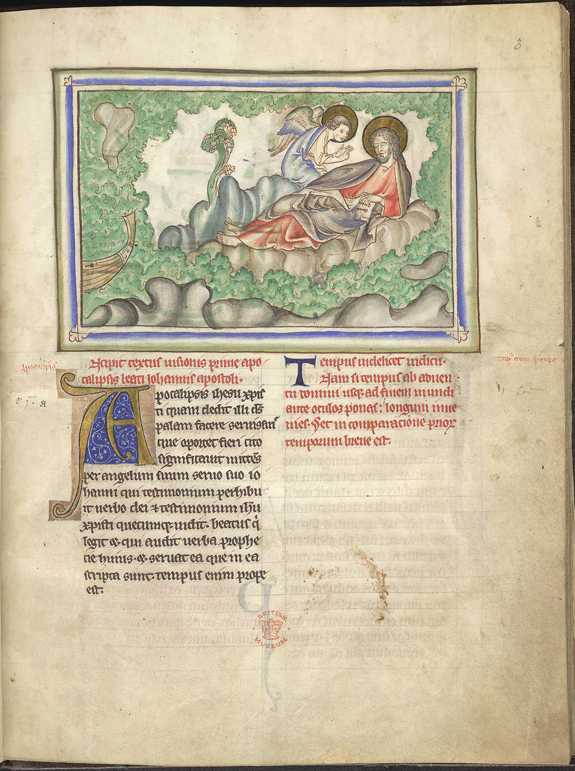
I read the second lesson in church on Sunday. It was a great passage from the Book of Revelation, the one that starts out “I saw no temple in the city, for the temple is the Lord God Almighty…”
Here is paradise! The hymns reflected this nicely. We sang #620, “Jerusalem, My Happy Home” and #621, “Lights’ Abode, Celestial Salem”.
The sermon, no surprise, did not address the holy city, but was about “Friends”. The preacher vaguely connected this to the Gospel, but it was a stretch.
I can’t help wondering if some ministers do not want to talk about resurrection and heaven, because they do not really believe in it. It certainly makes them very uncomfortable. Partly I think this is because they enjoy their life here and now too much. They certainly don’t buy into the idea put forth so well in hymn #621:
Now with gladness, now with courage,
bear the burden on thee laid,
that hereafter these thy labors
may with endless gifts be paid,
and in everlasting glory
thou with brightness be arrayed.
But what did old Thomas á Kempis know? Or for that matter, the Victorian (J. M. Neale) who translated it?
Well, who am I to say? It just got me thinking, you know? And Lord knows I have to think about something during those long sermons about #friendship.
I love quotations and have been filling “quote books” since I was in the eighth grade. I have no idea where that first book is, but I remember it clearly. It was a plain spiral notebook with a brown cardboard cover. I wish I could find it. I have no doubt the contents are priceless.
Forty-three years later, I am still at it. I have lots of quote books in every shape and size. Trouble is, there is no rhyme nor reason to my books and I have no idea where any particular quote is.
But as Melville writes: “There are some enterprises in which a careful disorderliness is the true method.”
Whenever I go back and look at one of these books, I find great things, which I have inevitably forgotten.
Here’s a quote from Mark Helprin’s Soldier of the Great War, which I read many years ago:
“Alessandro, in memory, things, objects, and sensations merely stand in for the people you love.” He had to rest and breathe before he continued. After a while, he said, “If I long for a thunderstorm in Rome sixty years ago, or seventy, for the heavy rain and the disheveled lightening, for the wet trees that were completely free and completely abandoned, it’s not because of the rain, or the quiet, or the ticking of the clock in the hallway–all of which I remember–but because of my mother and my father, who held me at the window as we watched the storm.”
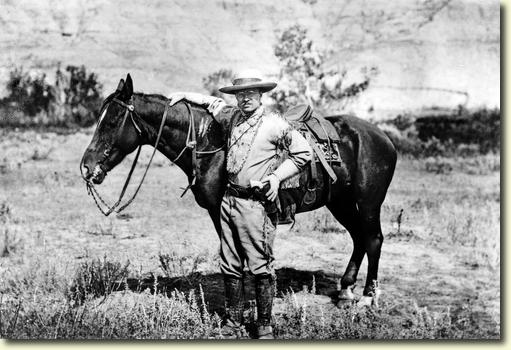
“Once upon a time in the dead of winter in the Dakota Territory, Theodore Roosevelt took off in a makeshift boat down the Little Missouri River in pursuit of a couple of thieves who had stolen his prized rowboat. After several days on the river, he caught up and got the draw on them with his trusty Winchester, at which point they surrendered. Then Roosevelt set off in a borrowed wagon to haul the thieves cross-country to justice. They headed across the snow-covered wastes of the Badlands to the railhead at Dickinson, and Roosevelt walked the whole way, the entire 40 miles. It was an astonishing feat, what might be called a defining moment in Roosevelt’s eventful life. But what makes it especially memorable is that during that time, he managed to read all of Anna Karenina. I often think of that when I hear people say they haven’t time to read.”
I had a bad day on Friday and it carried into my weekend. I’m afraid I am not spiritually advanced enough to power through those bad days. I disappoint myself, but it’s the truth.
It takes some work you know. I won’t go into all the details, but I finally had a breakthrough when I watched Awakenings (1990) on Saturday night.
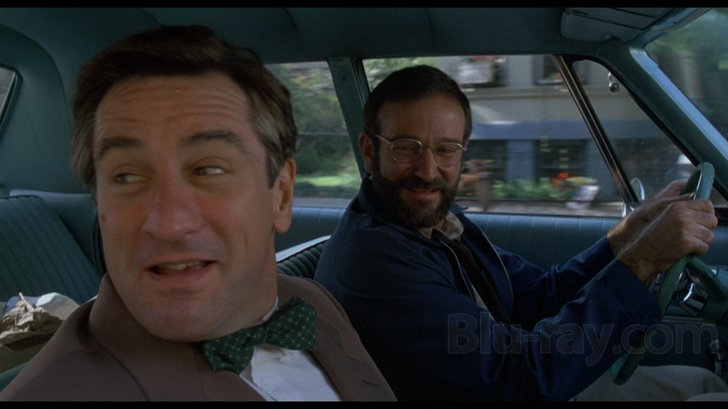
No, that is not my brother in the car with Robert De Niro! That’s Robin Williams.
Leonard Lowe, De Niro’s character, who has been “awakened” from a 30-year catatonic state, tells us:
Read the newspaper. What does it say? All bad. It’s all bad. People have forgotten what life is all about. They’ve forgotten what it is to be alive. They need to be reminded. They need to be reminded of what they have and what they can lose. What I feel is the joy of life, the gift of life, the freedom of life, the wonderment of life!
It is important to be reminded of this frequently. I highly recommend this wonderful movie, although be prepared to cry off-and-on for two hours. This also is a good thing (see here.)
I went to church on Sunday and was under-whelmed by the service and the sermon, but was gladdened by the display of new spring growth evident in the church grounds.
There was plenty of spring bounty at the grocery store as well.
Back in my yard, there is plenty of work to be done already.
But I’m feeling better already. Aren’t you?
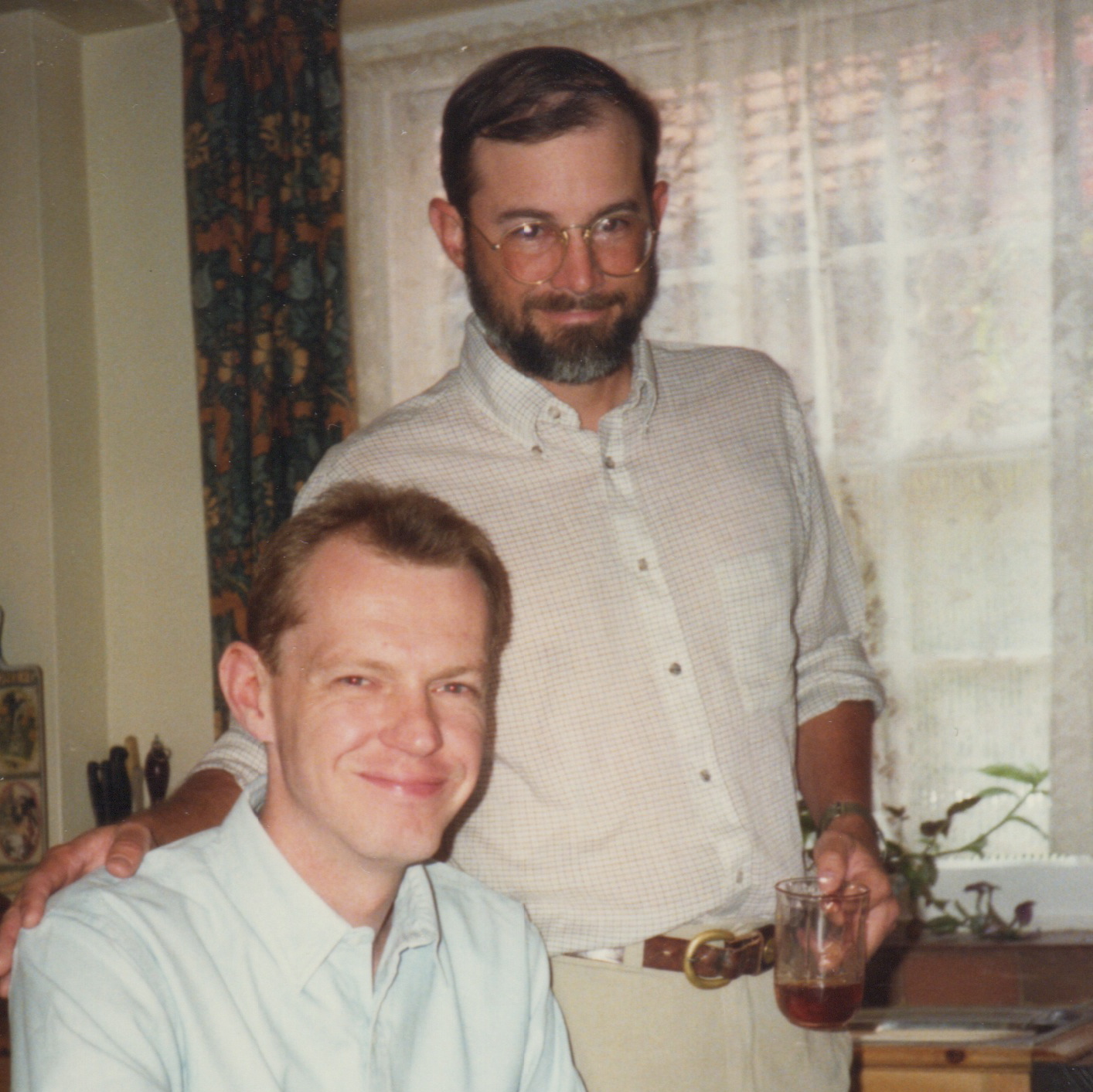
And for you doubters out there who don’t believe that Robin Williams is my brother’s doppelganger…here’s proof!
Here he is (on the right obviously) in 1989 with his bro-in-law.
Born a few weeks apart in 1951, the only way to tell them apart is that Robin is a LOT more hairy.
“Your house, being the place in which you read, can tell us the position books occupy in your life, if they are a defense you set up to keep the outside world at a distance, if they are a dream into which you sink as if into a drug, or bridges you cast toward the outside, toward the world that interests you so much that you want to multiply and extend its dimensions through books.”
― Italo Calvino, If on a Winter’s Night a Traveler
Or all of the above, right?
Furthermore, there are plenty of people who read, but do not have books in their home. Books, after all, gather dust and some people never read a book twice, so why would you want to own it? It is just entertainment. But for some of us, books are old friends whom we visit and re-visit.
The world can always be divided in two. You know, between people who collect and people who don’t. People who buy books and people who never buy books. People who buy a house and furnish it and never think of it again and those who are continually feathering their nests.
I spend a lot of time in my nest. Having my things around me (and my mother’s things and her mother’s things and so on) makes me happy. I appreciate them and enjoy them.
This is not to say, I don’t believe whole-heartedly in “editing” and being organized. But I had a friend once who lived like she might have to move out of her house overnight and she wanted to be ready. That meant no extraneous possessions–like last month’s magazines. The minute her son outgrew something, she got rid of it. If he didn’t play with a toy for some designated time, out it went. (This begs another question–Are children allowed to have their own things and should their mother be getting rid of them?) I could not live that way, but to each his own. You do what you have to do.
It is never a good thing to get too attached to our things. They are, after all, just things–not people.
But I always told my children: in case of a fire, someone grab the sampler!
It went without saying that the priority was getting oneself out the door!
The key, of course, is enjoying what you have. Don’t you agree?
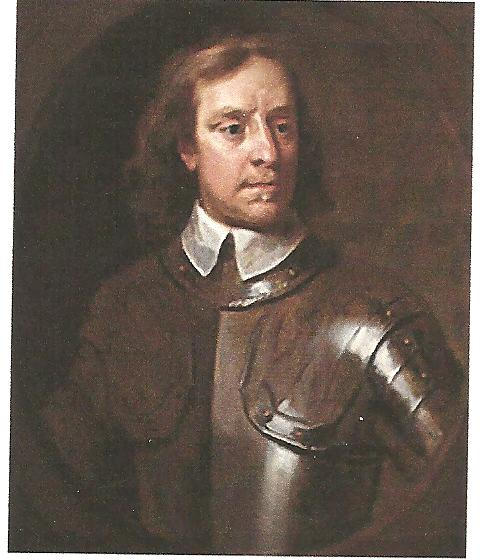
Well, this week we celebrate the birthdays of many worthy souls, but I have to say, none so worthy as Oliver Cromwell (25 April 1599 – 3 September 1658). I do love old Oliver, great-great-great-nephew, by the way, of another favorite, Thomas Cromwell. As an American and a member of the “rabble,” a lover of liberty, as a believer in public education for all and a Puritan at heart, I certainly sympathize with this Roundhead who rebelled against the absolute power of the monarchy and the divine right of kings.
“I had rather have a plain russet-coated captain that knows what he fights for, and loves what he knows, than that which you call a gentleman and is nothing else.”
–Letter from Cromwell to Sir William Spring. Sept. 1643
Indeed.
“I confess I have an interest in this Mr Cromwell; and indeed, if truth must be said, in him alone. The rest are historical, dead to me; but he is epic, still living. Hail to thee, thou strong one; hail across the longdrawn funeral-aisle and night of time!…”
Thomas Carlyle, Historical Sketches
You either love him or hate him. But even those who despise him, have to admit he was a good Protector of England.
“To give the devil (Cromwell) his due, he restored justice, as well distributive as comutative, almost to it’s ancient dignity and splendour; the judges without covetousness discharging their duties according to law and equity…..His own court also was regulated according to a severe discipline; here no drunkard, nor whoremonger, nor any guilty of bribery, was to be found, without severe punishment. Trade began again to prosper; and in a word, gentle peace to flourish all over England.”
Physician to the Cromwellian Court, George Bate, Post-Restoration indictment of his master Oliver Cromwell.
There seems to be little middle ground.
“He was a practical mystic, the most formidable and terrible of all combinations, uniting an aspiration derived from the celestial and supernatural with the energy of a mighty man of action; a great captain, but off the field seeming, like a thunderbolt, the agent of greater forces than himself ; no hypocrite, but a defender of the faith; the raiser and maintainer of the Empire of England.”
Lord Rosebery, in W.C. Abbott, The Writings and Speeches of Oliver Cromwell
I can relate to that “practical mystic.”
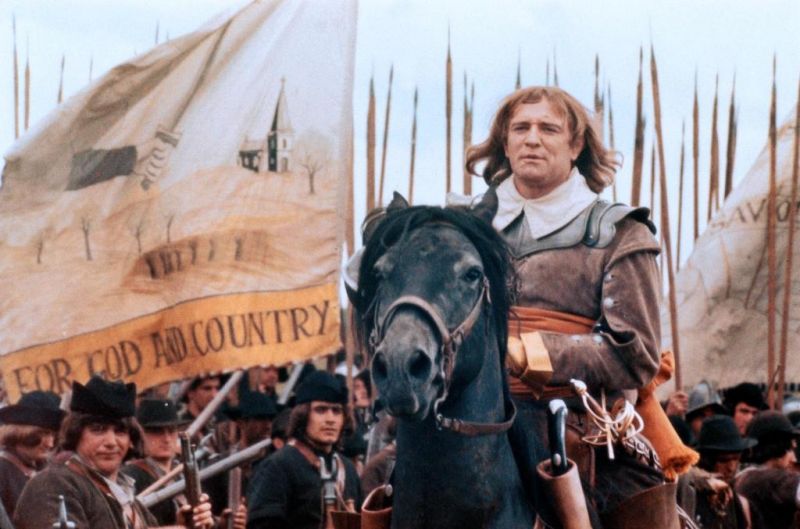
Anyway, I think this is a perfect occasion to watch Cromwell (1970) starring Richard Harris as Cromwell and Alec Guinness as Charles I. This is actually a really good movie, and I think Harris, although an Irishman and raised to be a hater, gets Cromwell just right. It is, indeed, one of his best film roles. Alec Guinness looks eerily like the King and manages to make him real and sympathetic.














 dual personalities