dual personalities

Tag: quotes

“…the great floodgates of the wonder-world swung open…”*

by chuckofish

On this day in 1844 the Missouri and Mississippi rivers reached the most devastating flood stages in history. The Mississippi River swelled to nearly 12 miles wide during the the flood. Crowds gathered on rooftops in St. Louis to watch the houses and trees of Illinoistown (now East St. Louis) being carried away. Steamboats that were still running on the river reported crashing into chimneys and mill machinery hidden below the water’s surface. River pirates took small boats back into the flooded, abandoned towns, looting the upper stories of homes.

The 1844 flood and 1993 flood square off as St. Louis’s “biggest”—the 1844 flood carried 21 percent more water, but the 1993 flood crested more than 8 feet higher. Had the 1993 flood carried the 1844 flood’s volume, it would have almost certainly crested St. Louis’s floodwall (the 1993 flood came within three feet of crest).

To give you an idea, here’s a photo of high water–flooded levee with buildings on one side and boats on the other–at St. Louis during the 1858 flood. (Missouri Historical Society Collections.)
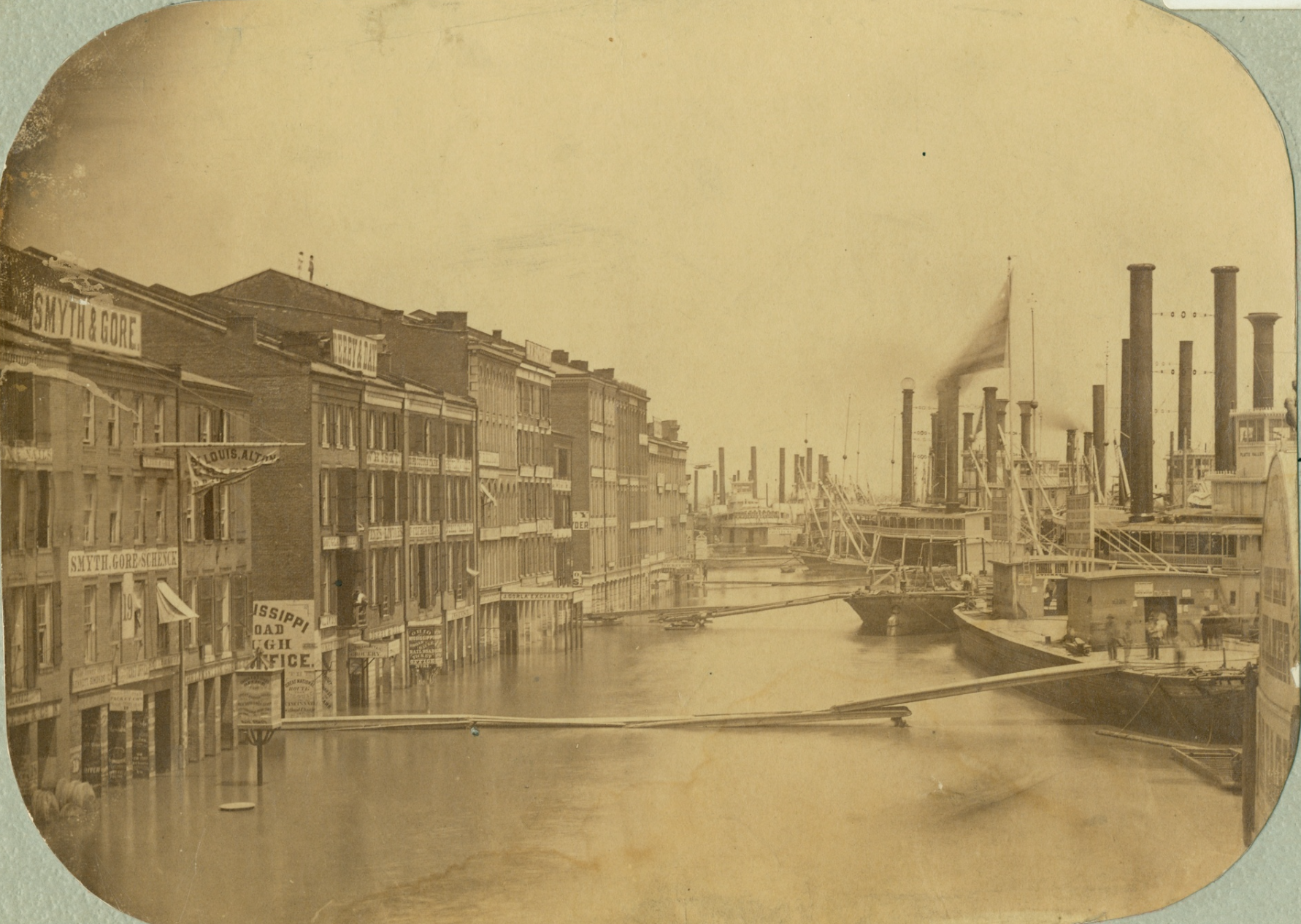
Not until June 28 did the waters begin to recede. By the middle of July the river was back to normal.

After the flood, Congress passed the Swamp Act in 1849 providing land grants to build stronger levees.

“A young man was sitting at home when a terrible rainstorm began. Within hours, the man’s house began to flood, and someone came to his door offering a ride to higher ground. The man declined, saying, ‘God will take care of me.’ A few hours later, as the waters engulfed the first floor of the man’s home, a boat passed by, and the captain offered to take the man to safety. The man declined, saying, ‘God will take care of me.’ A few hours after that, as the man waited on his roof—his entire home flooded—a helicopter flew by, and the pilot offered transportation to dry land. Again the man declined, telling the pilot that God would care for him. Soon thereafter, the waters overcame the man, and as he stood before God in heaven, he protested his fate: ‘You promised that you’d help me so long as I was faithful.’ God replied, ‘I sent you a car, a boat, and a helicopter. Your death is your own fault.’ God helps those who help themselves.”

–J.D. Vance, Hillbilly Elegy

*Herman Melville, Moby-Dick
He rose

by chuckofish

It is Good Friday and it is time to get serious.

Christmas has a large and colorful cast of characters including not only the three principals themselves, but the angel Gabriel, the innkeeper, the shepherds, the heavenly host, the three Wise Men, Herod, the star of Bethlehem, and even the animals kneeling in the straw. In one form or another we have seen them represented so often that we would recognize them anywhere. We know about the birth in all its detail as well as we know about the births of ourselves or our children, maybe more so. The manger is as familiar as home. We have made a major production of it, and as minor attractions we have added the carols, the tree, the presents, the cards. Santa Claus, Ebenezer Scrooge, and so on. With Easter it is entirely different.

The Gospels are far from clear as to just what happened. It began in the dark. The stone had been rolled aside. Matthew alone speaks of an earthquake. In the tomb there were two white-clad figures or possibly just one. Mary Magdalen seems to have gotten there before anybody else. There was a man she thought at first was the gardener. Perhaps Mary the mother of James was with her and another woman named Joanna. One account says Peter came too with one of the other disciples. Elsewhere the suggestion is that there were only the women and that the disciples, who were somewhere else, didn’t believe the women’s story when they heard it. There was the sound of people running, of voices. Matthew speaks of “fear and great joy.” Confusion was everywhere. There is no agreement even as to the role of Jesus himself. Did he appear at the tomb or only later? Where? To whom did he appear? What did he say? What did he do?

It is not a major production at all, and the minor attractions we have created around it — the bunnies and baskets and bonnets, the dyed eggs — have so little to do with what it’s all about that they neither add much nor subtract much. It’s not really even much of a story when you come right down to it, and that is of course the power of it. It doesn’t have the ring of great drama. It has the ring of truth. I f the Gospel writers had wanted to tell it in a way to convince the world that Jesus indeed rose from the dead, they would presumably have done it with all the skill and fanfare they could muster. Here there is no skill, no fanfare. They seem to be telling it simply the way it was. The narrative is as fragmented, shadowy, incomplete as life itself. When it comes to just what happened, there can be no certainty. That something unimaginable happened, there can be no doubt.

The symbol of Easter is the empty tomb. You can’t depict or domesticate emptiness. You can’t make it into pageants and string it with lights. It doesn’t move people to give presents to each other or sing old songs. It ebbs and flows all around us, the Eastertide. Even the great choruses of Handel’s Messiah sound a little like a handful of crickets chirping under the moon.

He rose. A few saw him briefly and talked to him. If it is true, there is nothing left to say. If it is not true, there is nothing left to say. For believers and unbelievers both, life has never been the same again. For some, neither has death. What is left now is the emptiness. There are those who, like Magdalen, will never stop searching it till they find his face.

~Frederick Buechner, originally published in Whistling in the Dark 

Hallelujah! Sure, we’ll get dressed up and go to church and cook a big brunch and set the table with the good china. But let’s just take a moment, shall we?

And this is interesting–C.S. Lewis admired this play by Dorothy Sayers so much that he re-read it every year during Holy Week. (He re-read things too.) I have never read it, but I think I will.

God was executed by people painfully like us, in a society very similar to our own…by a corrupt church, a timid politician, and a fickle proletariat led by professional agitators.

–Dorothy Sayers

Happy Easter. Christ is risen indeed.

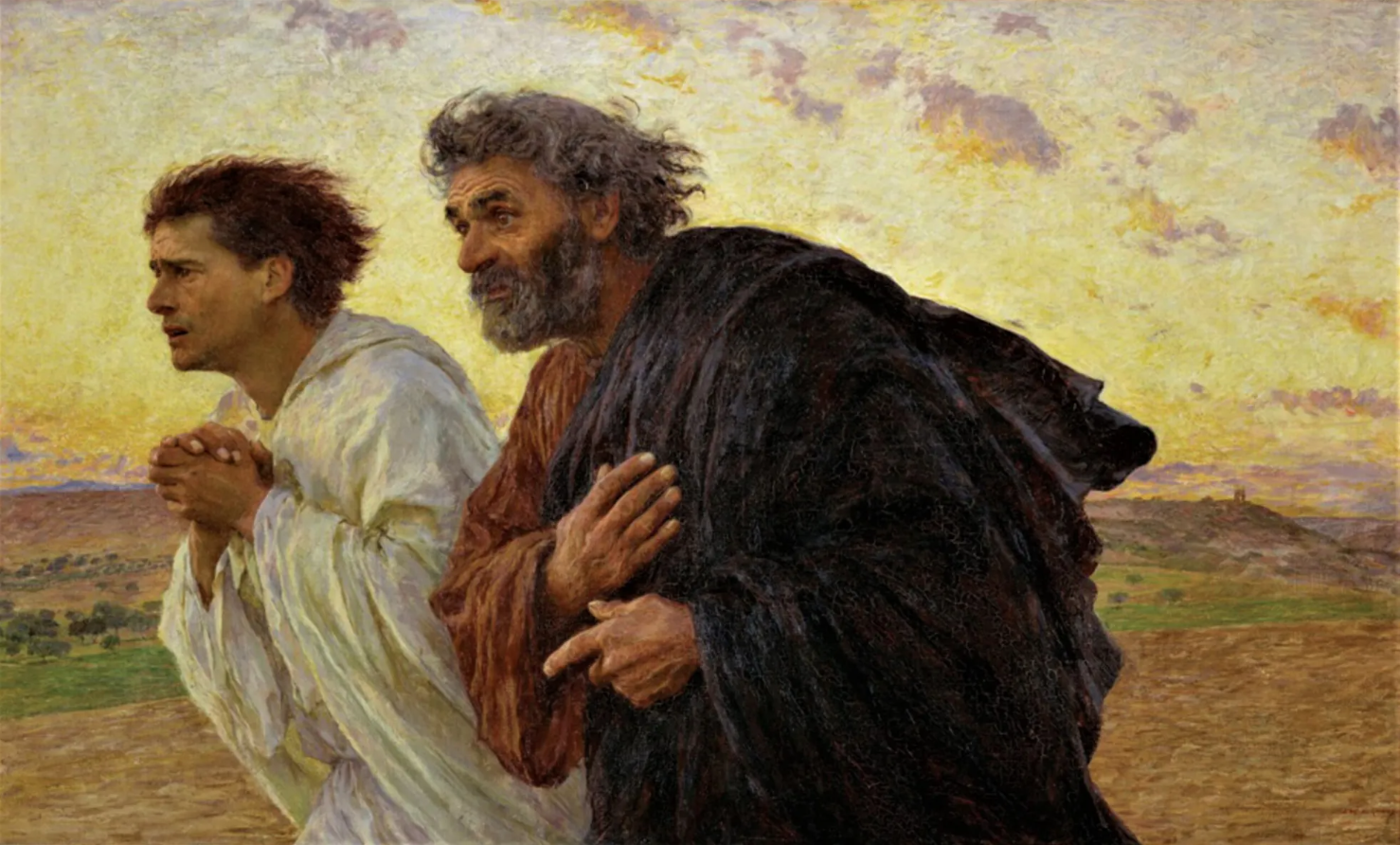
(The painting is The Disciples Peter and John Running to the Sepulchre on the Morning of the Resurrection by the Swiss artist Eugène Burnand, 1898.)

Let nothing you dismay

by chuckofish

“Oh! But he was a tight-fisted hand at the grindstone, Scrooge! a squeezing, wrenching, grasping, scraping, clutching, covetous, old sinner! Hard and sharp as flint, from which no steel had ever struck out generous fire; secret, and self-contained, and solitary as an oyster.”

–A Christmas Carol by Charles DIckens

Are you feeling a little like our friend Mr. Scrooge? Here’s a good message from the late, great R.C. Sproul: “Every generation has its abundance of Scrooges. The church is full of them. We hear endless complaints of commercialism. We are constantly told to put Christ back into Christmas. We hear that the tradition of Santa Claus is a sacrilege. We listen to those acquainted with history murmur that Christmas isn’t biblical…All this carping is but a modern dose of Scroogeism, our own sanctimonious profanation of the holy.”

So lighten up. Enjoy the season! Spread some cheer! Write some end-of-the-year checks to the Shriners and the Salvation Army and your local Christian radio station. Put some paper money in the red kettle at the grocery store. You’ll be glad you did.

And I hope you enjoy this rendition of God Rest Ye, Merry Gentlemen, which is one of the oldest Christmas carols, originating in 16th-century England. The earliest known printed edition was published in 1760.

God rest ye merry gentlemen
Let nothing you dismay
For Jesus Christ our Saviour
Was born on Christmas Day
To save us all from Satan’s pow’r
When we were gone astray
O tidings of comfort and joy
Comfort and joy
O tidings of comfort and joy

From God our Heavenly Father
A blessed Angel came;
And unto certain shepherds
Brought tidings of the same,
How that in Bethlehem was born
The Son of God by Name.
O tidings of comfort and joy,
Comfort and joy
O tidings of comfort and joy

The shepherds at those tidings
Rejoiced much in mind,
And left their flocks a-feeding
In tempest, storm and wind,
And went to Bethlehem straightway
The Son of God to find.
O tidings of comfort and joy,
Comfort and joy
O tidings of comfort and joy

But when to Bethlehem they came,
Whereat this infant lay,
They found Him in a manger,
Where oxen feed on hay;
His Mother Mary kneeling down,
Unto the Lord did pray.
O tidings of comfort and joy,
Comfort and joy
O tidings of comfort and joy

Now to the Lord sing praises,
All you within this place,
And with true love and brotherhood
Each other now embrace;
This holy tide of Christmas
All other doth efface.
O tidings of comfort and joy,
Comfort and joy
O tidings of comfort and joy.

Right on schedule

by chuckofish

The Christmas cactus is budding!

Well, as Emerson said, “Adopt the pace of nature: her secret is patience.”

This is sage advice indeed. I am an old lady so I have slowed down considerably and I do not think that is a bad thing.

We must learn to reawaken and keep ourselves awake, not by mechanical aids, but by an infinite expectation of the dawn, which does not forsake us in our soundest sleep. I know of no more encouraging fact than the unquestionable ability of man to elevate his life by a conscious endeavor. It is something to be able to paint a particular picture, or to carve a statue, and so to make a few objects beautiful; but it is far more glorious to carve and paint the very atmosphere and medium through which we look, which morally we can do. To affect the quality of the day, that is the highest of arts. Every man is tasked to make his life, even in its details, worthy of the contemplation of his most elevated and critical hour. If we refused, or rather used up, such paltry information as we get, the oracles would distinctly inform us how this might be done.

(Henry David Thoreau, Walden)

So elevate your life!

“Good God A’mighty! Another base hit.”*

by chuckofish

A few weeks ago, after I watched the movie 42 (2013), I started reading up a bit about Jackie Robinson and I came across the book The Boys of Summer by Roger Kahn.

It was a bestseller when it was published in 1971. I bought a used copy online and started reading. It is really good! I was a big fan in the mid-sixties when I was a little girl, and although I am not a big baseball fan anymore, I have always contended that it is the best sport. This is because everyone, from little children to old ladies, can understand it. It is not an overly violent game and finesse wins over brute force. Indeed, it is a majestic and heroic game where one man stands up alone against nine players of the other team–sometimes in front of thousands of people.

You may recall that the famous 20th century poet Marianne Moore was a huge fan of the Brooklyn Dodgers and wrote poems about them.

(Read the whole poem here.)

Anyway, Roger Kahn grew up in Brooklyn, a hop, skip and a jump from Ebbets Field where the Dodgers played. He lived and breathed the game. After college he went to work as a night copyboy at the New York Herald Tribune. His descriptions of growing up and of being a fledgling newspaper writer are funny, moving and detailed. I am really enjoying it.

As you know, our grandfather, ANC Jr., was a newspaperman who worked on the New York Times as well as the Herald Tribune, so this is especially interesting as a window into mid century journalism, which bears absolutely no similarity to today’s digital scribbling. These writers worked hard and took pride in their work. They were good writers.

So if you are so inclined, I highly recommend The Boys of Summer.

I should mention that Brooks Robinson, the Hall of Famer who played all 23 years of his professional baseball career with the Baltimore Orioles, died last week. He was my favorite non-Cardinal back in the day. He had class. Also Adam Wainwright retired last weekend after quite a career in St. Louis. He has class too. (And look at that wingspan.)

Unlike most, a ball player must confront two deaths. First, between the ages of thirty and forty he perishes as an athlete. Although he looks trim and feels vigorous and retains unusual coordination, the superlative reflexes, the major league reflexes, pass on. At a point when many of his classmates are newly confident and rising in other fields, he finds that he can no longer hit a very good fast ball or reach a grounder four strides to his right. At thirty-five he is is experiencing the truth of finality. As his major league career is ending, all things will end. However he sprang, he was always earthbound. Mortality embraces him. The golden age has passed in a moment. So will all things. So will all moments.

(Roger Kahn, The Boys of Summer)

In other news, bears are causing problems in of all places Japan! Indeed, the Japanese have deployed giant robot wolves to intimidate marauding bears. This is not science fiction.

Enjoy your Tuesday. Embrace the moment.

“Pee Wee Reese, shortstop, Brooklyn Dodgers

This and that

by chuckofish

“I dare not neglect prayer and thanksgiving if I am to enjoy God’s transcendent peace and overcome my worries.  I must abhor thankless bitterness and eschew sulkiness.  My worries must be enumerated before the Father, along with thoughtful requests framed in accordance with his will.  These requests must be offered to the accompaniment of sincere gratitude for the many undeserved blessings already received, and for the privilege of stretching my faith by exposure to this new and improved hardship.  Thus the follower of Jesus learns really to trust the all-wise and all-gracious sovereignty of God (Rom. 8:28), as he begins to experience the profundity of Peter’s injunction: “Humble yourselves, therefore, under God’s mighty hand, that he may lift you up in due time.  Cast all your anxiety on him because he cares for you” (1 Peter 5:6f.),  (D.A. Carson).

Anne reviewed Kevin DeYoung’s new book in Christianity Today. Five stars!

And, wow, this is really something. “[T]hese two people are in a lot of trouble.”

So feel the sun on your back, wear pink pants, pray without ceasing, and remember that God’s mercies are new every morning.

Choice

by chuckofish

“God is going to invade, all right: but what is the good of saying you are on his side then, when you see the whole natural universe melting away like a dream and something else – something it never entered your head to conceive – comes crashing in; something so beautiful to some of us and so terrible to others that none of us will have any choice left? For this time it will be God without disguise; something so overwhelming that it will strike either irresistible love or irresistible horror into every creature. It will be too late then to choose your side. There is no use saying you choose to lie down when it has become impossible to stand up. That will not be the time for choosing: it will be the time when we discover which side we really have chosen, whether we realized it before or not. Now, today, this moment, is our chance to choose the right side.”

–C.S. Lewis, Mere Christianity

Therefore you also must be ready, for the Son of Man is coming at an hour you do not expect.

(Matthew 24:44)

(The painting is by Albert Bierstadt.)

Ursus update

by chuckofish

DN is re-reading Moby-Dick and, reading this about Ahab in the chapter about dining at the captain’s table, he thought I’d like the reference to bears in Missouri:

“Though nominally included in the census of Christendom, he was still an alien to it. He lived in the world, as the last of the Grisly Bears lived in settled Missouri. And as when Spring and Summer had departed, that wild Logan of the woods, burying himself in the hollow of a tree, lived out the winter there, sucking his own paws; so, in his inclement, howling old age, Ahab’s soul, shut up in the caved trunk of his body, there fed upon the sullen paws of its gloom!”

Of course, I did.

(I also love that phrase, “nominally included in the census of Christendom”.)

Have a good weekend–re-read something good, watch out for bears!

(Photo–St. Louis Public Radio)

Every moment of happiness

by chuckofish

It’s Wednesday, so let’s all just take a moment to be thankful:

O MY GOD,

Thou fairest, greatest, first of all objects,
my heart admires, adores, loves thee,
for my little vessel is as full as it can be,
and I would pour out all that fullness before thee
in ceaseless flow.
When I think upon and converse with thee
ten thousand delightful thoughts spring up,
ten thousand sources of pleasure are unsealed,
ten thousand refreshing joys spread over my heart,
crowding into every moment of happiness.
I bless thee for the soul thou hast created,
for adorning it, sanctifying it,
though it is fixed in barren soil;
for the body thou hast given me,
for preserving its strength and vigour,
for providing senses to enjoy delights,
for the ease and freedom of my limbs,
for hands, eyes, ears that do thy bidding;
for thy royal bounty providing my daily support,
for a full table and overflowing cup,
for appetite, taste, sweetness,
for social joys of relatives and friends,
for ability to serve others,
for a heart that feels sorrows and necessities,
for a mind to care for my fellow-men,
for opportunities of spreading happiness around,
for loved ones in the joys of heaven,
for my own expectation of seeing thee clearly.
I love thee above the powers of language
to express,
for what thou art to thy creatures.

Increase my love, O my God, through time
and eternity.

(“Praise and Thanksgiving” from The Valley of Vision, the Puritan prayer book)

And that said, it seems appropriate to read this from Willa Cather’s My Antonia.

“Keep your accounts on your thumb nail”*

by chuckofish

Yesterday was National Simplicity Day so here’s some Thoreau:

When it was proposed to me to go abroad, rub oft some rust, and better my condition in a worldly sense, I fear lest my life will lose some of its homeliness. If these fields and streams and woods, the phenomena of nature here, and the simple occupations of the inhabitants should cease to interest and inspire me, no culture or wealth would atone for the loss.—Henry David Thoreau, Journal, 11 March 1856

I concur. What do you think?

[The photo is Thoreau’s Cove in 1908. U.S. Library of Congress]