dual personalities

Tag: quotes

I couldn’t agree more

by chuckofish

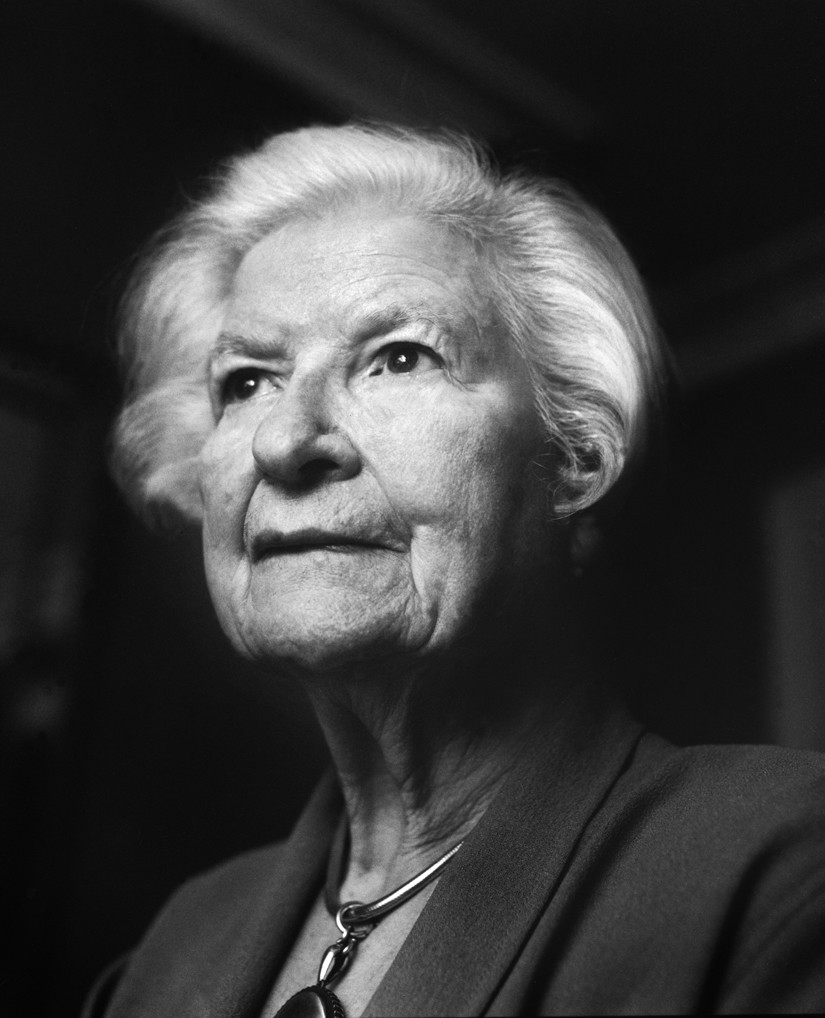
PD-James

“My love for the Prayer Book began in very early childhood, before I could read – when I could only listen to it. Of course, it was the only book used then. Later, when I could read, during long, boring sermons I would read it and specially loved the instructions – for instance, those to priests for giving holy communion in time of pestilence. That conjured up pictures in my childish mind of the priest walking with the sacred vessels through the almost deserted village, almost certainly to become ill himself; or the prayers for when in danger on the sea, knowing that they would have been read by everyone on board, and the ship would almost certainly founder.

“There is so much history, romance, and great beauty in it. And the prayers like the General Thanks­giving and the prayers after com­mun­ion are so superb that they meet my need in praying much better than my own words do, and I still use them in private prayer.

“I enjoy services in other denom­inations, like those of the Reformed Church, or going to a Roman Catholic mass with a friend – but what is essential to me is an atmos­phere of devotion and concentration on God. If there’s a great deal of happy-clappy singing and an­nounce­ments of birthdays, and so on, I can see that it binds people together, but I don’t personally find it’s useful to me. I want silence, so I can concentrate on God – not just talking to him and giving him a list of my requirements.”

–Baroness P.D. James, who died last week, quoted in the Church Times, 2009

Come, ye thankful people, come

by chuckofish

Raise the song of harvest home!

IMGP1137

I am working a half day today. Then I will get ready for tomorrow’s feast.

I have already started to set the table.

IMGP1131I like to mix up my china, using some of my own fine china pattern (Autumn) and some of my mother’s pattern (Nydia)–both Lenox. And I love this vintage Vera tablecloth! So autumnal.

IMGP1132

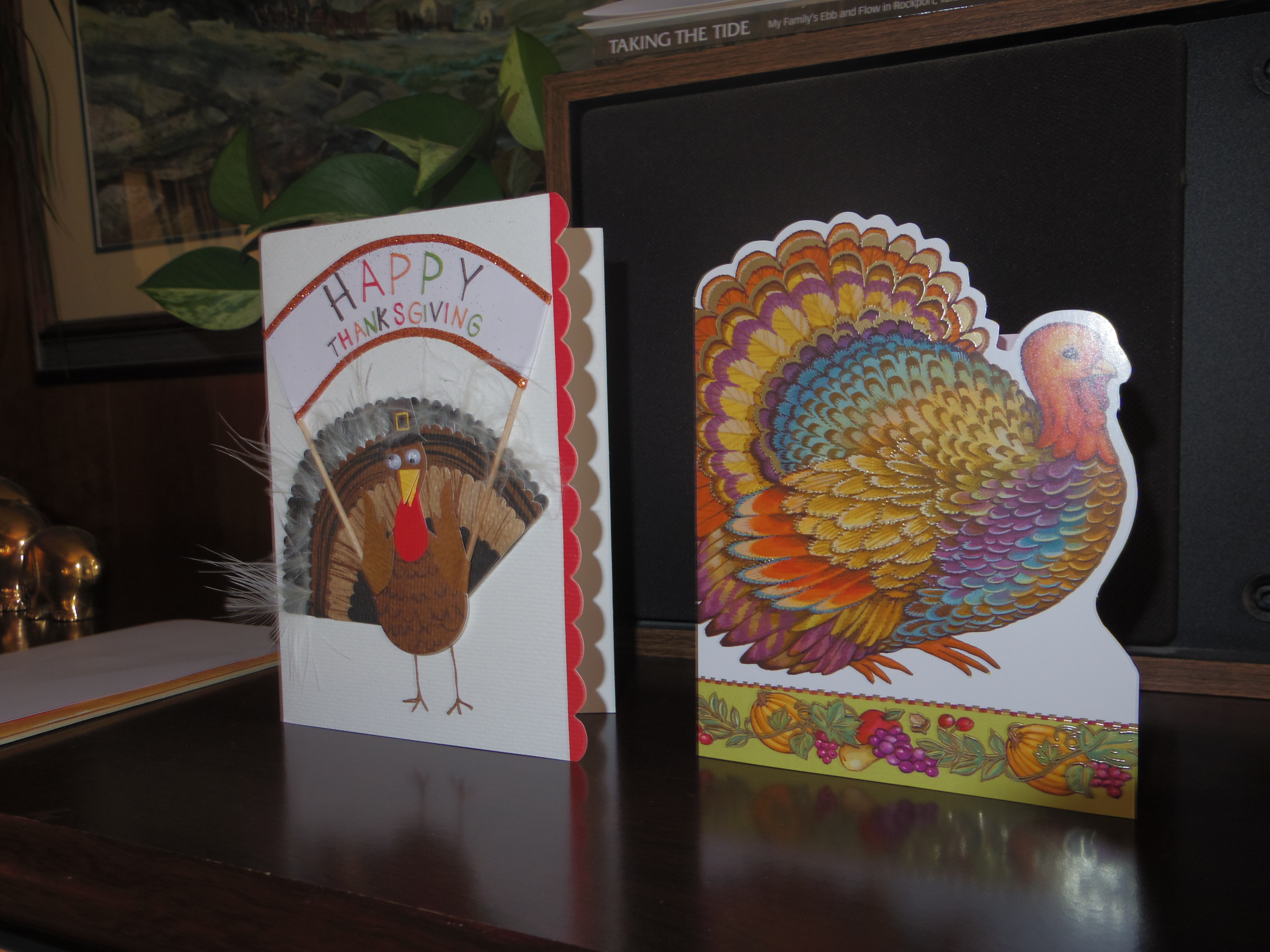
And what would a holiday table be without these guys?  Of course.

Have a good day and don’t work too hard.

For each new morning with its light,
For rest and shelter of the night,
For health and food,
For love and friends,
For everything Thy goodness sends.

– Ralph Waldo Emerson (1803-1882)

“By my troth, I was seeking for a fool when I found you.” *

by chuckofish


post-milestone-1000-1x

Yesterday marked our 1000th post. Gee whiz.

A big thank you to our loyal followers for sticking with us.

I guess I know who we’ll be toasting tonight!

1383845_770969569640056_5004344412959271949_n*Shakespeare, As You Like It


Our shelter from the stormy blast*

by chuckofish

IMGP1124

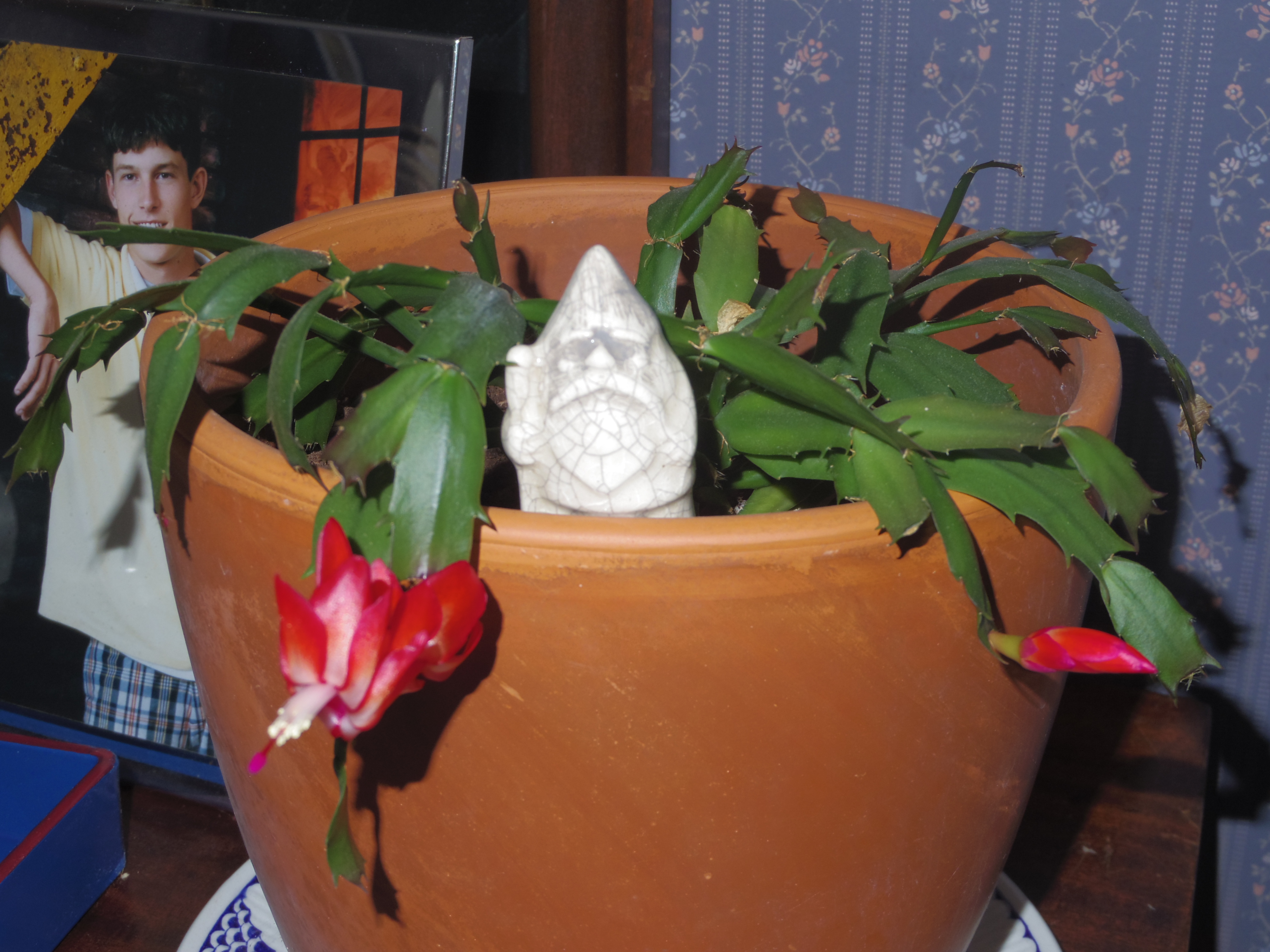
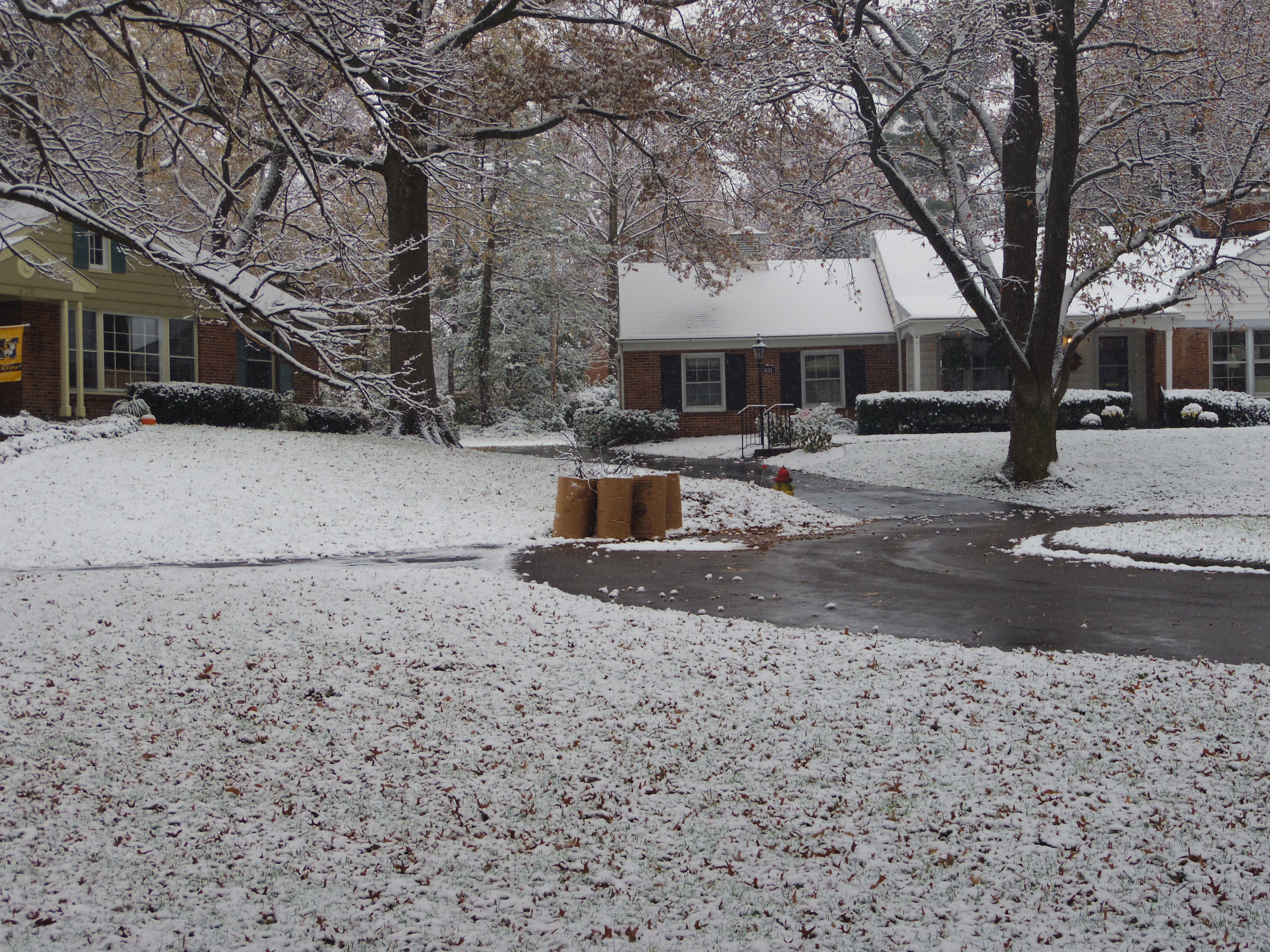
Yes, the Christmas cacti are blooming! Can it really be that time of year again?

IMGP1127

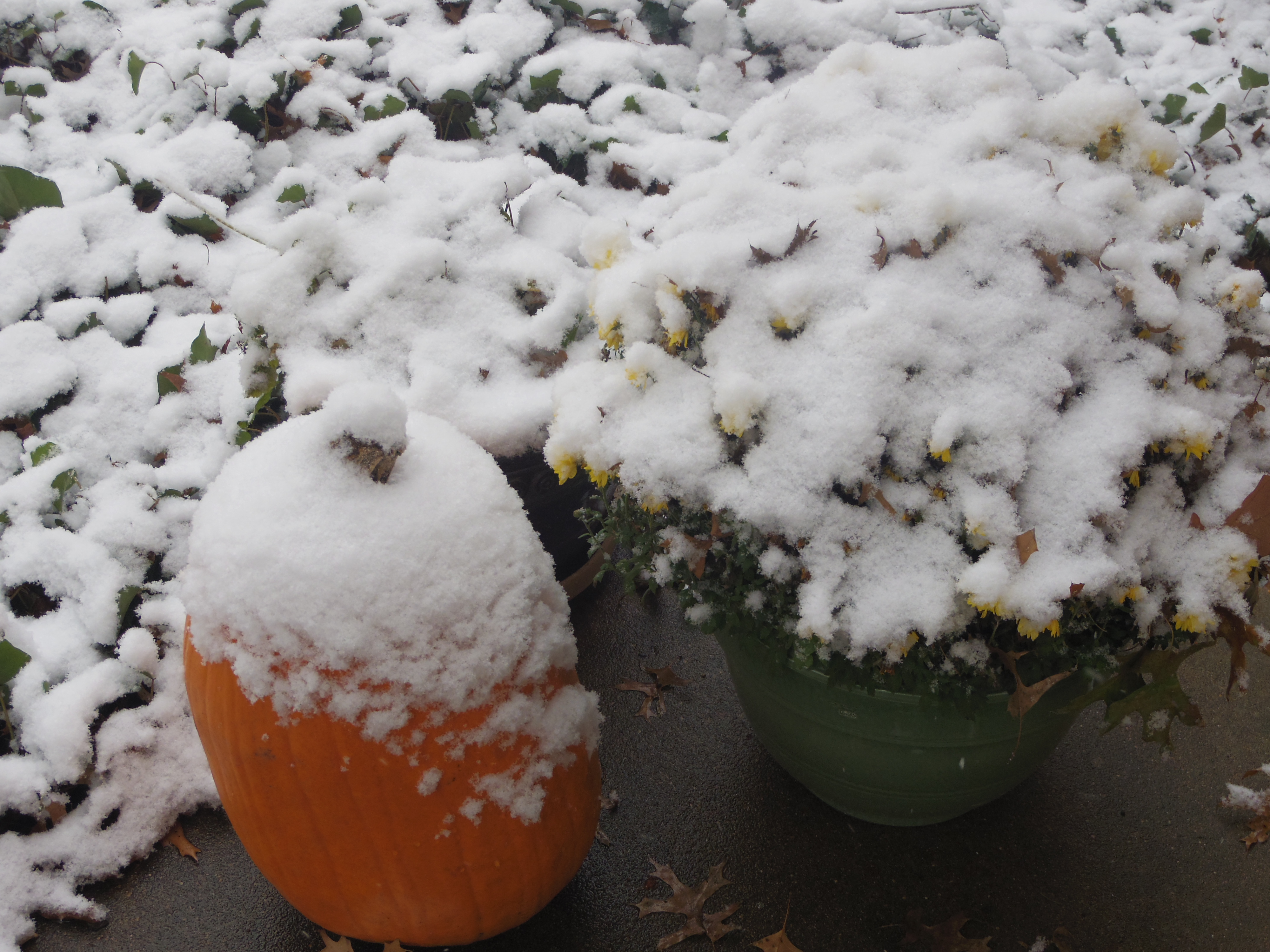
It must be…’cause it snowed too!

Note the leaf bags!

Note the leaf bags!

IMGP1129

The anthem at the Offertory at church on Sunday was the poem “Love” by George Herbert (1593-1632) which is a particularly lovely one:

Love bade me welcome: yet my soul drew back,

Guilty of dust and sin.

But quick-eyed Love, observing me grow slack

From my first entrance in,

Drew nearer to me, sweetly questioning

If I lacked anything.

“A guest,” I answered, “worthy to be here”:

Love said, “You shall be he.”

“I, the unkind, ungrateful? Ah, my dear,

I cannot look on thee.”

Love took my hand, and smiling did reply,

“Who made the eyes but I?”

“Truth, Lord; but I have marred them; let my shame

Go where it doth deserve.”

“And know you not,” says Love, “who bore the blame?”

“My dear, then I will serve.”

“You must sit down,” says Love, “and taste my meat.”

So I did sit and eat.

It snowed all day, but never amounted to too much. Time to get serious, though, about the snowball descent to the end of the year.

Have a good week!

*Hymn #680, Isaac Watts

What news on the Rialto?

by chuckofish

81480948d488b62ac27248cb8749f008

Did you see this funny post on the subject of pet peeves by Emily McDowell on Cup of Jo yesterday?

It got me thinking about my own pet peeves. Here are a few of mine.

1. Newscasters/journalists who make grammatical errors. Zut alors! It is reaching epidemic proportions and it really drives me crazy. I also hate when TV news reporters mispronounce words, such as “thee-A-ter” and “IN-surance”. I mean really.

2. People who microwave smelly frozen dinners for lunch at work and then the whole place smells disgusting all afternoon.

3. When there are many, many empty spots on the fourth floor of the parking garage and I park far away from everyone and someone comes and parks right next to me.

4. People who use the word “folks”.

5. Overuse of the F-bomb in 21st-century films. Ye gods! Is this really necessary? Do people really talk this way? Would it take that  much effort to write dialogue without the F-word? (P.S. Emily McDowell overuses this word too.) There is, of course, one exception to this pet peeve:


I laughed when I saw the pet peeve (of Emily’s) that was “excessive movie quoting”. Certainly my family has been guilty of that on occasion (okay, a lot)–but we keep  it within the family (I think). However, I think this has been going on since Shakespeare’s time. “Get thee to a nunnery!”  “What news on the Rialto?” It is just human nature to quote and to feel hip and in on the private joke doing so.

I realize these pet peeves make me sound old, old, old, and I guess I am. Daughter #1 calls me “Oldie Hawn” (btw, overuse of Simpson-quoting is not a pet peeve in my world.) Oh, well. C’est la vie.

Thank goodness it is less than two weeks until Thanksgiving when we can indulge in mega-movie-quoting while watching the above-mentioned movie. Until then, I am thinking of watching another favorite-to-quote-from movie tonight:

“So what else is on your mind besides hundred-proof women,  ninety-proof whiskey, and fourteen-carat gold?”

How about you?

Let me think about that for a moment

by chuckofish

greenleaves 3

Here is some food for thought on this Thursday n November. Take a moment (or two or three) for some deep thoughts.

1. “The trouble with you,” Walter had said in a recent phone conversation, “is that you’re too prepared. You don’t give the Holy Spirit room to do wondrous things. You need to take risks now and then–that’s what makes life snap, crackle and pop.”

–Jan Karon, At Home in Mitford

2. “When I was an object of much contempt and derision in the university,” he later wrote, “I strolled forth one day, buffeted and afflicted, with my little Testament in my hand … The first text which caught my eye was this: ‘They found a man of Cyrene, Simon by name; him they compelled to bear his cross.'”

–Charles Simeon

3. “That man is the richest whose pleasures are the cheapest.”

–Henry David Thoreau

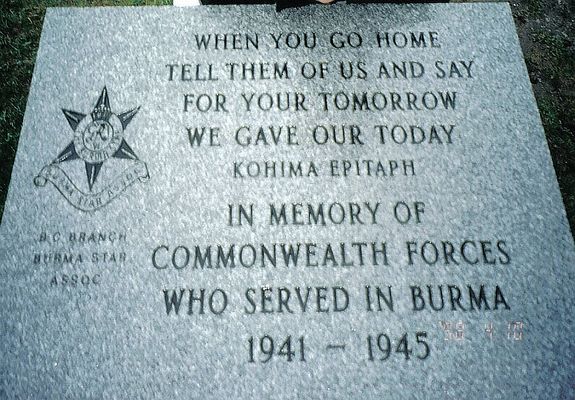
4.

British 2nd Division at Kohima, India war memorial

British 2nd Division at Kohima, India war memorial

Discuss among yourselves.


Strengthen such as do stand

by chuckofish

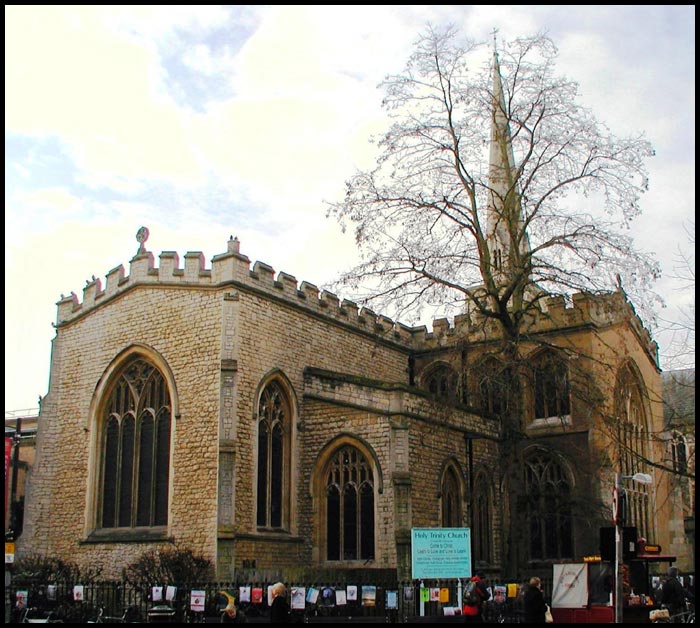
Today is the lesser feast day of evangelical Anglican Charles Simeon (1759–1836) on the Episcopal calendar. Simeon is best known for serving Holy Trinity Church, Cambridge, and Cambridge University for 54 years, practicing and popularizing biblical, expository preaching and pioneering on-campus discipleship among university students. He is also credited with starting the evangelical revival in the Church of England.

Two hundred years ago students at the English Universities were required to attend church regularly, and to receive the Holy Communion at least once a year. This latter requirement often had bad effects, in that it encouraged hypocrisy and an irreverent reception of the sacrament. Occasionally, however, it had a very good effect, as with the Cambridge student Charles Simeon. He wrote: “On 29 January 1779 I came to college. On 2 February I understood that at division of term I must attend the Lord’s Supper. The Provost absolutely required it. Conscience told me that, if I must go, I must repent and turn to God.”

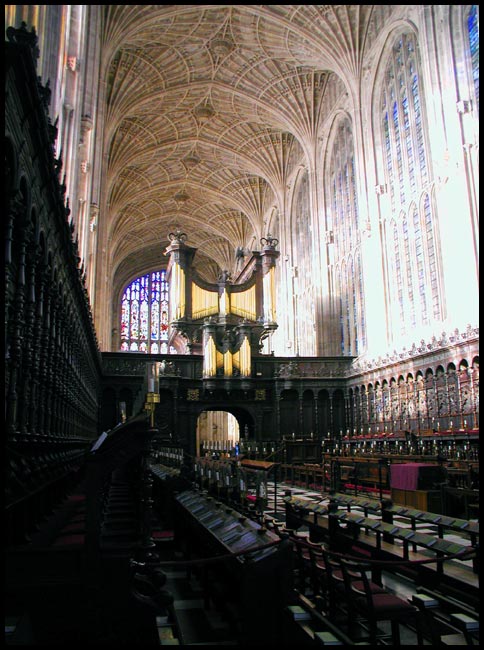
Kings College Chapel

Kings College Chapel

By this experience his life was transformed. Upon finishing his college work he was ordained, and shortly appointed chaplain of Holy Trinity, Cambridge, where he remained for 55 years, until shortly before his death on 12 November 1836. His ministry helped to transform the lives of many undergraduates, of whom we may mention two in particular. Henry Martyn inspired by Simeon, abandoned his intention of going into law and instead devoted his life and his considerable talents to preaching the Gospel in India and Persia. William Wilberforce, also led in part by Simeon’s ministry of teaching and example, devoted his life to the abolition of slavery throughout the British Empire. Simeon’s enthusiasm and zeal brought him much ridicule and abuse, which he bore uncomplainingly. Though he himself remained in one place, his influence extended through the Anglican world. (Lectionary Home Page)

Holy Trinity, Cambridge

Holy Trinity, Cambridge

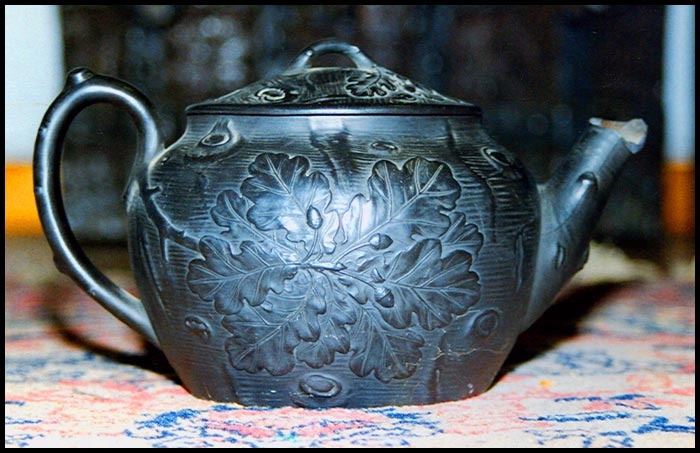
Simeon's black Wedgewood teapot used at his Friday night Conversation Parties

Simeon’s black Wedgewood teapot used at his Friday night Conversation Parties

Simeon's preaching Bible

Simeon’s preaching Bible

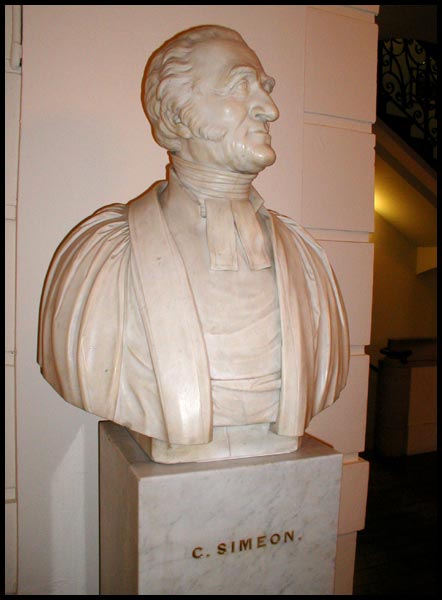
Bust of Simeon just outside the entrance to the Gonville and Caius Library.

Bust of Simeon just outside the entrance to the Gonville and Caius Library.

Simeon prayed the following prayer each Sunday before delivering his sermon:

“O God, who hast caused all Holy Scriptures to be written for our hearing, be with us now to sanctify unto us the truths that shall be delivered from them.
“Be with us especially to enlighten our minds by the Holy Spirit; and by the mighty working of thy power, bring in to the way of truth all such as have erred and are deceived.
“Be pleased also O Lord, to strengthen such as do stand, and comfort and help the weak hearted, and raise up them that fall, and finally to beat down Satan under all our feet.
“All this we humbly ask in the name and for the sake of Jesus Christ our Lord. Amen.”

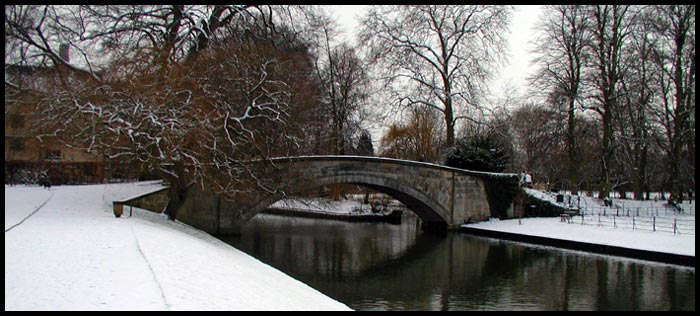
Looking south, down the River Cam, is Simeon's Bridge. In 1816 Simeon financed the major portion of this bridge connecting King's College property on both sides of The Backs. This is also the river into which Simeon threw a guinea (coin) as a self-prescribed punishment for not rising at the hour to which he had committed himself for Bible reading and prayer.

Looking south, down the River Cam, is Simeon’s Bridge. In 1816 Simeon financed the major portion of this bridge connecting King’s College property on both sides of The Backs. This is also the river into which Simeon threw a guinea (coin) as a self-prescribed punishment for not rising at the hour to which he had committed himself for Bible reading and prayer.

I like that prayer. And I want to go to there.

Photos are from the Charles Simeon website.


“He was a good man. Make sure that it says so on the patrol report.”*

by chuckofish

Arthur Newell Chamberlin grave

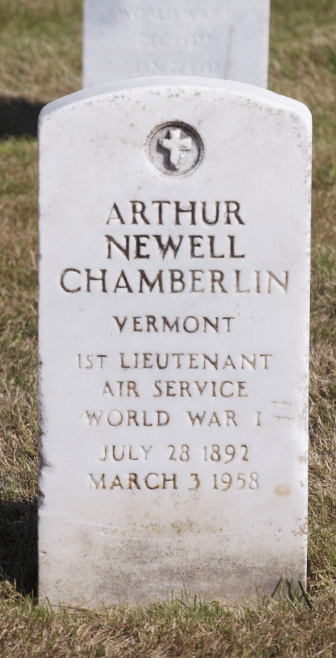
Our grandfather’s grave in San Francisco

Veterans Day was once known as Armistice Day. The term comes from an armistice between Germany and the Allied Nations on November 11, 1918. World War I actually ended on June 28, 1919, during the Treaty of Versailles. The first Armistice Day was acknowledged on November 11, 1919.

On June 1, 1954, Armistice Day had its named changed to Veterans Day, so that the veterans of WWII and all the men and women who have served in the U.S. Armed Forces would be honored.

So take some time today to think about your ancestors who served their country in the Armed Forces. A favorite fighting ancestor of mine is Moses Wheeler who fought in the French and Indian War. He was a soldier on the frontier as early as 1746,

and was one of the company of Capt. Stevens in his celebrated defense of the Fort at No. 4…and was also with Hobbs in his terrible encounter with Sackett…[Wheeler] was a very large man, yet of good proportions, and was said to have been, in his prime, the strongest man in the cordon of forts on the frontier. One time Wheeler and five others were detailed to take a cannon to the top of Hoosac Mountain. It appeared to some of them a hard task and they stood around it a long time earnestly discussing the way in which it should be done. At length, tiring of their suggestions, Wheeler threw up his arms, at the same time exclaiming “Stand aside boys, I am going to take the cannon up the mountain myself,” and swinging it upon his shoulder bore it to the place which had been designated for it, pausing only once for rest upon the way.

It is related that the reason of his pausing as he did was to get a drink from a spring which he saw bubbling up beside his path. As soon as he saw this he flung his cannon from his shoulder and throwing himself flat on his stomach, the more readily to get at the water, he commenced drinking, as the soldiers expressed it, “like a horse.” Thinking he would kill himself they warned him to desist, but as he gave no heed to their admonition three of them seized one leg and two the other and drew him forcibly away. He thought it rather hard usage but concluded on the whole it was best to submit to it. After resting awhile he again resumed his cannon and bore it to its place, when he found that he had burst his shoes open which were new when he started from the foot of the mountain, and his pantaloons were such a wreck that they were good for nothing afterwards. The officers and soldiers were, however, so pleased with his exploit they they clubbed together and very generously more than made up the loss. After this he became quite a hero to the Indians, who, whenever they came where he was, always wanted to see “The Strong Man.”

(History of Charlestown, New-Hampshire by Rev. Henry H. Saunderson, 1876)

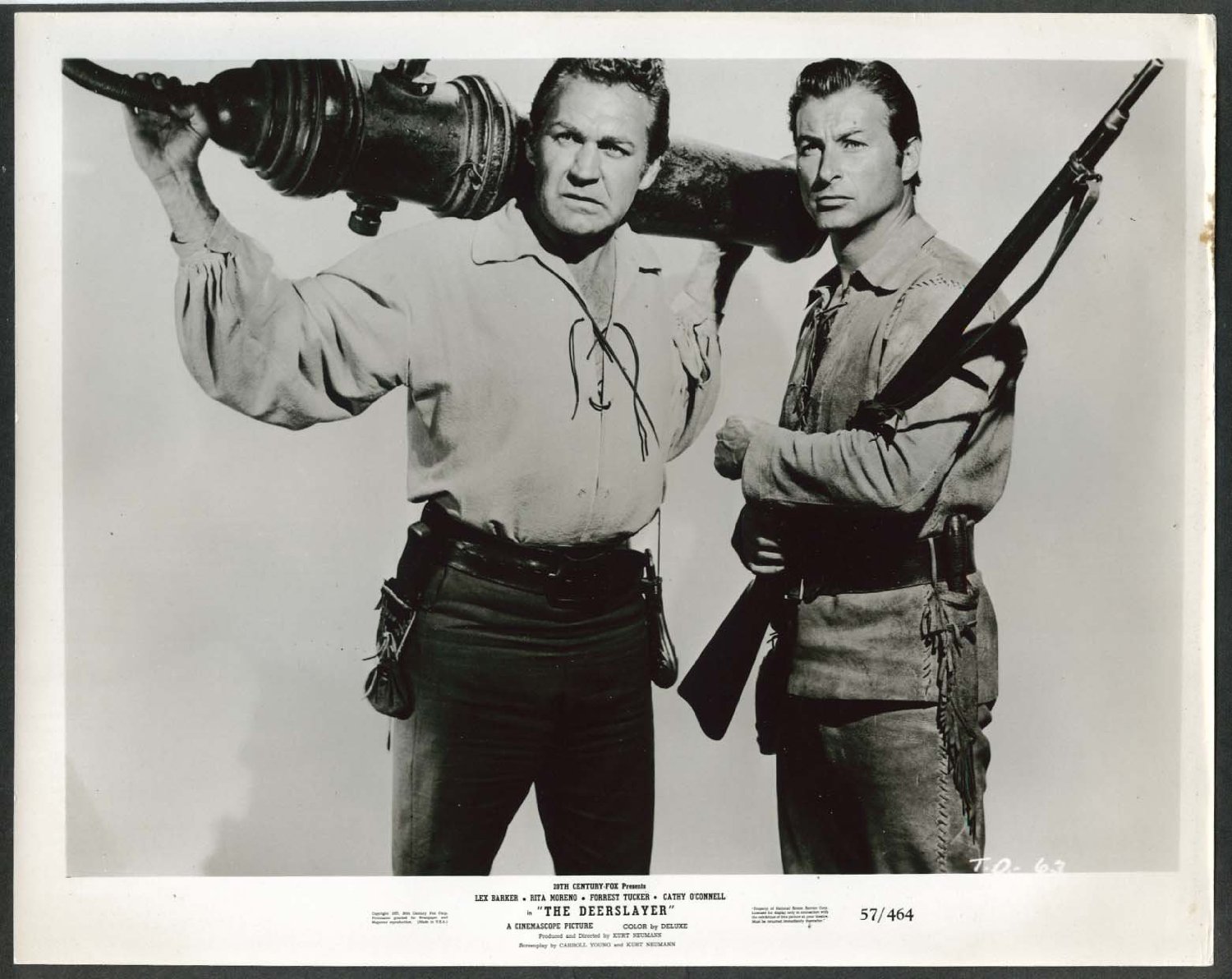
If this story sounds a bit familiar, it is because James Fenimore Cooper used some of Wheeler’s story to embellish a character in The Deerslayer. In the 1957 movie he was played by Forrest Tucker.

71SddV15GAL._SL1500_

Is it any wonder that 240 years later we named the boy after this ancestor?

If I had a copy of The Deerslayer, I would surely watch it tonight.  I’ll find something suitable. How about you?

*John Wayne in Operation Pacific
Smoting the Babylonian Dame

by chuckofish

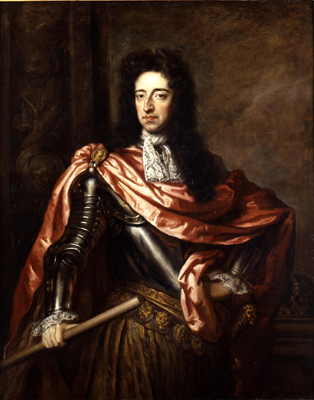
On this day in 1688, William of Orange invaded England in an action that ultimately deposed King James II and won him the crowns of England, Scotland and Ireland. Huzzah!

King_William_III_of_England,_(1650-1702)_(lighter)

William’s mother, Mary Stuart, was the oldest daughter of King Charles I and sister of King Charles II and King James II.  His wife was the daughter of King James II and his cousin. I can never keep all that royal genealogy straight, can you? I had forgotten that old William was the grandson of Charles I. It’s good to dust off the history books once in awhile, eh?

You will recall that the OM’s ancestor Henry Compton, the Bishop of London, crowned William King a few months later. He reigned jointly with his wife, Mary II, until her death in 1694–as William and Mary–and then alone until his death in 1702.

So a toast to William and Mary is definitely in order tonight, and to the Glorious Revolution when

Englands Church so much opprest
Of all its Rights now re-possest,
With all its Sacred Glories blest,
it shines in Heavenly splendor,
May it ever so endure,
And everlasting peace procure,
For him who keeps our Church secure,
and crush’d the Romish Grandieur.

(For the whole poem (ENGLANDS Triumph, OR, The Kingdoms Joy for the proclaiming of King William , and His Royal Consort, Queen Mary , in
the Throne of ENGLAND , on the 13th. of this instant February . 1688. To the Tune of, Thundering Cannons roar, click here.)


An attitude of gratitude

by chuckofish

givethanks

It being November again (!) it seems liked a good time to talk about thankfulness. “Nothing,” says Billy Graham “turns us into bitter, selfish, dissatisfied people more quickly than an ungrateful heart. And nothing will do more to restore contentment and the joy of our salvation than a true spirit of thankfulness.”

I have been re-reading Jan Karon’s seventh Mitford book In This Mountain and this is one of her main themes. Toward the end of the book, Father Tim preaches on this very subject (and I Thessalonians 5:18).

I admit to you that although I often thank God for my blessings, even the smallest, I haven’t thanked Him for my afflictions.

I know the fifth chapter of First Thessalonians pretty well, yet it just hadn’t occurred to me to actually take Him up on this notion. I’ve been too busy begging Him to lead me out of the valley and onto the mountaintop. After all, I have work to do, I have things to accomplish…alas, I am the White Rabbit everlastingly running down the hole like the rest of the common horde.

I want to tell you that I started thanking Him last night–this morning at two o’clock, to be precise–for something that grieves me deeply. And I’m committed to continue thanking Him in this hard thing, no matter how desperate it might become, and I’m going to begin looking for good in it. Whether God caused it or permitted it, we can rest assured–there is great good in it.

So no matter what happens to us, no matter how difficult our situation or how much our friends disappoint us, no matter how alone we feel–we must never forget that God is with us. No matter what happens, God has promised that He will be with us in whatever tribulation or trial that comes. God will not waste this experience. He doesn’t waste anything. And so we are thankful for everything. We try to be anyway.

Nobody said it would be easy, right?