dual personalities

Tag: quotes

Like a flash of light*

by chuckofish

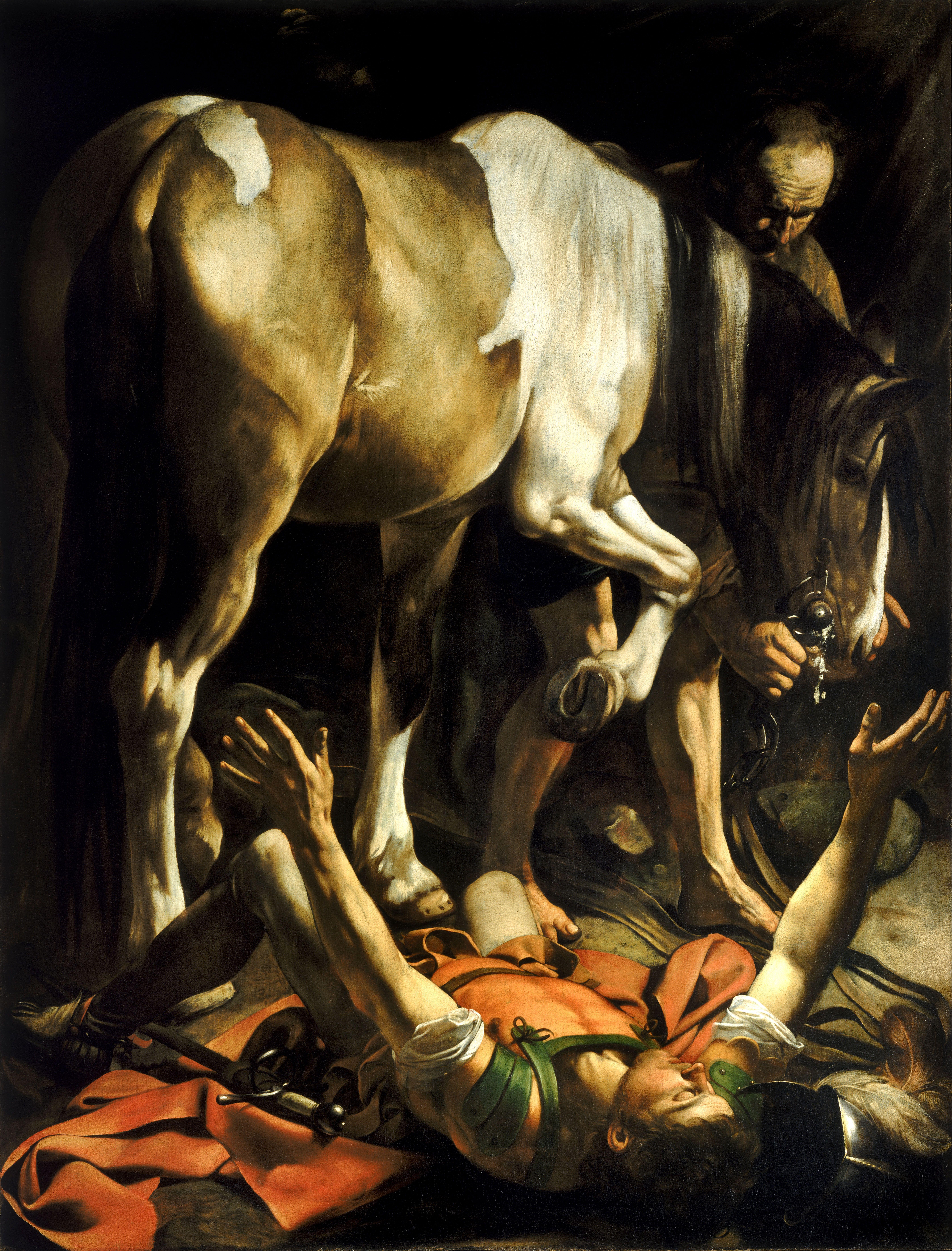
Conversion_on_the_Way_to_Damascus-Caravaggio_(c.1600-1)

“And he fell to the earth, and heard a voice saying unto him, Saul, Saul, why persecutest thou me?”

Today is the birthday of the Italian painter Caravaggio (1571–1610). I am not a big fan of his art, but I have always liked his painting of the conversion of Saint Paul. It is realistic and dramatic and the light–wow. Clearly something big is happening to Saul of Tarsus under the hooves of his horse.

Anyway, it gives us an opportunity to think about conversion today. Here is Frederick Buechner on the subject:

There are a number of conversions described in the New Testament. You think of Paul seeing the light on the road to Damascus (Acts 9:1-19), or the Ethiopian eunuch getting Philip to baptize him on the way from Jerusalem to Gaza (Acts 8:28-40). There is also the apostle Thomas saying, “My Lord and my God!” when he is finally convinced that Jesus is alive and whole again (John 20:26-29), not to mention the Roman centurion who witnessed the crucifixion saying, “Truly this man was the Son of God” (Luke 23:47). All these scenes took place suddenly, dramatically, when they were least expected. They all involved pretty much of an about-face, which is what the word conversion means. We can only imagine that they all were accompanied by a good deal of emotion.

But in this same general connection there are other scenes that we should also remember. There is the young man who, when Jesus told him he should give everything he had to the poor if he really wanted to be perfect as he said he did, walked sorrowfully away because he was a very rich man. There is Nicodemus, who was sufficiently impressed with Jesus to go talk to him under cover of darkness and later to help prepare his body for burial, but who never seems to have actually joined forces with him. There is King Agrippa, who, after hearing Paul’s impassioned defense of his faith, said, “Almost thou persuadest me to be a Christian” (Acts 26:28, KJV). There is even Pontius Pilate, who asked, “What is truth?” (John 18:38) under such circumstances as might lead you to suspect that just possibly, half without knowing it, he really hoped Jesus would be able to give him the answer, maybe even become for him the answer.

Like the conversions, there was a certain amount of drama about these other episodes too and perhaps even a certain amount of emotion, though for the most part unexpressed. But of course in the case of none of them was there any about-face. Presumably all these people kept on facing more or less the same way they had been right along. King Agrippa, for instance, kept on being King Agrippa just as he always had. And yet you can’t help wondering if somewhere inside himself, as somewhere also inside the rest of them, the “almost” continued to live on as at least a sidelong glance down a new road, the faintest itching of the feet for a new direction.

We don’t know much about what happened to any of them after their brief appearance in the pages of Scripture, let alone what happened inside them. We can only pray for them, not to mention also for ourselves, that in the absence of a sudden shattering event, there was a slow underground process that got them to the same place in the end.

–Frederick Buechner, Beyond Words

Discuss among yourselves.

*”Like a flash of light, I realized in what an abyss of errors, in what chaos I was.” (John Calvin)

What are you reading?

by chuckofish

Peter Vilhelm Ilsted (Danish artist, 1861-1933) Woman Reading by Candlelight 2

I have been re-reading some old favorites.

First I read One Fine Day by Mollie Painter-Downes, which I highly recommend. You will recall that between 1939 and 1945 Mollie Panter-Downes covered the war from England for the New Yorker. The action of this novel takes place all on one day in the summer of 1946 in a small village in England. It is a quiet meditation on how things change and how we adapt and how we still have so much to be grateful for.

“The country was tumbled out before her like the contents of a lady’s workbox, spools of green and silver and pale yellow, ribbed squares of brown stuff, a thread of crimson, a stab of silver, a round, polished gleam of mother of pearl. It was all bathed in magic light, the wonderful transforming light in which known things look suddenly new.”

IMGP1341 (1)

Now I am re-reading the wonderful Gilead by the great Marilynne Robinson. Basically it is a meditation by a dying minister, writing to his young son about his life and what it has meant to him.

“I’m writing this in part to tell you that if you ever wonder what you’ve done in your life, and everyone does wonder sooner or later, you have been God’s grace to me, a miracle, something more than a miracle. You may not remember me very well at all, and it may seem to you to be no great thing to have been the good child of an old man in a shabby little town you will no doubt leave behind. If only I had the words to tell you.”

It is all about the beauty of the world and our lives here on earth. Wow.

“There are two occasions when the sacred beauty of Creation becomes dazzlingly apparent, and they occur together. One is when we feel our mortal insufficiency to the world, and the other is when we feel the world’s mortal insufficiency to us.”

The new Jan Karon book, Come Rain or Come Shine, is out and I have ordered it. In this installment Dooley has graduated from vet school and opened his own animal clinic and is getting married. Sounds good to me.

What are you reading?

“He is rich who owns the day”*

by chuckofish

I had barely gotten my breath after returning from NYC when daughter #2 arrived for a short flyover visit. When it rains, it pours, as they say!
katie&susie

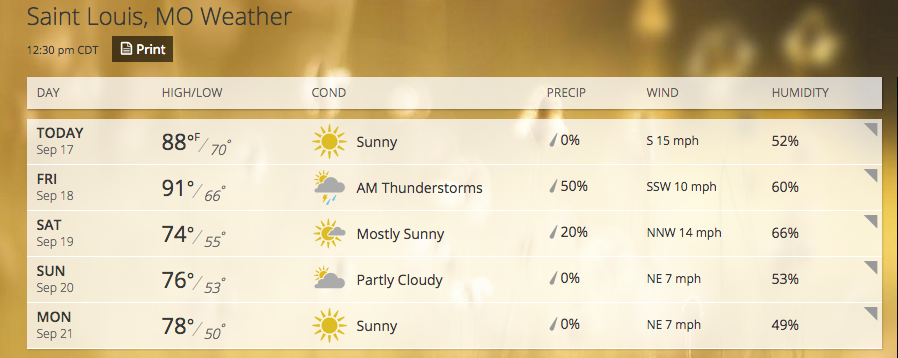
I drove up to the airport yesterday and picked her up and then dropped her off on campus so she cold schmooz with an old professor and hang out for awhile in her old stomping grounds while I finished up at work. I am taking today off so we can have fun, but, of course, thunderstorms are predicted.

Screen shot 2015-09-17 at 12.31.25 PM

C’est la vie.

And just as a reminder…

Write it on your heart that every day is the best day in the year. He is rich who owns the day, and no one owns the day who allows it to be invaded with fret and anxiety. Finish every day and be done with it. You have done what you could. Some blunders and absurdities, no doubt, crept in. Forget them as soon as you can, tomorrow is a new day; begin it well and serenely, with too high a spirit to be cumbered with your old nonsense. This new day is too dear, with its hopes and invitations, to waste a moment on the yesterdays.

–RWE

Have a super-duper weekend! Carpe diem!

Prayer 101

by chuckofish

SpringSky_Sloane

Readers of this blog know that I am a great one for prayer. Recently I was reading (in Springs in the Valley by Mrs. Charles E. Cowman) about the great 19th century Presbyterian minister Charles Grandison Finney (August 29, 1792 – August 16, 1875),  abolitionist and president of Oberlin College.

The summer of 1853 was unusually hot and dry; pastures were scorched. There seemed likely to be a total crop failure. At the church in Oberlin the great congregation had gathered as usual. Though the sky was clear the burden of Finney’s prayer was for rain.

“We do not presume, O Lord, to dictate to Thee what is best for us; yet Thou didst invite us to come to Thee as children to an earthly father and tell Thee all our wants. We want rain. Our pastures are dry. The earth is gaping open for rain. The cows are wandering about and lowing in search of water. Even the squirrels are suffering from thirst. Unless Thou givest us rain our cattle will die, and our harvest will come to naught. O Lord, send us rain, and send it now! This is an easy thing for Thee to do. Send it now, Lord, for Christ’s sake.

In a few minutes he had to cease preaching; his voice could not be heard because of the roar and rattle of the rain!

Yet another reminder that the direct approach is always best.

This guy has the right idea.

And, of course, Frederick Buechner always has something good to say.

The painting is by Eric Sloane.

In the old days

by chuckofish

2.The Lookout Ð "All's Well" Winslow Homer (American, 1836Ð1910) 1896 Oil on canvas *Museum of Fine Arts, Boston. Warren CollectionÑWilliam Wilkins Warren Fund *Photograph © Museum of Fine Arts, Boston

“All’s Well”, Winslow Homer 1896

“It was a dog’s life,” said the poor old gentleman, quite reassured, “but it made men of those who followed it. I see a change for the worse even in our own town here; full of loafers now, small and poor as ’tis, who once would have followed the sea, every lazy soul of ’em. There is no occupation so fit for just that class o’ men who never get beyond the fo’cas’le. I view it, in addition, that a community narrows down and grows dreadful ignorant when it is shut up to its own affairs, and gets no knowledge of the outside world except from a cheap, unprincipled newspaper. In the old days, a good part o’ the best men here knew a hundred ports and something of the way folks lived in them. They saw the world for themselves, and like’s not their wives and children saw it with them. They may not have had the best of knowledge to carry with ’em sight-seein’, but they were some acquainted with foreign lands an’ their laws, an’ could see outside the battle for town clerk here in Dunnet; they got some sense o’ proportion. Yes, they lived more dignified, and their houses were better within an’ without. Shipping’s a terrible loss to this part o’ New England from a social point o’ view, ma’am.”

–Sarah Orne Jewett, The Country of the Pointed Firs

Today is the birthday of Sarah Orne Jewett (September 3, 1849 – June 24, 1909)–American novelist, short story writer and Episcopalian.

sarah-orne-jewett-at-her-desk1

The Sarah Orne Jewett House is a historic house museum at 5 Portland Street in South Berwick, Maine, which is just over the border from New Hampshire. Built in 1774,  it is an excellent example of late Georgian architecture.

Jewett House

I guess I’ll have to add it to my list of literary/historic places to visit. In the meantime, let’s toast old Sarah and maybe re-read The Country of the Pointed Firs, which I have somewhere. You can download it here.

While we’re toasting Sarah, we may want to raise a glass to Sally Benson (September 3, 1897 – July 19, 1972) whose birthday is also today. She was a screenwriter and prolific short story writer for The New Yorker back in its heyday. She is best known for her semi-autobiographical stories collected in Junior Miss and Meet Me in St. Louis. Yes, that “Meet Me in St. Louis.”

Meet_Me_In_St_Louis_Poster

Her other screen credits include Shadow of a Doubt (1943) for Alfred Hitchcock, Summer Magic (1963) for Walt Disney, Viva Las Vegas (1964) for Elvis, and The Singing Nun (1966)–quite a disparate group!  Her screenplay for Anna and the King of Siam (1946) was nominated for an Academy Award.

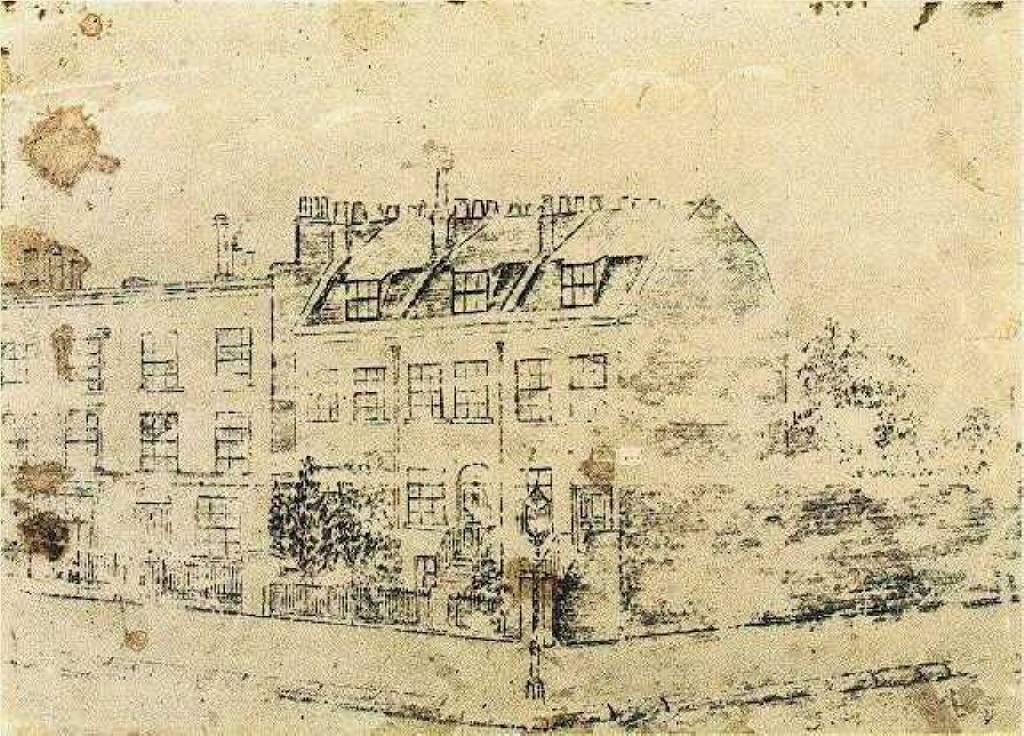
Here is a sketch of the St. Louis house in which Sally grew up:

Sketch-of-the-Real-5135-Kensington-Ave-house

This North St. Louis neighborhood “declined” and the house was torn down in 1994. Here’s a picture of the Hollywood version:

Meet-Me-in-St.-Louis-movie-house-side-view-summer-porch

(The pictures of the “Meet Me in St. Louis” houses were found here on a fun blog about houses.)

The Hollywood version was eventually torn down too when MGM sold off its lots in the 1970s.

C’est la vie. Plus ça change, plus c’est la même chose. (See above quote.)

Mid-week meditation

by chuckofish

StoneWall

September’s Baccalaureate
A combination is
Of Crickets—Crows—and Retrospects
And a dissembling Breeze

That hints without assuming—
An Innuendo sear
That makes the Heart put up its Fun
And turn Philosopher.

–Emily Dickinson

Yes, September is here.

DSCN1507And I have a very cute calendar page for this month, don’t I?

Note to self

by chuckofish

In America we have porcupines.

Porcupine

In Britain (and Europe) they have hedgehogs.

hedgehog-405726

Even though they share similar spiny protective “armour” they are unrelated.

But news flash: I gather that hedgehogs are endangered in England. The Hay Quaker blog had a link to this Hedgehog Rescue blog.

Hedgehog populations are in freefall! This is troubling indeed. I have always loved hedgehogs. They are my spirit animal.

So a toast and a prayer for the lowly hedgehog!

And hello, this is why you will never find me hiking in Yellowstone. This is seriously my greatest fear in Life.

Give me a hedgehog any day.

[She] has the elegance of the hedgehog: on the outside, she’s covered in quills, a real fortress, but my gut feeling is that on the inside, she has the same simple refinement as the hedgehog: a deceptively indolent little creature, fiercely solitary – and terribly elegant.
– Muriel Barbery (The Elegance of the Hedgehog)

As time goes by

by chuckofish

june 1966 1

June 1966

She had taken to wondering lately, during these swift-counted years, what had been done with all those wasted summer days; how could she have spent them so wantonly? I am foolish, she told herself early every summer, I am very foolish; I am grown up now and know the values of things. Nothing is ever really wasted, she believed sensibly, even one’s childhood, and then each year, one summer morning, the warm wind would come down the city street where she walked and she would be touched with the little cold thought: I have let more time go by.”

― Shirley Jackson, The Haunting of Hill House

Dog days

by chuckofish

winslow-homer-fishing-1268

The Old Farmer’s Almanac lists the traditional period of the Dog Days as the 40 days beginning July 3 and ending August 11, coinciding with the ancient heliacal (at sunrise) rising of the Dog Star, Sirius.

Well, we are certainly in the middle of them now! And they will not be over come August 11. But as I have said before, I have come to appreciate the summer–even the dog days–and enjoy the slower pace. Nobody’s in a hurry around here in August.

Summer is a good time to read old favorites:

“Maycomb was a tired old town, even in 1932 when I first knew it. Somehow, it was hotter then. Men’s stiff collars wilted by nine in the morning. Ladies bathed before noon and after their three o’clock naps. And by nightfall were like soft teacakes with frosting from sweating and sweet talcum. The day was twenty-four hours long, but it seemed longer.” (Harper Lee, To Kill a Mockingbird)

It is a good time to read poetry:

Now I will do nothing but listen,
To accrue what I hear into this song, to let sounds contribute toward it.
I hear bravuras of birds, bustle of growing wheat, gossip of flames, clack of sticks cooking my meals,
I hear the sound I love, the sound of the human voice,
I hear all sounds running together, combined, fused or following,
Sounds of the city and sounds out of the city, sounds of the day and night,
Talkative young ones to those that like them, the loud laugh of work-people at their meals,
The angry base of disjointed friendship, the faint tones of the sick,
The judge with hands tight to the desk, his pallid lips pronouncing a death-sentence,
The heave’e’yo of stevedores unlading ships by the wharves, the refrain of the anchor-lifters,
The ring of alarm-bells, the cry of fire, the whirr of swift-streak-
ing engines and hose-carts with premonitory tinkles and color’d lights,
The steam-whistle, the solid roll of the train of approaching cars,
The slow march play’d at the head of the association marching two and two,
(They go to guard some corpse, the flag-tops are draped with black muslin.)
I hear the violoncello, (’tis the young man’s heart’s complaint,)
I hear the key’d cornet, it glides quickly in through my ears,
It shakes mad-sweet pangs through my belly and breast.
I hear the chorus, it is a grand opera,
Ah this indeed is music—this suits me. (Walt Whitman, Song of Myself, 26)

And it is a good time to read history:

On the receipt of Mr. Dana’s dispatch Mr. Stanton sent for me. Finding that I was out he became nervous and excited, inquiring of every person he met, including guests of the house, whether they knew where I was, and bidding them find me and send me to him at once. About eleven o’clock I returned to the hotel, and on my way, when near the house, every person met was a messenger from the Secretary, apparently partaking of his impatience to see me. I hastened to the room of the Secretary and found him pacing the floor rapidly in his dressing-gown. Saying that the retreat must be prevented, he showed me the dispatch. I immediately wrote an order assuming command of the Military Division of the Mississippi, and telegraphed it to General Rosecrans. I then telegraphed to him the order from Washington assigning Thomas to the command of the Army of the Cumberland; and to Thomas that he must hold Chattanooga at all hazards, informing him at the same time that I would be at the front as soon as possible. A prompt reply was received from Thomas, saying, “We will hold the town till we starve.” I appreciated the force of this dispatch later when I witnessed the condition of affairs which prompted it. It looked, indeed, as if but two courses were open: one to starve, the other to surrender or be captured.

On the morning of the 20th of October I started, with my staff, and proceeded as far as Nashville. At that time it was not prudent to travel beyond that point by night, so I remained in Nashville until the next morning. Here I met for the first time Andrew Johnson, Military Governor of Tennessee. He delivered a speech of welcome. His composure showed that it was by no means his maiden effort. It was long, and I was in torture while he was delivering it, fearing something would be expected from me in response. I was relieved, however, the people assembled having apparently heard enough. At all events they commenced a general hand-shaking, which, although trying where there is so much of it, was a great relief to me in this emergency. (U.S. Grant, Personal Memoirs, Ch 40)

So try to enjoy these dog days of summer. And remember: This is the day which the Lord hath made; let us rejoice and be glad in it!

Scene-at-Houghton-Farm-Painting-by-Winslow-Homer

*The paintings are by Winslow Homer, of course.

Loaves and fishes

by chuckofish


11722656_1001643106532585_4632851247580885284_o

I went to two memorial services in three days.

Mamu’s was a high requiem eucharist service for the repose of her soul with full choir and all the bells and whistles.

The other was for a work friend–a secular service with ten speakers extolling her impressive life. There was no religious element save the singing at the end of “Amazing Grace”, which seemed all the sadder for the evident lack of faith of the deceased. Twenty years of Catholic school sometimes has that effect.

We sang “Abide With Me” at Mamu’s service and that about undid me. What is it about hymns? Something about the familiar (sad) music and the words, I guess. It made me want to run home and watch Shane (1953)–I didn’t (but I did later on Sunday).

At church on Sunday we were reminded that it is that time of year again when we all collect money for the United Thank Offering in what we use to call our “mite” boxes.

IMGP1316

I brought one home and I intend to fill it up while counting my blessings.

It is a good spiritual practice to count your blessings. Are you in the habit of doing that?

Here are some wise words from Thomas a Kempis (c. 1380 – 25 July 1471), whose feast day was last Friday:

“As long as you live, you will be subject to change, whether you will it or not – now glad, now sorrowful; now pleased, now displeased; now devout, now undevout; now vigorous, now slothful; now gloomy, now merry. But a wise man who is well taught in spiritual labor stands unshaken in all such things, and heeds little what he feels, or from what side the wind of instability blows.”

Have a good Monday!