dual personalities

Tag: quotes

Pick a little, talk a little

by chuckofish

Is anyone else as tired as I am of headlines like this?

The (Secretly Filthy) Winter Wardrobe Staples You Need to Wash Right Now

I mean c’mon. It’s the “You Need” and the “Right Now,” you know?

Isn’t there enough stress and pressure on us without getting hit right and left on the internet with orders about stuff like that?

Well, I say you need to sit down right now

George_Willison_-_Nancy_Parsons_in_Turkish_dress_-_Google_Art_Project

George Willison, “Nancy Parsons in Turkish Dress”

and stare out the window.

WInslow Homer

Winslow Homer, “Looking Out the Window”

Eat some candy if you feel like it

James Peale, "Still Life With Fruit"

James Peale, “Still Life With Fruit”

and have a glass of wine.
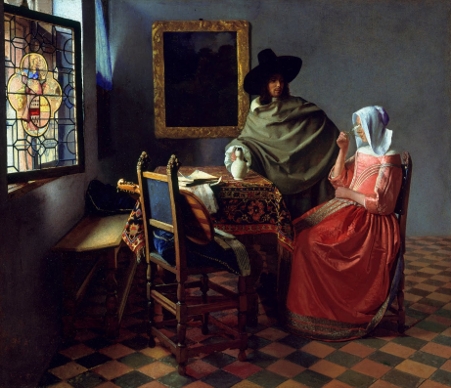
Johannes Vermeer, "The Glass of Wine"

Johannes Vermeer, “The Glass of Wine”

Then watch some great old tv show without commercials.
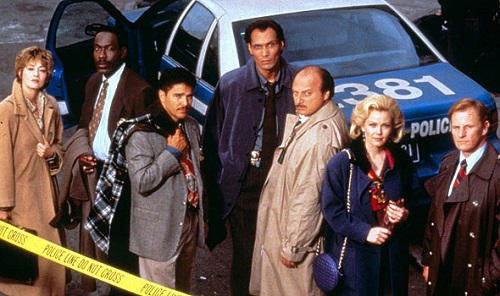
NYPD-Blue

But under no circumstances plan

9 DIY Projects That Help You Stay Organized.

And P.S. I don’t care if they are secretly filthy. I am not going to hand wash my leather gloves.

But I might re-read this old poem by W. Wordsworth that daughter #2 emailed me yesterday.

SHE was a Phantom of delight

When first she gleamed upon my sight;

A lovely Apparition, sent

To be a moment’s ornament;

Her eyes as stars of Twilight fair;

Like Twilight’s, too, her dusky hair;

But all things else about her drawn

From May-time and the cheerful Dawn;

A dancing Shape, an Image gay,

To haunt, to startle, and way-lay.


I saw her upon nearer view,

A Spirit, yet a Woman too!

Her household motions light and free,

And steps of virgin-liberty;

A countenance in which did meet

Sweet records, promises as sweet;

A Creature not too bright or good

For human nature’s daily food;

For transient sorrows, simple wiles,

Praise, blame, love, kisses, tears, and smiles.


And now I see with eye serene

The very pulse of the machine;

A Being breathing thoughtful breath,

A Traveller between life and death;

The reason firm, the temperate will,

Endurance, foresight, strength, and skill;

A perfect Woman, nobly planned,

To warn, to comfort, and command;

And yet a Spirit still, and bright

With something of angelic light.

I’m just saying.
The long procession

by chuckofish

202

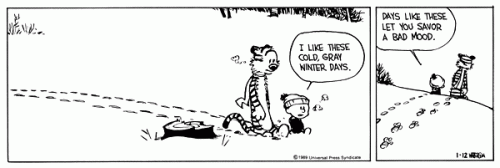
Well, I might not go quite so far as Calvin, but there is something to what he says. These gray winter days are certainly conducive to reflection. And reflection is a good thing.

“[My grandfather] returned to what he called ‘studying.’ He sat looking down at his lap, his left hand idle on the chair arm, his right scratching his head, his white hair gleaming in the lamplight. I knew that when he was studying he was thinking, but I did not know what about. Now I have aged into knowledge of what he thought about. He thought of his strength and endurance when he was young, his merriment and joy, and how his life’s burdens had then grown upon him. He thought of that arc of country that centered upon Port William as he first had known it in the years just after the Civil War, and as it had changed, and as it had become; and how all that time, which would have seemed almost forever when he was a boy, now seemed hardly any time at all. He thought of the people he remembered, now dead, and of those who had come and gone before his knowledge, and of those who would come after, and of his own place in that long procession.” (Wendell Berry, Andy Catlett: Early Travels)

Let’s all try to work some “studying” into our schedule.

A contant romance

by chuckofish

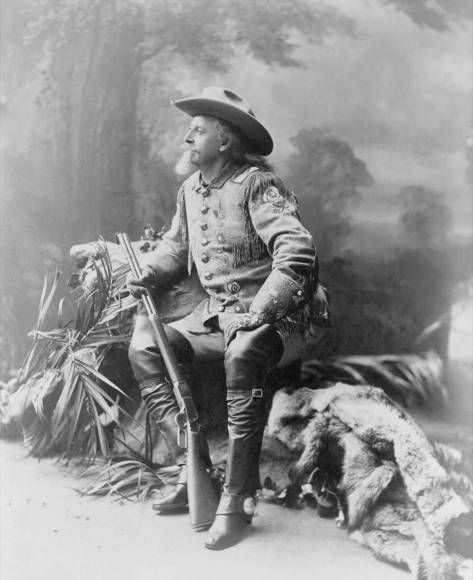
Buffalo Bill

As we look into the open fire for our fancies, so we are apt to study the dim past for the wonderful and sublime, forgetful of the fact that the present is a constant romance, and that the happenings of to-day which we count of little importance are sure to startle somebody in the future, and engage the pen of the historian, philosopher, and poet.

–William “Buffalo Bill” Cody, preface to The Old Santa Fe Trail by Colonel Henry Inman

Mid-week pep talk

by chuckofish

ralph-waldo-emerson-448

“Doubt not, O poet, but persist. Say ‘It is in me, and shall out.’ Stand there, balked and dumb, stuttering and stammering, hissed and hooted, stand and strive, until at last rage draw out of thee that dream-power which every night shows thee is thine own; a power transcending all limit and privacy, and by virtue of which a man is the conductor of the whole river of electricity.”

― Ralph Waldo Emerson, Essays

Oh man, when in doubt, read some Emerson. Isn’t he just the best?

And, by the way, don’t we all need one of these? Or we could have one made with a R.W. Emerson head.

And here’s a prayer to start the day by William Bright:

O Eternal Light, illuminate us; O eternal Power, strengthen us; O eternal Wisdom, instruct us; O eternal Mercy, have pity upon us; and grant us with all our hearts and minds to seek thy face, and to love thy name; through Jesus Christ our Lord.

(Prayer via here.)

Sackcloth and ashes

by chuckofish

Lent starts tomorrow. Lent, as you know, is a forty-day period of repentance and reflection leading up to Easter.

"Man of Sorrows" by William Dyce (1806--1864)

“Man of Sorrows” by William Dyce (1806–1864), Scottish National Gallery

The length is symbolic of Jesus’ forty days in the wilderness just before his temptation.

Before we plunge in, here is some food for thought from our old friend Fred Buechner:

During Lent, Christians are supposed to ask one way or another what it means to be themselves.

-If you had to bet everything you have on whether there is a God or whether there isn’t, which side would get your money and why?
-When you look at your face in the mirror, what do you see in it that you most like and what do you see in it that you most deplore?
-If you had only one last message to leave to the handful of people who are most important to you, what would it be in twenty-five words or less?
-Of all the things you have done in your life, which is the one you would most like to undo? Which is the one that makes you happiest to remember?
-Is there any person in the world, or any cause, that, if circumstances called for it, you would be willing to die for?
-If this were the last day of your life, what would you do with it?

To hear yourself try to answer questions like these is to begin to hear something not only of who you are but of both what you are becoming and what you are failing to become. It can me a pretty depressing business all in all, but if sackcloth and ashes are at the start of it, something like Easter may be at the end.

Whistling in the Dark

If nothing else, Buechner reminds us that our lives are important and that we must take them seriously. It is a good thing to take these forty days and practice some introspection. Times a-wastin’!

Playing along with the farce

by chuckofish

I’m not saying I will, but I could go on for hours escorting the reader–forcibly, if necessary–back and forth across the Paris-Chinese border. I happen to regard the Laughing Man as some kind of super-distinguished ancestor of mine–a sort of Robert E. Lee, say, with the ascribed virtues held under water or blood. And this illusion is only a moderate one compared to the one I had in 1928, when I regarded myself not only as the Laughing Man’s direct descendant but as his only legitimate living one. I was not even my parents’ son in 1928 but a devilishly smooth imposter, awaiting their slightest blunder as an excuse to move in–preferably without violence, but not necessarily–to assert my true identity. As a precaution against breaking my bogus mother’s heart, I planned to take her into my underworld employ in some undefined but appropriately regal capacity. But the main thing I had to do in 1928 was watch my step. Play along with the farce. Brush my teeth. Comb my hair. At all costs, stifle my natural hideous laughter.

–J.D. Salinger, The Laughing Man

Can I get an amen?

by chuckofish

President Theodore Roosevelt on a horse in Colorado; Photographer unknown; Around 1905

President Theodore Roosevelt on a horse in Colorado, c. 1905

“There were all kinds of things of which I was afraid at first, ranging from grizzly bears to “mean” horses and gunfighters; but by acting as if I was not afraid I gradually ceased to be afraid. Most men can have the same experience if they choose.”
―Theodore Roosevelt, Theodore Roosevelt: An Autobiography 

Agreed, but I will always be afraid of grizzly bears no matter what and always.

“How could I have known that murder could sometimes smell like honeysuckle?”

by chuckofish

Come now, you’ve never read an actuarial table in your life, have you? Why they’ve got ten volumes on suicide alone. Suicide by race, by color, by occupation, by sex, by seasons of the year, by time of day. Suicide, how committed: by poison, by firearms, by drowning, by leaps. Suicide by poison, subdivided by *types* of poison, such as corrosive, irritant, systemic, gaseous, narcotic, alkaloid, protein, and so forth; suicide by leaps, subdivided by leaps from high places, under the wheels of trains, under the wheels of trucks, under the feet of horses, from *steamboats*. But, Mr. Norton, of all the cases on record, there’s not one single case of suicide by leap from the rear end of a moving train. And you know how fast that train was going at the point where the body was found? Fifteen miles an hour. Now how can anybody jump off a slow-moving train like that with any kind of expectation that he would kill himself? No. No soap, Mr. Norton. We’re sunk, and we’ll have to pay through the nose, and you know it.

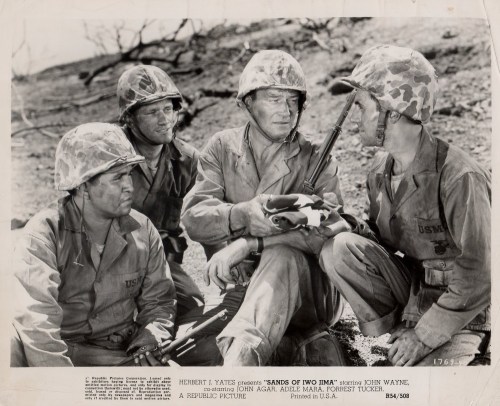
Did you watch Double Indemnity (1944) last night? It was on TCM as part of their Star of the Month–Fred MacMurray–repertoire.

double-indemnity_1707721c

It is the ultimate noir film and, in my opinion, just a great movie. It is certainly Fred MacMurray’s best movie. And Barbara Stanwyck, although she has seldom looked worse, is terrific.

Double-Indemnity-4

Edward G. Robinson, playing against type as is MacMurray, is wonderful in the good guy role.

di2

However, it is the sharp dialogue and grim, realistic narration written by Raymond Chandler that makes the movie. I mean, no one before or since writes like him. Many have tried, but no one comes close.

It was nominated for seven Oscars, including Best Picture, Actress, Director, Screenplay, Cinematography, Music, and Sound. It won nothing. (Why wasn’t Fred nominated? And E. G. R.?) This was the year Going My Way won a bunch–hello, please!–but you know, the war was raging…voters went for sentimentality and breezy Bing Crosby, not a gritty crime drama.

Sigh.

Well, if you missed it, you might want to look it up. It’s a good one.

Wednesday optimism check

by chuckofish

np1-02-normandy-landing-beaches

“No matter how bad things got, no matter how anxious the staff became, the commander had to “preserve optimism in himself and in his command. Without confidence, enthusiasm and optimism in the command, victory is scarcely obtainable.” Eisenhower realized that “optimism and pessimism are infectious and they spread more rapidly from the head downward than in any other direction.” He learned that a commander’s optimism “has a most extraordinary effect upon all with whom he comes in contact. With this clear realization, I firmly determined that my mannerisms and speech in public would always reflect the cheerful certainty of victory—that any pessimism and discouragement I might ever feel would be reserved for my pillow.”

–Stephen E. Ambrose, D-Day, June 6, 1944: The Battle for the Normandy Beaches

Leadership 101, guys. Now, go out there and SMILE!

“Arise, shine; for your light has come”*

by chuckofish

7d2ef65247923ae672436798884cb7da

“He knew that all was well, because he had done the best that he could, from day to day. He had been true to the light that had been given to him. He had looked for more. And if he had not found it, if a failure was all that came out of his life, doubtless that was the best that was possible. He had not seen the revelation of “life everlasting, incorruptible and immortal.” But he knew that even if he could live his earthly life over again, it could not be otherwise than it had been.”

–Henry Van Dyke, The Story of the Other Wise Man

Today is the feast of Epiphany, celebrating the ‘shining forth’ or revelation of God to mankind in human form, in the person of Jesus Christ. The observance had its origins in the eastern Christian church, and included the birth of Jesus Christ, the visit of the three Magi who arrived in Bethlehem, and all of Jesus’ childhood events, up to his baptism in the Jordan by John the Baptist. The visit of the Magi is traditionally interpreted as symbolic of God’s revelation of himself to the Gentiles.

I think I will re-read the short book The Story of the Other Wise Man written in 1896 by Henry Van Dyke, Presbyterian minister and Princeton graduate. It was a great favorite of our mother. It is a wonderful of story of the fourth wise man, who sets out to see the newborn king, carrying treasures to give as gifts–a sapphire, a ruby, and a “pearl of great price.”  But he gets side-tracked on the way to Bethlehem. His journey lengthens and he finally finds Jesus as he is crucified.

“I do not know where this little story came from,” said Van Dyke, “out of the air, perhaps. One thing is certain, it is not written in any other book, nor is it to be found among the ancient lore of the East. And yet I have never felt as if it were my own. It was a gift, and it seemed to me as if I knew the Giver.”

*Isaiah 60:1