dual personalities

Tag: prayer

Mid-week pep talk

by chuckofish

ralph-waldo-emerson-448

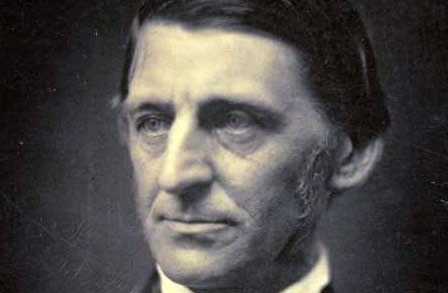
“Doubt not, O poet, but persist. Say ‘It is in me, and shall out.’ Stand there, balked and dumb, stuttering and stammering, hissed and hooted, stand and strive, until at last rage draw out of thee that dream-power which every night shows thee is thine own; a power transcending all limit and privacy, and by virtue of which a man is the conductor of the whole river of electricity.”

― Ralph Waldo Emerson, Essays

Oh man, when in doubt, read some Emerson. Isn’t he just the best?

And, by the way, don’t we all need one of these? Or we could have one made with a R.W. Emerson head.

And here’s a prayer to start the day by William Bright:

O Eternal Light, illuminate us; O eternal Power, strengthen us; O eternal Wisdom, instruct us; O eternal Mercy, have pity upon us; and grant us with all our hearts and minds to seek thy face, and to love thy name; through Jesus Christ our Lord.

(Prayer via here.)

So God imparts to human hearts

by chuckofish

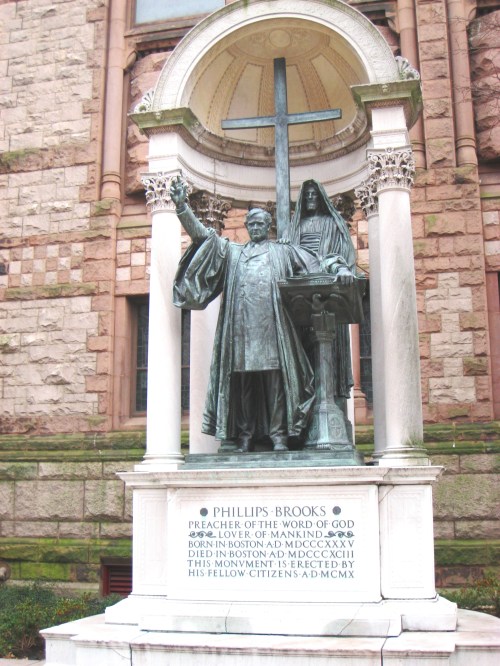
Phillips Brooks (December 13, 1835 – January 23, 1893) was an American clergyman and author, who briefly served as Bishop of Massachusetts in the Episcopal Church during the early 1890s. In the Episcopal liturgical calendar he is remembered on January 23.

Phillips Brooks memorial by Augustus Saint Gaudens, Trinity CHurch, Boston

Phillips Brooks memorial by Augustus Saint-Gaudens, Trinity Church, Boston

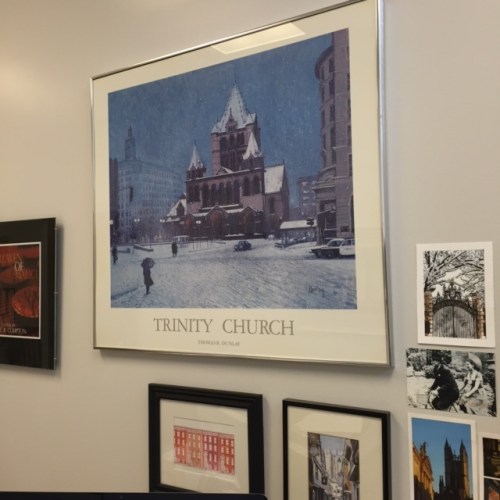
Under his inspiration, architect Henry Hobson Richardson, muralist John La Farge, and stained glass artists William Morris and Edward Burne Jones created an architectural masterpiece in Trinity Church, Boston.

OLYMPUS DIGITAL CAMERA

A favorite building of mine, this picture of the beloved church in Copley Square hangs in my flyover university office.

IMG_1647[3]

Brooks died in 1893, after an episcopate of only 15 months. His death was a major event in the history of Boston. One observer reported: “They buried him like a king. Harvard students carried his body on their shoulders. All barriers of denomination were down. Roman Catholics and Unitarians felt that a great man had fallen in Israel.”

IMG_1649

Remembered today mostly as the man who wrote “O Little Town of Bethlehem,” he must have been quite the guy.

Collect of the Day: Phillips Brooks, Bishop of Massachusetts, 1893

O everlasting God, you revealed truth to your servant Phillips Brooks, and so formed and molded his mind and heart that he was able to mediate that truth with grace and power: Grant, we pray, that all those whom you call to preach the Gospel may steep themselves in your Word, and conform their lives to your will; through Jesus Christ our Lord, who lives and reigns with you and the Holy Spirit, one God, for ever and ever. Amen.

Have a good weekend!

Mid-week pep talk

by chuckofish

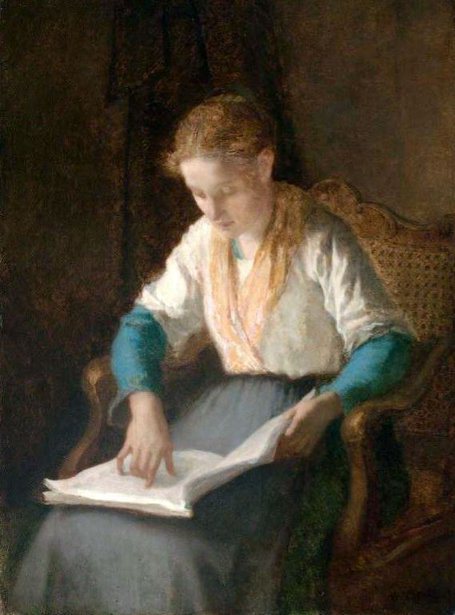
William Morris Hunt (1824-1879)

William Morris Hunt (1824-1879)

“We tend to use prayer as a last resort, but God wants it to be our first line of defense. We pray when there’s nothing else we can do, but God wants us to pray before we do anything at all.

Most of us would prefer, however, to spend our time doing something that will get immediate results. We don’t want to wait for God to resolve matters in His good time because His idea of ‘good time’ is seldom in sync with ours.”

–Oswald Chambers

I pray

by chuckofish

Yesterday I was back at work full swing and it was one of those days that really tests the soul. Not that anything bad happened or that people were mean or anything like that. It was just non-stop dealing with stuff.

I thought of this quote by C.S. Lewis:

“I pray because I can’t help myself. I pray because I’m helpless. I pray because the need flows out of me all the time, waking and sleeping. It does not change God. It changes me.”

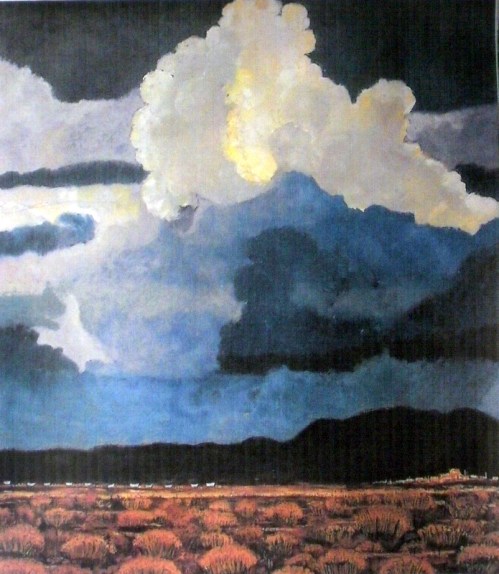
"Toward Toas" by Eric Sloan

“Toward Taos” by Eric Sloane

Know what I mean?

Giving thanks

by chuckofish

ca55bb6d443aa3b0c7faa55485451294

“I have just four words to leave with you. Four words that have spoken volumes of truth into my life.’

He wanted the words to stay in the room, to remain long after he had gone. Though no one wished to hear Paul’s radical injunction, it had to be told.

‘In everything, give thanks.’

This was the lifeboat in any crisis. Over and over again, he had learned this, and over and over again, he had to be reminded.”

–Jan Karon, In This Mountain

Here’s something to read if you’ve forgotten the difference between Pilgrims and Puritans.

e61086a5903ffa38982b335c59ed672e

And here’s a prayer for the day in case, like me, your plans don’t include church today.

Almighty and gracious Father, we give you thanks for the fruits of the earth in their season and for the labors of those who harvest them. Make us, we pray, faithful stewards of your great bounty, for the provision of our necessities and the relief of all who are in need, to the glory of your Name; through Jesus Christ our Lord, who lives and reigns with you and the Holy Spirit, one God, now and for ever. Amen.

–Thanksgiving Day collect, BCP

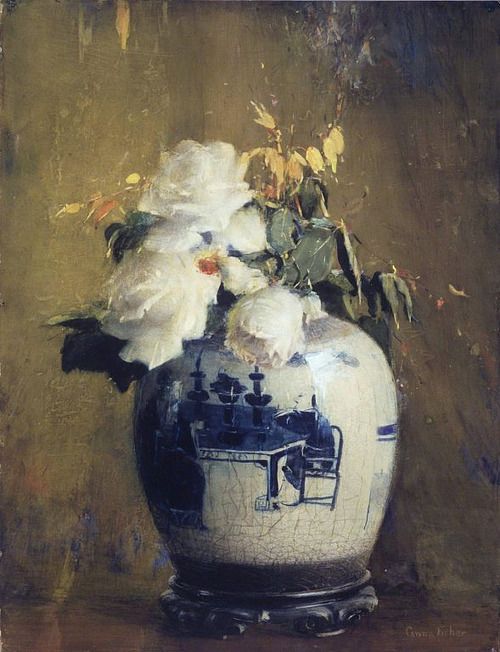
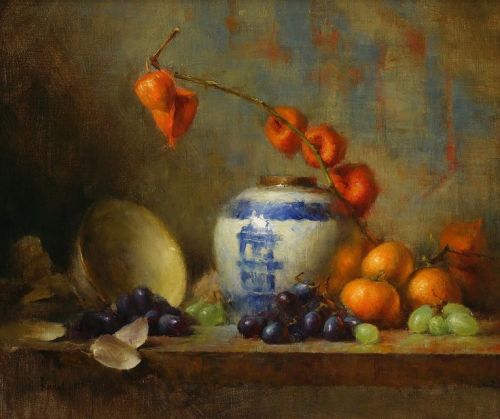
[The first painting is by Anna S. Fisher, c. 1922; the second by David Reidel, b. 1956]

A floating sense of doom

by chuckofish

107-Christ the Comforter

“God knows we have our own demons to be cast out, our own uncleanness to be cleansed. Neurotic anxiety happens to be my own particular demon, a floating sense of doom that has ruined many of what could have been, should have been, the happiest days of my life, and more than a few times in my life I have been raised from such ruins, which is another way of saying that more than a few times in my life I have been raised from death – death of the spirit anyway, death of the heart – by the healing power that Jesus calls us both to heal with and to be healed by.”

― Frederick Buechner, Secrets in the Dark: A Life in Sermons

I can surely relate to what Frederick Buechner is saying here, although I wouldn’t classify it as neurotic anxiety exactly. I just have always had a morbid imagination, always thinking about what might happen, especially concerning loved ones.

At the evensong service on Sunday the choir sang an anthem based on a poem by Robert Herrick (1591–1674):

In the hour of my distress,

When temptations me oppress,

And when I my sins confess,

Sweet Spirit, comfort me!


When I lie within my bed,

Sick in heart and sick in head,

And with doubts discomforted,

Sweet Spirit, comfort me!


When the house doth sigh and weep,

And the world is drown’d in sleep,

Yet mine eyes the watch do keep,

Sweet Spirit, comfort me!

I was reminded that people back in the seventeenth century lay in bed at night and obsessed over problems too. I must say that I do find comfort in that.

And as I always say to the boy after one of our overwrought discussions of current events, God is in control. It is good to remember that.

The evensong service ends with the wonderful prayer for mission:

Keep watch, dear Lord, with those who work, or watch, or weep this night, and give thine angels charge over those who sleep. Tend the sick, Lord Christ; give rest to the weary, bless the dying, soothe the suffering, pity the afflicted, shield the joyous; and all for thy love’s sake. Amen.

You can’t go wrong with this prayer at bedtime. Keep it on your bedside table. Envision those angels watching over you and your loved ones. It helps to dissipate that floating sense of doom.
Prayer 101

by chuckofish

SpringSky_Sloane

Readers of this blog know that I am a great one for prayer. Recently I was reading (in Springs in the Valley by Mrs. Charles E. Cowman) about the great 19th century Presbyterian minister Charles Grandison Finney (August 29, 1792 – August 16, 1875),  abolitionist and president of Oberlin College.

The summer of 1853 was unusually hot and dry; pastures were scorched. There seemed likely to be a total crop failure. At the church in Oberlin the great congregation had gathered as usual. Though the sky was clear the burden of Finney’s prayer was for rain.

“We do not presume, O Lord, to dictate to Thee what is best for us; yet Thou didst invite us to come to Thee as children to an earthly father and tell Thee all our wants. We want rain. Our pastures are dry. The earth is gaping open for rain. The cows are wandering about and lowing in search of water. Even the squirrels are suffering from thirst. Unless Thou givest us rain our cattle will die, and our harvest will come to naught. O Lord, send us rain, and send it now! This is an easy thing for Thee to do. Send it now, Lord, for Christ’s sake.

In a few minutes he had to cease preaching; his voice could not be heard because of the roar and rattle of the rain!

Yet another reminder that the direct approach is always best.

This guy has the right idea.

And, of course, Frederick Buechner always has something good to say.

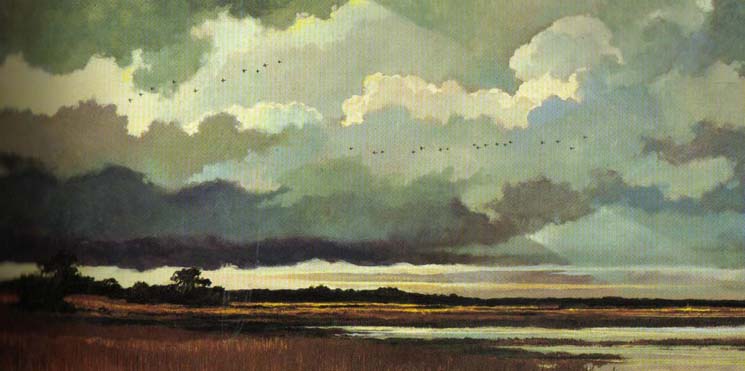
The painting is by Eric Sloane.

Mid-week reminder

by chuckofish

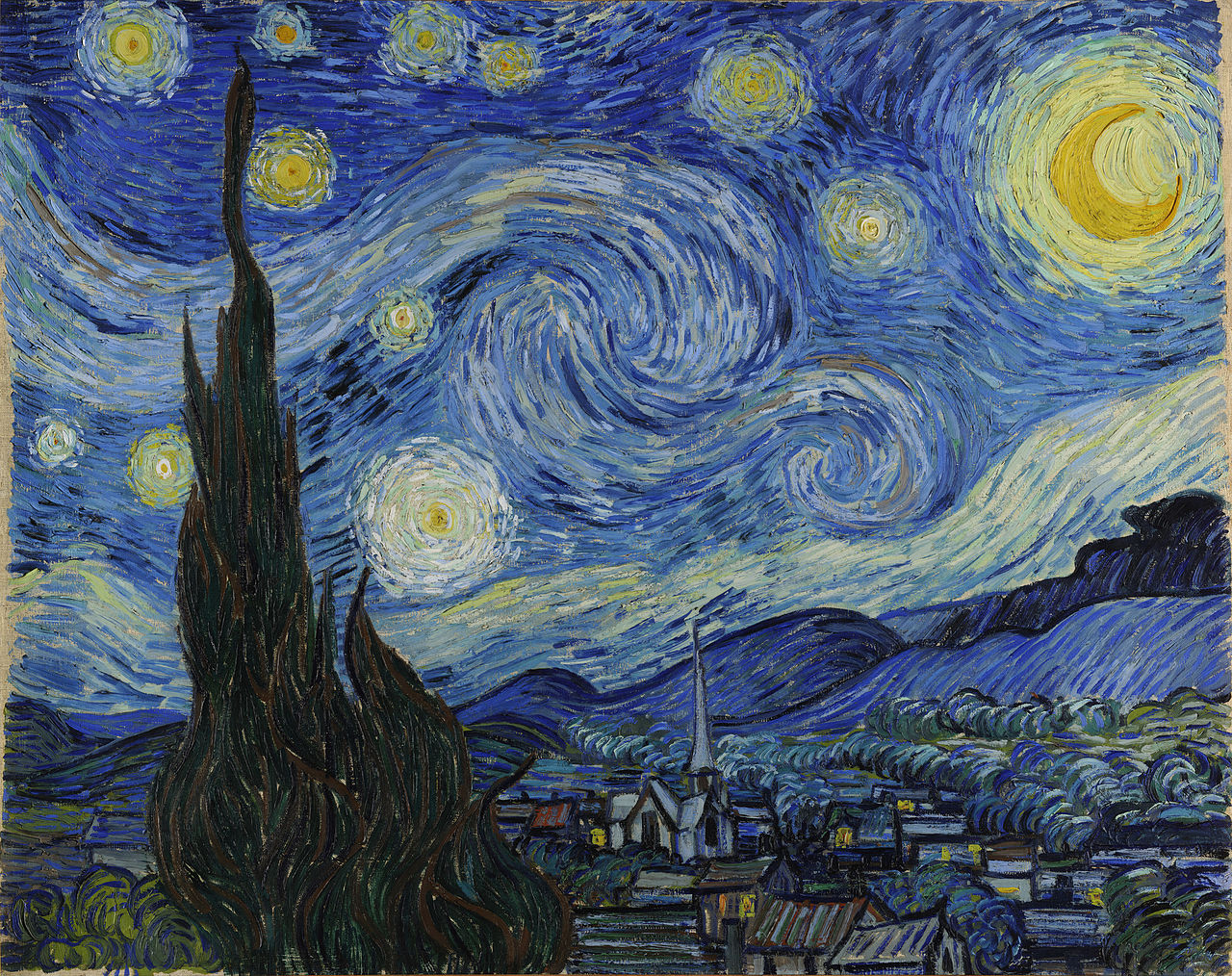
1280px-Van_Gogh_-_Starry_Night_-_Google_Art_Project

“A religious observance can be a wedding, a christening, a Memorial Day service, a bar mitzvah, or anything like that you might be apt to think of. There are lots of things going on at them. There are lots of things you can learn from them if you’re in a receptive state of mind. The word ‘observance’ itself suggests what is perhaps the most important thing about them.

A man and a woman are getting married. A child is being given a name. A war is being remembered and many deaths. A boy is coming of age.

It is life that is going on. It is always going on, and it is always precious. It is God that is going on. It is you who are there that is going on.

As Henry James advised writers, be one on whom nothing is lost.

OBSERVE!! There are few things as important, as religious, as that.”

–Frederick Buechner, The Faces of Jesus


The road ahead

by chuckofish

ericsloane

My Lord God, I have no idea where I am going. I do not see the road ahead of me. I cannot know for certain where it will end. Nor do I really know myself, and the fact that I think I am following your will does not mean that I am actually doing so. But I believe that the desire to please you does in fact please you. And I hope I have that desire in all that I am doing. I hope that I will never do anything apart from that desire. And I know that if I do this you will lead me by the right road, though I may know nothing about it. Therefore I will trust you always though I may seem to be lost and in the shadow of death. I will not fear, for you are ever with me, and you will never leave me to face my perils alone.

–Thomas Merton (1915-1968)

The painting is “Spring Sky” by Eric Sloane

Strengthen such as do stand

by chuckofish

Today is the lesser feast day of evangelical Anglican Charles Simeon (1759–1836) on the Episcopal calendar. Simeon is best known for serving Holy Trinity Church, Cambridge, and Cambridge University for 54 years, practicing and popularizing biblical, expository preaching and pioneering on-campus discipleship among university students. He is also credited with starting the evangelical revival in the Church of England.

Two hundred years ago students at the English Universities were required to attend church regularly, and to receive the Holy Communion at least once a year. This latter requirement often had bad effects, in that it encouraged hypocrisy and an irreverent reception of the sacrament. Occasionally, however, it had a very good effect, as with the Cambridge student Charles Simeon. He wrote: “On 29 January 1779 I came to college. On 2 February I understood that at division of term I must attend the Lord’s Supper. The Provost absolutely required it. Conscience told me that, if I must go, I must repent and turn to God.”

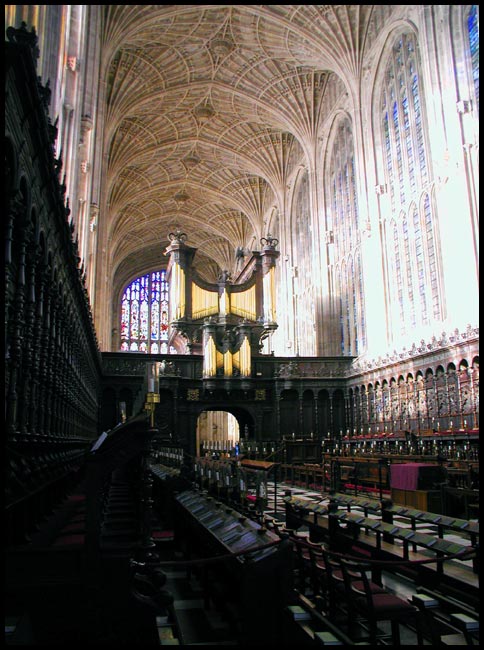
Kings College Chapel

Kings College Chapel

By this experience his life was transformed. Upon finishing his college work he was ordained, and shortly appointed chaplain of Holy Trinity, Cambridge, where he remained for 55 years, until shortly before his death on 12 November 1836. His ministry helped to transform the lives of many undergraduates, of whom we may mention two in particular. Henry Martyn inspired by Simeon, abandoned his intention of going into law and instead devoted his life and his considerable talents to preaching the Gospel in India and Persia. William Wilberforce, also led in part by Simeon’s ministry of teaching and example, devoted his life to the abolition of slavery throughout the British Empire. Simeon’s enthusiasm and zeal brought him much ridicule and abuse, which he bore uncomplainingly. Though he himself remained in one place, his influence extended through the Anglican world. (Lectionary Home Page)

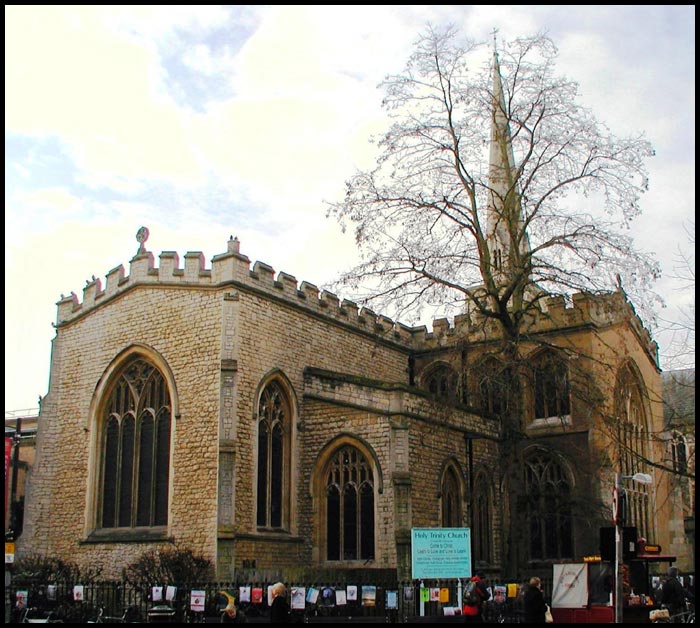
Holy Trinity, Cambridge

Holy Trinity, Cambridge

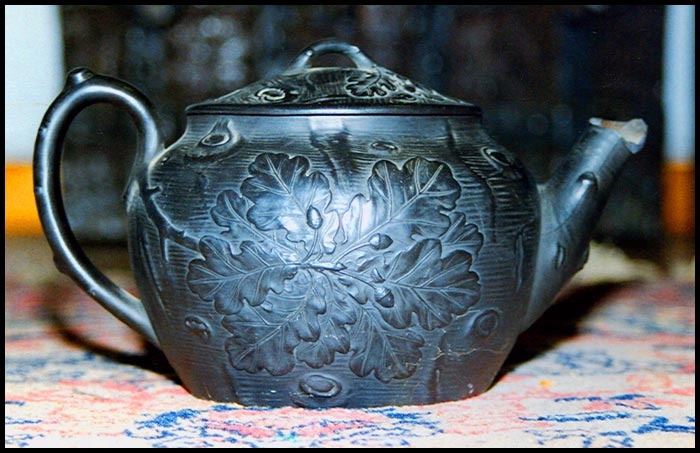
Simeon's black Wedgewood teapot used at his Friday night Conversation Parties

Simeon’s black Wedgewood teapot used at his Friday night Conversation Parties

Simeon's preaching Bible

Simeon’s preaching Bible

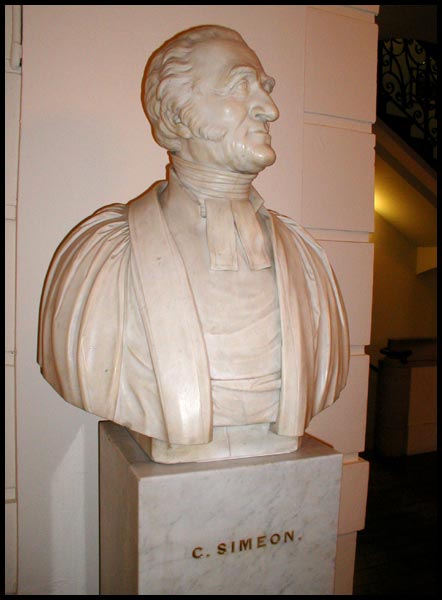
Bust of Simeon just outside the entrance to the Gonville and Caius Library.

Bust of Simeon just outside the entrance to the Gonville and Caius Library.

Simeon prayed the following prayer each Sunday before delivering his sermon:

“O God, who hast caused all Holy Scriptures to be written for our hearing, be with us now to sanctify unto us the truths that shall be delivered from them.
“Be with us especially to enlighten our minds by the Holy Spirit; and by the mighty working of thy power, bring in to the way of truth all such as have erred and are deceived.
“Be pleased also O Lord, to strengthen such as do stand, and comfort and help the weak hearted, and raise up them that fall, and finally to beat down Satan under all our feet.
“All this we humbly ask in the name and for the sake of Jesus Christ our Lord. Amen.”

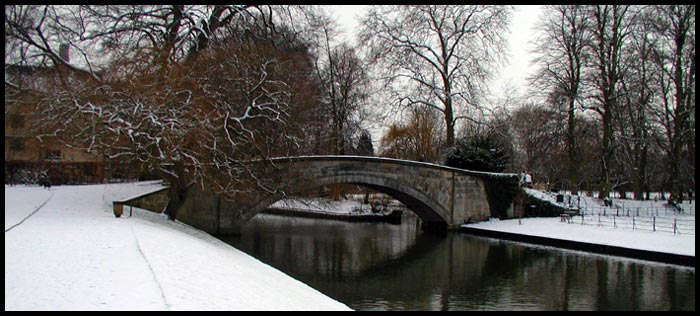
Looking south, down the River Cam, is Simeon's Bridge. In 1816 Simeon financed the major portion of this bridge connecting King's College property on both sides of The Backs. This is also the river into which Simeon threw a guinea (coin) as a self-prescribed punishment for not rising at the hour to which he had committed himself for Bible reading and prayer.

Looking south, down the River Cam, is Simeon’s Bridge. In 1816 Simeon financed the major portion of this bridge connecting King’s College property on both sides of The Backs. This is also the river into which Simeon threw a guinea (coin) as a self-prescribed punishment for not rising at the hour to which he had committed himself for Bible reading and prayer.

I like that prayer. And I want to go to there.

Photos are from the Charles Simeon website.