dual personalities

Tag: poetry

“Whereon it is enough for me, Not to be doing, but to be!”*

by chuckofish

beachview

What heed I of the dusty land
And noisy town?
I see the mighty deep expand
From its white line of glimmering sand
To where the blue of heaven on bluer waves shuts down!

In listless quietude of mind,
I yield to all
The change of cloud and wave and wind
And passive on the flood reclined,
I wander with the waves, and with them rise and fall.

–from “Hampton Beach” by John Greenleaf Whittier

Tomorrow I am off to Florida to meet up with daughters #1 and #2 for a week on the beach. The OM has flaked on us due to work commitments, so we will eat and drink what we please and binge watch “Freaks and Geeks” if we so desire.

Although daughter #2 will have her laptop, I will not be online. So I’ll see you in a week or so. Keep us travelers in your prayers.

beach2

*From “A Day of Sunshine” by Henry Wadsworth Longfellow

“A good man, full of the Holy Spirit and faith.” *

by chuckofish

paul-barnabas

Today the Episcopal Church observes the feast day of St. Barnabas, the early Christian fondly nicknamed Son of Encouragement (Acts 4:37). He befriended Saul of Tarsus after his conversion and introduced him to the skeptical leaders back in Jerusalem: “But Barnabas took him, brought him to the apostles, and described for them how on the road he had seen the Lord, who had spoken to him, and how in Damascus he had spoken boldly in the name of Jesus.” (Acts 9:27)

After that he and Paul (formerly Saul) undertook several missionary journeys together.

Willem de Poorter's "St. Paul and Barnabas in Lystra"

Willem de Poorter’s “St. Paul and Barnabas in Lystra”

Eventually the two disagreed about whether to take Barnabas’ cousin/nephew John Mark, whom Paul thought was a quitter, on another trip. The dispute ended with Paul taking Silas as his companion and journeying through Syria and Cilicia, while Barnabas took John Mark to visit Cyprus.

You see, even back then, church people were arguing and separating and going off in a huff. Why should we be surprised when this happens today?

Acts 15:38

Acts 15:38

I always liked old Barnabas. I’m sure he had to put up with a lot from Paul, who wasn’t always the easiest person/apostle to get along with. I always thought it was sad that their friendship ended the way it did. I’m sure we can all take a lesson from it.

St. Barnabas, with John his sister’s son,
Set sail for Cyprus; leaving in their wake
That chosen Vessel, who for Jesus’ sake
Proclaimed the Gentiles and the Jews at one.
Divided while united, each must run
His mighty course not hell should overtake;
And pressing toward the mark must own the ache
Of love, and sigh for heaven not yet begun.
For saints in life-long exile yearn to touch
Warm human hands, and commune face to face;
But these we know not ever met again:
Yet once St. Paul at distance overmuch
Just sighted Cyprus; and once more in vain
Neared it and passed;–not there his landing-place.

–Christina Rossetti

*Acts 11:24

O Pioneers!

by chuckofish

The Sign of the Arrow called Tuesday to say that daughter #1’s ornament–which she had dropped off in April when she was home–was ready to pick up and so I stopped by after work.

photo

Isn’t it great? The Pioneer is the mascot of our local high school. He is a manly pioneer with a coonskin cap. For me he always evokes Walt Whitman and his:

COME, my tan-faced children,

Follow well in order, get your weapons ready;

Have you your pistols? have you your sharp-edged axes? Pioneers! O Pioneers!

Anyway, I had to share.

Windows open

by chuckofish

May is white clouds behind pine trees

Puffed out and marching upon a blue sky.

May is green as no other,

May is much sun through small leaves,

May is soft earth,

And appleblossoms,

and windows open to a south wind.

–Amy Lowell

I found this poem torn out of a magazine and stuck in my mother’s notebook about gardens where she had painstakingly copied out poems about gardens and bible quotations and other quotes.

Also stuck in it was this photo:

farm family

You can click on it to enlarge the picture.

Her mother and grandfather are on the right. They are visiting their relatives (the Wheeler-Rand-Smiths) who owned the farm. My mother is the little dark-haired girl with the baby carriage and her older sister Susanne is to the right. I don’t know whose baby my grandmother is holding, because her youngest daughter was born in 1933 and this must be 1928-29, judging from my mother’s age (3?). The other women and the blonde children are members of the family (the Frohawks) who lived on the farm and farmed it.

My mother spent her summers on this farm in North Charlestown, N.H. and, boy, did she love it and the Frohawks. At that time, the farm had been in her family for 150 years. We heard about it all the time growing up. I would have liked to spend my summers there, but it had been sold after the war and was gone with the wind.

Sigh.

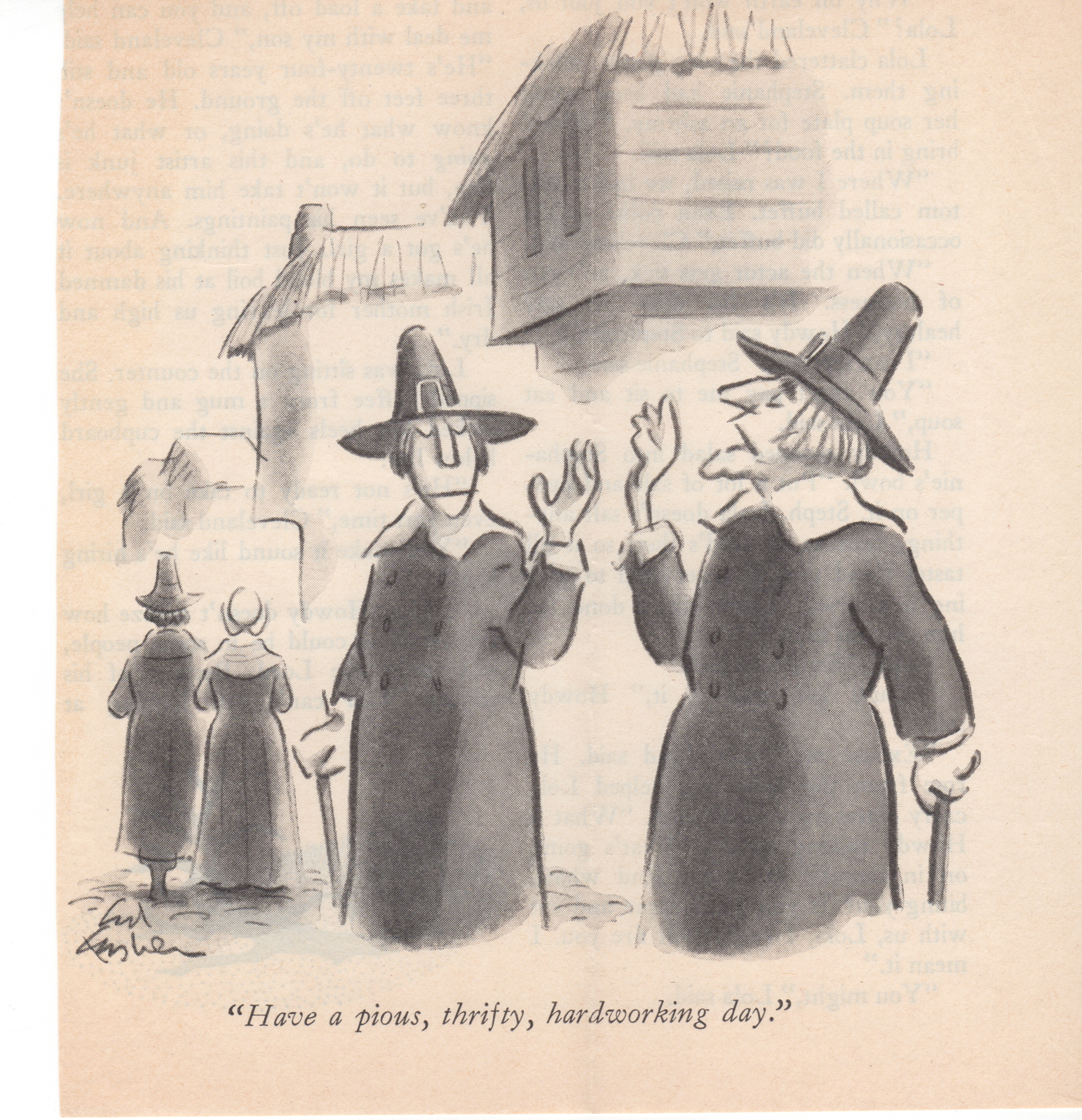
Anyway, also tucked into the notebook was this cartoon, which I am sure I had sent her.

puritans 1

It is still my mantra. So have a pious, thrifty, hardworking day…and weekend!

Festina lente

by chuckofish

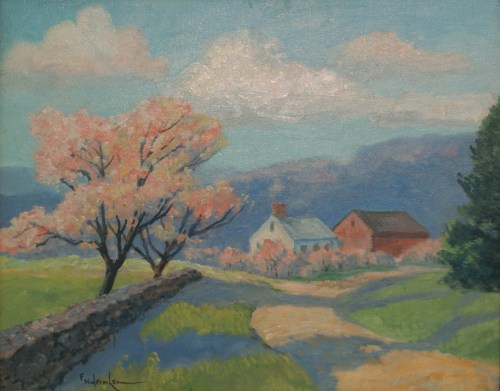
Fred Ndercher, 1922, "Spring Landscape" in the St. Louis Mercantile Library collection

Nothing is so beautiful as Spring –

When weeds, in wheels, shoot long and lovely and lush;

Thrush’s eggs look little low heavens, and thrush

Through the echoing timber does so rinse and wring

The ear, it strikes like lightnings to hear him sing;

The glassy peartree leaves and blooms, they brush

The descending blue; that blue is all in a rush

With richness; the racing lambs too have fair their fling.

What is all this juice and all this joy?

A strain of the earth’s sweet being in the beginning

In Eden garden. – Have, get, before it cloy,

Before it cloud, Christ, lord, and sour with sinning,

Innocent mind and Mayday in girl and boy,

Most, O maid’s child, thy choice and worthy the winning.

“Spring” by Gerard Manley Hopkins

A friend at work brought this poem to my attention by stopping by my office and quoting, “What is all this juice and all this joy?” He was alluding to the beautiful spring day of course. We have certainly enjoyed an exceptionally beautiful spring with long strings of crisp, clear days in the high 60s. Carpe diem, I say–but I am glued to a desk. Sigh.

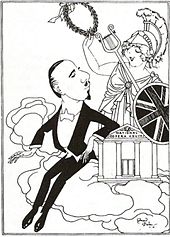
Anyway, it is also the birthday today of Sir Thomas Beecham (29 April 1879 – 8 March 1961) who, you will recall, was an English conductor and impresario best known for his association with the London Philharmonic and the Royal Philharmonic orchestras.
170px-Thomas_Beecham_1919_cartoon

From the early 20th century until his death, Beecham was a major influence on the musical life of Britain and, according to the BBC, was Britain’s first international conductor. If you are like me and my dual personality, you were brought up on Sir Thomas Beecham’s recordings. True, some may have considered him low-brow for saying things like, “I would give the whole of Bach’s Brandenburg Concertos for Massenet’s Manon, and would think I had vastly profited by the exchange.” But I can’t say I disagree with him.

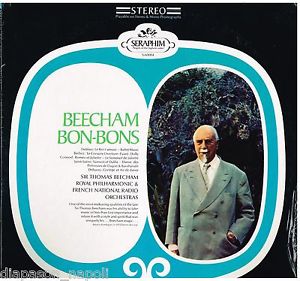
I remember in particular an LP titled “Beecham Bon-Bons” which included popular favorites by Faure, Delius, Sibelius, Ralph Vaughan Williams and the like.
beecham

I wiled away many an hour with Beecham’s music in the background. So a toast to Sir Thomas Beecham! And I think I’ll look him up on eBay and see what I can find.

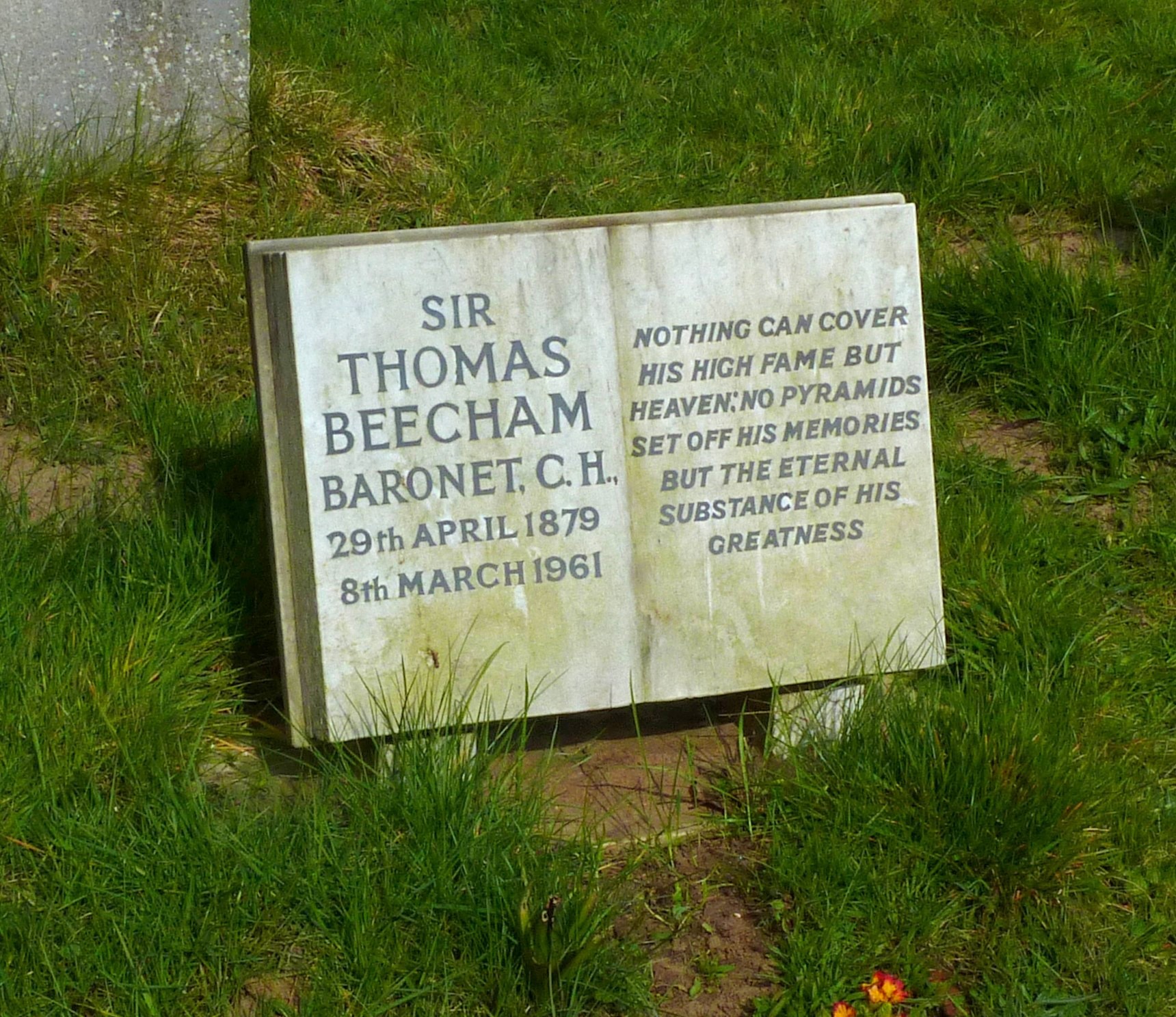
Beecham's grave in

Beecham’s grave in Surrey

By the way, the painting at the top of the page is by St. Louis artist Frank Nudercher (July 19, 1880 – October 7, 1959)–“Spring Landscape” in the St. Louis Mercantile Library collection. Nudercher is sometimes referred to as the “dean of St. Louis artists.” You can read about him here.

Dear March–Come in

by chuckofish

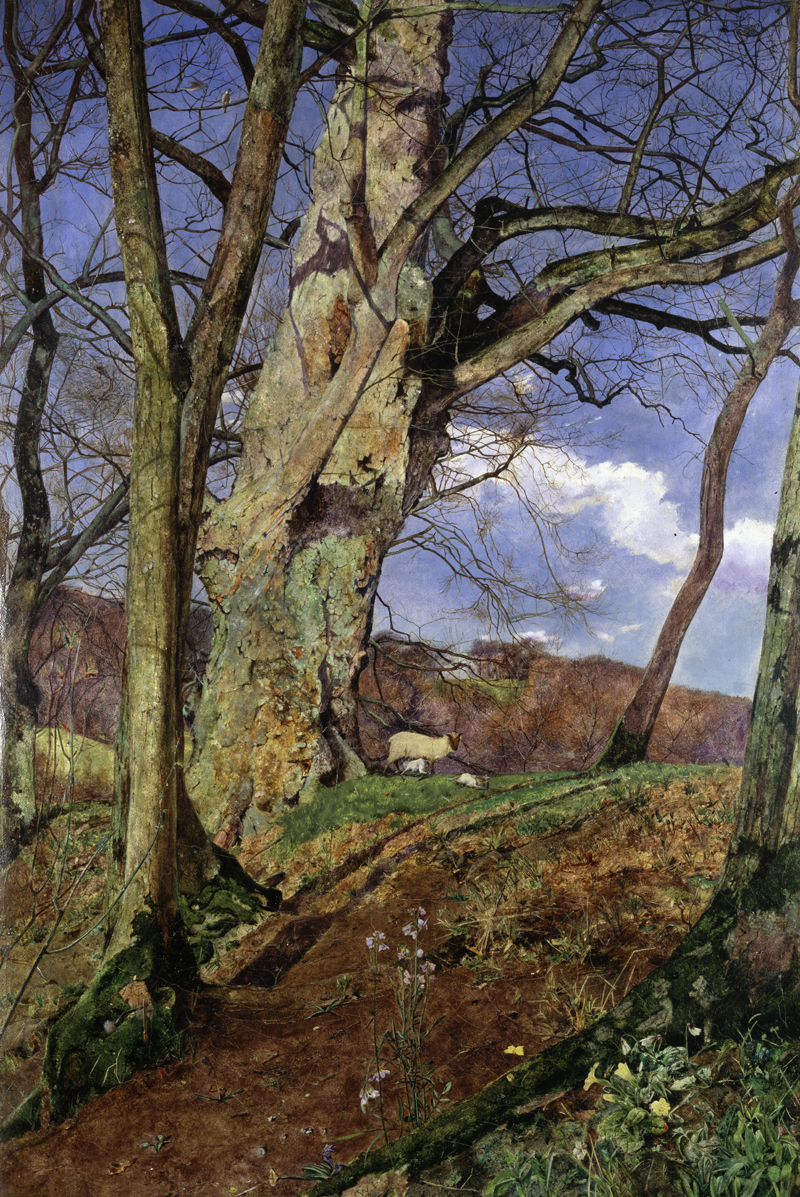
John William Inchbold (1830--1888)

Dear March — Come in —
How glad I am —
I hoped for you before —

Put down your Hat —
You must have walked —
How out of Breath you are —
Dear March, Come right up the stairs with me —
I have so much to tell —

I got your Letter, and the Birds —
The Maples never knew that you were coming — till I called
I declare — how Red their Faces grew —
But March, forgive me — and
All those Hills you left for me to Hue —
There was no Purple suitable —
You took it all with you —

Who knocks? That April.
Lock the Door —
I will not be pursued —
He stayed away a Year to call
When I am occupied —
But trifles look so trivial
As soon as you have come

That Blame is just as dear as Praise
And Praise as mere as Blame —

(Emily Dickinson)

The painting is “A Study, In March”  by John William Inchbold (1830–1888)

Have a nice Wednesday

by chuckofish

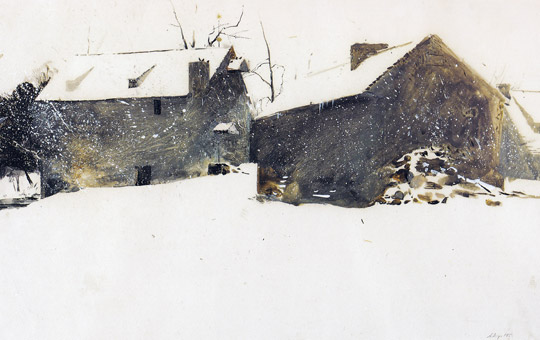
andrew_wyeth_snow_1

The way a crow

Shook down on me

The dust of snow

From a hemlock tree

Has given my heart

A change of mood

And saved some part

Of a day I had rued.

(Robert Frost)

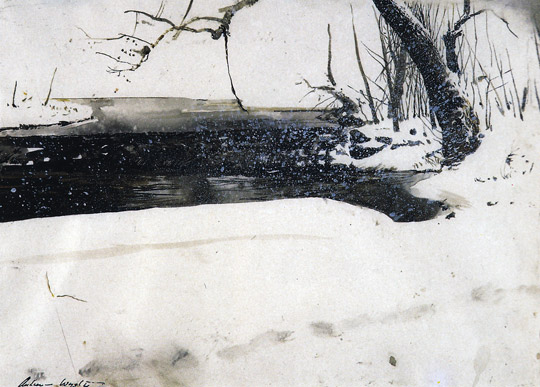
andrew_wyeth_snow_2

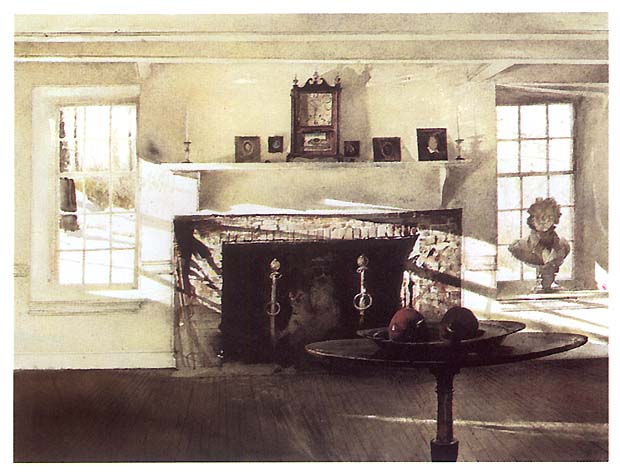
wyethandrew_23205_2

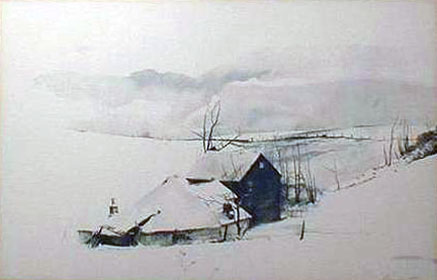
bigroom(All paintings above by Andrew Wyeth and one bonus piece by N.C. Wyeth below)

nc wyeth

Way Back Wednesday: we are but flowers

by chuckofish

MCC flower

Little Mary in Worcester, MA, circa 1931

These are thy wonders, Lord of love,

To make us see we are but flowers that glide;

         Which when we once can find and prove,

Thou hast a garden for us where to bide;

                      Who would be more,

                      Swelling through store,

         Forfeit their Paradise by their pride.

–George Herbert, from “The Flower”

Happy New Year!

by chuckofish

comptonbattram1.jpg

Can you find the pixilated Dual Personality in this festive bunch?

I give you an old reliable–but still wonderful–poem for the new year by Alfred Tennyson. Nothing much has changed since he wrote it in 1850. I mean people are still people and it is good to keep that in mind. Tennyson was writing about the “faithless coldness of the times” back then too.

Ring out, wild bells, to the wild sky,
The flying cloud, the frosty light;
The year is dying in the night;
Ring out, wild bells, and let him die.

Ring out the old, ring in the new,
Ring, happy bells, across the snow:
The year is going, let him go;
Ring out the false, ring in the true.

Ring out the grief that saps the mind,
For those that here we see no more,
Ring out the feud of rich and poor,
Ring in redress to all mankind.

Ring out a slowly dying cause,
And ancient forms of party strife;
Ring in the nobler modes of life,
With sweeter manners, purer laws.

Ring out the want, the care the sin,
The faithless coldness of the times;
Ring out, ring out my mournful rhymes,
But ring the fuller minstrel in.

Ring out false pride in place and blood,
The civic slander and the spite;
Ring in the love of truth and right,
Ring in the common love of good.

Ring out old shapes of foul disease,
Ring out the narrowing lust of gold;
Ring out the thousand wars of old,
Ring in the thousand years of peace.

Ring in the valiant man and free,
The larger heart, the kindlier hand;
Ring out the darknss of the land,
Ring in the Christ that is to be.


“There’s a certain Slant of light”*

by chuckofish

Today is Emily Dickinson’s birthday!

emily-dickinsonEmily lived her whole life (December 10, 1830 – May 15, 1886) in Amherst, Massachusetts. She lived in this beautiful house, called by her family “The Homestead”.

emily's home

She had a room of her own, and for Emily, this seems to have been enough. She also had her family and she did not lack for friends. She may have seemed “eccentric” to some, but plenty of people thought she was pretty cool. If she was mysterious back in her day, she is increasingly misunderstood now.

The Emily Dickinson Home, a National Historic Landmark, is located at 280 Main St. in Amherst, MA. Although I lived in the vicinity during my college years, I never visited the house. I saw it, but never went inside. The property, which is now owned by Amherst College, is a museum and is open to the public for guided tours March through December. It is definitely on my “to do/see” list.

So tonight let’s toast Emily and read a few of her poems. Here’s a good one for a winter afternoon:

There’s a certain Slant of light,
Winter Afternoons –
That oppresses, like the Heft
Of Cathedral Tunes –
Heavenly Hurt, it gives us –
We can find no scar,
But internal difference –
Where the Meanings, are –
None may teach it – Any –
‘Tis the seal Despair –
An imperial affliction
Sent us of the Air –
When it comes, the Landscape listens –
Shadows – hold their breath –
When it goes, ’tis like the Distance
On the look of Death –