dual personalities

Tag: poetry

Within our inward temple

by chuckofish

stained_glass_in_the_cathedral_-_geograph-org-uk_-_615756

What powerful Spirit lives within!
What active Angel doth inhabit here!
What heavenly light inspires my skin,
Which doth so like a Deity appear!
A living Temple of all ages, I
Within me see
A Temple of Eternity!
All Kingdoms I descry
In me.

An inward Omnipresence here
Mysteriously like His within me stands,
Whose knowledge is a Sacred Sphere
That in itself at once includes all lands.
There is some Angel that within me can
Both talk and move,
And walk and fly and see and love,
A man on earth, a man
Above.

Dull walls of clay my Spirit leaves,
And in a foreign Kingdom doth appear,
This great Apostle it receives,
Admires His works and sees them, standing here,
Within myself from East to West I move
As if I were
At once a Cherubim and Sphere,
Or was at once above
And here.

The Soul’s a messenger whereby
Within our inward Temple we may be
Even like the very Deity
In all the parts of His Eternity.
O live within and leave unwieldy dross!
Flesh is but clay!
O fly my Soul and haste away
To Jesus’ Throne or Cross!
Obey!

–Thomas Traherne, An Hymn Upon St. Bartholomew’s Day

In commemoration of his poems and spiritual writings, Thomas Traherne is included in the anglican calendar of saints. Today is his feast day (in the Episcopal Church) and this is the collect for the day:

“Creator of wonder and majesty, who didst inspire thy poet Thomas Traherne with mystical insight to see thy glory in the natural world and in the faces of men and women around us: Help us to know thee in thy creation and in our neighbors, and to understand our obligations to both, that we may ever grow into the people thou hast created us to be; through our Savior Jesus Christ, who with thee and the Holy Spirit liveth and reigneth, one God, in everlasting light. Amen.”

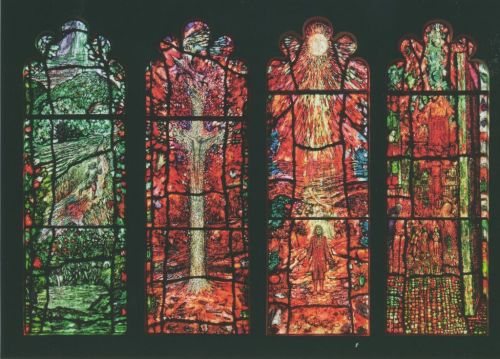
The stained glass window is one of the four Traherne Windows in Audley Chapel, Hereford Cathedral, created by stained-glass artist Tom Denny in 2007.
thomas-traherne-stained-glass-1

And I just thought this was really nice:

The Lord is my refuge

by chuckofish

6c3cb3297523e7d09c3e5df1fe8cf225

The boy is okay.

Whoever dwells in the shelter of the Most High
    will rest in the shadow of the Almighty.
I will say of the Lord, “He is my refuge and my fortress,
    my God, in whom I trust.”

Surely he will save you
    from the fowler’s snare
    and from the deadly pestilence.
He will cover you with his feathers,
    and under his wings you will find refuge;
    his faithfulness will be your shield and rampart.
You will not fear the terror of night,
    nor the arrow that flies by day,
nor the pestilence that stalks in the darkness,
    nor the plague that destroys at midday.
A thousand may fall at your side,
    ten thousand at your right hand,
    but it will not come near you.
You will only observe with your eyes
    and see the punishment of the wicked.

If you say, “The Lord is my refuge,”
    and you make the Most High your dwelling,
10 no harm will overtake you,
    no disaster will come near your tent.
11 For he will command his angels concerning you
    to guard you in all your ways;
12 they will lift you up in their hands,
    so that you will not strike your foot against a stone.
13 You will tread on the lion and the cobra;
    you will trample the great lion and the serpent.

14 “Because he loves me,” says the Lord, “I will rescue him;
    I will protect him, for he acknowledges my name.
15 He will call on me, and I will answer him;
    I will be with him in trouble,
    I will deliver him and honor him.
16 With long life I will satisfy him
    and show him my salvation.”

 –Psalm 91 (NIV)

The OM and I are heading back home today. Daughter #3 and her mother are staying in Indianapolis with the boy ’til they release him on Friday or Saturday. We were very impressed with the University Hospital in Indianapolis and the A Team that operated on the boy. All is well.

Poetry amid the jarring notes of day

by chuckofish

440px-john_greenleaf_whittier_bpl_ambrotype_c1840-60-crop
John Greenleaf Whittier (1807 – September 7, 1892) was an American Quaker poet and Abolitionist. One of the “Fireside Poets” of the 19th century, he is hardly read anymore, of course. Whittier, California is named after him and also Whittier College. (Please note: The school mascot is “The Poet.”)

A number of his poems have been turned into hymns, including  Dear Lord and Father of Mankind, taken from his poem “The Brewing Soma”.  You may recall that Whittier was also one of the founding contributors of the magazine Atlantic Monthly and was supportive of women writers, including Sarah Orne Jewett, who dedicated one of her books to him.

You probably know more of his poems than you think. Remember–“Blessings on thee, little man, Barefoot boy, with cheek of tan!”

And how about Barbara Frietchie?

“Up from the meadows rich with corn,
Clear in the cool September morn,

The clustered spires of Frederick stand
Green-walled by the hills of Maryland.”

Here is a favorite of mine; read the entire thing and enjoy.

I mourn no more my vanished years
Beneath a tender rain,
An April rain of smiles and tears,
My heart is young again.

The west-winds blow, and, singing low,
I hear the glad streams run;
The windows of my soul I throw
Wide open to the sun.

No longer forward nor behind
I look in hope or fear;
But, grateful, take the good I find,
The best of now and here.

I plough no more a desert land,
To harvest weed and tare;
The manna dropping from God’s hand
Rebukes my painful care.

I break my pilgrim staff, I lay
Aside the toiling oar;
The angel sought so far away
I welcome at my door.

The airs of spring may never play
Among the ripening corn,
Nor freshness of the flowers of May
Blow through the autumn morn.

Yet shall the blue-eyed gentian look
Through fringed lids to heaven,
And the pale aster in the brook
Shall see its image given;–

The woods shall wear their robes of praise,
The south-wind softly sigh,
And sweet, calm days in golden haze
Melt down the amber sky.

Not less shall manly deed and word
Rebuke an age of wrong;
The graven flowers that wreathe the sword
Make not the blade less strong.

But smiting hands shall learn to heal,–
To build as to destroy;
Nor less my heart for others feel
That I the more enjoy.

All as God wills, who wisely heeds
To give or to withhold,
And knoweth more of all my needs
Than all my prayers have told.

Enough that blessings undeserved
Have marked my erring track;
That wheresoe’er my feet have swerved,
His chastening turned me back;

That more and more a Providence
Of love is understood,
Making the springs of time and sense
Sweet with eternal good;–

That death seems but a covered way
Which opens into light,
Wherein no blinded child can stray
Beyond the Father’s sight;

That care and trial seem at last,
Through Memory’s sunset air,
Like mountain-ranges overpast,
In purple distance fair;

That all the jarring notes of life
Seem blending in a psalm,
And all the angles of its strife
Slow rounding into calm.

And so the shadows fall apart,
And so the west-winds play;
And all the windows of my heart
I open to the day.

(1859)

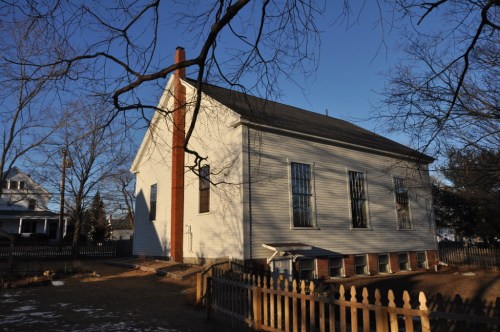
Lovely, lovely, lovely. Also lovely is the Amesbury, MA Friends Meeting House. The simple 1.5 story wood frame building was constructed in 1850, with our poet Whittier serving on the building committee. We are told it is currently a thriving congregation, with Meeting for Worship every Sunday at 10 a.m. The facing bench displays a small plaque that reads, “Whittier’s Bench.”

amesburyma_friendsmeetinghouse_1

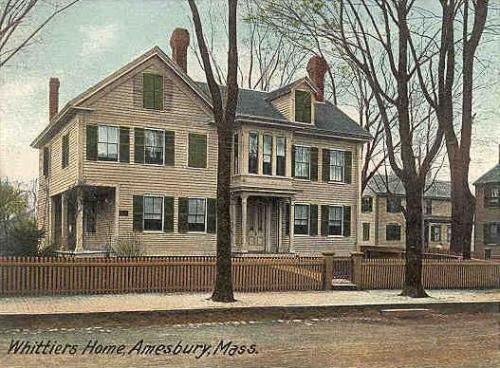
I have never been to Amesbury, but it appears to be a nice place.

whittiers_home_amesbury_ma

Besides Whittier, our ancestor Josiah Bartlett lived there,

josiah_bartletts_statue_amesbury_ma

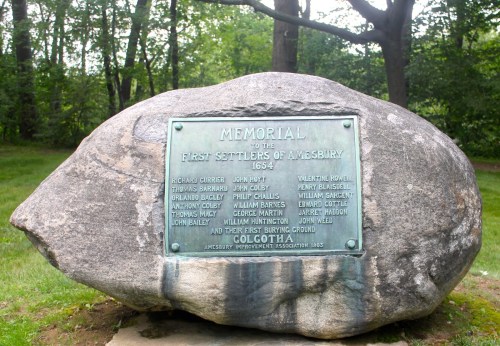
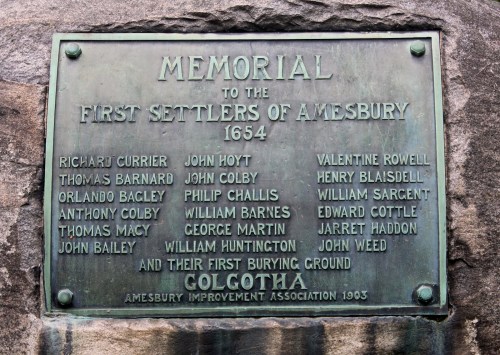
as did Mary Baker Eddy and Robert Frost. And there is this:

amesbury

amesbury-first-settlers

I need to check this place out. Have a good Thursday.

I have it on good authority

by chuckofish

Friday already, you say! This sure has been a busy week at work and it flew by. And that is okay.

7a48b46342ea6322d2e6e5f05bdccd57

Abracadabra, thus we learn,
The more you create, the less you earn.
The less you earn, the more you’re given,
The less you lead, the more you’re driven,
The more destroyed, the more they feed,
The more you pay, the more they need
The more you earn, the less you keep,
And now I lay me down to sleep.
I pray the Lord my soul should take
If the tax collector hasn’t got it before I wake.

Ogden Nash (August 19, 1902 – May 19, 1971) wrote that and his birthday is today. Tonight I will toast Ogden Nash and also Blaise Pascal who died on this day in 1662. You remember, he had a religious experience on November 23, 1654, a “definitive conversion” during a vision of the crucifixion:

“From about half-past ten in the evening until about half-past twelve … FIRE … God of Abraham, the God of Isaac, the God of Jacob, and not of the philosophers and savants. Certitude. Certitude. Feeling. Joy. Peace.”

He recorded the experience on a piece of parchment, which he carried with him the rest of his life, sewn inside his coat.

Awesome.

Nowadays people make lists like this.

Have a good weekend. I have no plans.

*the illustration is by Miroslav Sasek

“Why do stars fall down from the sky Every time you walk by?”*

by chuckofish

SCC and NU

Daughter #2 and Nate arrive today for a long weekend of celebrating in flyover country. We even have tickets to the Cardinals game on Monday night! It’s my flyover university’s first ever Night at the Ballpark–should be very interesting.

78fcea867ec30062aa68046beced5667

I hope Fred Bird makes an appearance and that he dances with our chancellor! I mean, how great would that be?

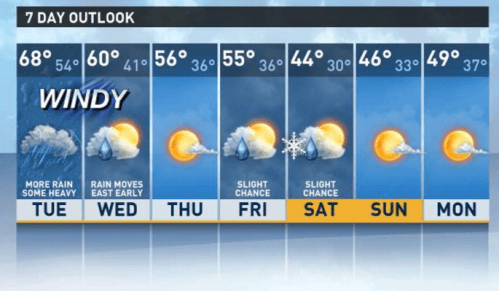
The weather isn’t even going to be that bad.

Screen Shot 2016-08-04 at 11.19.55 AM

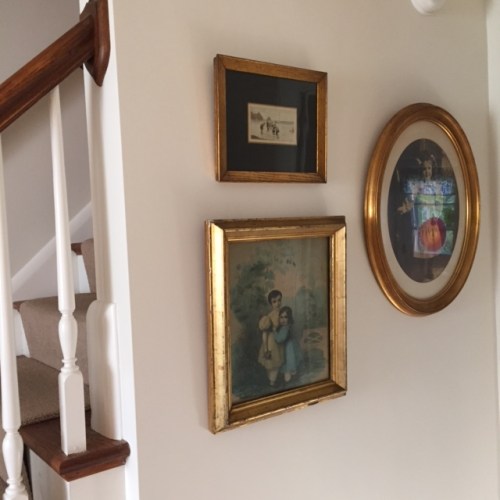
Meanwhile my friend Gary has finished stripping the wallpaper off the front hall, stairway and upstairs hall and painting it all. It looks fantastic. He even hung up my pictures so the OM would not have to engage in a battle of hammering to do so.

IMG_2098

IMG_2097

IMG_2096

I will also note that Saturday is the birthday of Alfred, Lord Tennyson (1809–1892), Poet Laureate of Great Britain. You might spend some time this weekend brushing up on your Tennyson poetry. It is pretty great. Here’s a section of “Ulysses” to get you started:

I am a part of all that I have met;
Yet all experience is an arch wherethro’
Gleams that untravell’d world whose margin fades
For ever and forever when I move.
How dull it is to pause, to make an end,
To rust unburnish’d, not to shine in use!
As tho’ to breathe were life! Life piled on life
Were all too little, and of one to me
Little remains: but every hour is saved
From that eternal silence, something more,
A bringer of new things; and vile it were
For some three suns to store and hoard myself,
And this gray spirit yearning in desire
To follow knowledge like a sinking star,
Beyond the utmost bound of human thought.

Go ahead: follow knowledge like a sinking star! Shine in use! Use it or lose it! Have a good weekend!

*The Carpenters, “Close to You”

Keeping cool, flyover style

by chuckofish

wrc:mwc pool

Circa 1990

It is really hot here in flyover country–dog days hot–and it is only June! Time to break out the gin and tonics and read poetry!

Here is an appropriate poem by old William Cullen Bryant, who probably thought the temperature was roasting at 79-degrees. Try 99-degrees! Read the whole thing–it’s good!

It is a sultry day; the sun has drunk

The dew that lay upon the morning grass,

There is no rustling in the lofty elm

That canopies my dwelling, and its shade

Scarce cools me. All is silent, save the faint

And interrupted murmur of the bee,

Settling on the sick flowers, and then again

Instantly on the wing. The plants around

Feel the too potent fervors; the tall maize

Rolls up its long green leaves; the clover droops

Its tender foliage, and declines its blooms.

But far in the fierce sunshine tower the hills,

With all their growth of woods, silent and stern,

As if the scorching heat and dazzling light

Were but an element they loved. Bright clouds,

Motionless pillars of the brazen heaven;–

Their bases on the mountains–their white tops

Shining in the far ether–fire the air

With a reflected radiance, and make turn

The gazer’s eye away. For me, I lie

Languidly in the shade, where the thick turf,

Yet virgin from the kisses of the sun,

Retains some freshness, and I woo the wind

That still delays its coming. Why so slow,

Gentle and voluble spirit of the air?

Oh, come and breathe upon the fainting earth

Coolness and life. Is it that in his caves

He hears me? See, on yonder woody ridge,

The pine is bending his proud top, and now,

Among the nearer groves, chestnut and oak

Are tossing their green boughs about. He comes!

Lo, where the grassy meadow runs in wives!

The deep distressful silence of the scene

Breaks up with mingling of unnumbered sounds

And universal motion. He is come,

Shaking a shower of blossoms from the shrubs,

And bearing on the fragrance; and he brings

Music of birds, and rustling of young boughs,

And sound of swaying branches, and the voice

Of distant waterfalls. All the green herbs

Are stirring in his breath; a thousand flowers,

By the road-side and the borders of the brook,

Nod gaily to each other; glossy leaves

Are twinkling in the sun, as if the dew

Were on them yet, and silver waters break

Into small waves and sparkle as he comes.

–William Cullen Bryant, “Summer Wind”

Have a good weekend–keep cool!

Tonight I long for rest

by chuckofish

Arthur_Hacker-Fire_Fancies__1865

Here’s a great poem, “The Day is Done,” from the forgotten Henry Wadsworth Longfellow. Read the whole thing.

The day is done, and the darkness
Falls from the wings of Night,
As a feather is wafted downward
From an eagle in his flight.

I see the lights of the village
Gleam through the rain and the mist,
And a feeling of sadness comes o’er me
That my soul cannot resist:

A feeling of sadness and longing,
That is not akin to pain,
And resembles sorrow only
As the mist resembles the rain.

Come, read to me some poem,
Some simple and heartfelt lay,
That shall soothe this restless feeling,
And banish the thoughts of day.

Not from the grand old masters,
Not from the bards sublime,
Whose distant footsteps echo
Through the corridors of Time,

For, like strains of martial music,
Their mighty thoughts suggest
Life’s endless toil and endeavor;
And tonight I long for rest.

Read from some humbler poet,
Whose songs gushed from his heart,
As showers from the clouds of summer,
Or tears from the eyelids start;

Who, through long days of labor,
And nights devoid of ease,
Still heard in his soul the music
Of wonderful melodies.

Such songs have a power to quiet
The restless pulse of care,
And comes like the benediction
That follows after prayer.

Then read from the treasured volume
The poem of thy choice,
And lend to the rhyme of the poet
The beauty of thy voice.

And the night shall be filled with music,
And the cares, that infest the day,
Shall fold their tents, like the Arabs,
And as silently steal away.

–Henry Wadsworth Longfellow (1807-1882

The painting is “Fire Fancies” by Arthur Hacker, 1865

He bids me sing

by chuckofish

I had a scratchy throat and was fighting a cold all last weekend, so flying on Sunday kind of did my ears in and I am feeling not-so-good now…So this is all I’ve got.

‘Winter Sunshine’ (1930s or 1940s) by English artist Frederick William Elwell (1870-1958).

‘Winter Sunshine’ (1930s or 1940s) by English artist Frederick William Elwell (1870-1958)

I

The irresponsive silence of the land,

The irresponsive sounding of the sea,

Speak both one message of one sense to me:–

Aloof, aloof, we stand aloof, so stand

Thou too aloof bound with the flawless band

Of inner solitude; we bind not thee;

But who from thy self-chain shall set thee free?

What heart shall touch thy heart? what hand thy hand?–

And I am sometimes proud and sometimes meek,

And sometimes I remember days of old

When fellowship seemed not so far to seek

And all the world and I seemed much less cold,

And at the rainbow’s foot lay surely gold,

And hope felt strong and life itself not weak.


II

Thus am I mine own prison.

Everything

Around me free and sunny and at ease:

Or if in shadow, in a shade of trees

Which the sun kisses, where the gay birds sing

And where all winds make various murmuring;

Where bees are found, with honey for the bees;

Where sounds are music, and where silences

Are music of an unlike fashioning.

Then gaze I at the merrymaking crew,

And smile a moment and a moment sigh

Thinking: Why can I not rejoice with you?

But soon I put the foolish fancy by:

I am not what I have nor what I do;

But what I was I am, I am even I.


III

Therefore myself is that one only thing

I hold to use or waste, to keep or give;

My sole possession every day I live,

And still mine own despite Time’s winnowing.

Ever mine own, while moons and seasons bring

From crudeness ripeness mellow and sanitive;

Ever mine own, till Death shall ply his sieve;

And still mine own, when saints break grave and sing.

And this myself as king unto my King

I give, to Him Who gave Himself for me;

Who gives Himself to me, and bids me sing

A sweet new song of His redeemed set free;

he bids me sing: O death, where is thy sting?

And sing: O grave, where is thy victory?


–Christina Rosetti, “The Thread of Life”

“Let us cross over the river, and rest under the shade of the trees.”*

by chuckofish

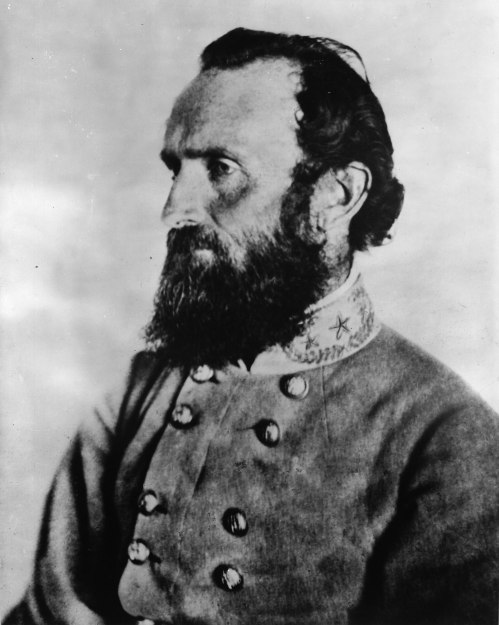
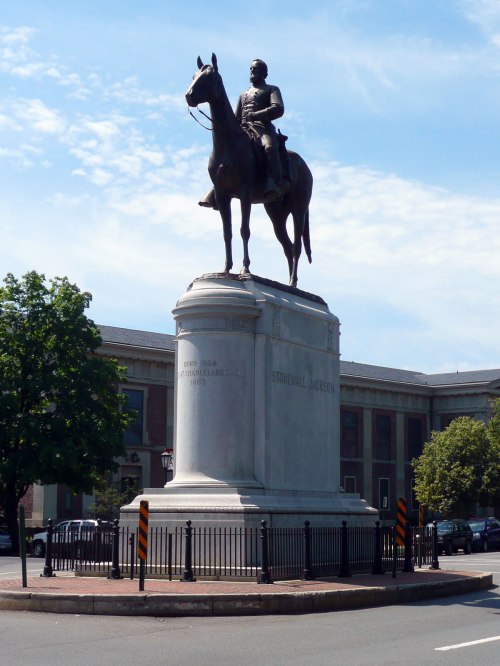
Today is the 153rd anniversary of the death of General Thomas “Stonewall” Jackson (age 39) following the Battle of Chancellorsville, when he was shot by friendly fire on the moonlit night of May 2, 1863.

"Chancellorsville" portrait, taken at a Spotsylvania County farm on April 26, 1863, seven days before he was wounded.

“Chancellorsville” portrait, taken at a Spotsylvania County farm on April 26, 1863, seven days before he was wounded. What a face!

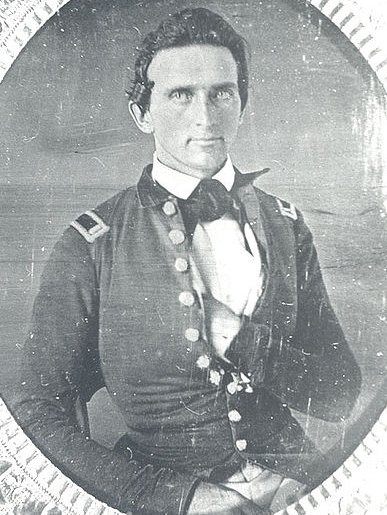
Here he is younger and beardless. Pretty dreamy.

stonewall-young

I have always admired Stonewall Jackson as an exemplar of the Scotch-Irish Protestants who came to this country in the eighteenth century, many of them as indentured servants, and worked and fought hard to make a home here. In fact his paternal great-grandparents (John Jackson and Elizabeth Cummins) met on the prison ship from London and fell in love. They married six years later when they gained their freedom.

The family migrated west across the Blue Ridge Mountains to settle near Moorefield, Virginia in 1758. In 1770, they moved farther west to the Tygart Valley. They began to acquire large parcels of virgin farming land near the present-day town of Buckhannon, including 3,000 acres in Elizabeth’s name. John and his two teenage sons fought in the Revolutionary War; John finished the war as a captain. While the men were in the army, Elizabeth converted their home to a haven for refugees from Indian attacks known as “Jackson’s Fort.”

Yes, the Jacksons were awesome.

Furthermore, Stonewall was a profoundly religious man and a deacon in the Presbyterian Church. One of his many nicknames was “Old Blue Lights,” a term applied to a military man whose evangelical zeal burned with the intensity of the blue light used for night-time display. He disliked fighting on Sunday, although that did not stop him from doing so after much personal debate.

Here is a poem by Herman Melville that pretty well sums up my feelings about the great Stonewall:

Mortally Wounded at Chancellorsville

The Man who fiercest charged in fight,
Whose sword and prayer were long –
Stonewall!
Even him who stoutly stood for Wrong,
How can we praise? Yet coming days
Shall not forget him with this song.

Dead is the Man whose Cause is dead,
Vainly he died and set his seal –
Stonewall!
Earnest in error, as we feel;
True to the thing he deemed was due,
True as John Brown or steel.

Relentlessly he routed us;
But we relent, for he is low –
Stonewall!
Justly his fame we outlaw; so
We drop a tear on the bold Virginian’s bier,
Because no wreath we owe.

Monument Avenue in Richmond, VA

Monument Avenue in Richmond, VA

*Stonewall Jackson’s dying words–beautiful!

November rain

by chuckofish

Screen shot 2015-11-17 at 11.17.45 AM

The day is cold, and dark, and dreary;
It rains, and the wind is never weary;
The vine still clings to the mouldering wall,
But at every gust the dead leaves fall,
And the day is dark and dreary.

My life is cold, and dark, and dreary;
It rains, and the wind is never weary;
My thoughts still cling to the mouldering past,
But the hopes of youth fall thick in the blast,
And the days are dark and dreary.

Be still, sad heart, and cease repining;
Behind the clouds is the sun still shining;
Thy fate is the common fate of all,
Into each life some rain must fall,
Some days must be dark and dreary.

–Henry Wadsworth Longfellow

November rain, when it goes on for days, cannot help but bring a person’s spirits down. But I like old Longfellow’s thinking on this subject. When did we stop reading him? He’s kind of great.

Henry_Wadsworth_Longfellow_by_Southworth_&_Hawes_c1850_restored

Henry was one of those handsome mid-century American writers we are so fond of. Read more about this poet here.

Anyway, please note that there is a slight chance of snow on Saturday! It won’t be long until the weather media is whipping us up into a stock-up-on-bread-and-milk frenzy.