dual personalities

Tag: History

Give the devil his due*

by chuckofish

clapper bridge

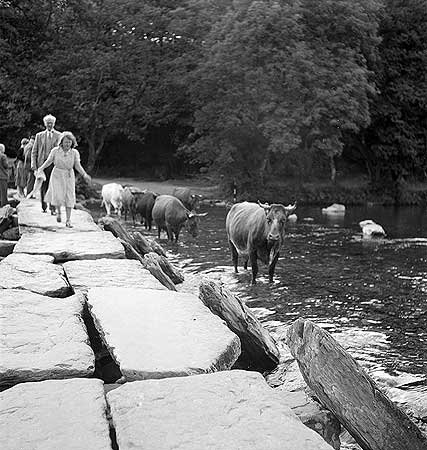
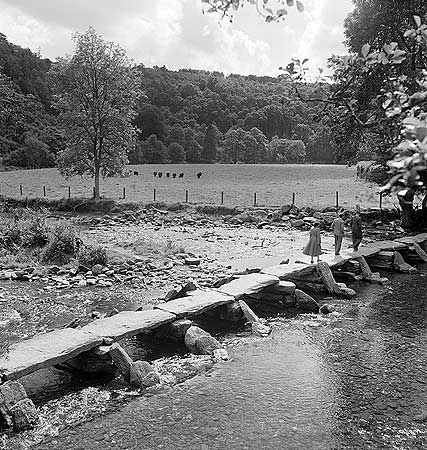
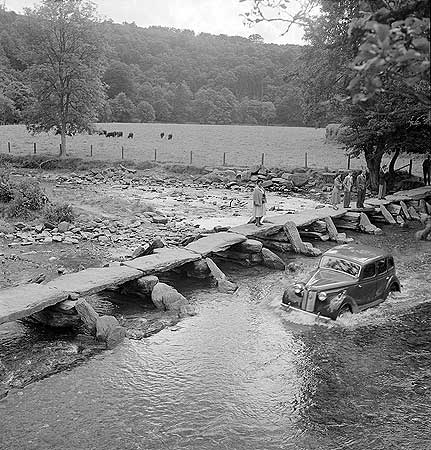
Have you ever heard of this clapper bridge, Tarr Steps, over the River Barle in Exmoor? I first came upon it here. (There are many more good pictures, so check it out.)

clapper 2

This is so cool! I mean the bridge may date to around 1000 BC! (Its age is unknown–several theories claim that Tarr Steps dates from the Bronze Age, but others date it from around 1400 AD.)  A clapper bridge, you will recall, is an ancient form of bridge found on the moors of Devon (Dartmoor and Exmoor) and in other upland areas of the United Kingdom.

The stone slabs weigh up to 1-2 tons apiece. How were they moved? According to local legend, they were placed by the devil to win a bet. The bridge is 180 feet (55 m) long and has 17 spans. Half of this bridge was washed away by the river during heavy rains in December 2012. Thankfully the bridge has now been re-assembled.

The aforementioned myth has it that the Devil built the bridge at Tarr Steps and still has sunbathing rights on its stones. Supposedly the devil swore he would kill anyone who tried to cross his bridge. The terrified locals got the parson to face him. A cat was sent over the Bridge but was vaporised in a puff of smoke. The parson then set off and met the Devil midway. The Devil swore and intimidated him but the parson reciprocated equally and finally the Devil conceded to let people pass except when he wants to sunbathe.

Photo by John Gay, 1953

These photos were taken in 1953 by John Gay. You can see more here.

John Gay 53

car in river

I’ve no doubt that my dual personality has probably been to Tarr Steps, but this provincial girl has not. If I ever get back to merry old England, I will definitely try to check out Exmoor’s National Park!

Wonderful.

*English proverb

“As if someone fled from a lion, and was met by a bear”*

by chuckofish

Are you prepared for the day of the Lord? For whom would it be good news? (Matthew 25: 1-13) These were the questions asked in our sermon yesterday. They are good ones to ask yourself. My rector was not terribly helpful in answering them, but that’s par for the course. You have to work out your own salvation anyway, so c’est la vie. I’m still stuck on old Amos’ imagery from the OT reading anyway (see above).

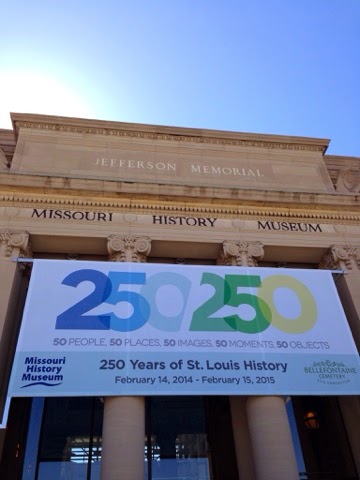
Well, the highlight of my weekend was an after-church jaunt to the Missouri History Museum with the OM. I had not been in years, but I had heard that the “250 in 250: A Yearlong Exhibit Commemorating the 250th Anniversary of the Founding of St. Louis” was not to be missed.

blogger-image-1915946725

This turned out to be an over-statement. “Through the stories of 50 People, 50 Places, 50 Images, 50 Moments, and 50 Objects we were invited to learn all about St. Louis.” This kind of display is not really my cup of tea, but it was okay.

Across the hall, however, was a very cool exhibit–“The Louisiana Purchase: Making St. Louis, Remaking America”.

2339_dt_detail

You will recall that in 1803 the United States agreed to pay France $15 million for the Louisiana Territory—828,000 square miles of land west of the Mississippi River. The United States doubled its size, expanding the nation westward. Beyond the geographic expansion, The Louisiana Purchase remade St. Louis into an American city—”and reshaped and redefined what it meant to be an American.” Featuring loans from the National Archives and documents and artifacts from the Missouri History Museum’s collections, the exhibition explores the complex negotiations related to The Louisiana Purchase and its after-effect on St. Louis. A highlight of the exhibition is the Treaty of Cession (in French), better known as The Louisiana Purchase Treaty. The Treaty was first drafted in French and then translated into English, so it can be said that the French text is the “original original.”

Anyway, the Museum has changed quite a lot since the days when we would visit with our mother. Nowhere in sight is the riverboat wheelhouse which was a favorite of mine and my dual personality’s as wee children. Also the gun collection, which made up a good part of the second floor exhibition space, is nowhere to be seen. Thankfully in moth balls is all the Veiled Prophet knick-knack-iture that also took up a lot of space in days gone by. Yes, it is all very 21st century and up-to-the-minute PC-wise, but I do miss the old-fashioned dusty taxidermy and Mark Twainia of the olden days.

Well, I’ve been there and done that now, but it is a good and mindful thing to be reminded of the wonderful and important part Missouri played in our national history.

There is a fancy restaurant in the museum, but we headed over to the Wildflower Cafe in the CWE for some eggs benedict. Yum.

How was your weekend?

*Amos 5:18 (Not Abraham Lincoln like you thought)

Smoting the Babylonian Dame

by chuckofish

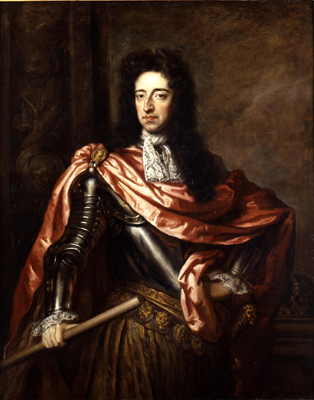
On this day in 1688, William of Orange invaded England in an action that ultimately deposed King James II and won him the crowns of England, Scotland and Ireland. Huzzah!

King_William_III_of_England,_(1650-1702)_(lighter)

William’s mother, Mary Stuart, was the oldest daughter of King Charles I and sister of King Charles II and King James II.  His wife was the daughter of King James II and his cousin. I can never keep all that royal genealogy straight, can you? I had forgotten that old William was the grandson of Charles I. It’s good to dust off the history books once in awhile, eh?

You will recall that the OM’s ancestor Henry Compton, the Bishop of London, crowned William King a few months later. He reigned jointly with his wife, Mary II, until her death in 1694–as William and Mary–and then alone until his death in 1702.

So a toast to William and Mary is definitely in order tonight, and to the Glorious Revolution when

Englands Church so much opprest
Of all its Rights now re-possest,
With all its Sacred Glories blest,
it shines in Heavenly splendor,
May it ever so endure,
And everlasting peace procure,
For him who keeps our Church secure,
and crush’d the Romish Grandieur.

(For the whole poem (ENGLANDS Triumph, OR, The Kingdoms Joy for the proclaiming of King William , and His Royal Consort, Queen Mary , in
the Throne of ENGLAND , on the 13th. of this instant February . 1688. To the Tune of, Thundering Cannons roar, click here.)


Here in Missouri

by chuckofish

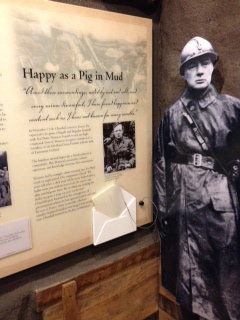
How was your weekend? The OM and I had an adventure–a roadtrip on Saturday over to Fulton in the rolling green hills of central Missouri to visit the Winston Churchill Memorial on the campus of Westminster College.

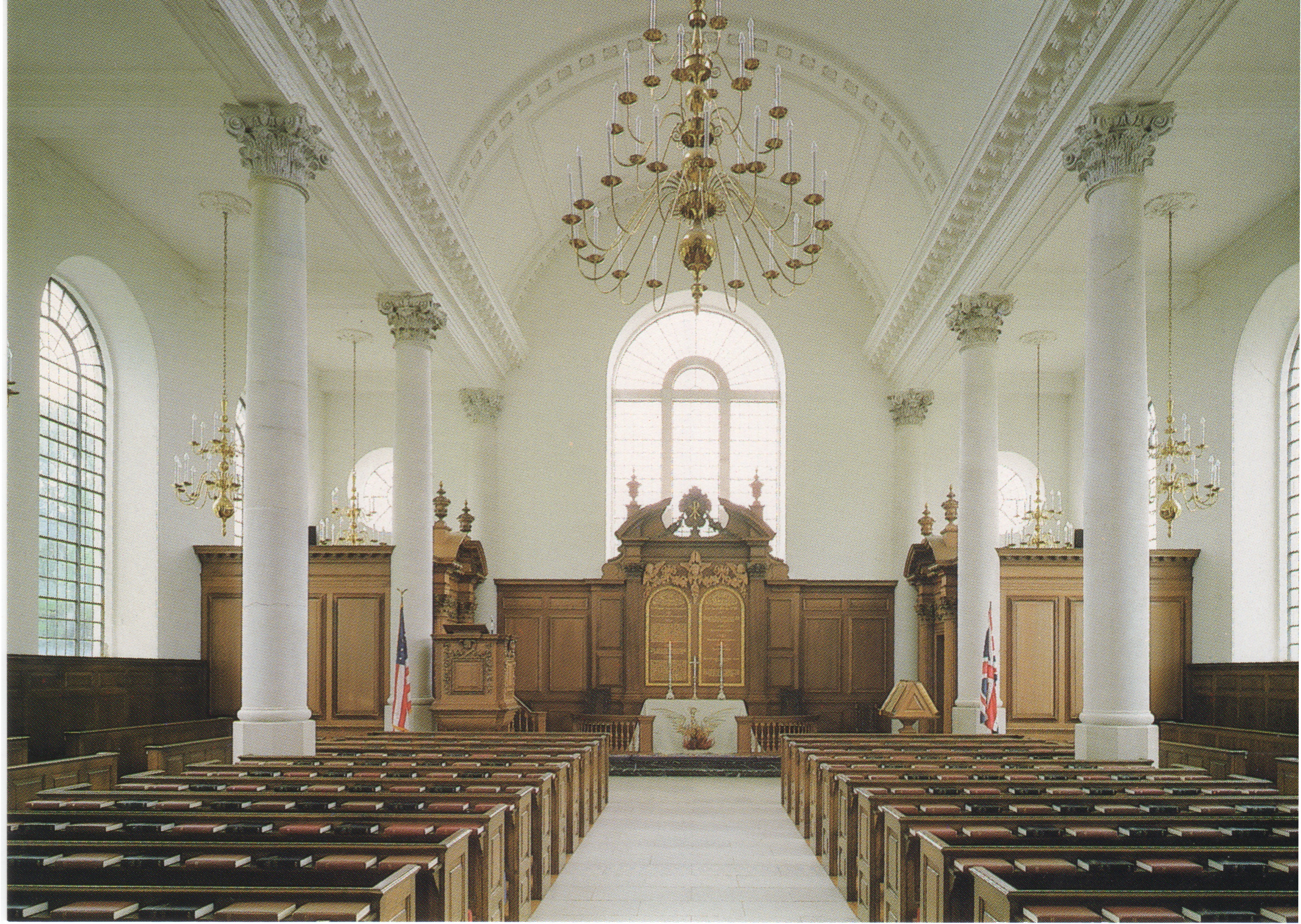
You will recall that in 1946 it was at Westminster College that Winston Churchill delivered one of the most significant speeches of his long and illustrious career–the “Iron Curtain” speech. In the 1960s Westminster College set out to mark what would be the 20th anniversary of Churchill’s visit. After due consideration of traditional modes of commemoration, Westminster College settled on the rather more ambitious notion of moving a Christopher Wren designed Church from London. This Church, St. Mary the Virgin Aldermanbury, had stood in London since 1677 when it replaced an earlier structure that had sat on the same site since the 12th century until it was destroyed in the great fire of 1666. This magnificent building, badly damaged during the London Blitz, was moved stone by stone to Westminster’s campus and rebuilt to Wren’s original specifications.

54016226

What an incredible undertaking! I had not been there since 1969 when it was dedicated. It is breathtaking.

stmarys

It is a popular venue for weddings, as you can imagine, and there was one about to take place when we ducked in, so this postcard view will have to suffice. It is my favorite type of church, reflecting the puritan branch of the Anglican church. I love those clear glass windows and brass chandeliers and the Ten Commandments behind the altar.

kneeler

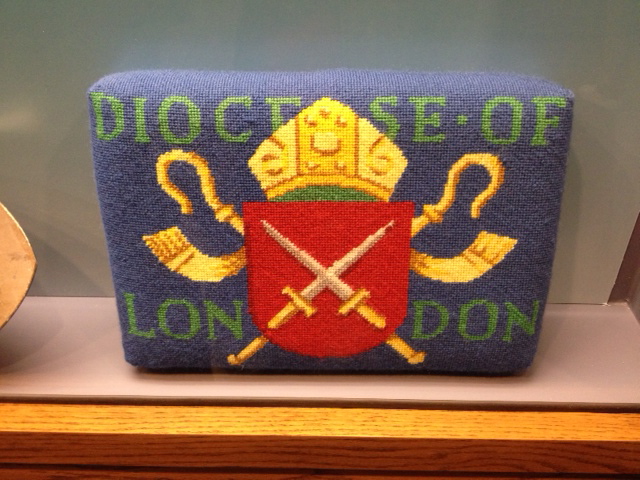
A needlepoint kneeler in the museum downstairs

The National Churchill Museum which opened in 2006 is downstairs under the church. I was quite impressed.

ANC III woud have approved

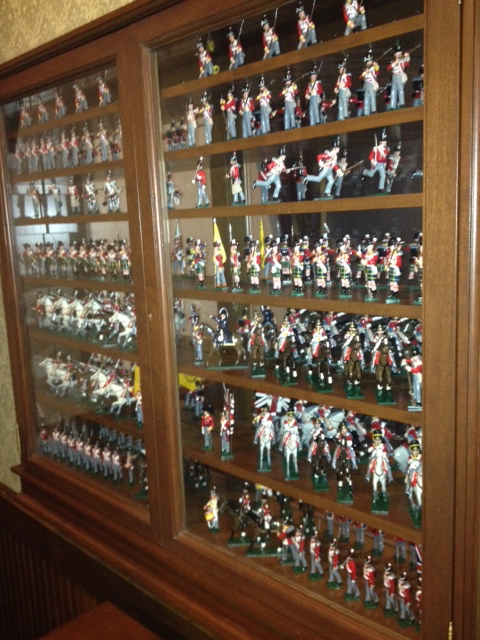
ANC III would have approved of these toy soldiers.

museuem

Indeed, ANC would have liked the museum as it illustrates the life and career of W.C.

window

Iron Curtain Speech sculpture

Iron Curtain Speech sculpture

Anyway, it is well-worth the trip to Fulton which is a nice college town, not unlike Greencastle, Indiana which we visited many times over the years when daughter #1 was a student at DePauw University. I like college towns and am always up for visiting one.

Sunday was All Saints Sunday and we had three baptisms in church. All three children, who ranged in age from infant to toddler, wailed for dear life. (Bill Baker who baptized daughter #1 and the boy always said that that was the devil leaving the child and not to worry.) Well, I always enjoy renouncing “Satan and all the spiritual forces of wickedness that rebel against God”, including “the evil powers of this world which corrupt and destroy the creatures of God”--especially a few days before an election.

Don’t forget to vote tomorrow!

Sesquicentennial news

by chuckofish

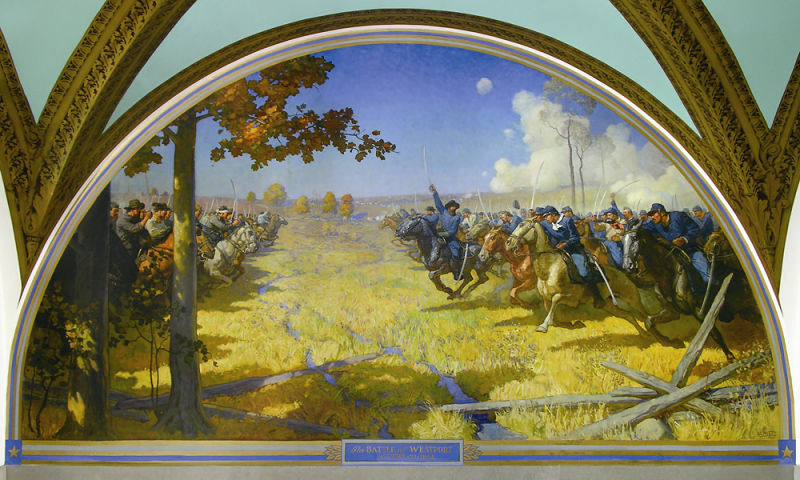
Today is the 150th anniversary of the Battle of Westport–sometimes referred to as the Gettysburg of the West–on October 23, 1864.

N.C. Wyeth mural of the Battle of Westport at the MO State Capitol

N.C. Wyeth mural of the Battle of Westport at the MO State Capitol

Union forces under Major Samuel R. Curtis decisively defeated an outnumbered Confederate force under Major Sterling Price. This engagement was the turning point of Price’s Missouri Expedition, forcing his army to retreat and ending the last significant Confederate operation west of the Mississippi River. This battle was one of the largest ever to be fought west of the Mississippi River, with over 30,000 men engaged. Buffalo Bill Cody, Wild Bill Hickcock (a scout for Gen. Curtis), Frederick Benteen, and Jeremiah Johnson all fought in this battle.

I am definitely adding this trip to my “To Do” list. I have been meaning to visit Westport, Missouri (now called Kansas City) where my ancestors were among the first pioneers to settle. And now I find that there was a major Civil War battle fought there? Where have I been?

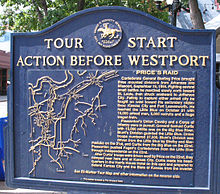
220px-Westport-plan

Unfortunately, I will have to miss the reenactment, but, as you know, I am more of the self-guided-tour type anyway.

Road trip, anyone?

Trivia question: What famous movie character had a cat named after Gen. Sterling Price?  What movie?

Way Back When Wednesday

by chuckofish

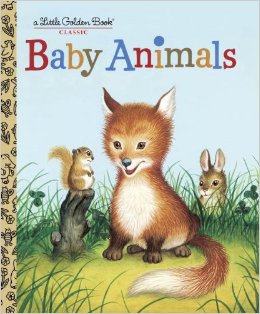
On this date back in 1942 the first twelve titles of the Little Golden Books series were published. You remember. These were the books your mother used to buy for you in the grocery store when you were a good child and deserved a treat. The books, which initially sold for 25¢ (rising to 29¢ in 1962 and currently $3.99), were published by Simon and Schuster.

Many of the best children’s writers and illustrators have worked on the series, including several of my personal favorites:

Mary Blair,

golden-fly

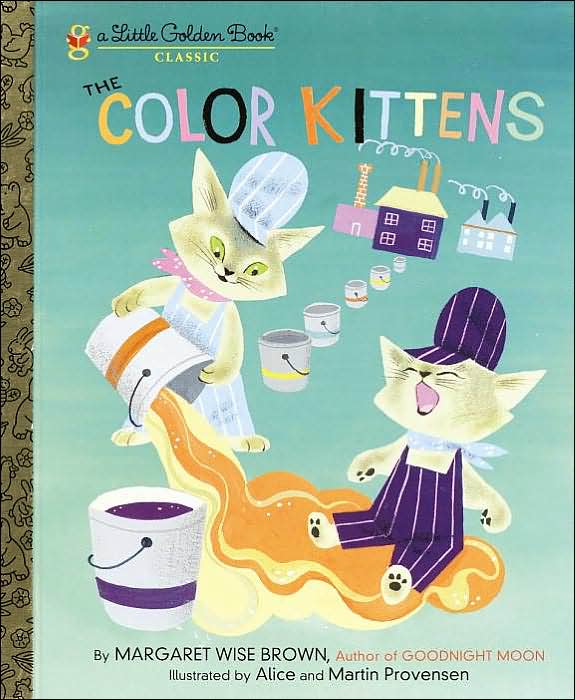
Margaret Wise Brown and Alice and Martin Provensen,

Color_Kittens Garth Williams,

babyanimals

and, of course, Richard Scarry.

the-fire-engine-golden-book-lg

You will be happy to know that now there are Little Golden Book apps for children: “Now the Little Golden Book that you loved as a child can be shared with a whole new generation in this magically interactive storybook app. Open the cover, complete with its distinctive gold spine, to reveal the timeless story, beautifully rendered with interactive illustrations on every page, and activities that encourage reading comprehension and creativity.”

“Magically interactive”! Oh brother. Just what every 3-year old needs for his/her iPad, iPhone, and iPod touch! Gone I suppose is the magically interactive time you spent with your mother or father while you were read these books.

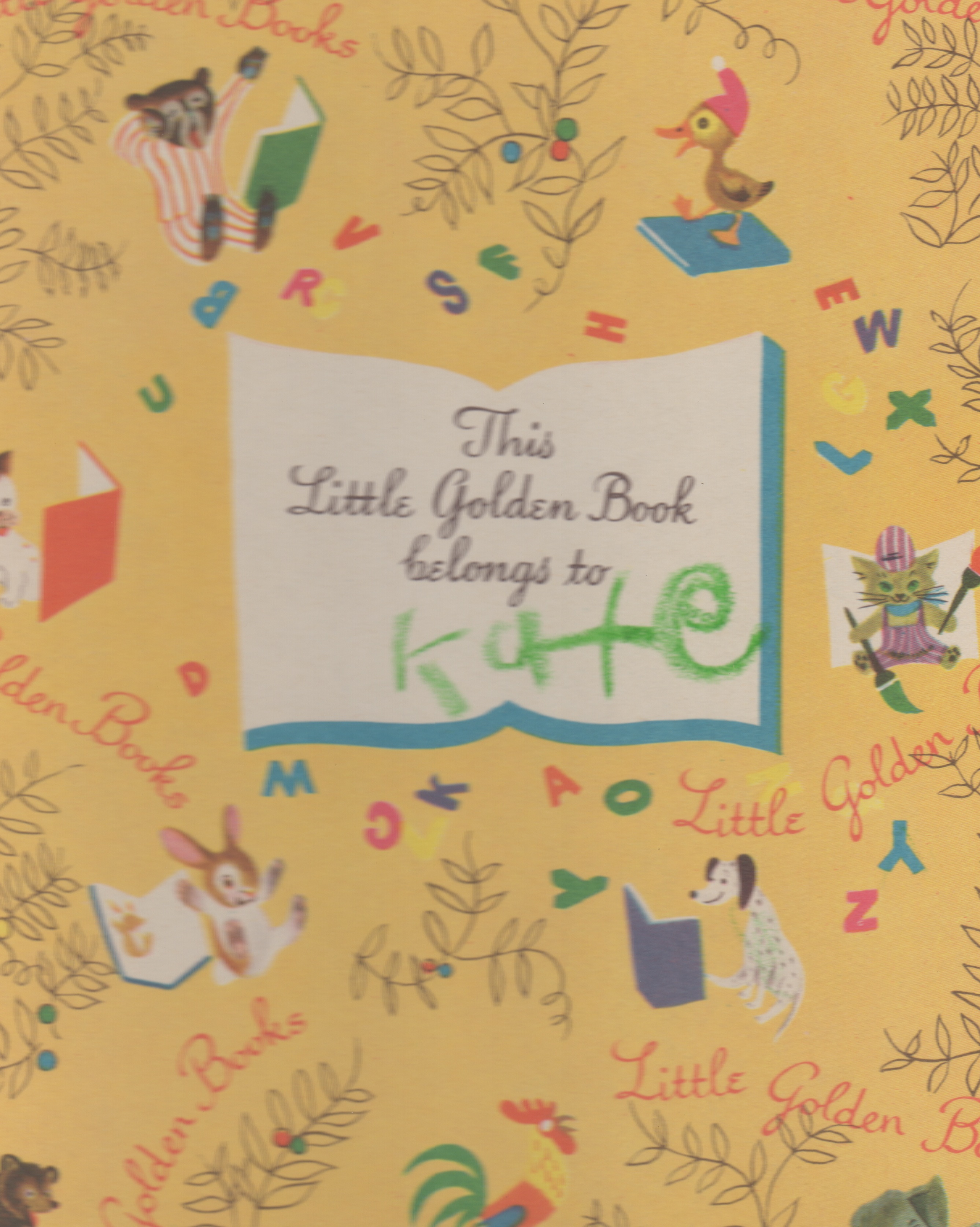
I know I am an old curmudgeon, but this concerns me. And I have to say, it’s sad that there is no name plate on an app where you can make that first attempt at proudly writing your own name on your own book.

book plate 2

Oh well. C’est la vie. Do you have a favorite Little Golden Book?

“He will my shield and portion be”*

by chuckofish

Today on the Episcopal Church calendar is the feast day of the worthy William Wilberforce, English politician, philanthropist and a leader of the movement to abolish the slave trade.

Unfinished portrait by Sir Thomas Lawrence

Unfinished portrait of Wilberforce by Sir Thomas Lawrence

He was born in 1759 and served in Parliament from 1780 to 1825. A turning point in his religious life came while on a tour of Europe. In the luggage of a travelling companion he saw a copy of William Law’s book, A Serious Call to a Devout and Holy Life. He asked his friend, “What is this?” and received the answer, “One of the best books ever written.” The two of them agreed to read it together on the journey, and Wilberforce embarked on a lifelong program of setting aside Sundays and an interval each morning on arising for prayer and religious reading. He considered his options, including the clergy, and was persuaded by Christian friends that his calling was to serve God through politics.

He was a major supporter of programs for popular education, overseas missions, parliamentary reform, and religious liberty. He is best known, however, for his untiring commitment to the abolition of slavery and the slave trade. He introduced his first anti-slavery motion in the House of Commons in 1788, in a three-and-a-half hour oration that concluded: “Sir, when we think of eternity and the future consequence of all human conduct, what is there in this life that shall make any man contradict the dictates of his conscience, the principles of justice and the law of God!”

The motion was defeated. Wilberforce brought it up again every year for eighteen years, until the slave trade was finally abolished on 25 March 1806. He continued the campaign against slavery itself, and the bill for the abolition of all slavery in British territories passed its crucial vote just four days before his death on July 29, 1833. A year later, on July 31, 1834, 800,000 slaves, chiefly in the British West Indies, were set free.

A movie of the life of William Wilberforce, Amazing Grace, was released in 2006. It stars Ioan Gruffudd as Wilberforce.

wilberAlso featured are Albert Finney as John Newton, Rufus Sewell as Thomas Clarkson and Benedict Cumberbatch as William Pitt. It is definitely worth watching for many reasons, not the least of which is that Mr. Gruffudd is so darn cute.

*Amazing Grace by John Newton

Information about Wilberforce from Christianitytoday.com.


“Though many brave unwritten tales were simply told in vapour trails”*

by chuckofish

Let’s take a moment to remember that the Battle of Britain began on July 10, 1940 as Nazi forces attacked shipping convoys in the English Channel. It was the first major assault by the Luftwaffe. Although heavily outnumbered, the British fighter pilots put up a fierce fight and succeeded in driving off the attackers.

The Battle of Britain Memorial Window for Rolls-Royce, dedicated in 1947 in the Lady Chapel in Westminster Abbey

The Battle of Britain Memorial Window for Rolls-Royce, dedicated in 1947 in the Lady Chapel in Westminster Abbey

“Spitfire” window was created to honour all members of RAF Fighter Command. It’s located at the former RAF Bentley Priory, headquarters of Fighter Command during the Second World War

“Spitfire” window created to honor all members of RAF Fighter Command. It’s located at the former RAF Bentley Priory, headquarters of Fighter Command during the Second World War.

Battle of Britain Memorial in Kent, England

Battle of Britain Memorial in Kent, England

A section of the Battle of Britain Monument in London, England

A section of the Battle of Britain Monument in London, England

I might have to dust off my copy of The Battle of Britain (1969), an “historical reenactment of the air war in the early days of World War Two for control of the skies over Britain as the new Luftwaffe and the Royal Air Force determine whether or not an invasion can take place.”

10448

Directed by Guy Hamilton, there is a lot of aerial action by Spitfires and it boasts a who’s who of British actors, including Michael Caine, Trevor Howard, Ian McShane, Laurence Olivier, Michael Redgrave, Kenneth More, Ralph Richardson, and on and on.

If I had not just recently seen Spitfire–The First of Few (1942) starring Leslie Howard and David Niven, I would certainly watch it.

spitfire-rosamund-john-david-niven-leslie-howard-1942

Leslie Howard is great as aircraft designer R.J. Mitchell and, as usual, he is doing his best to support the war effort in the best way he can.

It goes without saying that I will toast those few brave flyers who fought so valiantly to save so many. Will you join me?

* Lines from “Our Wall” by Flight Lieutenant William Walker, 616 Squadron, inscribed on a plaque next to the memorial wall in Kent.


“I don’t know what I would do without her.”*

by chuckofish

Grace_Coolidge_Official_portrait

Grace Goodhue Coolidge (January 3, 1879 – July 8, 1957) is one of my favorite first ladies. She and her husband Calvin lived for many years in Northampton, MA, a town I know well. In fact they met there, when she was on the faculty of the Clark School for the Deaf and he was a lawyer.

The story goes that while watering flowers outside the school one day in 1903, she happened to look up at the open window of Robert N. Weir’s boardinghouse and caught a glimpse of Calvin Coolidge shaving in front of a mirror with nothing on but long underwear and a hat. She burst out laughing at the sight; he heard the noise and turned to look at her. It was their first meeting. After a more formal introduction sometime later, the two were quickly attracted to each other.

Her vivacious personality was the perfect complement to his shy character. They were such opposites. She was a Pi Phi at the University of Vermont and the president of her sorority. Calvin was no Greek at Amherst. He was an outsider, an “ouden”–or “nothing.” At the Christmas break of his freshman year, he did  not want to return to school, but because he believed in finishing what he started, he did, and he pulled himself together.

Throughout their marriage, Grace and Calvin were a devoted pair. They may have been very different in some ways, but they also had a lot in common. They were both descended from Puritans, both were from Vermont and both had found their way to Northampton.

Both were animal lovers and the White House was a veritable menagerie sometimes referred to as the “Pennsylvania Avenue zoo.” Dogs, cats, birds, rabbits, even a raccoon–“She was a mischievous, inquisitive party,” wrote Grace of their raccoon Rebecca. “We had to keep watch of her when she was in the house. She enjoyed nothing better than being placed in a bathtub with a little water in it and given a cake of soap with which to play. In this fashion she would amuse herself for an hour or more.”

It is amusing to picture the man who brought dignity back to the White House with a raccoon in the bathtub.

They were indeed a couple, supporting each other. Somehow they went forward after the tragic death of their 16-year old son Calvin Jr. who had played tennis without socks and developed a blister and then sepsis. It nearly ruined them, but Calvin found solace in knowing that Abraham Lincoln had also lost a son while president. He and Grace pressed on.

If you are interested in learning more about the Coolidges, I recommend Coolidge by Amity Shlaes, published last year by Harper Collins. He and his wife were warm and real and unpretentious. They worked hard. I’m afraid we will not see their like again.

So join me in toasting Grace Coolidge tonight on the anniversary of her death in 1958.

*Calvin Coolidge referring to his wife.


“Gentleman, this is America!”*

by chuckofish

Last Saturday (June 28) was the birthday of Emerson Hough (1857–1923), the author of some 34 books and countless magazine articles and a distant cousin of my great-grandmother. You can read all about him here.

Emerson_Hough

Emerson was also descended from the original Hough who emigrated from Chester, England in 1683 to Pennsylvania, but his ancestors subsequently moved from Pennsylvania to Loudoun County, Virginia.

Family legend has it that Hough’s most famous novel, The Covered Wagon, was based on my great-great grandmother’s journal.

coveredwagon

If there is any truth to this story, boy, wouldn’t I love to get my hands on that journal! One of these days I’ll have to venture up to the University of Iowa (Hough’s alma mater) to check out his archive. (There are also letters in the collections at Iowa State and the University of Virginia.)

Besides writing fiction, Hough was also a journalist and conservationist. He once explored Yellowstone on skis and his reports were largely responsible for an act of Congress protecting the buffalo in the park.

One of the highlights of his writing career came when Theodore Roosevelt wrote him a fan letter, praising Story of the Cowboy (1897):

I don’t know when I have read a book that I like more than your “Story of the Cowboy.” I have always been hoping against hope that such a book would be written, but I had about given it up, and there was scant time remaining in which anyone could write it. At last, thank Heaven, it has been done! Not only is it to my mind a most fascinating book, but I think it is as valuable a bit of genuine contemporary history as I have yet examined.

Hough died in Evanston, Illinois, on April 30, 1923, a week after seeing the Chicago premiere of the silent movie The Covered Wagon, which was a huge hit. It ran fifty-nine weeks at the Criterion Theater in New York City, eclipsing the record of The Birth of a Nation. He is buried in Galesburg, Illinois.

findagrave.com

findagrave.com

Anyway, I plan to toast old Emerson Hough tonight. And while I’m at it, I’ll toast Teddy Roosevelt and his Rough Riders who stormed San Juan Hill on this day in 1898.

1263px-RoughRiders

How about you?

*First line of The Mississippi Bubble by Emerson Hough