dual personalities

Tag: Herman Melville

This and that

by chuckofish

“It’s better to fail in originality than to succeed in imitation.”

–Herman Melville

This statement was quoted by House Beautiful Editor-in-Chief Sophie Donelson in her July/August column. She doesn’t say where the quote comes from, but it probably wasn’t from the book on her nightstand. Of course, she was quoting Melville in reference to home decoration and that is valid I suppose, but poor Herman was talking about something different. Sadly, he knew a lot about failure.

Today is Melville’s birthday, so let’s give some thought to how to celebrate. You could check out this website: Melville’s Marginalia Online, a virtual archive of books owned and borrowed by Melville (1819-1891). Amazing! If you are in New York City, you could take the Melville walking tour. Whatever you do, be sure to wear your Herman Melville t-shirt.
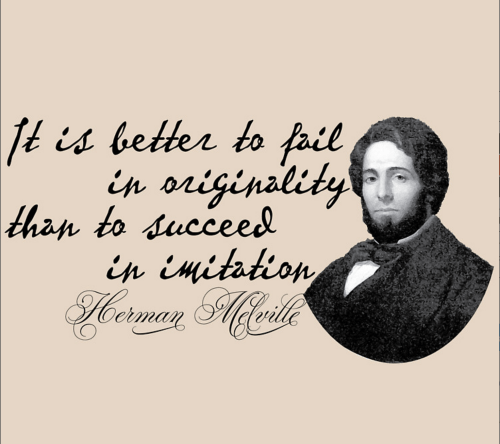
Screen Shot 2017-07-31 at 11.44.45 AM.pngAnd by that I mean, please don’t. (Maybe Ms. Donelson found the quote on a t-shirt!)

Well, moving on…we have heard a lot lately about the total solar eclipse that will occur around 1 p.m. on Monday, August 21. The last total solar eclipse here in flyover country was in 1442. As you can see, we are right in line for some great viewing!

Screen Shot 2017-07-31 at 11.02.42 AM.pngWe have, of course, been reminded ad nauseum to obtain special protective glasses if we plan to watch, so I sent off to Amazon for some of these. Am I cool or what? (Well, the OM is a scouter, so I always try to be prepared.)

Are you wondering how I am going to tie up Herman Melville’s birthday and the total eclipse of the sun? Here is a section of his obit in the New York Times of October 2, 1891:
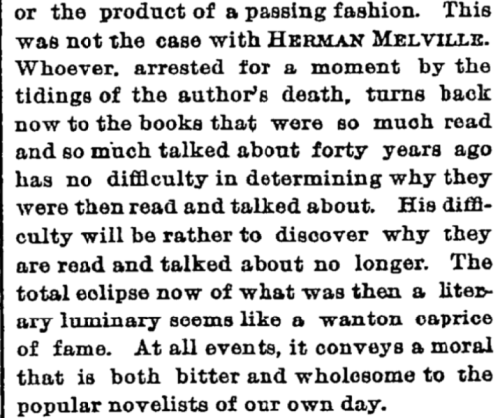
Screen Shot 2017-07-31 at 3.09.57 PM.png

Sad, sad, so sad.

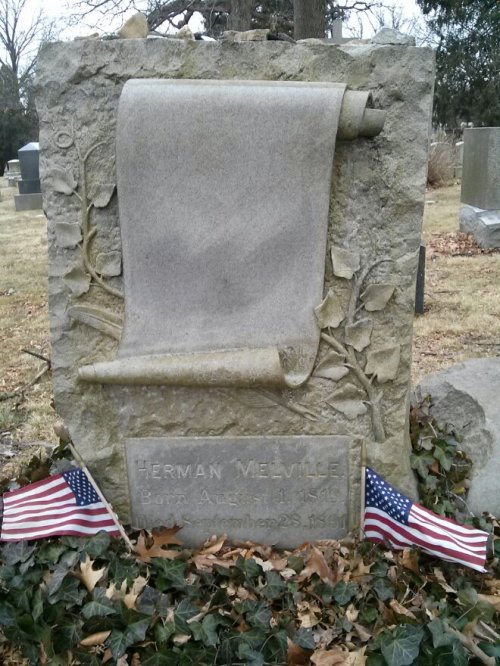
wpid-herman-melville-grave.jpg

Discuss among yourselves.

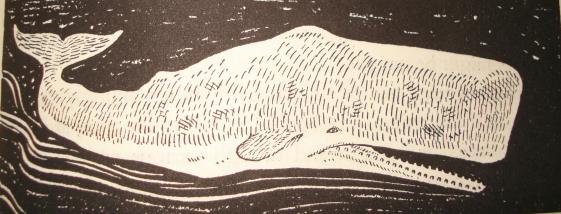
“Top-heavy was the ship as a dinnerless student with all Aristotle in his head.”*

by chuckofish

So Bob Dylan finally made his Nobel Laureate acceptance speech, the only requirement to claim the money that comes with the prize, with several days to spare. (The deadline was June 10.)

bob-dylan-2016.jpg

And of course he spent a long portion of his speech talking about Moby-Dick! Bob never disappoints.

Huzzah for Bob! And here’s some Moby-Dick for your mid-week inspiration:

“Whether to admit Hercules among us or not, concerning this I long remained dubious: for though according to the Greek mythologies, that ancient Crockett and Kit Carson–that brawny doer of rejoicing good deeds, was swallowed down and thrown up by a whale; still, whether that strictly makes a whaleman of him, that might be mooted. It nowhere appears that he ever actually harpooned his fish, unless, indeed, from the inside. Nevertheless, he may be deemed a sort of involuntary whaleman; at any rate the whale caught him, if he did not the whale. I claim him for one of our clan.”

I will also note the passing a few days ago of rock legend Gregg Allman (1947–2017) who had been sober for twenty years and was a Christian. Funnily enough, he ended up an EpiscopalianInto paradise may the angels lead you. At your coming may the martyrs receive you, and bring you into the holy city Jerusalem.

*Herman Melville, Moby-Dick

“The skeleton of the whale furnishes but little clue to the shape of his fully invested body.”*

by chuckofish

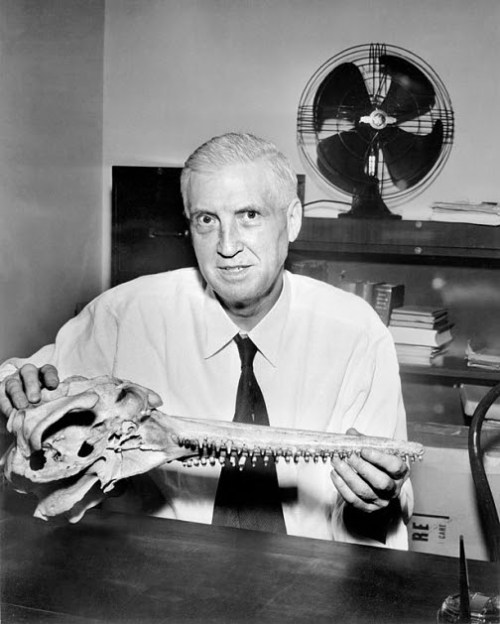
kellogg-photoToday is the birthday of Remington Kellogg (October 5, 1892 –May 8, 1969)–a fascinating fellow who was an American naturalist and a director of the United States National Museum. Born and raised in Davenport, Iowa, he attended the University of Kansas where he pursued his lifelong interest in wildlife. From there he went to the University of California–Berkeley. While serving in the Army in France during WWI, Kellogg still found time to collect specimens, which he sent back to Berkeley and the University of Kansas. He was discharged in July 1919 and returned to Berkeley to complete his doctorate, transferring from zoology to study vertebrate paleontology.

6a01156e4c2c3d970c01b8d0d4c2a7970c

In 1928 Kellogg became assistant curator at the United States National Museum and in 1941 became curator. At the museum he devoted time to studying primitive whales from the Eocene and early Oligocene of North America. In 1948 he was appointed director of the Museum and in 1958 was made assistant secretary of the Smithsonian Institution. He was elected to the National Academy of Sciences in 1951.

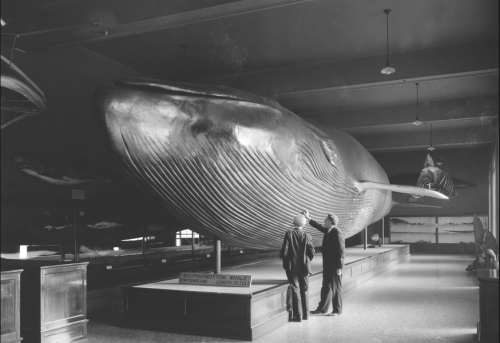
Whales have been at the heart of Smithsonian research since 1850. It was Museum director Remington Kellogg who wanted a “scientifically accurate” model and pushed for the research to make one.

2002-12150

So a toast to Remington Kellogg (what a great name!) and to Herman Melville while we’re at it.

“Speak, thou vast and venerable head,” muttered Ahab, “which, though ungarnished with a beard, yet here and there lookest hoary with mosses; speak, mighty head, and tell us the secret thing that is in thee. Of all divers, thou hast dived the deepest. That head upon which the upper sun now gleams, has moved amid this world’s foundations. Where unrecorded names and navies rust, and untold hopes and anchors rot; where in her murderous hold this frigate earth is ballasted with bones of millions of the drowned; there, in that awful water-land, there was thy most familiar home. Thou hast been where bell or diver never went; hast slept by many a sailor’s side, where sleepless mothers would give their lives to lay them down. Thou saw’st the locked lovers when leaping from their flaming ship; heart to heart they sank beneath the exulting wave; true to each other, when heaven seemed false to them. Thou saw’st the murdered mate when tossed by pirates from the midnight deck; for hours he fell into the deeper midnight of the insatiate maw; and his murderers still sailed on unharmed — while swift lightnings shivered the neighboring ship that would have borne a righteous husband to outstretched, longing arms. O head! thou hast seen enough to split the planets and make an infidel of Abraham, and not one syllable is thine!

Have a good “hump” day!

*Moby-Dick, Herman Melville

“Let us cross over the river, and rest under the shade of the trees.”*

by chuckofish

Today is the 153rd anniversary of the death of General Thomas “Stonewall” Jackson (age 39) following the Battle of Chancellorsville, when he was shot by friendly fire on the moonlit night of May 2, 1863.

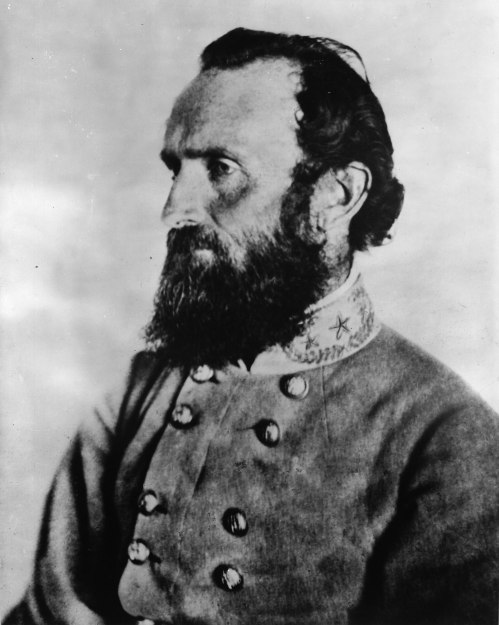
"Chancellorsville" portrait, taken at a Spotsylvania County farm on April 26, 1863, seven days before he was wounded.

“Chancellorsville” portrait, taken at a Spotsylvania County farm on April 26, 1863, seven days before he was wounded. What a face!

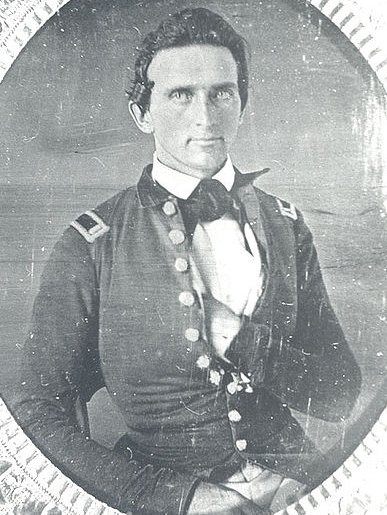
Here he is younger and beardless. Pretty dreamy.

stonewall-young

I have always admired Stonewall Jackson as an exemplar of the Scotch-Irish Protestants who came to this country in the eighteenth century, many of them as indentured servants, and worked and fought hard to make a home here. In fact his paternal great-grandparents (John Jackson and Elizabeth Cummins) met on the prison ship from London and fell in love. They married six years later when they gained their freedom.

The family migrated west across the Blue Ridge Mountains to settle near Moorefield, Virginia in 1758. In 1770, they moved farther west to the Tygart Valley. They began to acquire large parcels of virgin farming land near the present-day town of Buckhannon, including 3,000 acres in Elizabeth’s name. John and his two teenage sons fought in the Revolutionary War; John finished the war as a captain. While the men were in the army, Elizabeth converted their home to a haven for refugees from Indian attacks known as “Jackson’s Fort.”

Yes, the Jacksons were awesome.

Furthermore, Stonewall was a profoundly religious man and a deacon in the Presbyterian Church. One of his many nicknames was “Old Blue Lights,” a term applied to a military man whose evangelical zeal burned with the intensity of the blue light used for night-time display. He disliked fighting on Sunday, although that did not stop him from doing so after much personal debate.

Here is a poem by Herman Melville that pretty well sums up my feelings about the great Stonewall:

Mortally Wounded at Chancellorsville

The Man who fiercest charged in fight,
Whose sword and prayer were long –
Stonewall!
Even him who stoutly stood for Wrong,
How can we praise? Yet coming days
Shall not forget him with this song.

Dead is the Man whose Cause is dead,
Vainly he died and set his seal –
Stonewall!
Earnest in error, as we feel;
True to the thing he deemed was due,
True as John Brown or steel.

Relentlessly he routed us;
But we relent, for he is low –
Stonewall!
Justly his fame we outlaw; so
We drop a tear on the bold Virginian’s bier,
Because no wreath we owe.

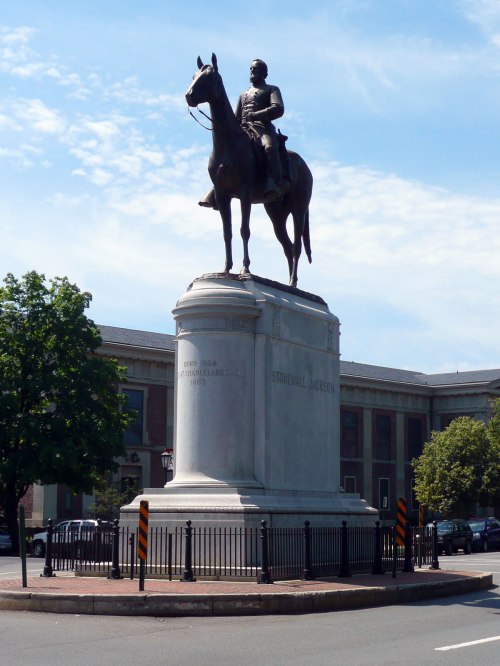
Monument Avenue in Richmond, VA

Monument Avenue in Richmond, VA

*Stonewall Jackson’s dying words–beautiful!

All is hushed at Shiloh

by chuckofish

One hundred and fifty-three years ago, on April 7, 1862, Union forces led by Gen. Ulysses S. Grant defeated the Confederates at the battle of Shiloh in Tennessee. The day before, however, was a terrible day for Grant.

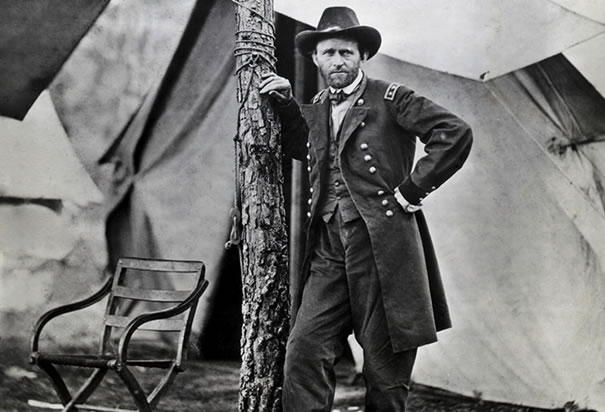
ulysses-s-grant-civiltree

In his memoirs Grant describes the night of April 6:

During the night rain fell in torrents and our troops were exposed to the storm without shelter. I made my headquarters under a tree a few hundred yards back from the river bank. My ankle was so much swollen from the fall of my horse the Friday night preceding, and the bruise was so painful, that I could get no rest. The drenching rain would have precluded the possibility of sleep without this additional cause. Some time after midnight, growing restive under the storm and the continuous pain, I moved back to the loghouse under the bank. This had been taken as a hospital, and all night wounded men were being brought in, their wounds dressed, a leg or an arm amputated as the case might require, and everything being done to save life or alleviate suffering. The sight was more unendurable than encountering the enemy’s fire, and I returned to my tree in the rain.

Historian Bruce Catton (Grant Moves South) describes a meeting between Sherman and Grant that night:

Late that night…Sherman came to see him. Sherman had found himself, in the heat of the enemy’s fire that day, but now he was licked; as far as he could see, the important next step was to “put the river between us and the enemy, and recuperate,” and he hunted up Grant to see when and how the retreat could be arranged. He came on Grant, at last, at midnight or later, standing under the tree in the heavy rain, hat slouched down over his face, coat-collar up around his ears, a dimly-glowing lantern in his hand, cigar clenched between his teeth. Sherman looked at him; then, “moved,” as he put it later, “by some wise and sudden instinct” not to talk about retreat, he said: “Well, Grant, we’ve had the devil’s own day, haven’t we?”

Grant said “Yes,” and his cigar glowed in the darkness as he gave a quick, hard puff at it, “Yes. Lick ’em tomorrow, though.”

And they did.

Among the enlisted men fighting that day were a young Ambrose Bierce of the Ninth Indiana and 21-year old Henry Morton Stanley (who later discovered Dr. Livingstone in Africa) of the 6th Arkansas Infantry.  Major General Lew Wallace (who later wrote Ben Hur) was there as well.

Herman Melville was not present at Shiloh, but he wrote a poem about it which I like very much:

Skimming lightly, wheeling still,
The swallows fly low
Over the field in clouded days,
The forest-field of Shiloh–
Over the field where April rain
Solaced the parched ones stretched in pain
Through the pause of night
That followed the Sunday fight
Around the church of Shiloh–
The church so lone, the log-built one,
That echoed so many a parting groan
And natural prayer
Of dying foeman mingled there–
Foeman at morn, but friends at eve–
Fame or country least their care:
(What like a bullet can undeceive!)
But now they lie low,
While over them the swallows skim
And all is hushed at Shiloh.

–Herman Melville, “Shiloh: A Requiem”

Let’s all just take a moment.

Dedication to a mountain

by chuckofish

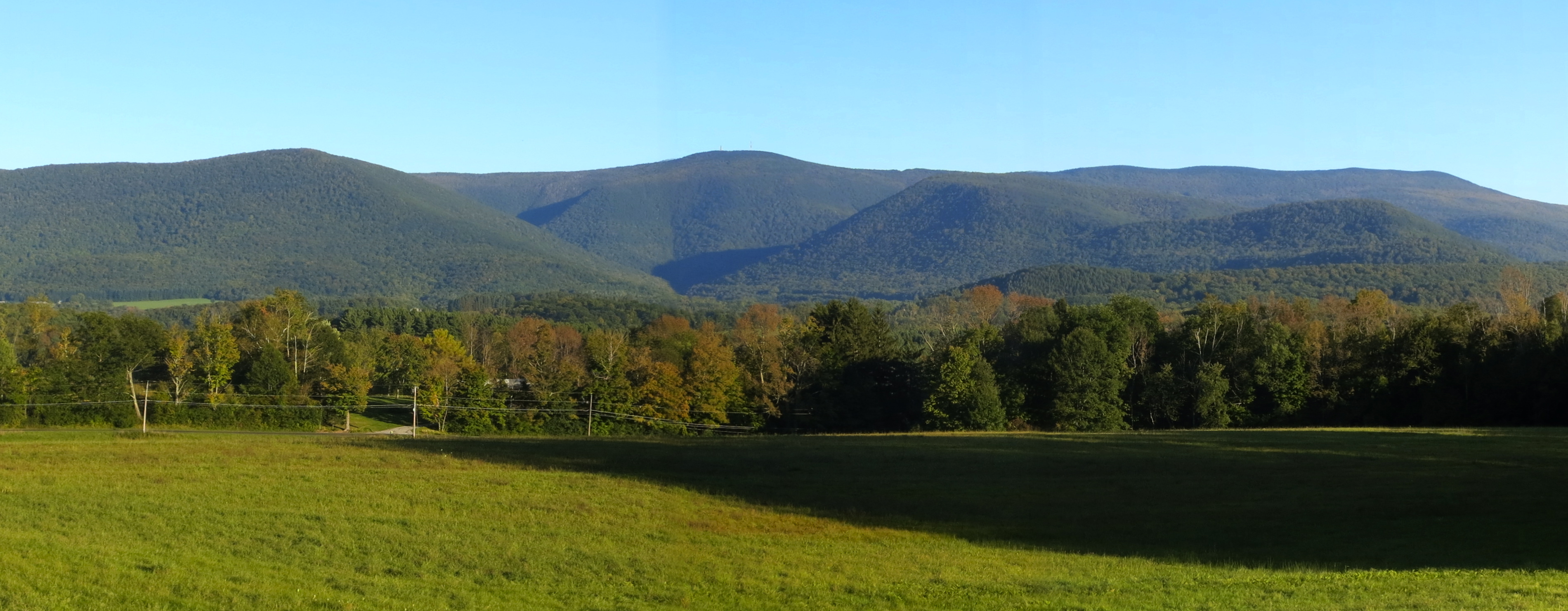
I was reminded recently that Herman Melville dedicated Pierre: or, The Ambiguities to a particular mountain, which I saw every day when I was a student at Williams College. I climbed Mt. Greylock one Saturday with members of the Mountain Club and enjoyed the view which encompasses five states.

Mount_Greylock_Massive

It was always in the background of all our shenanigans.

mt greylock

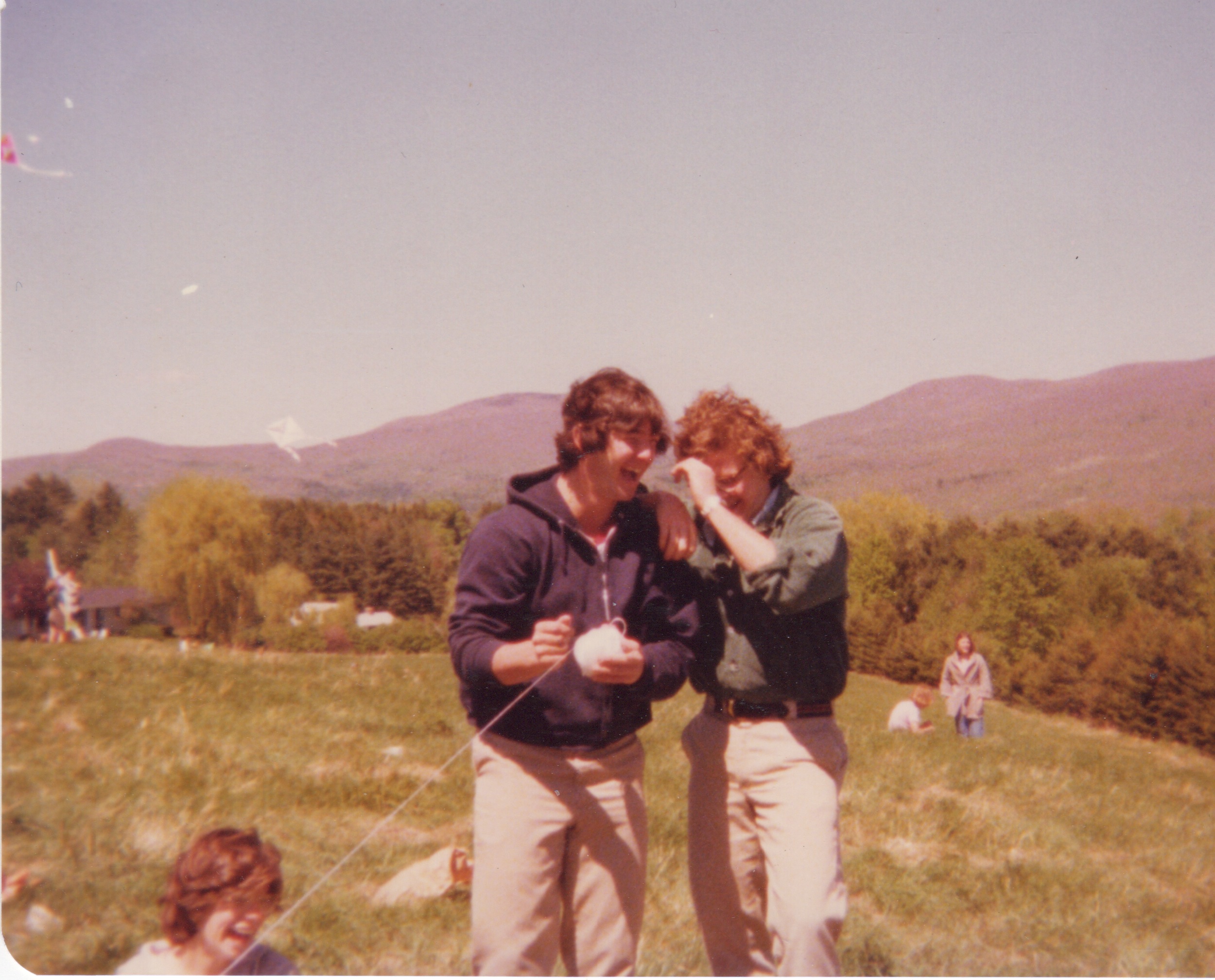
Kite flying in the spring of 1977 with Spud and Emmett

I miss those mountains, and I suppose those big-hearted football players.

Anyway, here is Melville’s most gracious dedication:

To Greylock’s Most Excellent Majesty

In old times authors were proud of the privilege of dedicating their works to Majesty. A right noble custom, which we of Berkshire must revive. For whether we will or no, Majesty is all around us here in Berkshire, sitting as in a grand Congress of Vienna of majestical hill-tops, and eternally challenging homage.

But since the majestic mountain, Greylock–my own more immediate sovereign lord and king–hath now, for innumerable ages, been the one grand dedicatee of the earliest rays of all the Berkshire mornings, I know not how his Imperial Purple Majesty (royal born: Porphyrogenitus) will receive the dedication of my own poor solitary ray.

Nevertheless, forasmuch as I, dwelling with my loyal neighbours, the Maples and the Beeches, in the amphitheatre over which his central majesty presides, have received his most bounteous and unstinted fertilisations, it is but meet, that I here devoutly kneel, and render up my gratitude, whether, thereto, The Most Excellent Purple Majesty of Greylock benignantly incline his hoary crown or no.

Don’t you just love old Herman? I mean really.

I look down deep and do believe

by chuckofish

Moby Dick by Rockwell Kent

Moby Dick by Rockwell Kent

(Ahab) “Oh, grassy glades! oh, ever vernal endless landscapes in the soul; in ye,–though long parched by the dead drought of the earthly life,–in ye, men yet may roll, like young horses in new morning clover; and for some few fleeting moments, feel the cool dew of life immortal in them. Would to God these blessed calms would last. But the mingled, mingling threads of life are woven by warp and woff; calms crossed by storms, a storm for every calm. There is no stead unretracing progress in this life; we do not advance through fixed graduations, and at the last one pause:–through infancy’s unconscious spell, boyhood’s thoughtless faith, adolescence’s doubt (the common doom), then skepticism, then disbelief, resting at last in manhood’s pondering repose of If. But once gone through, we trace the round again; and are infants, boys, and men, and Ifs eternally. Where lies the final harbor, whence we unmoor no more? In what rapt ether sails the world, of which the weariest will never weary? Where is the foundling’s father hidden? Our souls are like those orphans whose unwedded mothers die in bearing them: the secret of our paternity lies in their grave, and we must there to learn it.”

And the same day, too, gazing far down from his boat’s side into that same golden sea. Starbuck lowly murmured:–“Loveliness unfathomable, as ever lover saw in his young bride’s eye!–Tell me not of thy teeth-tiered sharks, and thy kidnapping cannibal ways. Let faith oust fact; let fancy oust memory; I look deep down and do believe.”

Tomorrow is Herman Melville’s birthday, so take a break today and read some Moby-Dick!


“May the wind under your wings bear you where the sun sails and the moon walks”*

by chuckofish

Happy MLK Day! A three-day weekend is most welcome, n’est-ce pas?

I am enjoying my Monday at home. Hope you are as well.

Yesterday after church I convinced my old man to drive to West Alton to the Riverlands Migratory Bird Sanctuary, located at the confluence of the Missouri, Illinois and Mississippi Rivers. It is primetime for watching Bald Eagles and Trumpeter Swans.

Here is a cool video about the awesome Mississippi Flyway:

http://riverlands.audubon.org/videos/spectacle-birds

It was very crowded at the Audubon Center (which is lovely), so we didn’t stay too long, but headed north up the Great River Road.

We saw a lot of eagles. (You know how I feel about raptors.) And eagles are the coolest, right?

“…and there is a Catskill eagle in some souls that can alike dive down into the blackest gorges, and soar out of them again and become invisible in the sunny spaces. And even if he forever flies within the gorge, that gorge is in the mountains; so that even in his lowest swoop the mountain eagle is still higher than the other birds upon the plain, even though they soar.”

(H. Melville)

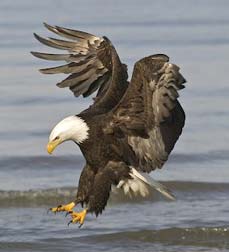
Someone else's cool picture of a Bald Eagle on the Mississippi Flyway

Someone else’s cool picture of a Bald Eagle on the Mississippi Flyway

I did not take any good pictures with my iPhone, although I tried (see below).

sky

But they were there. The river was filled with chunks of ice.

ice

We drove all the way up through Elsah and Grafton to Pere Marquette State Park and stopped for lunch at the historic Lodge,

IMGP0896

but the wait would have been too long, so we headed back down the road and home to terra cognita and our local Schneithorst’s Bavarian Koffee Haus. It was not crowded.

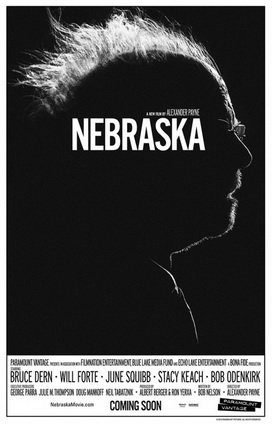
On my own “Road to Oscar” travels, I watched the movie Nebraska this weekend.

Nebraska_Poster

It is a “comedy-drama” starring Bruce Dern and Will Forte and is directed by Alexander Payne. It was nominated for the Palme d’Or at the 2013 Cannes Film Festival, where Bruce Dern won the Best Actor Award. It has also been nominated for 6 Academy Awards, including Best Picture, Best Director, Best Actor and Best Supporting Actress, and Best Original Screenplay. My guess is it won’t win anything except maybe the screenplay award. We’ll see.

I can’t say I was impressed. It is one of those movies where nothing much happens and is, therefore, “arty”. Plus, it is in black and white, and that makes it even arty-er. It is also about people who live in flyover country, so they are all kind of stupid, vulgar and boring. (I live in flyover country and I do not know anyone like the people in this movie; they are what people who live on the East/West coasts think people in flyover country are like.) The only person who is at all nice is the son played by Will Forte. I kept waiting for something to happen, for the Bruce Dern character to finally have a say, but he never comes out of his dementia-fog. Why the French thought him worthy of the Best Actor award, I’ll never know.

It held my interest–mostly because I was waiting for a pay-off (none came)–and I have to say, my old man sat through the whole thing without a break. That is saying something. However, he didn’t like it either.

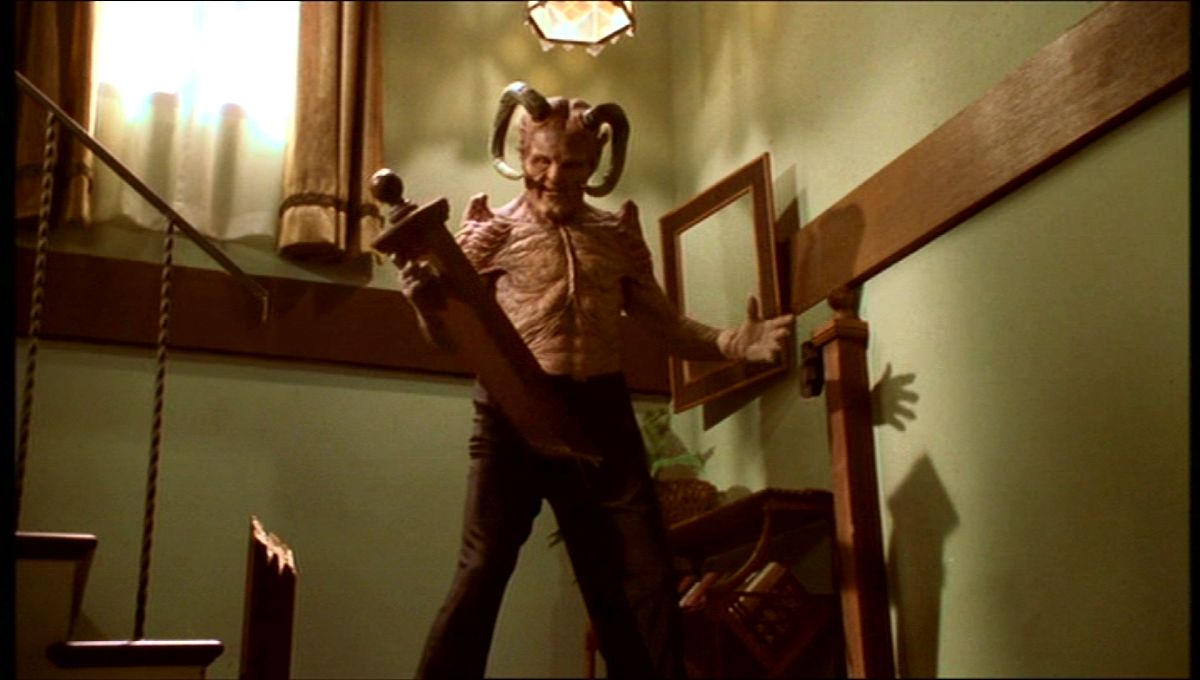
I also watched, per my recommendation on Friday, Buffy’s season 4 birthday episode with Giles as a fyoral demon.

412_NewMan3

It was a much better choice.

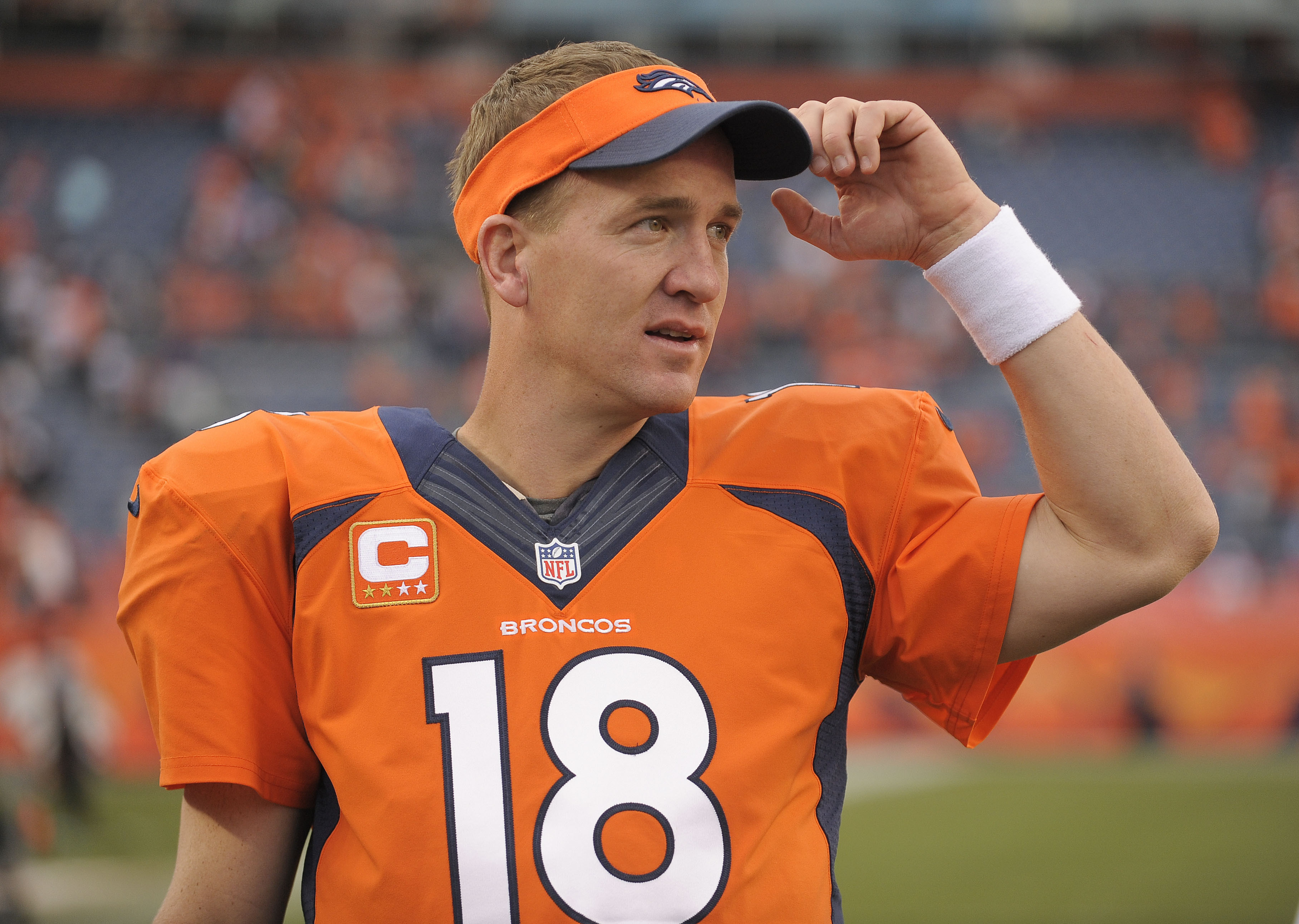
P.S. The Broncos won–go, my man, Peytie Pie!

Eagles Broncos Football

*Gandalf

A new month and a few things to keep in mind

by chuckofish

deskaugust

A new month, a new calendar page and the end of summer in sight. For those of us in this flyover state it has not been a bad summer weather-wise. Indeed, we have had lovely long stretches of Michigan-esque weather. By this time, usually, we are counting the days ’til fall, but not this year. I am in no hurry for school to be back in session full throttle. I plan to enjoy the dog days that are left of summer 2013.

The August TCM star of the month is old Humphrey Bogart, film idol and Episcopalian.

bogart

As I’ve mentioned before, my mother had a preference for Warner Brothers stars, such as Bogart and Errol Flynn, because she went to see all those movies at the Lewis J. Warner ’28 Memorial Theater at Worcester Academy (which I blogged about here). Like my mother, I feel that same thrill when the Warner Brothers logo appears and their rousing theme is played at the beginning of all their movies. TCM is not showing anything that I haven’t seen a million times and my favorite Bogart film, The Petrified Forest, is not on the line-up, but oh well. They are all still better than anything you’ll see on network television–reruns and commercials!

Tonight, however, they are showing my second-favorite Bogart film Key Largo, which is also one of my all-time favorite movies. I just saw it again recently and it really is fabulous. John Huston and Bogart were a good team and the star is at his best, ably supported by Edward G. Robinson, Claire Trevor and Lauren Bacall. So be sure to tune in or (at the very least) set your DVR.

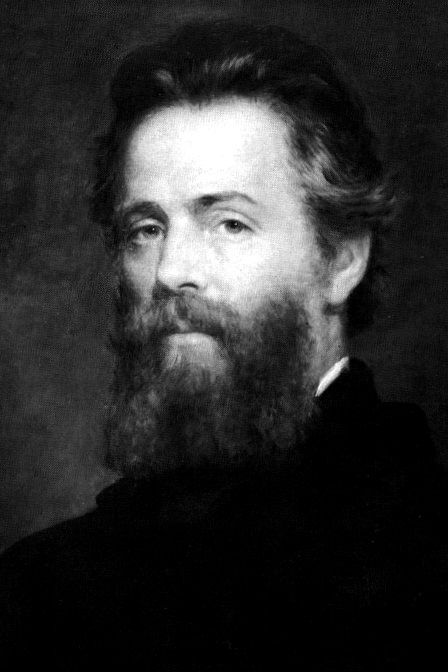
August 1 is also the birthday of Herman Melville (August 1, 1819 – September 28, 1891), American writer and author, of course, of Moby-Dick.

Herman_Melville

This would be a great month to read the great book! You know you’ve been meaning to. Here’s a little something to get you in the mood.

“There is no steady unretracing progress in this life; we do not advance through fixed gradations, and at the last one pause:– through infancy’s unconscious spell, boyhood’s thoughtless faith, adolescence’s doubt (the common doom), then scepticism, then disbelief, resting at last in manhood’s pondering repose of If. But once gone through, we trace the round again; and are infants, boys, and men, and Ifs eternally. Where lies the final harbor, whence we unmoor no more? In what rapt ether sails the world, of which the weariest will never weary? Where is the foundling’s father hidden? Our souls are like those orphans whose unwedded mothers die in bearing them: the secret of our paternity lies in their grave, and we must there to learn it.”

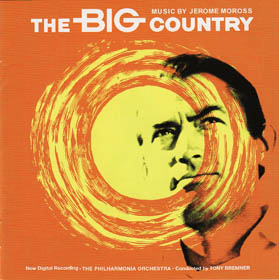
August 1 is the birthday as well of Jerome Moross (August 1, 1913 – July 25, 1983) who composed works for symphony orchestra, chamber ensembles, soloists, musical theatre, and movies. He also orchestrated motion picture scores for other composers. His best known film score is that for the 1958 movie The Big Country, for which he was nominated for an Academy Award for Original Music Score.

Jerome Moross - The Big Country - Front

The winner that year in that category was The Old Man and the Sea, scored by Dimitri Tiomkin. Hold the phone! Are you kidding me? Jerome Moross was robbed! But why am I never surprised? Anyway, you might want to watch that movie–it’s a good one. It misses being a great western because of the annoying plot and the super annoying character played by Carol Baker. Nevertheless, it has some great people in it: Gregory Peck, Charlton Heston, Jean Simmons, and Burl Ives (who won the Oscar for Best Supporting Actor). And the score is probably the best ever.

So here’s to a good August filled with great movies and great books! Let’s all have a good one.

“I hate quotations. Tell me what you know.”*

by chuckofish

quote1

I love quotations and have been filling “quote books” since I was in the eighth grade. I have no idea where that first book is, but I remember it clearly. It was a plain spiral notebook with a brown cardboard cover. I wish I could find it. I have no doubt the contents are priceless.

Forty-three years later, I am still at it. I have lots of quote books in every shape and size. Trouble is, there is no rhyme nor reason to my books and I have no idea where any particular quote is.

But as Melville writes: “There are some enterprises in which a careful disorderliness is the true method.”

Whenever I go back and look at one of these books, I find great things, which I have inevitably forgotten.

Here’s a quote from Mark Helprin’s Soldier of the Great War, which I read many years ago:

“Alessandro, in memory, things, objects, and sensations merely stand in for the people you love.” He had to rest and breathe before he continued. After a while, he said, “If I long for a thunderstorm in Rome sixty years ago, or seventy, for the heavy rain and the disheveled lightening, for the wet trees that were completely free and completely abandoned, it’s not because of the rain, or the quiet, or the ticking of the clock in the hallway–all of which I remember–but because of my mother and my father, who held me at the window as we watched the storm.”

Do you have a quote book?

*Said by the ever-so-quotable Ralph Waldo Emerson