dual personalities

Tag: George Herbert

The soul in paraphrase

by chuckofish

Maybe nobody wants to hear any more about prayer, but here’s a great poem by George Herbert who, you will recall, was a poet and Anglican priest writing in the seventeenth century.

Prayer the church’s banquet, angel’s age,
God’s breath in man returning to his birth,
The soul in paraphrase, heart in pilgrimage,
The Christian plummet sounding heav’n and earth
Engine against th’ Almighty, sinner’s tow’r,
Reversed thunder, Christ-side-piercing spear,
The six-days world transposing in an hour,
A kind of tune, which all things hear and fear;
Softness, and peace, and joy, and love, and bliss,
Exalted manna, gladness of the best,
Heaven in ordinary, man well drest,
The milky way, the bird of Paradise,
Church-bells beyond the stars heard, the soul’s blood,
The land of spices; something understood.

“Prayer (1)” by George Herbert

So brave a palace

by chuckofish

IMG_1149.jpeg

Well, the wee babes went back to school this week. They were pretty excited about it.

As you can see, Lottiebelle is already co-leading the class…

IMG_1190.JPG

Tomorrow the OM and I are heading down to Jefferson City to hang out at daughter #1’s new apartment. (Check out the new video on the JC Visitor’s Bureau webpage–JC is a happening place.) I’m sure we won’t be much actual help unpacking stuff etc, but we can lend moral support and give advice.

Screen Shot 2019-08-15 at 5.03.26 PM.png

Yeah, that lamp looks swell over there….

I am looking forward to a change of scenery!

Today I start a new, once-a-week chemo routine and I am hoping it is a bit easier than the last rotation. On verra bien.

For us the winds do blow,
The earth doth rest, heaven move, and fountains flow.
     Nothing we see but means our good,
     As our delight or as our treasure:
The whole is either our cupboard of food,
          Or cabinet of pleasure.

          The stars have us to bed;
Night draws the curtain, which the sun withdraws;
     Music and light attend our head.
     All things unto our flesh are kind
In their descent and being; to our mind
          In their ascent and cause.

          Each thing is full of duty:
Waters united are our navigation;
     Distinguishèd, our habitation;
     Below, our drink; above, our meat;
Both are our cleanliness.
  Hath one such beauty?
          Then how are all things neat?

          More servants wait on Man
Than he'll take notice of:  in every path
     He treads down that which doth befriend him
     When sickness makes him pale and wan.
O mighty love!  Man is one world, and hath
          Another to attend him.

          Since then, my God, thou hast
So brave a palace built, O dwell in it
     That it may dwell with thee at last!
     Till then, afford us so much wit,
That, as the world serves us, we may serve thee,
          And both thy servants be.
--George Herbert, from "Man"

“When glorie swells the heart”*

by chuckofish

Can you believe that a week from today is Ash Wednesday? Where did February go? I  mean really.

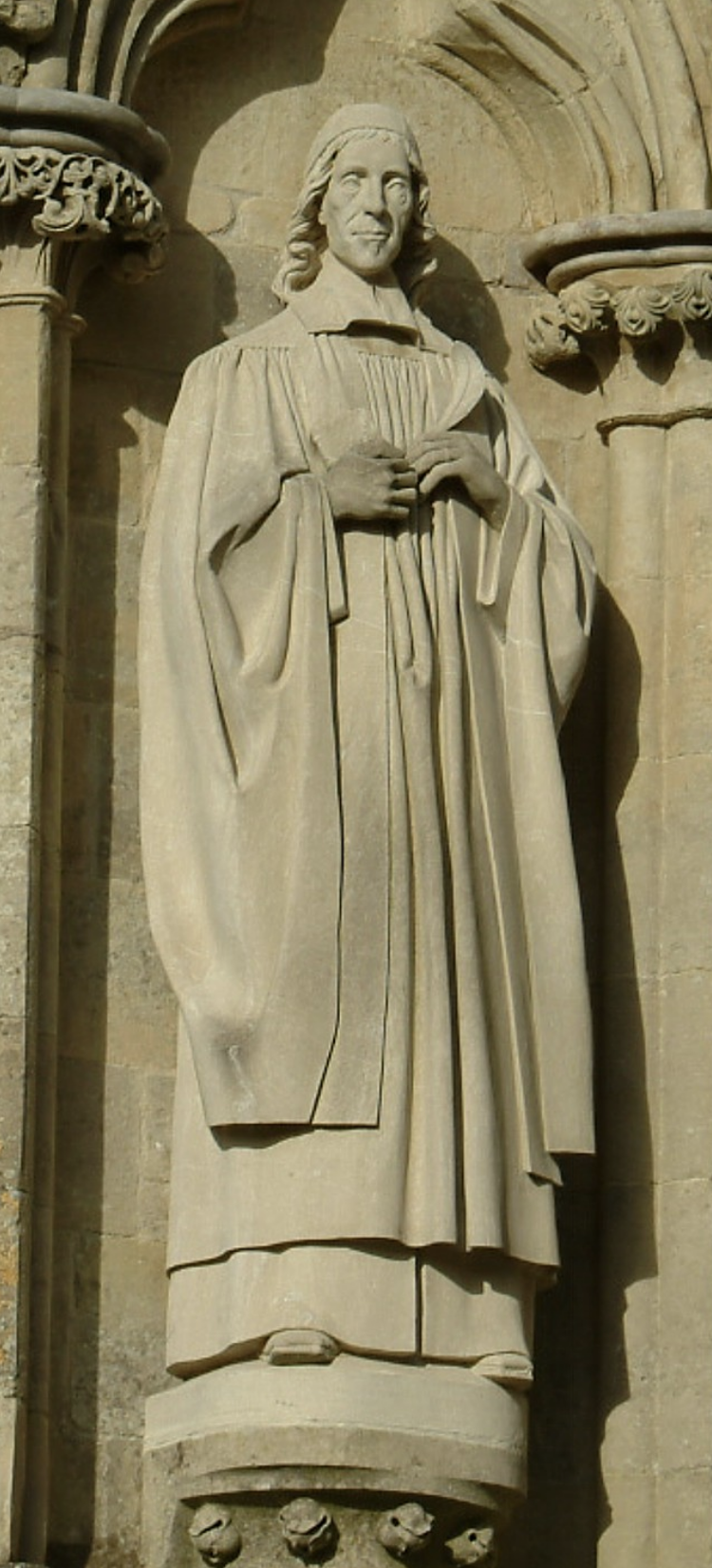
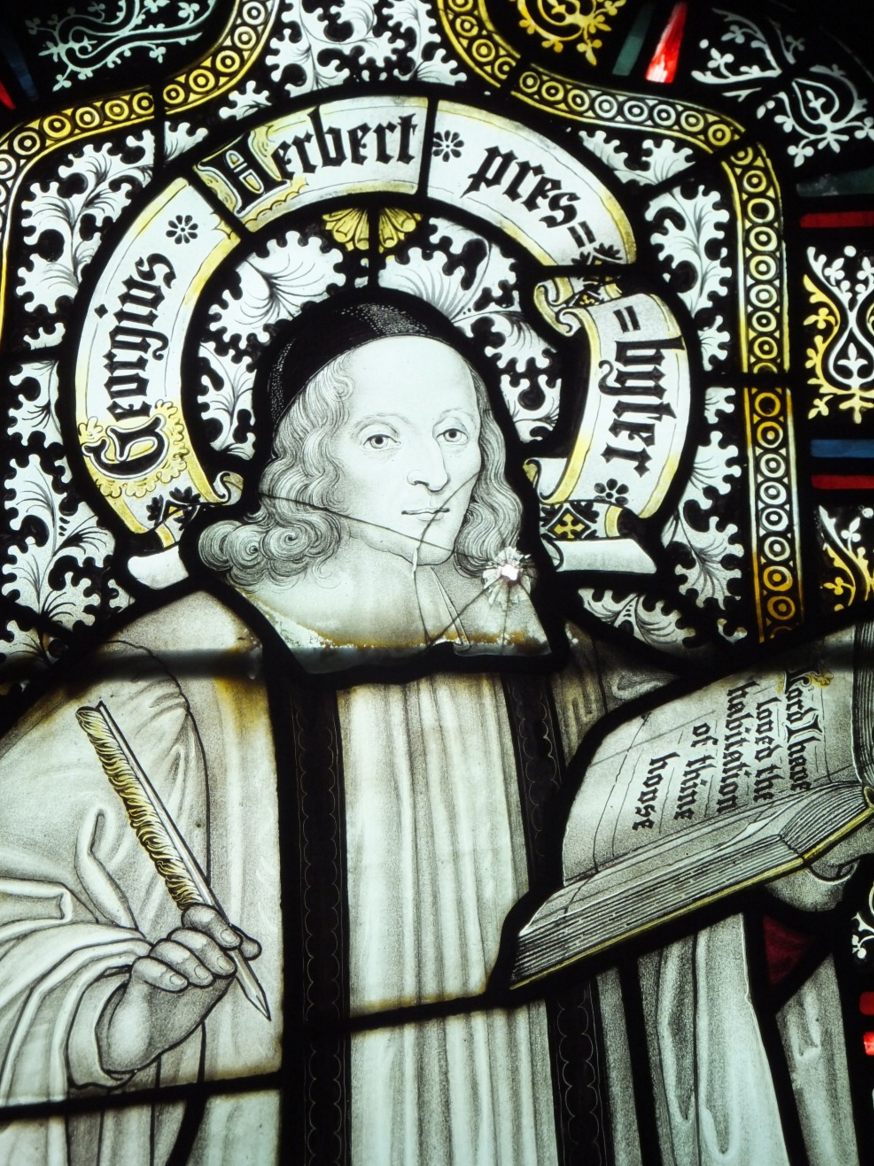
Well, today George Herbert (1593 – 1633) is commemorated on the calendar of saints throughout the Anglican Communion.

Screen Shot 2019-02-26 at 1.34.09 PM.png

“The Herbert Niche” at Salisbury Cathedral

Herbert wrote poetry in English, Latin and Greek.  Shortly before his death, he sent the manuscript of The Temple to Nicholas Ferrar, the founder of a semi-monastic Anglican religious community at Little Gidding, reportedly telling him to publish the poems if he thought they might “turn to the advantage of any dejected poor soul”, otherwise to burn them. Thanks to Ferrar, all of Herbert’s English poems were published in The Temple: Sacred Poems and Private Ejaculations, with a preface by Ferrar, shortly after his death in 1633. The book went through eight editions by 1690.

Here’s one of his most famous poems, “The Flower”.

How fresh, oh Lord, how sweet and clean
Are thy returns! even as the flowers in spring;
         To which, besides their own demean,
The late-past frosts tributes of pleasure bring.
                      Grief melts away
                      Like snow in May,
         As if there were no such cold thing.
         Who would have thought my shriveled heart
Could have recovered greenness? It was gone
         Quite underground; as flowers depart
To see their mother-root, when they have blown,
                      Where they together
                      All the hard weather,
         Dead to the world, keep house unknown.
         These are thy wonders, Lord of power,
Killing and quickening, bringing down to hell
         And up to heaven in an hour;
Making a chiming of a passing-bell.
                      We say amiss
                      This or that is:
         Thy word is all, if we could spell.
         Oh that I once past changing were,
Fast in thy Paradise, where no flower can wither!
         Many a spring I shoot up fair,
Offering at heaven, growing and groaning thither;
                      Nor doth my flower
                      Want a spring shower,
         My sins and I joining together.
         But while I grow in a straight line,
Still upwards bent, as if heaven were mine own,
         Thy anger comes, and I decline:
What frost to that? what pole is not the zone
                      Where all things burn,
                      When thou dost turn,
         And the least frown of thine is shown?
         And now in age I bud again,
After so many deaths I live and write;
         I once more smell the dew and rain,
And relish versing. Oh, my only light,
                      It cannot be
                      That I am he
         On whom thy tempests fell all night.
         These are thy wonders, Lord of love,
To make us see we are but flowers that glide;
         Which when we once can find and prove,
Thou hast a garden for us where to bide;
                      Who would be more,
                      Swelling through store,
         Forfeit their Paradise by their pride.

He’s pretty great, don’t you think?

*Herbert, from “The Pearl”
He that throws a stone at another, hits himself

by chuckofish

Screen Shot 2018-02-26 at 10.58.59 AM.png

Today on the Episcopal calendar of saints we celebrate the life of George Herbert, English poet and parson (1593-1633). Best known for his wonderful poetry, he also wrote a volume for parish clergy,  A Country Parson. Here is section  XXVIII, The Parson in Contempt, which seems very apropos today:

The Country Parson knows well, that both for the general ignominy which is cast upon the profession, and much more for those rules, which out of his choysest judgment he hath resolved to observe, and which are described in this Book, he must be despised; because this hath been the portion of God his Master, and of Gods Saints his Brethren, and this is foretold, that it shall be so still, until things be no more. Nevertheless, according to the Apostles rule, he endeavours that none shall despise him; especially in his own Parish he suffers it not to his utmost power; for that, where contempt is, there is no room for instruction. This he procures, first by his holy and unblameable life; which carries a reverence with it, even above contempt. Secondly, by a courteous carriage, & winning behaviour: he that will be respected, must respect; doing kindnesses, but receiving none; at least of those, who are apt to despise: for this argues a height and eminency of mind, which is not easily despised, except it degenerate to pride. Thirdly, by a bold and impartial reproof, even of the best in the Parish, when occasion requires: for this may produce hatred in those that are reproved, but never contempt either in them, or others. Lastly, if the contempt shall proceed so far as to do any thing punishable by law, as contempt is apt to do, if it be not thwarted, the Parson having a due respect both to the person, and to the cause, referreth the whole matter to the examination, and punishment of those which are in Authority, that so the sentence lighting upon one, the example may reach to all. But if the Contempt be not punishable by Law, or being so, the Parson think it in his discretion either unfit, or bootelesse to contend, then when any despises him, he takes it either in an humble way, saying nothing at all; or else in a slighting way, shewing that reproaches touch him no more, then a stone thrown against heaven, where he is, and lives; or in a sad way, grieved at his own, and others sins, which continually break Gods Laws, and dishonour him with those mouths, which he continually fills, and feeds: or else in a doctrinal way, saying to the contemner, Alas, why do you thus? you hurt your self, not me; he that throws a stone at another, hits himself; and so between gentle reasoning, and pitying, he overcomes the evil: or lastly, in a Triumphant way, being glad, and Joyful, that he is made conformable to his Master; and being in the world as he was, hath this undoubted pledge of his salvation. These are the five shields, wherewith the Godly receive the darts of the wicked; leaving anger, and retorting, and revenge to the children of the world, whom another’s ill mastereth, and leadeth captive without any resistance, even in resistance, to the same destruction. For while they resist the person that reviles, they resist not the evil which takes hold of them, and is far the worse enemy.

Speaking of saints, we don’t need to remind you that Dolly Parton is awesome, but this is very cool.

Have a good day!

Way Back Wednesday: we are but flowers

by chuckofish

MCC flower

Little Mary in Worcester, MA, circa 1931

These are thy wonders, Lord of love,

To make us see we are but flowers that glide;

         Which when we once can find and prove,

Thou hast a garden for us where to bide;

                      Who would be more,

                      Swelling through store,

         Forfeit their Paradise by their pride.

–George Herbert, from “The Flower”

Our shelter from the stormy blast*

by chuckofish

IMGP1124

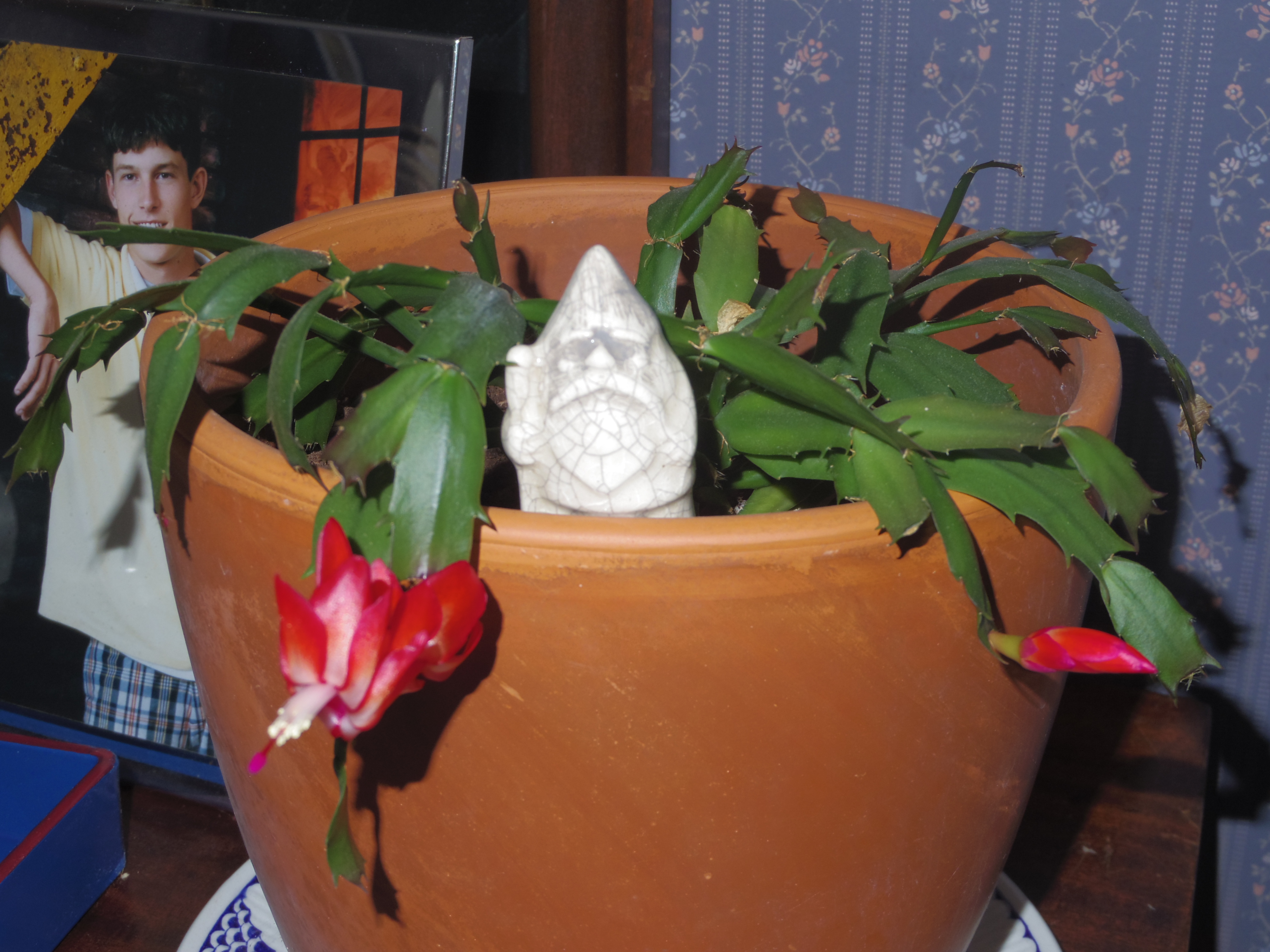
Yes, the Christmas cacti are blooming! Can it really be that time of year again?

IMGP1127

It must be…’cause it snowed too!

Note the leaf bags!

Note the leaf bags!

IMGP1129

The anthem at the Offertory at church on Sunday was the poem “Love” by George Herbert (1593-1632) which is a particularly lovely one:

Love bade me welcome: yet my soul drew back,

Guilty of dust and sin.

But quick-eyed Love, observing me grow slack

From my first entrance in,

Drew nearer to me, sweetly questioning

If I lacked anything.

“A guest,” I answered, “worthy to be here”:

Love said, “You shall be he.”

“I, the unkind, ungrateful? Ah, my dear,

I cannot look on thee.”

Love took my hand, and smiling did reply,

“Who made the eyes but I?”

“Truth, Lord; but I have marred them; let my shame

Go where it doth deserve.”

“And know you not,” says Love, “who bore the blame?”

“My dear, then I will serve.”

“You must sit down,” says Love, “and taste my meat.”

So I did sit and eat.

It snowed all day, but never amounted to too much. Time to get serious, though, about the snowball descent to the end of the year.

Have a good week!

*Hymn #680, Isaac Watts

Let’s do our best

by chuckofish

Tonight I had pancakes for dinner at Grace Church. It is a pretty low-key, family-friendly event. And who can say no to pancakes for dinner? Especially if someone else is cooking? But let me say, I am not a Mardi Gras kind of person. I do not wear cheap plastic beads or drink in public or attend events where public urination is an issue. The idea of overdoing it in anticipation of some fake fasting is somewhat repellent to me. I know that makes me sound like an old lady and I suppose I am too much of a puritan. But I have always felt that way, even when I was a young lady.

But I do like Lent. I like the idea of trying to be more intentional about prayer and bible study. I like the idea of taking on rather than just giving up. I like having a “Mite Box”.

So I will be blogging some about this darker season leading up to Easter. I even have my favorite Lenten movies to share.

Lent

Welcome deare feast of Lent: who loves not thee, He loves not Temperance, or Authoritie,
But is compos’d of passion. The Scriptures bid us fast; the Church sayes, now:
Give to thy Mother, what thou wouldst allow To ev’ry Corporation.
… It’s true, we cannot reach Christ’s fortieth day; Yet to go part of that religious way,
Is better than to rest: We cannot reach our Savior’s purity;
Yet are bid, Be holy ev’n as he. In both let’s do our best.
Who goeth in the way which Christ hath gone, Is much more sure to meet with him, than one
That travelleth by-ways: Perhaps my God, though he be far before,
May turn, and take me by the hand, and more May strengthen my decays.
Yet Lord instruct us to improve our fast By starving sin and taking such repast
As may our faults control: That ev’ry man may revel at his door,
Not in his parlor; banqueting the poor, And among those his soul.

George Herbert
1633