dual personalities

Tag: Frederick Buechner

E-I-E-I-O

by chuckofish

Screen Shot 2018-05-09 at 10.22.26 AM.png

To have grandchildren is not only to be given something but to be given something back.

You are given back something of your children’s childhood all those years ago. You are given back something of what it was like to be a young parent. You are given back something of your own childhood even, as on creaking knees you get down on the floor to play tiddlywinks, or sing about Old MacDonald and his farm, or watch Saturday morning cartoons till you’re cross-eyed.

It is not only your own genes that are part of your grandchildren but the genes of all sorts of people they never knew but who, through them, will play some part in times and places they never dreamed of. And of course along with your genes, they will also carry their memories of you into those times and places too—the afternoon you lay in the hammock with them watching the breezes blow, the face you made when one of them stuck out a tongue dyed Popsicle blue at you, the time you got a splinter out for one of them with the tweezers of your Swiss army knife. On some distant day they will hold grandchildren of their own with the same hands you once held them by as you searched the beach at low tide for Spanish gold.

In the meantime, they are the freshest and fairest you have. After you’re gone, it is mainly because of them that the earth will not be as if you never walked on it.

-Frederick Buechner, Beyond Words

[Love this “Portrait of Mrs Salisbury with her Grandchildren Edward and Elizabeth Bagot” by John Michael Wright, 1675-76. She was Welsh–thus the hat.]

No ironic laughter

by chuckofish

“Have no anxiety about anything,” Paul writes to the Philippians. In one sense it is like telling a woman with a bad head cold not to sniffle and sneeze so much or a lame man to stop dragging his feet. Or maybe it is more like telling a wino to lay off the booze or a compulsive gambler to stay away from the track.

Is anxiety a disease or an addiction? Perhaps it is something of both. Partly, perhaps, because you can’t help it, and partly because for some dark reason you choose not to help it, you torment yourself with detailed visions of the worst that can possibly happen. The nagging headache turns out to be a malignant brain tumor. When your teenage son fails to get off the plane you’ve gone to meet, you see his picture being tacked up in the post office among the missing and his disappearance never accounted for. As the latest mid-East crisis boils, you wait for the TV game show to be interrupted by a special bulletin to the effect that major cities all over the country are being evacuated in anticipation of nuclear attack. If Woody Allen were to play your part on the screen, you would roll in the aisles with the rest of them, but you’re not so much as cracking a smile at the screen inside your own head.

Does the terrible fear of disaster conceal an even more terrible hankering for it? Do the accelerated pulse and the knot in the stomach mean that, beneath whatever their immediate cause, you are acting out some ancient and unresolved drama of childhood? Since the worst things that happen are apt to be the things you don’t see coming, do you think there is a kind of magic whereby, if you only can see them coming, you will be able somehow to prevent them from happening? Who knows the answer? In addition to Novocain and indoor plumbing, one of the few advantages of living in the twentieth century is the existence of psychotherapists, and if you can locate a good one, maybe one day you will manage to dig up an answer that helps.

But answer or no answer, the worst things will happen at last even so. “All life is suffering” says the first and truest of the Buddha’s Four Noble Truths, by which he means that sorrow, loss, death await us all and everybody we love. Yet “the Lord is at hand. Have no anxiety about anything,” Paul writes, who was evidently in prison at the time and with good reason to be anxious about everything, “but in everything by prayer and supplication with thanksgiving let your requests be made known to God.”

He does not deny that the worst things will happen finally to all of us, as indeed he must have had a strong suspicion they were soon to happen to him. He does not try to minimize them. He does not try to explain them away as God’s will or God’s judgment or God’s method of testing our spiritual fiber. He simply tells the Philippians that in spite of them-even in the thick of them-they are to keep in constant touch with the One who unimaginably transcends the worst things as he also unimaginably transcends the best.

“In everything,” Paul says, they are to keep on praying. Come Hell or high water, they are to keep on asking, keep on thanking, above all keep on making themselves known. He does not promise them that as a result they will be delivered from the worst things any more than Jesus himself was delivered from them. What he promises them instead is that “the peace of God, which passes all understanding, will keep your hearts and your minds in Christ Jesus.”

The worst things will surely happen no matter what-that is to be understood-but beyond all our power to understand, he writes, we will have peace both in heart and in mind. We are as sure to be in trouble as the sparks fly upward, but we will also be “in Christ,” as he puts it. Ultimately not even sorrow, loss, death can get at us there.

That is the sense in which he dares say without risk of occasioning ironic laughter, “Have no anxiety about anything.” Or, as he puts it a few lines earlier, “Rejoice in the Lord always. Again I will say, Rejoice!”

(Philippians: 4:4-7)

–Frederick Buechner, Whistling in the Dark

I had another post ready to go last night, but I decided, after thinking about it, that it wasn’t ready to go quite yet. So Fred Buechner to the rescue. He’s just the best.

Have a good Wednesday and have no anxiety about anything.

Thoughts and (more) prayers

by chuckofish

Do you need a little mid-week pick-me-up? Mandisa will lift your spirits! Don’t be embarrassed–sing along!

Here’s a thought for today from Frederick Buechner:

“God speaks to us, I would say, much more often than we realize or than we choose to realize. Before the sun sets every evening, he speaks to each of us in an intensely personal and unmistakable way. His message is not written out in starlight, which in the long run would make no difference; rather it is written out for each of us in the humdrum, helter-skelter events of each day; it is a message that in the long run might just make all the difference. Who knows what he will say to me today or to you today or into the midst of what kind of unlikely moment he will choose to say it. Not knowing is what makes today a holy mystery as every day is a holy mystery. But I believe that there are some things that by and large God is always saying to each of us. Each of us, for instance, carries around inside himself, I believe, a certain emptiness—a sense that something is missing, a restlessness, the deep feeling that somehow all is not right inside his skin. Psychologists sometimes call it anxiety, theologians sometimes call it estrangement, but whatever you call it, I doubt that there are many who do not recognize the experience itself, especially no one of our age, which has been variously termed the age of anxiety, the lost generation, the beat generation, the lonely crowd. Part of the inner world of everyone is this sense of emptiness, unease, incompleteness, and I believe that this in itself is a word from God, that this is the sound that God’s voice makes in a world that has explained him away. In such a world, I suspect that maybe God speaks to us most clearly through his silence, his absence, so that we know him best through our missing him. But he also speaks to us about ourselves, about what he wants us to do and what he wants us to become; and this is the area where I believe that we know so much more about him than we admit even to ourselves, where people hear God speak even if they do not believe in him. A face comes toward us down the street. Do we raise our eyes or do we keep them lowered, passing by in silence? Somebody says something about somebody else, and what he says happens to be not only cruel but also funny, and everybody laughs. Do we laugh too, or do we speak the truth? When a friend has hurt us, do we take pleasure in hating him, because hate has its pleasures as well as love, or do we try to build back some flimsy little bridge? Sometimes when we are alone, thoughts come swarming into our heads like bees—some of them destructive, ugly, self-defeating thoughts, some of them creative and glad. Which thoughts do we choose to think then, as much as we have the choice? Will we be brave today or a coward today? Not in some big way probably but in some little foolish way, yet brave still. Will we be honest today or a liar? Just some little pint-sized honesty, but honest still. Will we be a friend or cold as ice today? All the absurd little meetings, decisions, inner skirmishes that go to make up our days. It all adds up to very little, and yet it all adds up to very much. Our days are full of nonsense, and yet not, because it is precisely into the nonsense of our days that God speaks to us words of great significance—not words that are written in the stars but words that are written into the raw stuff and nonsense of our days, which are not nonsense just because God speaks into the midst of them. And the words that he says, to each of us differently, are be brave…be merciful…feed my lambs…press on toward the goal.”

And here’s a prayer for today:

“Much as we wish, not one of us can bring back yesterday or shape tomorrow. Only today is ours, and it will not be ours for long, and once it is gone it will never in all time be ours again. Thou only knowest what it holds in store for us, yet even we know something of what it will hold. The chance to speak the truth, to show mercy, to ease another’s burden. The chance to resist evil, to remember all the good times and good people of our past, to be brave, to be strong, to be glad.”

–Frederick Buechner, The Hungering Dark

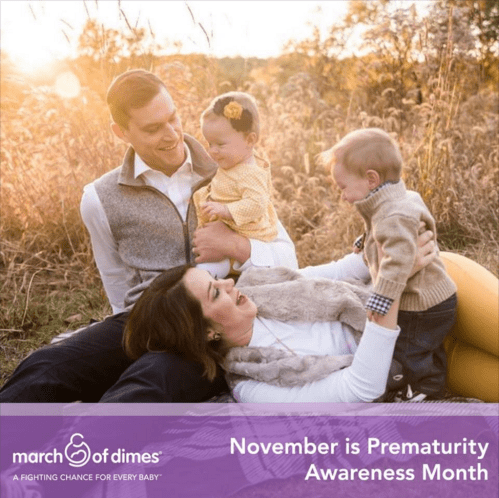
And did you know that November is Prematurity Awareness Month? The wee babes are literally poster kids for it!

Screen Shot 2017-11-14 at 2.16.49 PM.png

“And the moral of the story is?”

by chuckofish

“What is it with you white people and morals? Maybe it’s just a story about what happened.” He paused for a moment. “If an Indian points at a tree, you white people are always thinking, What does that mean? What does the tree stand for? What’s the lesson in this for me? Maybe it’s just a tree.” (Virgil White Buffalo in Hell Is Empty)

While waiting for cabs and resting between long walks and Big Events last weekend, I sought solace in the company of Walt Longmire in the Wyoming mountains.  Hell Is Empty is amazingly apropos reading for wiling away hours in LaGuardia Airport! (“Hell is empty and all the devils are here.”–Shakespeare, The Tempest)

Anyway, at the beginning of this novel we are told that one of Walt’s deputies, regretting a stint in higher education devoted almost exclusively to criminal justice, is attempting to fill in some of the literary gaps. Walt and his deputies, plus the dispatcher and the lady who runs the diner have all made book lists for him. Dante’s Inferno plays a big part in the rest of the story.

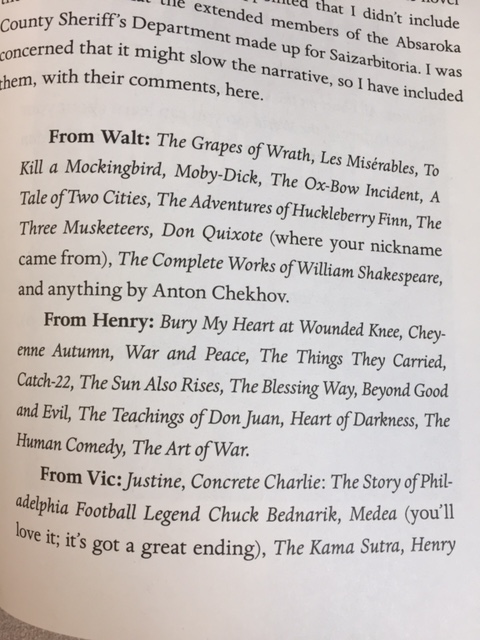
Craig Johnson, understanding that his readers would want to know, thoughtfully includes the different lists in an appendix to the novel.
Unknown-1.jpeg

Of course, Ruby, the dispatcher and my soul sister, includes The Holy Bible (NT), The Pilgrim’s Progress, Inferno, Paradise Lost, My Antonia, The Scarlett Letter, Walden, Poems of Emily Dickinson, My Friend Flicka, and Our Town.

How great is that? I guess I’ll have to read My Friend Flicka!

I love lists.

My list would include: The Holy Bible (NT), The Book of Common Prayer, Moby-Dick, The Catcher in the Rye, O Pioneers!, The Big Sky, The Waters of Kronos, The Big Sleep, Gilead, Lonesome Dove…

I’m sure I’m forgetting something important that I really love. You know how that goes.

Here’s Frederick Buechner on a similar theme:

THE WRITERS WHO get my personal award are the ones who show exceptional promise of looking at their lives in this world as candidly and searchingly and feelingly as they know how and then of telling the rest of us what they have found there most worth finding. We need the eyes of writers like that to see through. We need the blood of writers like that in our veins.

J.D. Salinger’s The Catcher in the Rye was one of the first books I read that did it to me, that started me on the long and God knows far from finished journey on the way to becoming a human being—started making that happen. What I chiefly learned from it was that even the slobs and phonies and morons that Holden Caulfield runs into on his travels are, like Seymour Glass’s Fat Lady, “Christ Himself, buddy,” as Zooey explains it to his sister Franny in the book that bears her name Even the worst among us are precious. Even the most precious among us bear crosses. That was a word that went straight into my bloodstream and has been there ever since. Along similar lines I think also of Robertson Davies’ Deptford trilogy, Ford Madox Ford’s The Good Soldier, Rose Macaulay’s The Towers of Trebizond, George Garrett’s Death of the Fox, some of the early novels of John Updike like The Poorhouse Fair and The Centaur, John Irving’s A Prayer for Owen Meany. I think of stories like Flannery O’Connor’s “The Artificial Nigger” and Raymond Carver’s “Feathers” and works of non-fiction, to use that odd term (like calling poetry non-prose) such as Annie Dillard’s Holy the Firm and Geoffrey Wolff’s The Duke of Deception and Robert Capon’s The Supper of the Lamb or plays like Death of a Salesman or Our Town.

What 10 books would you put on your list of must-reads? Think about it.

But excuse me, I have to get back to Absaroka County…

04c3b6f656d895842ccde47daf712055.jpg

Food for thought

by chuckofish

adam_crop.jpg

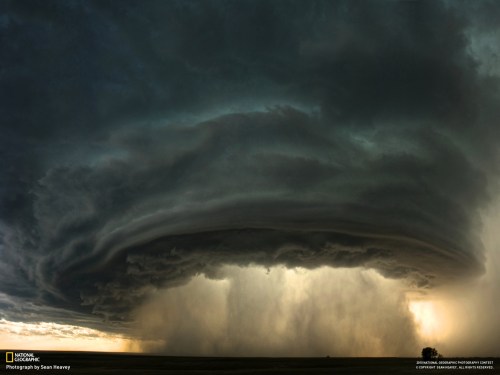
IT IS OUT OF the whirlwind that Job first hears God say “Who is this that darkens counsel by words without knowledge?” (Job 42:3). It is out of the absence of God that God makes himself present, and it is not just the whirlwind that stands for his absence, not just the storm and chaos of the world that knock into a cocked hat all man’s attempts to find God in the world, but God is absent also from all Job’s words about God, and from the words of his comforters, because they are words without knowledge that obscure the issue of God by trying to define him as present in ways and places where he is not present, to define him as moral order, as the best answer man can give to the problem of his life. God is not an answer man can give, God says. God himself does not give answers. He gives himself, and into the midst of the whirlwind of his absence gives himself.

–Frederick Buechner, Telling the Truth

Job_Confessing_His_Presumption_to_God_Who_Answers_from_the_Whirlwind,_object_1_(Butlin_461).jpg

whirlwind.jpg

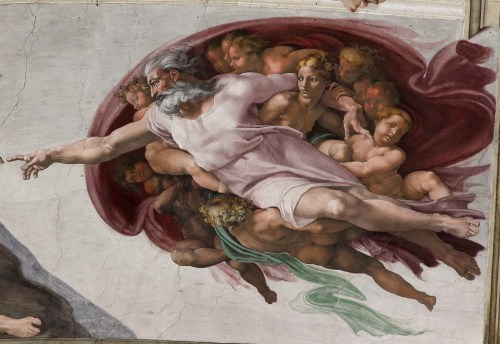
P.S. Have you ever noticed that God looks like he is in a big brain in Michelangelo’s depiction of him on the Sistine Chapel (see above)? That green scarf is the vertebral artery. I did not think of this myself, but I have to admit, it really does look like a brain. Discuss among yourselves.

Savior, let me walk with thee*

by chuckofish

Well, here we are about to enter Holy Week and I haven’t watched even one of my favorite lenten movies! I guess I will have to make up for lost time this weekend…I think I will probably work my way through Jesus of Nazareth, Franco Zefferelli’s epic 1977 mini-series…

timthumb.jpeg

This film still looks like a Rembrandt drawing, doesn’t it?

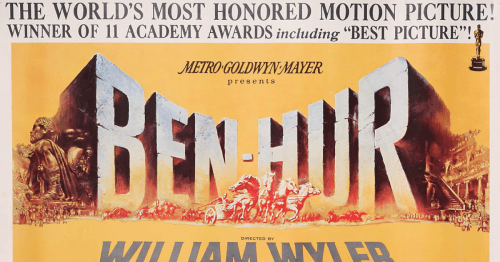
…and, of course, finish up with Ben-Hur (1959) on Good Friday and Holy Saturday. I am, after all, a creature of habit.

ben-hur-poster-1959.png

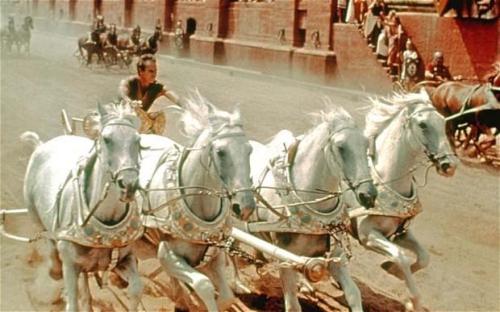
Sidenote: They remade Ben-Hur last year–did anyone see it? I didn’t think so. It was, indeed, the summer’s biggest box office bomb, and one of the biggest flops of 2016. When is Hollywood going to figure out that you can’t/shouldn’t try to re-make classics? No one wants to see a digitized chariot race.

2_ChuckRace.jpg

Please. We want the real thing.

Anyway, this Sunday is Palm Sunday and I am the Narrator of The Passion of Jesus Christ According to Saint Matthew which is very cool. In my world anyway.

ART127907.jpg

Wall painting by Hippolyte Flandrin, early 19c.

Here’s a little Buechner to get you in the mood for Palm Sunday:

“Blessed be the King who comes in the name of the Lord,” the cry goes up. There is dust in the air with the sun turning it gold. Around a bend in the road, there suddenly is Jerusalem. He draws back on the reins. Crying disfigures his face. “Would that even today you knew the things that make for peace.” Even today, he says, because there are so few days left. Then the terror of his vision as he looks at the city that is all cities and sees not one stone left standing on another – you and your children within you – your children. “Because you did not know the time of your visitation,” he says. Because we don’t know who it is who comes to visit us. Because we do not know what he comes to give. The things that make for peace, that is what he comes to give. We do not know these things, he says, and God knows he’s right. The absence of peace within our own skins no less than within our nations testifies to that. But we know their names at least. We all of us know in our hearts the holy names of the things that make for peace – real peace – only for once let us honor them by not naming them. Let us name instead only him who is himself the Prince of Peace.”

–Frederick Buechner, A Room Called Remember

And hopefully the boy will catch up on his sleep.

Unknown-1.jpg

Probably not.

Unknown.jpeg

Have a good weekend!

*Fanny J. Crosby, “Close to Thee”, Methodist Hymnal

Day by day

by chuckofish

Happy MLK Day and, if you are lucky enough to be home like I am, I hope you are enjoying your day off.

IMG_2369.JPG

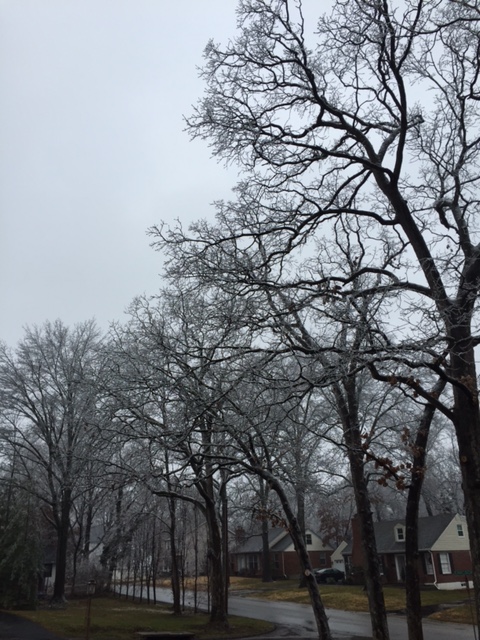
That’s ice on the trees…

In fact, this has turned out to be a very nice four-day weekend for me, because we had a “snow day” on Friday due to the ice storm here in flyover country. I stayed home for two days puttering around and re-organizing drawers and shelves and closets.

IMG_2361.JPG

By Sunday morning the storm was pretty much over. I went to church and was surprised by how many people were there. The OM said they were probably stir crazy and just wanted to get out of the house. Well, maybe.

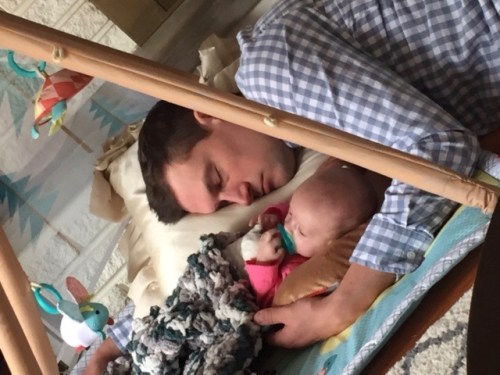
After church we went to lunch and then to the hospital to see the wee babes and their parents who were kangarooing as they do every day (even during the ice storm).

img_2355

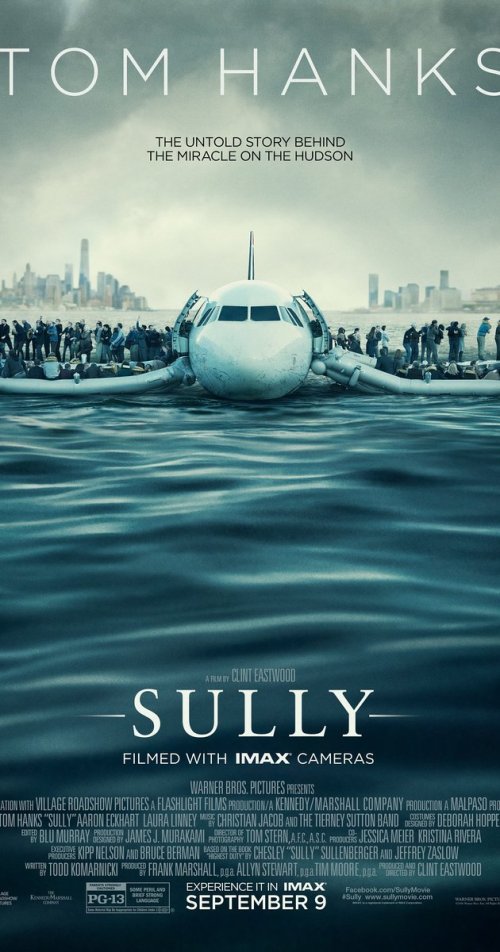
We watched Sully (2016) over the weekend and liked it a lot. Tom Hanks was just right as the remarkable pilot who landed the plane on the Hudson River without a single loss of life back in 2009. I think the movie could have used a little more backstory, but I won’t quibble. It was good.

mv5bmtg5ntuwndiyov5bml5banbnxkftztgwmji2otc3ote-_v1_uy1200_cr9006301200_al_

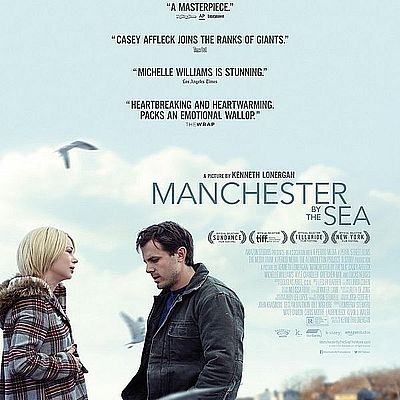
I cannot say the same for the much heralded Manchester By the Sea (2016) which I did not like.

1477375651_manchester-u-morya.jpg

Bad things happen in life, terrible things, but this movie seems to say that all of life is just a long, sad, hopeless journey and then you die. The characters in this movie are uniformly unable to express their feelings, much less talk without use of the F-word in every sentence. After the movie the OM and I both wondered what the writer/director was trying to say. I just didn’t get this movie.

Well, today I am going to enjoy my day off as the temperatures continue to climb and the ice melts. And I will continue to believe that life has meaning.

The question is not whether the things that happen to you are chance things or God’s things because, of course, they are both at once. There is no chance thing through which God cannot speak — even the walk from the house to the garage that you have walked ten thousand times before, even the moments when you cannot believe there is a God who speaks at all anywhere. He speaks, I believe, and the words he speaks are incarnate in the flesh and blood of our selves and of our own footsore and sacred journeys. We cannot live our lives constantly looking back, listening back, lest we be turned to pillars of longing and regret, but to live without listening at all is to live deaf to the fullness of the music. Sometimes we avoid listening for fear of what we may hear, sometimes for fear that we may hear nothing at all but the empty rattle of our own feet on the pavement. But be not affeard, says Caliban, nor is he the only one to say it. “Be not afraid,” says another, “for lo, I am with you always, even unto the end of the world.” He says he is with us on our journeys. He says he has been with us since each of our journeys began. Listen for him. Listen to the sweet and bitter airs of your present and your past for the sound of him.

–Frederick Buechner, The Sacred Journey 

Incarnate words

by chuckofish

c27680bed2c1e89b93a9c348781deb04.jpg

If God speaks anywhere, it is into our personal lives that he speaks. Someone we love dies, say. Some unforeseen act of kindness or cruelty touches the heart or makes the blood run cold. We fail a friend, or a friend fails us, and we are appalled at the capacity we all of us have for estranging the very people in our lives we need the most. Or maybe nothing extraordinary happens at all — just one day following another, helter-skelter, in the manner of days. We sleep and dream. We wake. We work. We remember and forget. We have fun and are depressed. And into the thick of it, or out of the thick of it, at moments of even the most humdrum of our days, God speaks. But what do I mean by saying that God speaks? He speaks not just through the sounds we hear, of course, but through events in all their complexity and variety, through the harmonies and disharmonies and counterpoint of all that happens. As to the meaning of what he says, there are times that we are apt to think we know. Adolf Hitler dies a suicide in his bunker with the Third Reich going up in flames all around him, and what God is saying about the wages of sin seems clear enough. Or Albert Schweitzer renounces fame as a theologian and musician for a medical mission in Africa, where he ends up even more famous still as one of the great near-saints of Protestantism; and again we are tempted to see God’s meaning as clarity itself. But what is God saying through a good man’s suicide? What about the danger of the proclaimed saint’s becoming a kind of religious prima donna as proud of his own humility as a peacock of its tail? What about sin itself as a means of grace? What about grace, when misappropriated and misunderstood, becoming an occasion for sin? To try to express in even the most insightful and theologically sophisticated terms the meaning of what God speaks through the events of our lives is as precarious a business as to try to express the meaning of the sound of rain on the roof or the spectacle of the setting sun. But I choose to believe that he speaks nonetheless, and the reason that his words are impossible to capture in human language is of course that they are ultimately always incarnate words. They are words fleshed out in the everydayness no less than in the crises of our own experience.

–Frederick Buechner, The Sacred Journey

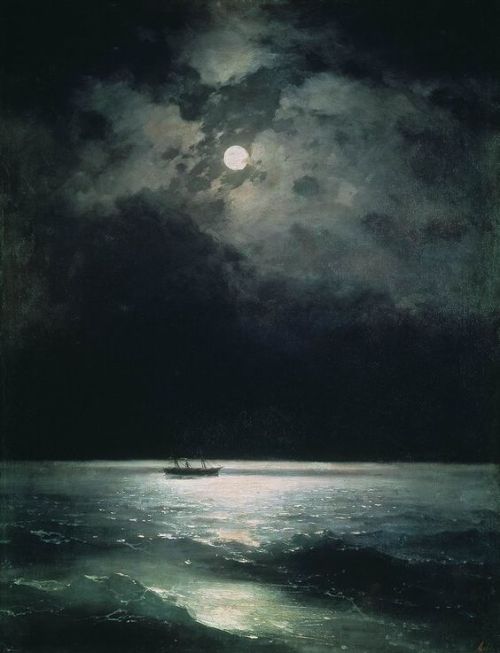
 The painting is  The Black Sea at Night by Ivan Aivazovsky

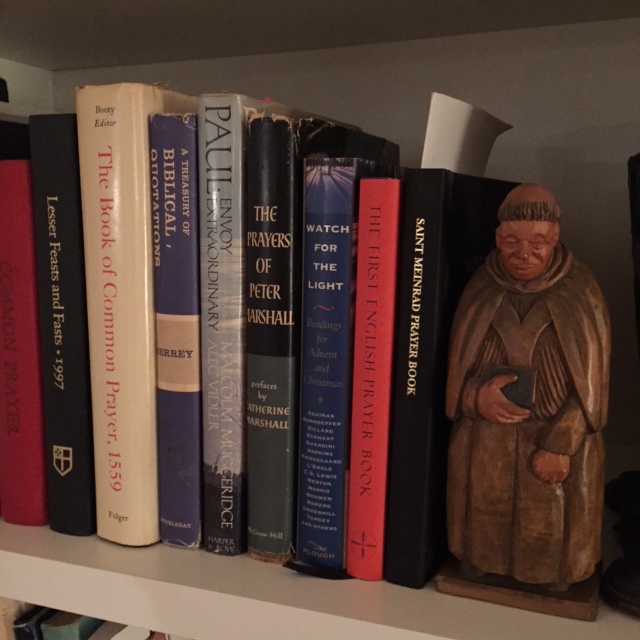
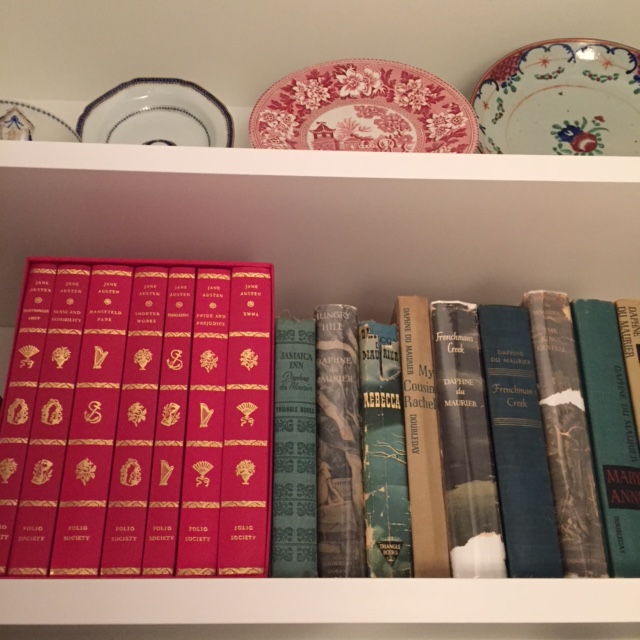
An honor just to have them on your shelves

by chuckofish

unknown

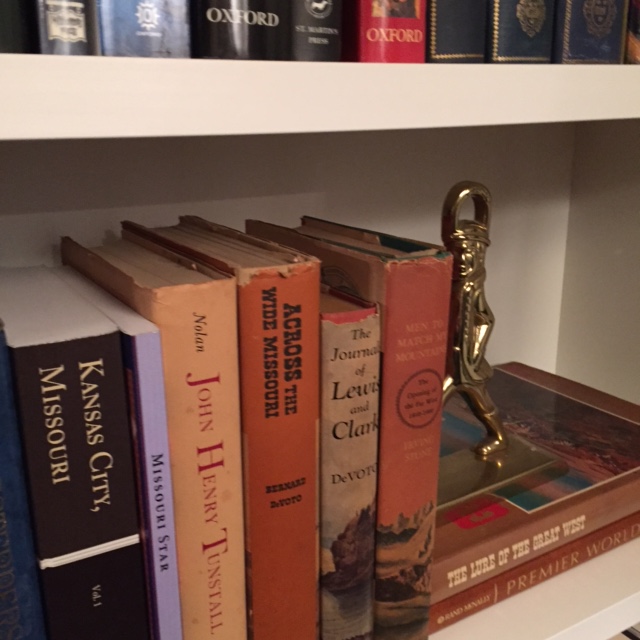
Books are to read, but that is by no means the end of it.

The way they are bound, the paper they are printed on, the smell of them (especially if they are either very new or very old), the way the words are fitted to the page, the look of them in the bookcase — sometimes lined up straight as West Point cadets, sometimes leaning against each other for support or lying flat so you have to tip your head sideways to see them properly. Bede’s Ecclesiastical History of the English Nation, the plays of Beaumont and Fletcher, the Pleiade edition of Saint Simon, Chesterfield’s letters, the Qur’an. Even though you suspect you will probably never get around to them, it is an honor just to have them on your shelves.

Something of what they contains gets into the air you breathe. They are like money in the bank, which is a comfort even though you never spend it. They are prepared to give you all they’ve got at a moment’s notice, but are in no special hurry about it. In the meanwhile they are holding their tongues, even the most loquacious of them, even the most passionate.

They are giving you their eloquent and inexhaustible silence. They are giving you time to find your way to them. Maybe they are giving you time, with or without them, just to find your way.

–Frederick Buechner

unknown-2

img_2296

img_2298

img_2295

img_2294

And isn’t Dolly wonderful?

Rescued from oblivion

by chuckofish

3fb3a4cf3388ec7871fa4f7f753cf10b

Even the most cursory of diaries can be of incalculable value. What the weather was doing. Who we ran into on the street. The movie we saw. The small boy at the dentist’s office. The dream.

Just a handful of the barest facts can be enough to rescue an entire day from oblivion — not just what happened in it, but who we were when it happened. Who the others were. What it felt like back then to be us.

“Our years come to an end like a sigh . . . ” says Psalm 90, “so teach us to number our days that we may get a heart of wisdom” (w. 9,12).

It is a mark of wisdom to realize how precious our days are, even the most uneventful of them. If we can keep them alive by only a line or so about each, at least we will know what we’re sighing about when the last of them comes.

~ Frederick Buechner, Beyond Words

img_2225

The illustration of parked cars on a residential street is from This is New York by Miroslav Sasek.