We are family*
by chuckofish
Last September when we were bouncing around southeast Colorado, we visited the John W. Rawlings Heritage Center in Las Animas. A helpful staff person there told me that they had a few volunteers who would do research for me, since their Heritage Library is not open to the public on a regular basis. I filled out a form asking for information concerning my Hough and Prowers ancestors. After some phone message tag and an email, I was getting ready to check back with them when, low and behold, yesterday I received a little packet of photocopies in the mail.
“Bing-pot!”**
Included were photocopies of several photos donated to the museum by one of the daughters of John W. Prowers, including this portrait of our great-great grandmother Mary Prowers Hough at a younger age than previously we have seen with the notation “Aunt Mimie Hough”.

There is a new portrait of Anna Hough, daughter of Mary and John Hough, our great-grandmother (on the left)…

…and of the elusive Susie V. Hough, sister of Anna.

This is thrilling!
There is also a picture of Frank Baron Hough, John and Mary’s son, as a boy…

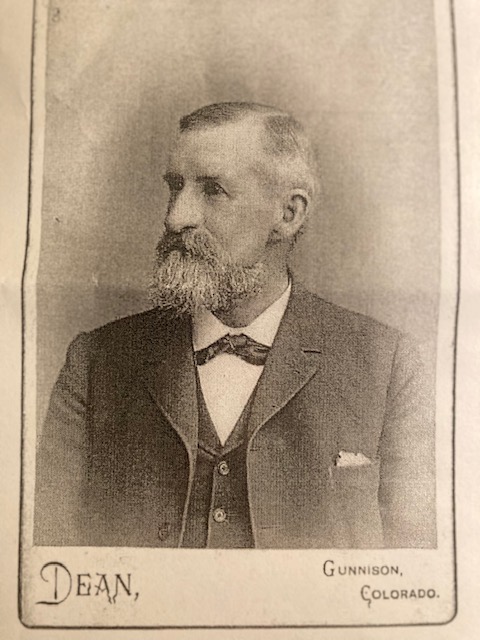
Here is a new-to-me picture of John S. Hough at an older age…
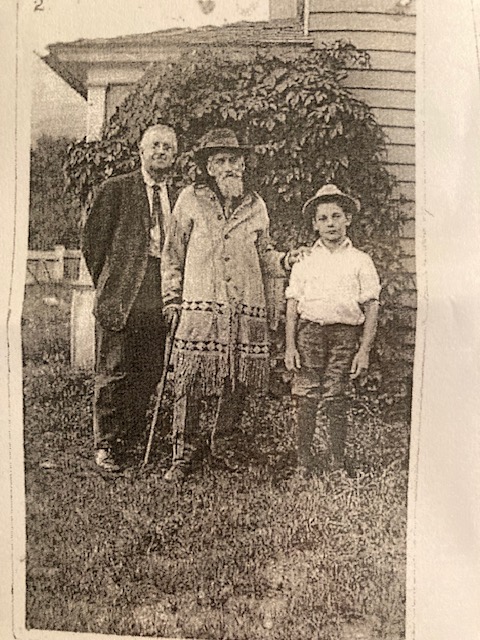
…and at a very old age in Lake City, Colorado with his son Frank and a young neighbor (Ward Crane) circa August, 1919. “The last picture Dad had made.” (He died on November 28, 2019.) Note he is wearing the Kit Carson coat.
Along with another portrait of Mary Hough which I already have is the notation: “Mrs. Mary Hough, a well beloved Christian whose untiring efforts matched by faith which never wavered, gave to this community its early Baptist Church. In early 1874 a group of seven Baptists, led by Mrs. Mary Hough, associated themselves together for the purpose of organizing a Baptist Church. The first church building was erected that year.” It was the first church in Bent County. Indeed, Mary was what they now call a church “planter”–someone who organized a community of believers wherever she chanced to be. She helped to do this in Las Animas, Lake City and Trinidad, Colorado. She usually ran the Sunday School.
This makes sense since Mary grew up in the wild and wooly Westport Landing, which became Kansas City. Westport, you will recall, was founded by John Calvin McCoy, the missionary who came to help resettle the Eastern tribes that were beginning their migration to the Plains States. He plotted most of the original streets and settlements of the city. His brother-in-law, Johnston Lykins, was the first duly-elected mayor of Kansas City who, along with his wife, Mattie, pulled together the founders of First Baptist Church on April 21,1855. Before this, these pioneers would have met in private homes. Lykins is the minister who married our great-great-great grandmother Susanna Matney Prowers and her second husband Louis Vogel in 1840. They would have been members of this group.
Well, we keep digging away and sometimes our digging yields dividends!
*Sister Sledge
**Bing-pot = bingo and jackpot combined, coined by Jake Peralta
 dual personalities