dual personalities

Tag: Conrad Richter

“The wind rises… We must try to live!”*

by chuckofish

Today we toast the great, but under-appreciated, writer Conrad Richter, who died on this day in 1968. Isaac Bashevis Singer wrote, “There are in the literature of the world few works of historical fiction that make the reader feel that the writer must have been a witness to what he describes; he was actually there and came back – a transmigrated soul – to tell a story. The Awakening Land is such a work… it would be a great novel in any literature.”

I would heartily concur. Richter wrote short stories and 15 novels. His novel The Town, the last story of his trilogy The Awakening Land about the Ohio frontier, won the 1951 Pulitzer Prize for Fiction. His novel The Waters of Kronos won the 1961 National Book Award for Fiction.

A strange, uneasy feeling ran over him. If he had been wrong about his mother in this, might he by any chance have been wrong in other things about her also? Could it be even faintly possible that the children of pioneers like himself, born under more benign conditions than their parents, hated them because they themselves were weaker, resented it when their parents expected them to be strong, and so invented all kinds of intricate reasoning to prove that their parents were tyrannical and cruel, their beliefs false and obsolete, and their accomplishments trifling? Never had his mother said that. But once long ago he had heard her mention, not in as many words, that the people were too weak to follow God today, that in the Bible God made strong demands on them for perfection, so the younger generation watered God down, made Him impotent and got up all kinds of reasons why they didn’t have to follow Him but could go along their own way.” (The Town)

Like all great fiction, his words still speak to us, even seventy-five years after being published.

Well, as you know, I am a great re-reader, so I will reward myself with some Conrad Richter today.

Yesterday the boy came over and fixed our shutters which have been buffeted around by the wind all year and thus we were beginning to look like that house in the neighborhood that looks like it is decorated for Halloween all year. He also took apart the crib which was taking up a lot of room in our spare bedroom and moved it to the garage. I am so grateful to have adult children who are still speaking to me. This is a blessing not everyone can claim.

So re-read an old book, count your blessings and remember:

The steadfast love of the Lord never ceases;
    his mercies never come to an end;
they are new every morning;
    great is your faithfulness.

(Lamentations 3:22)

*Today is the poet Paul Valéry’s birthday (1871-1945)–“Le vent se lève… il faut tenter de vivre !” Read the whole poem here.
What are you reading?

by chuckofish

Screen Shot 2019-02-25 at 1.33.54 PM.png

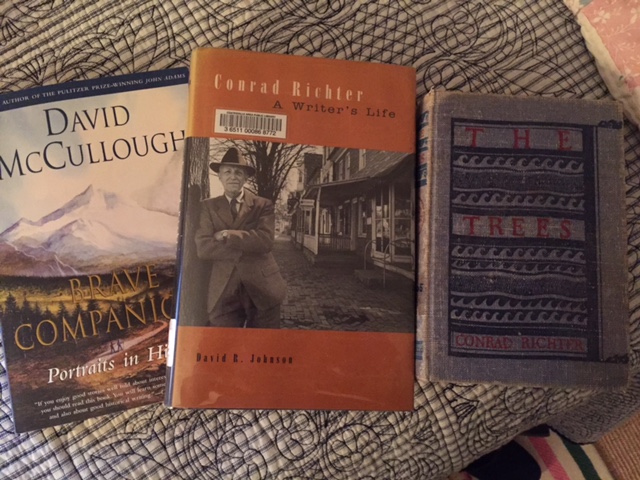
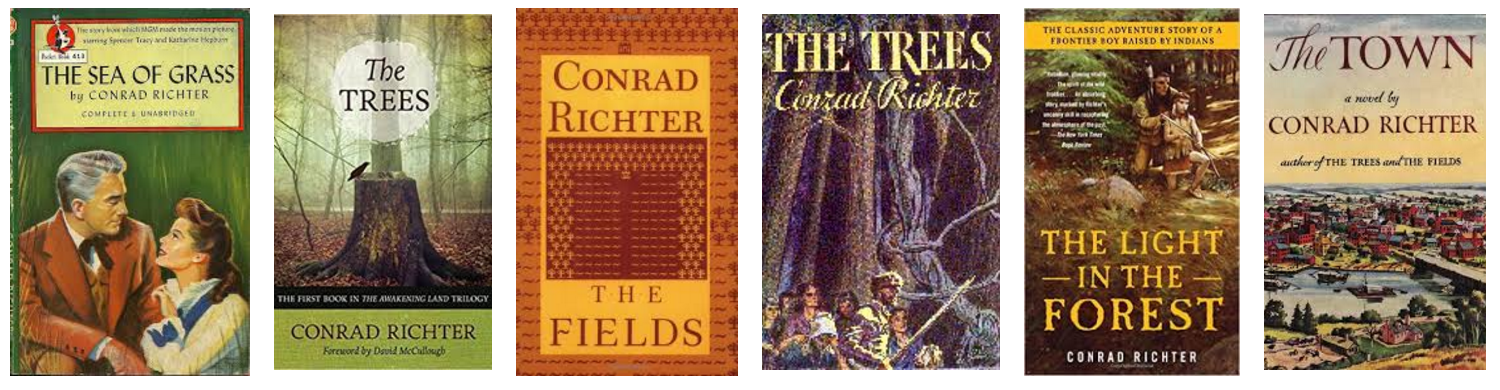
I finished re-reading The Trees by Conrad Richter over the weekend.  It is such a great book. So underrated.  He reminds me of Willa Cather, who also worked hard at her craft, getting it right. Richter also put so much into his books, so much research, and they are spare and perfect–no extraneous showing off.

RichterFullSizeRender.jpg

“There is great tenderness in his stories,” wrote David McCullough about Richter, “Much that is raw and earthy, much that is funny, and not a little cold-blooded violence. The land is never merely the setting; it is elemental to the story, vast and full of power and mystery. His characters do not merely move across the landscape; it is part of them and they are part of it…In the trilogy [The Trees, The Fields, The Town] it is the ancient trees, ‘a race of giants,’ that shut out the light.”

There they stood [Sayward Luckett reflects] with their feet deep in the guts of the earth and their heads in the sky, never even looking at you or letting on you were there. This was their country. Here they had lived and died since back in heathen times. Even the Lord, it seemed, couldn’t do much with them. For every one He blew down, a hundred tried to grow up in its place.

“The underlying values expressed in the trilogy,” McCullough continues, “in all the novels, are the old-fashioned primary values–courage, respect for one’s fellow man, self-reliance, courtesy, devotion to the truth, a loathing of hypocrisy, the power in simple goodness. He called them “the old verities” and he was sure they were vanishing from  American life. He had no patience with such expressions as “the Puritan ethic.” He thought most of those who used that expression never bothered to understand what the Puritans were all about.”

So, if you are looking for something to read, try Conrad Richter! I am going on with the trilogy.

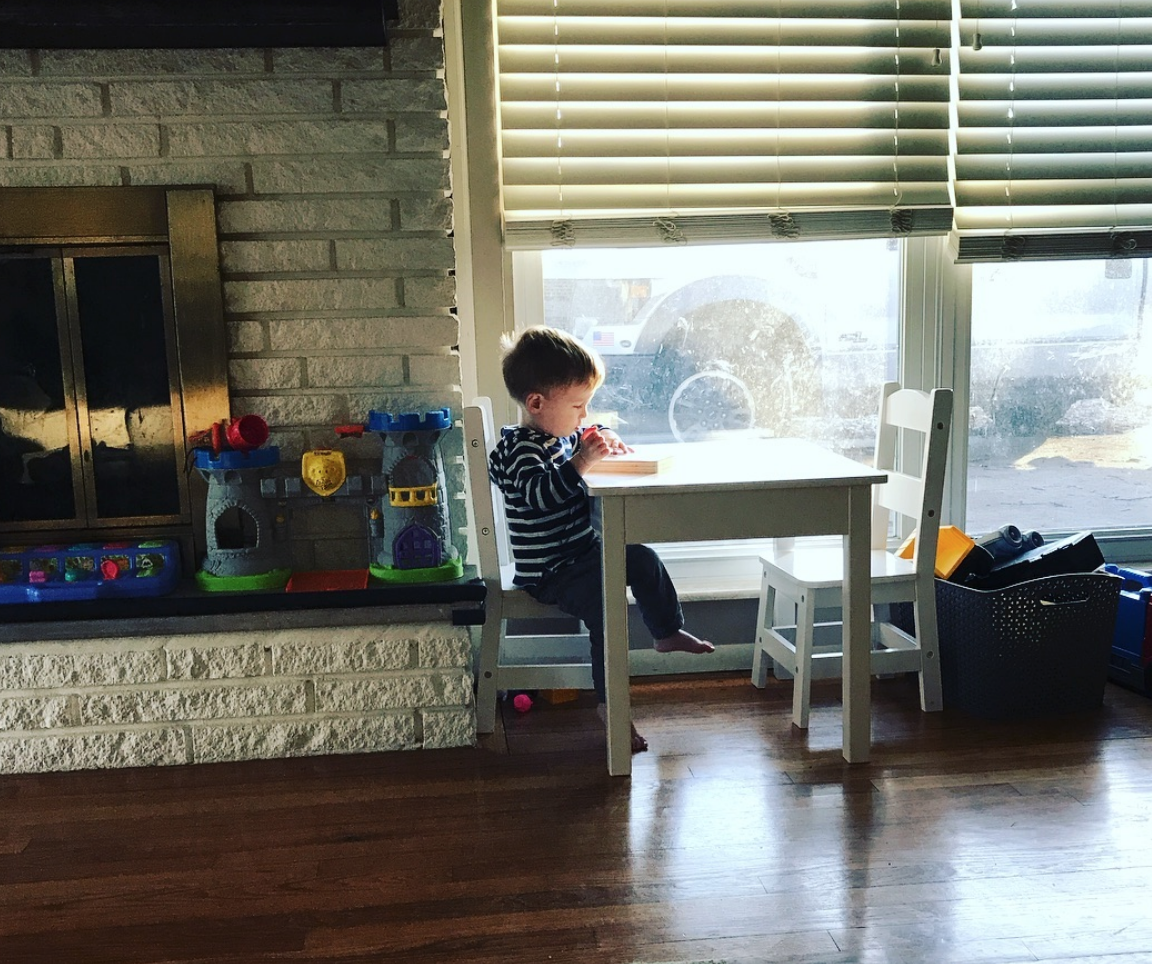
On another note, I must say, there is nothing more gratifying than seeing the wee babes “reading” books.

Screen Shot 2019-02-25 at 10.34.00 AM.pngScreen Shot 2019-02-25 at 5.39.04 PM.png

“You can be too rich and too thin, but you can never be too well read or too curious about the world.”
― Tim Gunn, Gunn’s Golden Rules: Life’s Little Lessons for Making It Work 

What are you reading?

by chuckofish

evening-at-home.jpg

I am reading a bunch of different things.

IMG_2983.JPG

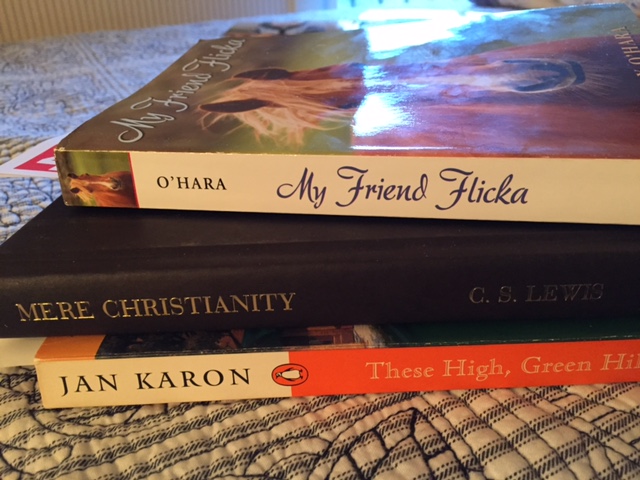
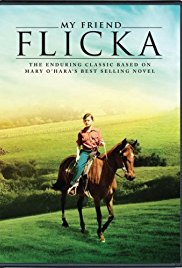
You will recall that My Friend Flicka, written by Wyomingite Mary O’Hara, was mentioned a couple of times in a Longmire mystery…so I felt I should read it since I never have. Written in 1941, it tells the story of Ken McLaughlin, the son of a a Wyoming rancher, and his horse Flicka. It was the first in a trilogy, followed by Thunderhead (1943) and Green Grass of Wyoming (1946). The popular 1943 film version featured young Roddy McDowell.

MV5BMTk3MjUzMDE2OF5BMl5BanBnXkFtZTcwOTYxODE0MQ@@._V1_UY268_CR3,0,182,268_AL_.jpg

They re-made Flicka in 2006 with a girl protagonist (of course) and Tim McGraw as the father. Oy.

Anyway, the book is very well-written and quite sophisticated for a young adult novel of that era–there is a graphic scene of yearlings being gelded which I could have lived without.  Furthermore, Ken’s mother is a Bryn Mawr graduate and they are Episcopalians! But I’m just not that interested in horses, I guess, because I’m not sure I will trudge on to the end.

I am also re-reading Mere Christianity, which–no surprise–is really good!

“I am trying here to prevent anyone saying the really foolish thing that people often say about Him: I’m ready to accept Jesus as a great moral teacher, but I don’t accept his claim to be God. That is the one thing we must not say. A man who was merely a man and said the sort of things Jesus said would not be a great moral teacher. He would either be a lunatic — on the level with the man who says he is a poached egg — or else he would be the Devil of Hell. You must make your choice. Either this man was, and is, the Son of God, or else a madman or something worse. You can shut him up for a fool, you can spit at him and kill him as a demon or you can fall at his feet and call him Lord and God, but let us not come with any patronizing nonsense about his being a great human teacher. He has not left that open to us. He did not intend to.”

When I wake up in the middle of the night and can’t get back to sleep, I read Jan Karon. So now I am reading These High, Green Hills.

Lunch at the Grill, thought Father Tim, was what kept life real. He had to confess, however, that he could hardly wait to get back to the office and finish the C.S. Lewis essay entitled “Thought, Imagination, Language.”

I also recently re-read The Free Man by Conrad Richter. It tells the story of Henry Free, a hard-working Palatine German who comes to farm in Pennsylvania but is tricked, along with many of his countrymen, by the British, and is sold as an indentured servant when he arrives in America.  He escapes and thrives and eventually fights for liberty on the battlefields of the Revolution. The book did not receive good reviews when it was published in 1943 during the height of WWII. I am not surprised, since the British–our allies!–are the bad guys. It must have been shocking and somewhat distasteful at the time. The lesson here is an important one though–the British are not always the good guys and the Germans not always the villains.

I admire Richter and his spare, but beautiful writing a lot. He is an all-but-forgotten writer these days, but I read that they are re-making the Awakening Land trilogy for television. Frances McDormand is going to play Sayward Luckett, the main character, which could be good or bad. Perhaps it will encourage someone to go back and read the books.

Screen Shot 2017-11-28 at 9.43.07 AM.png

What are you reading?

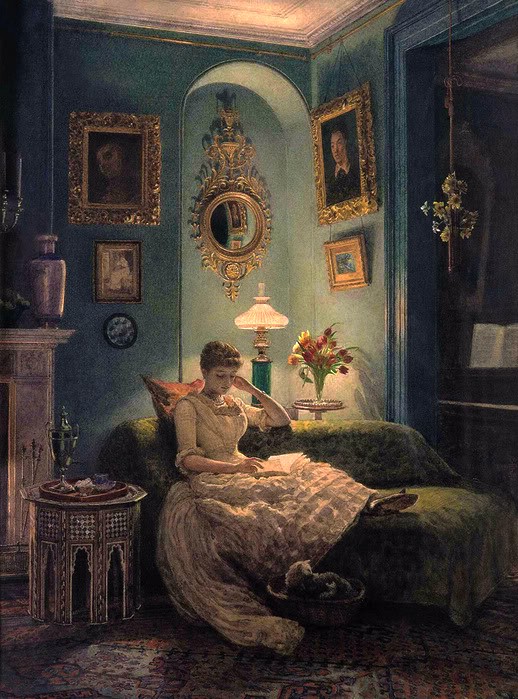
The painting at the top is “Evening at Home” by Edward John Poynter (1836-1919)

Happy birthday, Conrad Richter

by chuckofish

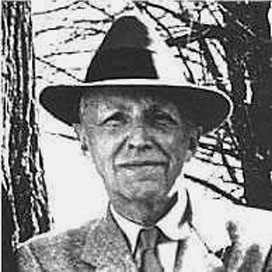
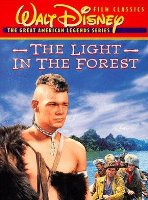
Today is the birthday of author Conrad Richter (October 13, 1890—October 30, 1968). Richter is one of my favorite writers, one I go back to over and over again. In fact, I just recently re-read The Waters of Kronos (1960) for the third or fourth time. He won the National Book Award for this book, and I highly recommend it. Unfortunately, Richter will probably be best remembered for A Light in the Forest because it was made into a movie by Walt Disney in 1958. It starred James MacArthur and Fess Parker.

They still teach this book in some middle schools, but he is not a “young adult writer” and he should not be relegated to that particular pigeon hole.

Louis Bromfield described Richter’s work this way: “He has that gift – the first and most important in a novelist – of creating for the reader a world as real as the one in which he lives, a world which the reader enters on the first page and in which he remains until the last.” (It should be noted that Louis Bromfield is not that kind a writer, but I’m glad he could recognize the gift in others.) Anyway, I whole-heartedly recommend The Awakening Land trilogy (The Trees, The Fields, The Town) as well as A Company of Strangers, The Free Man, A Simple Honorable Man, and The Waters of Kronos.

For a moment Sayward reckoned that her father had fetched them unbeknownst to the Western ocean and what lay beneath was the late sun glittering on green-black water. Then she saw that what they looked down on was a dark, illimitable expanse of wilderness. It was a sea of solid tree-tops broken only by a gash where deep beneath the foliage an unknown stream made its way. As far as the eye could reach, this lonely forest sea rolled on and on till its faint blue billows broke against an incredibly distant horizon.

–from The Trees (1940)