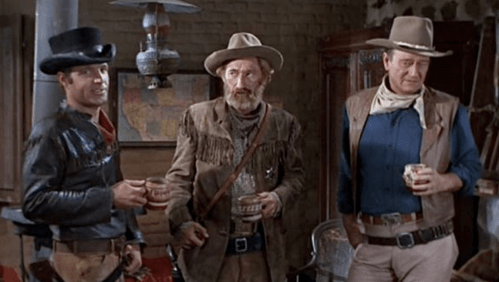
“Step down off your high horse, mister”*
by chuckofish
On Wednesday my copy of Rude Pursuits and Rugged Peaks, Schoolcraft’s Ozark Journal 1818-1819 arrived.
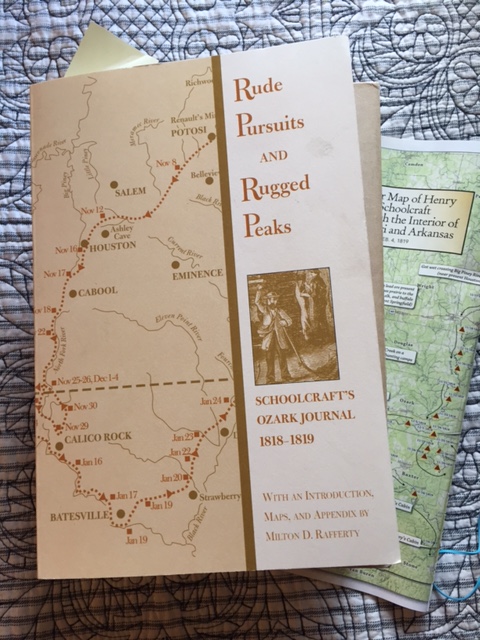
Included in this edition, besides Schoolcraft’s journal of his and Levi Pettibone’s expedition from Potosi, Missouri, to what is now Springfield by way of Arkansas, are an introduction, maps and appendix by Milton D. Rafferty. Rafferty was a professor and head of the Department of Geography, Geology and Planning at Missouri State University in Springfield. These additions are very helpful.
I will read the whole thing, but I know you are all wondering what I found out about the Matneys, so I will tell you.
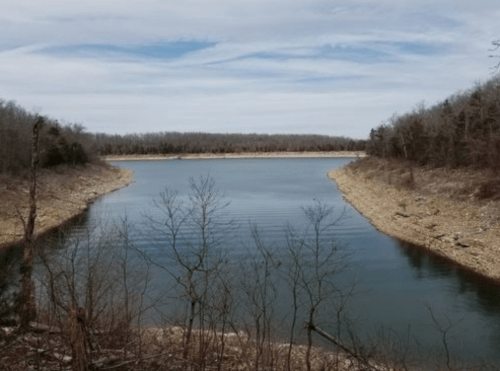
Schoolcraft and his partner arrived at dusk at their cabin, “wet and chilly” from swimming across the White River, on January 14.
Compelled, by the non-arrival of our canoe, to spend the day at this spot, I determined to improve the time by a ramble through the adjacent country, and to seek that amusement in the examination of rocks, and trees, and mountain-scenery, which was neither to be found in conversation with the inmates of the house, nor in any other way.
How rude.
With such an assemblage of interesting objects around me, I sauntered out to take a nearer view of the face of nature, and spent the day along the shores of the river, in the contiguous forest, or on the naked peaks of the neighboring hills.
After spending the day taking notes on the flora, fauna and mineral deposits in the area, Schoolcraft returned to the Matney Cabin to find that the hunters had not yet arrived with their canoe, but finally made their appearance at dusk…
accompanied by several neighbors and friends in their canoes, who also came down to trade, making a party of twelve or fourteen in all. Whisky soon began to circulate freely, and by the time they had unloaded their canoes, we began plainly to discover that a scene of riot and drinking was to follow. Of all this, we were destined to be unwilling witnesses; for as there was but one house, and that a very small one, necessity compelled us to pass the night together; but sleep was not to be obtained. Every mouth, hand, and foot, were in motion. Some drank, some sang, some danced, a considerable proportion attempted all three together, and a scene of undistinguishable bawling and riot ensued. An occasional quarrel gave variety to the scene, and now and then, one drunker than the rest, fell sprawling upon the floor, and for a while remained quiet. We alone remained listeners to this grand exhibition of human noises, beastly intoxication, and mental and physical nastiness. We did not lie down to sleep, for that was dangerous. Thus the night rolled heavily on, and as soon as light could be discerned in the morning we joyfully embarked in our canoe, happy in having escaped bodily disfiguration, and leaving such as could yet stand, vociferating with all their might like some delirious man upon his dying bed, who makes one desperate effort to rise, and then falls back in death.
What a picture he paints! Clearly he was not amused by their behavior, but I surely was, reading about it. Prof. Rafferty explains Schoolcraft’s sometimes disdainful appraisal of frontier life by asking us to consider his youth (he was only 25) and that he was “freshly indoctrinated with a church upbringing, including a strong emphasis on Christian dutifulness and temperance…”
I have to say, I can relate to young Schoolcraft. I remember going on a school-sanctioned float-trip back in high school–on some river in Missouri–where everyone got drunk, including the two male, gym-teacher chaperones! One other girl and I stayed awake most of the night watching out for our classmates and making sure they didn’t drown while relieving themselves. (Seriously) It was not fun, but nobody died or anything.
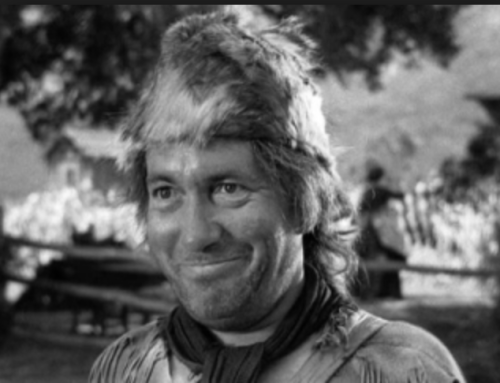
Matney and his companions remind me of Mac MacPherson, the wild Scotsman played by Wilfred Lawson in Alleghany Uprising (1939).
Another literary evocation of this type is Worth Luckett in The Trees by Conrad Richter, who provides for his family by hunting wild animals for food and trading their pelts for other commodities they need. When Worth notices that the wild game is leaving the woods near their settlement in Pennsylvania, he convinces his wife and family to move where the animal population is more plentiful–further west.
These men were the hardiest of woodsmen, cut from the same cloth as Daniel Boone and his sons, who settled along the interior streams, hunting and trading. Schoolcraft “admired their stoic courage and tenacity, but could not conceal his disdain for their lack of education and rude lifestyle. He noted that men and women alike could talk only of bears, hunting, and the rude pursuits and coarse enjoyments of hunters.” (Rafferty) He had to admit they were hospitable.
I have always been oddly drawn to this type and I guess now I know why. It runs in my blood. Come the apocalypse, I want to be on their team. I am pretty sure this is how my great-great grandfather John Simpson Hough felt. He went west to get away from Philadelphia and all his well-meaning, upstanding Quaker relatives. He was smitten with all the old rough types he met in Missouri and Kansas and in his travels westward: Uncle Dick Wooten, Seth Hays, Kit Carson. I am sure he would have liked his freedom-loving grandfather-in-law, Mr. Matney.
Funnily enough, I have just been reading about Conrad Richter and had already resolved to re-read The Trees. Now I will for sure.
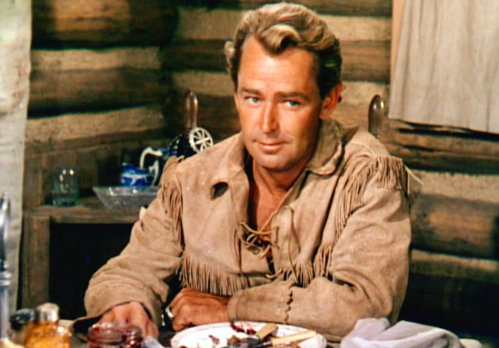
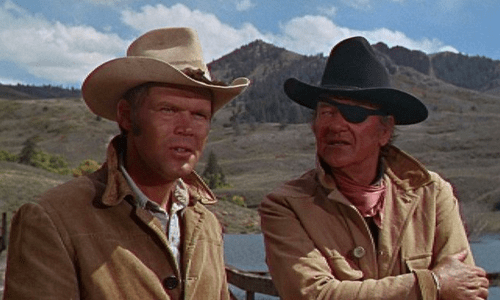
And this weekend I’ll find something to watch where the men wear buckskin suits.
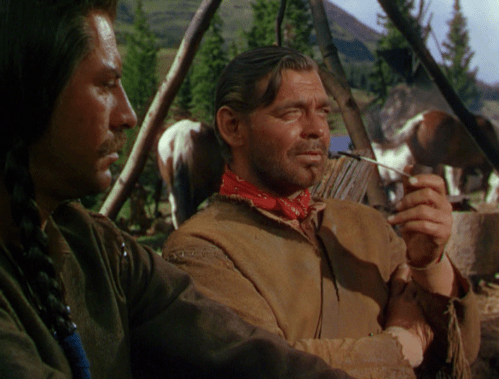
You betcha.
*Davy Crockett (John Wayne) in The Alamo (1960)
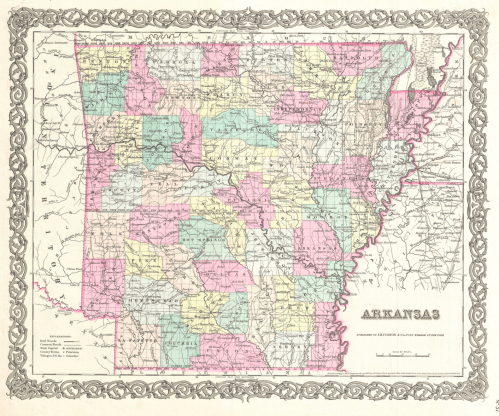
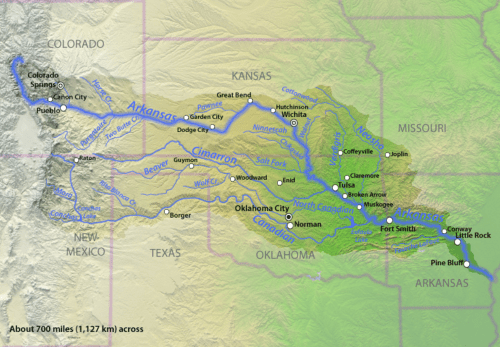 However, I can’t say I have a great desire to go to Little Rock.


 dual personalities