“To be born in a duck’s nest in a farmyard is of no consequence to a bird if it is hatched from a swan’s egg. He now felt glad at having suffered sorrow and trouble, because it enabled him to enjoy so much better all the pleasure and happiness around him; for the great swans swam round the newcomer and stroked his neck with their beaks, as a welcome.”
–Hans Christian Andersen, “The Ugly Duckling” (1843)
Some say that Andersen considered this story to be autobiographical. As a child, he was mocked for his big nose and large feet, as well as for his beautiful singing voice and love of theater. There were also rumors that Hans Christian Andersen was the illegitimate son of King Christian VIII of Denmark! It is a story that many children can relate to on some level–at least those who feel excluded in some way from their peers.
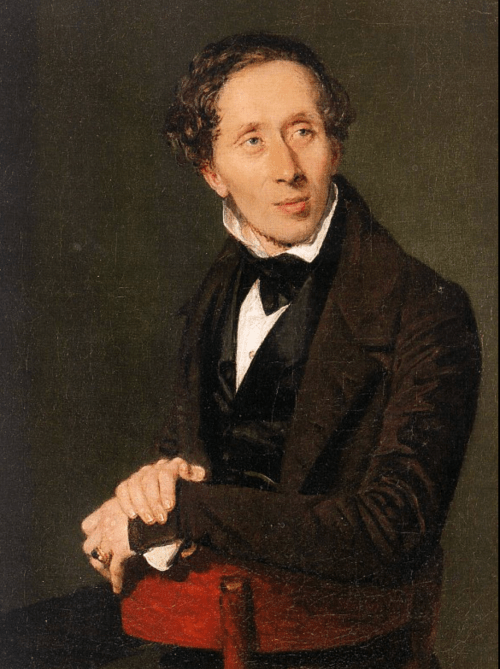
Anyway, today is the birthday of Hans Christian Andersen (1805 – 1875), the great Danish writer, who is the author of many personal favorites. Our mother could not read through “The Little Match Girl” without weeping, which was quite disconcerting to me as a small child.
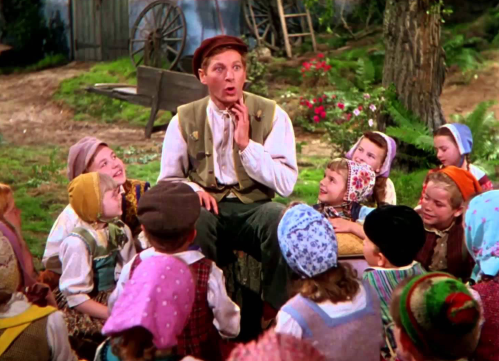
I will toast him tonight and perhaps listen to Danny Kaye singing about the Ugly Duckling…
Good morning! There’s nothing like some Mandisa to start your day off right! And it is important to start your day off right.
This is the day which the Lord has made; let us rejoice and be glad in it.
(Psalm 118:24)
My mother, who was not one to scold or correct, did tell me once, when I was grousing about something as an adolescent, that this is the day which the Lord has made, and you ought not to complain about it, but, indeed, rejoice about it. And for Pete’s sake, don’t waste it! That advice struck a cord in me and I never forgot it.
IT IS A MOMENT of light surrounded on all sides by darkness and oblivion. In the entire history of the universe, let alone in your own history, there has never been another just like it and there will never be another just like it again. It is the point to which all your yesterdays have been leading since the hour of your birth. It is the point from which all your tomorrows will proceed until the hour of your death. If you were aware of how precious it is, you could hardly live through it. Unless you are aware of how precious it is, you can hardly be said to be living at all.
“This is the day which the Lord has made,” says the 118th Psalm. “Let us rejoice and be glad in it.” Or weep and be sad in it for that matter. The point is to see it for what it is because it will be gone before you know it. If you waste it, it is your life that you’re wasting. If you look the other way, it may be the moment you’ve been waiting for always that you’re missing.
All other days have either disappeared into darkness and oblivion or not yet emerged from them. Today is the only day there is.
– Frederick Buechner, Whistling in the Dark
“If the day and the night are such that you greet them with joy, and life emits a fragrance like flowers and sweet-scented herbs, is more elastic, more starry, more immortal- that is your success. All nature is your congratulation, and you have cause momentarily to bless yourself. The greatest gains and values are farthest from being appreciated. We easily come to doubt if they exist. We soon forget them. They are the highest reality. Perhaps the facts most astounding and most real are never communicated by man to man. The true harvest of my daily life is somewhat as intangible and indescribable as the tints of morning or evening. It is a little star-dust caught, a segment of the rainbow which I have clutched.”
― Henry David Thoreau, Walden
“Write it on your heart
that every day is the best day in the year.
He is rich who owns the day, and no one owns the day
who allows it to be invaded with fret and anxiety.
Finish every day and be done with it.
You have done what you could.
Some blunders and absurdities, no doubt crept in.
Forget them as soon as you can, tomorrow is a new day;
begin it well and serenely, with too high a spirit
to be cumbered with your old nonsense.
This new day is too dear,
with its hopes and invitations,
to waste a moment on the yesterdays.”
― Ralph Waldo Emerson, Collected Poems and Translations
I may have said all this before, but it bears repeating. Write it on your heart.
And here’s a little Stephen Stills on the subject:
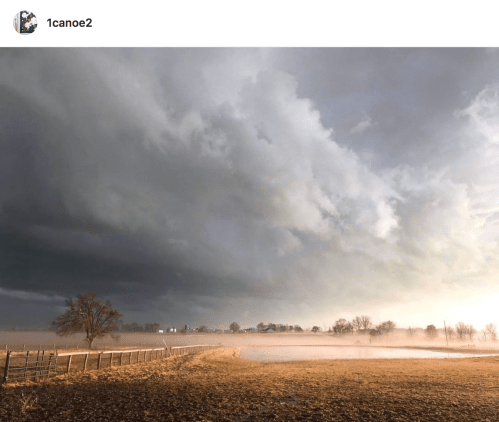
I love this picture from the 1canoe2 Instagram feed. It is so mid-Missouri! We are moving into severe weather season now, so, although we like our thunderstorms, we pray for no tornadoes! The news of the tornadoes in Alabama last week fills us with dread.
“They all stood unwilling on the sandbar, holding to the net. In the eastern sky were the familiar castles and the round towers to which they were used, gray, pink, and blue, growing darker and filling with thunder. Lightning flickered in the sun along their thick walls. But in the west the sun shone with such a violence that in an illumination like a long-prolonged glare of lightning the heavens looked black and white; all color left the world, the goldenness of everything was like a memory, and only heat, a kind of glamor and oppression, lay on their heads. The thick heavy trees on the other side of the river were brushed with mile-long streaks of silver, and a wind touched each man on the forehead. At the same time there was a long roll of thunder that began behind them, came up and down mountains and valleys of air, passed over their heads, and left them listening still. With a small, near noise a mockingbird followed it, the little white bars of its body flashing over the willow trees.
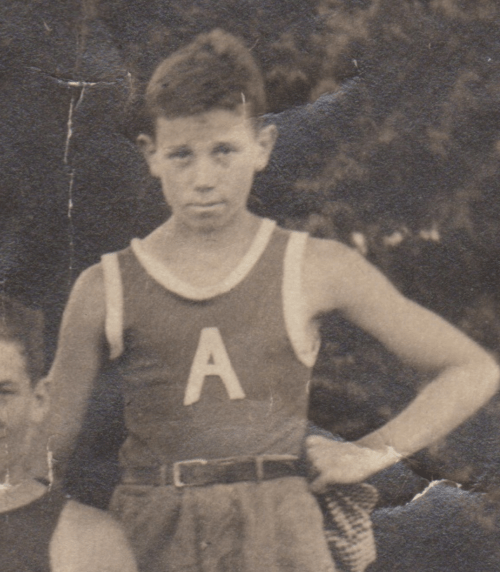
I was thinking about this ‘anecdote’ the other night and looked it up to read. It always reminded me so much of the boy when he was…a boy…and also, what I imagined my grandfather Bunker to be like.
It’s an Anecdote, sink me, but I’ll let it rip: At about nine, I had the very pleasant notion that I was the Fastest Boy Runner in the World. It’s the kind of queer, basically extracurricular conceit, I’m inclined to add, that dies hard, and even today, at a supersedentary forty, I can picture myself, in street clothes, whisking past a series of distinguished but hard-breathing Olympic milers and waving to them, amiably, without a trace of condescension. Anyway, one beautiful spring evening when we were still living over on Riverside Drive, Bessie sent me to the drugstore for a couple of quarts of ice cream. I came out of the building at that very same magical quarter hour described just a few paragraphs back. Equally fatal to the construction of this anecdote, I had sneakers on–sneakers surely being to anyone who happens to be the Fastest Boy Runner in the World almost exactly what red shoes were to Hans Christian Andersen’s little girl. Once I was clear of the building, I was Mercury himself, and broke into a “terrific” sprint up the long block to Broadway. I took the corner at Broadway on one wheel and kept going, doing the impossible: increasing speed. The drugstore that sold Louis Sherry ice cream, which was Bessie’s adamant choice, was three blocks north, at 113th. About halfway there, I tore past the stationery store where we usually bought our newspapers and magazines, but blindly, without noticing any acquaintances or relatives in the vicinity. Then, about a block farther on, I picked up the sound of pursuit at my rear, plainly conducted on foot. My first, perhaps typically New Yorkese thought was that the cops were after me–the charge, conceivably, Breaking Speed Records on a Non-School-Zone Street. I strained to get a little more speed out of my body, but it was no use. I felt a hand clutch out at me and grab hold of my sweater just where the winning-team numerals should have been, and, good and scared, I broke my speed with the awkwardness of a gooney bird coming to a stop. My pursuer was, of course, Seymour, and he was looking pretty damned scared himself. “What’s the matter? What happened?” he asked me frantically. He was still holding on to my sweater. I yanked myself loose from his hand and informed him, in the rather scatological idiom of the neighborhood, which I won’t record here verbatim, that nothing happened, nothing was the matter, that I was just running, for cryin’ out loud. His relief was prodigious. “Boy, did you scare me!” he said. “Wow, were you moving! I could hardly catch up with you!” We then went along, at a walk, to the drugstore together. Perhaps strangely, perhaps not strangely at all, the morale of the Second-Fastest Boy Runner in the World had not been perceptibly lowered. For one thing, I had been outrun by him. Besides, I was extremely busy noticing that he was panting a lot. It was oddly diverting to see him pant.
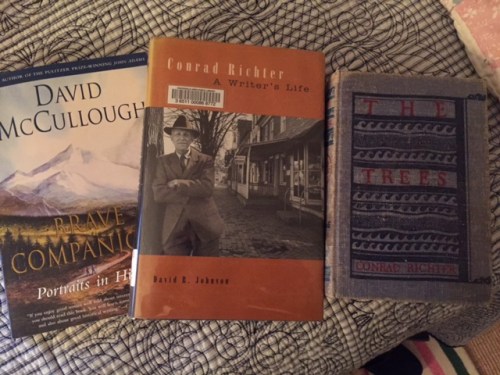
I finished re-reading The Trees by Conrad Richter over the weekend. It is such a great book. So underrated. He reminds me of Willa Cather, who also worked hard at her craft, getting it right. Richter also put so much into his books, so much research, and they are spare and perfect–no extraneous showing off.
“There is great tenderness in his stories,” wrote David McCullough about Richter, “Much that is raw and earthy, much that is funny, and not a little cold-blooded violence. The land is never merely the setting; it is elemental to the story, vast and full of power and mystery. His characters do not merely move across the landscape; it is part of them and they are part of it…In the trilogy [The Trees, The Fields, The Town] it is the ancient trees, ‘a race of giants,’ that shut out the light.”
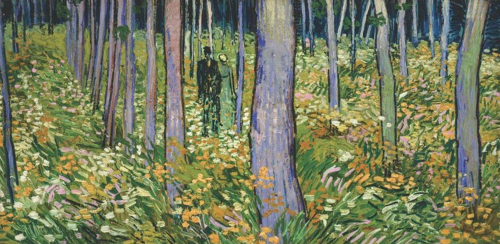
There they stood [Sayward Luckett reflects] with their feet deep in the guts of the earth and their heads in the sky, never even looking at you or letting on you were there. This was their country. Here they had lived and died since back in heathen times. Even the Lord, it seemed, couldn’t do much with them. For every one He blew down, a hundred tried to grow up in its place.
“The underlying values expressed in the trilogy,” McCullough continues, “in all the novels, are the old-fashioned primary values–courage, respect for one’s fellow man, self-reliance, courtesy, devotion to the truth, a loathing of hypocrisy, the power in simple goodness. He called them “the old verities” and he was sure they were vanishing from American life. He had no patience with such expressions as “the Puritan ethic.” He thought most of those who used that expression never bothered to understand what the Puritans were all about.”
So, if you are looking for something to read, try Conrad Richter! I am going on with the trilogy.
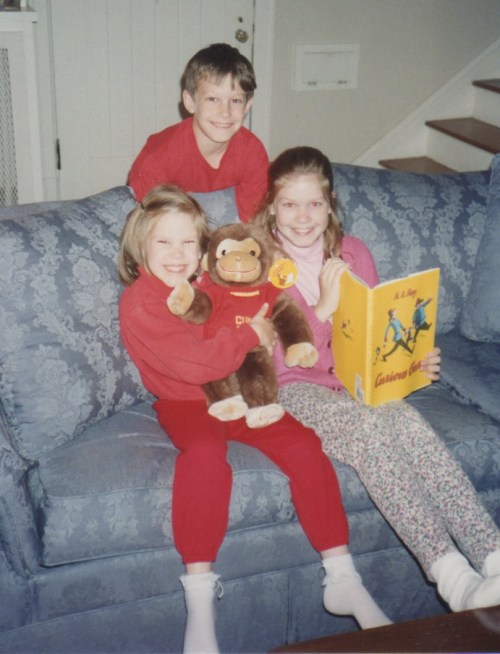
On another note, I must say, there is nothing more gratifying than seeing the wee babes “reading” books.
“You can be too rich and too thin, but you can never be too well read or too curious about the world.”
― Tim Gunn, Gunn’s Golden Rules: Life’s Little Lessons for Making It Work
One of the great causes of sadness in human life is the collision between expectation and what actually happens. The New Testament, therefore, for our joy, is relentlessly helping us to lower our expectations for this life and raise our expectations for the next.⠀
⠀
For example, in 1 Peter 4:12, it says, “Don’t be surprised at the fiery ordeal when it comes upon you as though something strange were happening to you.” In other words, get it fixed in your head that it is not strange to have life go bad for you as a Christian. Paul, in Romans 8, said, “Even we who have the Holy Spirit groan inwardly as we wait for our adoption as children, the redemption of our body.” Even those in this life who have the Holy Spirit will experience all the rheumatism and cancer and accidents and horror that the world does. “Many are the afflictions of the righteous, but the Lord delivers him out of them all” (Psalm 34:19).⠀
⠀
The constant lowering of expectations now is accompanied with a raising of expectations later: “Blessed be the God and Father of our Lord Jesus Christ, who caused us to be born again to a living hope through the resurrection of Jesus Christ from the dead to an inheritance that is undefiled, unfading, imperishable, kept in heaven for you who by God’s power are being guarded through faith for a salvation ready to be revealed in the last time. In this you rejoice” (1 Peter 1:3–6).⠀
⠀
Now, we know it’s going to be hard. Many are the afflictions of the righteous, but oh, how the New Testament raises higher and higher and higher our expectations of the life to come. Live in hope and embrace what God gives you in this life in love.⠀
⠀
–John Piper (Read more at desiringGod.org.)
Yes, God has a plan for you, but that plan is not for you to be happy, fulfilled, rich and famous. His plan is for you to be holy and content. It is easy to lose sight of that.
“Christ never promises peace in the sense of no more struggle and suffering. Instead, he helps us to struggle and suffer as he did, in love, for one another. Christ does not give us security in the sense of something in this world, some cause, some principle, some value, which is forever. Instead, he tells us that there is nothing in this world that is forever, all flesh is grass. He does not promise us unlonely lives. His own life speaks loud of how, in a world where there is little love, love is always lonely. Instead of all these, the answer that he gives, I think, is himself. If we go to him for anything else, he may send us away empty or he may not. But if we go to him for himself, I believe that we go away always with this deepest of all our hungers filled.”
― Frederick Buechner, Listening to Your Life: Daily Meditations with Frederick Buechner
“You think you will never forget any of this, you will remember it always just the way it was. But you can’t remember it the way it was. To know it, you have to be living in the presence of it right as it is happening. It can return only by surprise. Speaking of these things tells you that there are no words for them that are equal to them or that can restore them to your mind. And so you have a life that you are living only now, now and now and now, gone before you can speak of it, and you must be thankful for living day by day, moment by moment, in this presence. But you have a life too that you remember. It stays with you. You have lived a life in the breath and pulse and living light of the present, and your memories of it, remember now, are of a different life in a different world and time. When you remember the past, you are not remembering it as it was. You are remembering it as it is. It is a vision or a dream, present with you in the present, alive with you in the only time you are alive.”
I am grateful for what I am and have. My thanksgiving is perpetual. It is surprising how contented one can be with nothing definite — only a sense of existence. Well, anything for variety. I am ready to try this for the next 1000 years, and exhaust it. How sweet to think of! My extremities well charred, and my intellectual part too, so that there is no danger of worm or rot for a long while. My breath is sweet to me. O how I laugh when I think of my vague indefinite riches. No run on my bank can drain it — for my wealth is not possession but enjoyment.
–Henry David Thoreau, Letter to Harrison Gray Otis Blake (December 1856), as published in The Correspondence of Henry David Thoreau (1958)
Thankfulness is an essential guardian of the soul, and therefore we should guard ourselves with gratitude. Evidently we are fair game for the devil when we don’t abound with thanksgiving. Unless the song of thanksgiving is being sung in our hearts the enemy outside will deceive his way into the city of our soul, and the enemy sympathizers within will make his job easy. So for the sake of your own safety, strive to fill your heart with thanksgiving! Guard yourselves with gratitude!
–John Piper
Almighty God, Father of all mercies, we, thine unworthy servants, do give thee most humble and hearty thanks for all thy goodness and loving-kindness to us, and to all men. We bless thee for our creation, preservation, and all the blessings of this life; but above all, for thine inestimable love in the redemption of the world by our Lord Jesus Christ; for the means of grace, and for the hope of glory. And, we beseech thee, give us that due sense of all thy mercies, that our hearts may be unfeignedly thankful; and that we show forth thy praise, not only with our lips, but in our lives, by giving up our selves to thy service, and by walking before thee in holiness and righteousness all our days; through Jesus Christ our Lord, to whom, with thee and the Holy Ghost, be all honor and glory, world without end. Amen.
–A General Thanksgiving, BCP
(The painting is J. Alden Weir, 1859-1919, American Impressionist painter)
Well, it is getting very cold here in flyover country. Not surprising, since it is January. But you know, people like to get panicky about weather.
I must say, it is the kind of weather that makes one want to curl up on the couch and read a good book or watch a good movie.
“To enjoy bodily warmth, some small part of you must be cold, for there is no quality in this world that is not what it is merely by contrast. Nothing exists in itself. If you flatter yourself that you are all over comfortable, and have been so a long time, then you cannot be said to be comfortable any more. For this reason a sleeping apartment should never be furnished with a fire, which is one of the luxurious discomforts of the rich. For the height of this sort of deliciousness is to have nothing but the blanket between you and your snugness and the cold of the outer air. Then there you lie like the one warm spark in the heart of an arctic crystal.”






 I must say, it is the kind of weather that makes one want to curl up on the couch and read a good book or watch a good movie.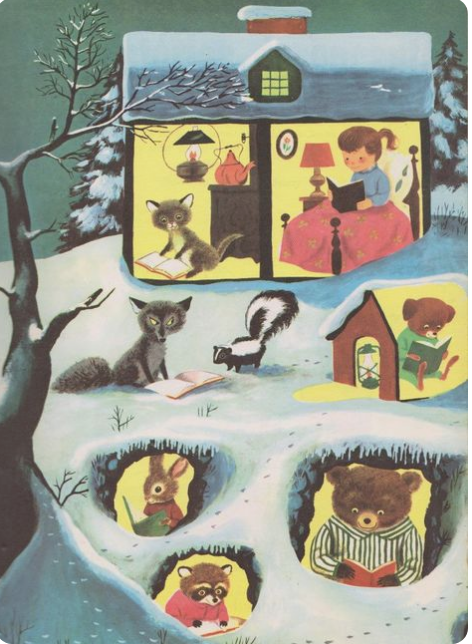
 dual personalities