dual personalities

Category: Poetry

The beacons are lit!

by chuckofish

In honor of today being the 430th anniversary of the “invincible” Spanish Armada being sighted in England on July 19, 1588, when it appeared off The Lizard in Cornwall,

2880px-C.C._van_Wieringen_The_Spanish_Armada_off_the_English_coast (1) 2.jpg

here is the famous lighting of the beacons scene in The Return of the King (2005).

https://www.youtube.com/watch?v=sIhnYFRu4ao

The news of the Armada was likewise conveyed to London by a system of beacons that had been constructed all the way along the south coast. Do you think this is where Tolkien got his idea?

CulmstockBeacon 2.jpg

A stone building, a signal station, at Culmstock Beacon in Devon, UK, built in 1588 to enclose a wooden pole, which protruded through the roof to support one or more fire baskets. This is one of a chain of signal stations along England’s southern counties – but the only remaining stone building – the purpose of which was to warn of the Spanish Armada being sighted.

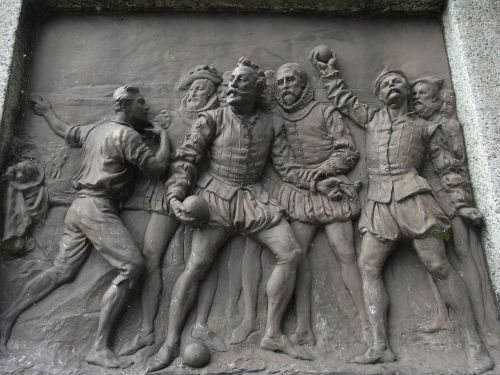
On the evening of July 19, the English fleet was trapped in Plymouth Harbour by the incoming tide. The Spanish convened a council of war, where it was proposed to ride into the harbor on the tide and incapacitate the defending ships at anchor and from there to attack England; but Medina Sidonia declined to act and decided to sail on to the east and towards the Isle of Wight. As the tide turned, 55 English ships set out to confront them from Plymouth under the command of Lord Howard of Effingham, with Sir Francis Drake as Vice Admiral. Howard ceded some control to Drake, given his experience in battle. The rear admiral was Sir John Hawkins.
DrakeMonumentTavistock 2.jpg

Sir Francis Drake playing bowls on Plymouth Hoe is informed of the approach of the Spanish Armada.

This brief look into an exciting piece of history makes me want to go back and re-read Garrett Mattingly’s The Armada, first published in 1959. I know I have a copy…if I can just find it!

In May fifteen hundred and eighty-eight,
Cries Philip, “The English I’ll humble;
For I have taken it into my Majesty’s pate,
And their lion, oh! down he shall tumble.
They lords of the sea!”—then his sceptre he shook,—
“I’ll prove it an arrant bravado.
By Neptune! I’ll knock ’em all into a nook,
With the invincible Spanish Armada!”

This fleet then sailed forth, and the winds they did blow,
Their guns made a terrible clatter;
Our noble Queen Bess, ’cause she wanted to know,
Quill’d her ruff and cried, “Pray, what’s the matter?”
“They say, my good Queen,” replied Howard so stout,
“The Spaniard has drawn his toledo,
He’s cock sure that he’ll thump us, and kick us about,
With the invincible Spanish Armada.”

The Lord Mayor of London, a very wise man,
What to do in this case vastly wondered;
Says the Queen, “Send in fifty good ships, if you can.”
Says my Lord, “Ma’am, I’ll send in a hundred.”
Our fire-ships they soon struck their cannons all dumb,
And the Dons run to Ave and Credo.
Great Medina roars out, “Sure the devil is come,
For the invincible Spanish Armada.”

On Effingham’s squadron, though all in a breast
Like open-mouth curs they came bowling;
But our sugar-plums finding they could not digest,
Away home they ran yelping and howling.
When e’er Britain’s foes shall, with envy agog,
In our Channel make such a bravado—
Well, huzza, my brave boys! we’re still able to flog
An invincible Spanish Armada!

The Spanish Armada by Irish actor and dramatist John O’Keefe (1747-1833)

Happy Thursday!

“For love of unforgotten times”*

by chuckofish

chris:mother 1951.jpeg

oh antic God

return to me

my mother in her thirties

leaned across the front porch

the huge pillow of her breasts

pressing against the rail

summoning me in for bed.


I am almost the dead woman’s age times two.


I can barely recall her song

the scent of her hands

though her wild hair scratches my dreams

at night.   return to me, oh Lord of then

and now, my mother’s calling,

her young voice humming my name.

–Lucille Clifton

June 26 was the 30th anniversary of our mother’s death. As a day it doesn’t mean that much to me, because I think of her every day.

mary.jpeg

I see her in me and in my children and in other people. I read her books and wear her jewelry. I sometimes get out her dishes and use them. I watch movies that we watched together. I am reminded of what she said and thought about things.

I went to the memorial service of a 96-year old friend the other day. Her adult granddaughter spoke lovingly about her and related how when she was a child, she would visit her grandparents in the summer. She would go to the grocery store with her grandmother, who would drive with her hand on her granddaughter’s leg. I thought of my mother and of myself, who did the same thing (and still do sometimes!) with our children–that wordless pat of affection saying, I’m so happy you are here with me.

“We ourselves shall be loved for awhile and forgotten. But the love will have been enough; all those impulses of love return to the love that made them. Even memory is not necessary for love. There is a land of the living and a land of the dead and the bridge is love, the only survival, the only meaning.”

–Thornton Wilder, The Bridge of San Luis Rey

*Robert Louis Stevenson, from “To My Mother”

“The singing heart of June”*

by chuckofish

Screen Shot 2018-06-25 at 10.40.00 AM.png

“How do you like to go up in a swing,
Up in the air so blue?
Oh, I do think it the pleasantest thing
Ever a child can do!
Up in the air and over the wall,
Till I can see so wide,
River and trees and cattle and all
Over the countryside.
Till I look down on the garden green,
Down on the roof so brown–
Up in the air I go flying again,
Up in the air and down!”

–  Robert Louis Stevenson, The Swing 

You may have noticed that swings are becoming less common on school playgrounds throughout the country for liability reasons and because school officials are “looking for new ways to engage students in activities using safer equipment.” We are told that more than 200,000 children show up in hospital emergency rooms each year due to playground equipment injuries, according to the National Safety Council. Fewer than 20 of those accidents are fatal, but “swing set danger” looms large in the public’s imagination.**

Well.

I was a timid child. Lots of things scared me, but I loved to swing. And I liked to swing high, the higher the better. Sometimes I would swing and sing at the same time! Talk about feeling free! I mean I was never crazy and I held on tight–not like one of our friends who swears he could swing up and over on the swings at his elementary school. I was no dare-devil, but even timid kids like me can feel like they can fly on a swing. And they can flirt with danger in a way that is an important part of growing up.

Indeed, I’m with old RLS.

*Willa Cather; the illustration is by Mary Blair

**Statistics found here.

“The mind was dreaming. The world was its dream.”

by chuckofish

“A book is more than a verbal structure or series of verbal structures; it is the dialogue it establishes with its reader and the intonation it imposes upon his voice and the changing and durable images it leaves in his memory. A book is not an isolated being: it is a relationship, an axis of innumerable relationships.”

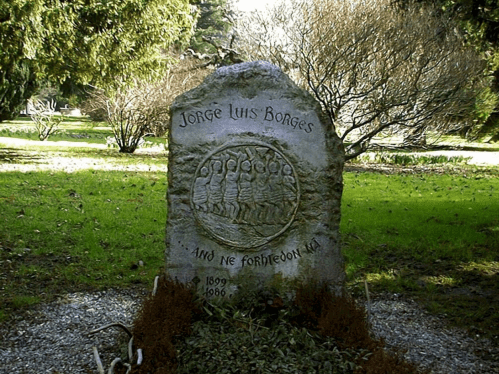
Today is the anniversary of the death of Jorge Luis Borges (1899-1986), Argentine short-story writer, essayist, poet and translator.

Borges_001.JPG

He is buried in the Cimetière de Plainpalais, in Geneva, Switzerland, along with John Calvin.

Screen Shot 2018-06-13 at 7.50.07 PM.png

Many people thought that he should have been awarded the Nobel Prize for literature. This makes me think of Philip Roth, who died a few weeks ago, who also felt robbed of the same award.

Well, as Calvin said, “Man’s nature, so to speak, is a perpetual factory of idols.”

If you are looking for something to read, you might look up old Jorge Luis Borges. I am not well read in his canon, but what I have read, I liked.

I’m talking to an American: there’s a book I must speak about — nothing unexpected about it — that book is Huckleberry Finn. I thoroughly dislike Tom Sawyer. I think that Tom Sawyer spoils the last chapters of Huckleberry Finn. All those silly jokes. They are all pointless as jokes; but I suppose Mark Twain thought it was his duty to be funny even when he wasn’t in the mood. The jokes had to be worked in somehow. According to what George Moore said, the English always thought, “better a bad joke than no joke.”

I think that Mark Twain was one of the really great writers, but I think he was rather unaware of that fact. But perhaps in order to write a really great book, you must be rather unaware of the fact. You can slave away at it and change every adjective to some other adjective, but perhaps you can write better if you leave the mistakes.

I remember Bernard Shaw said, that as to style, a writer has as much style as his conviction will give him and not more. Shaw thought that the idea of a game of style was quite nonsensical, quite meaningless. He thought of Bunyan, for example, as a great writer because he was convinced of what he was saying. If a writer disbelieves what he is writing, then he can hardly expect his readers to believe it. In this country, though, there is a tendency to regard any kind of writing — especially the writing of poetry — as a game of style. I have known many poets here who have written well — very fine stuff — with delicate moods and so on — but if you talk with them, the only thing they tell you is smutty stories or they speak of politics in the way that everybody does, so that really their writing turns out to be a kind of sideshow. They had learned writing in the way that a man might learn to play chess or to play bridge. They were not really poets and writers at all. It was a trick they had learned, and they had learned it thoroughly. They had the whole thing at their finger ends. But most of them — except four or five, I should say — seemed to think of life as having nothing poetic or mysterious about it.

(Interview with Borges in The Paris Review)

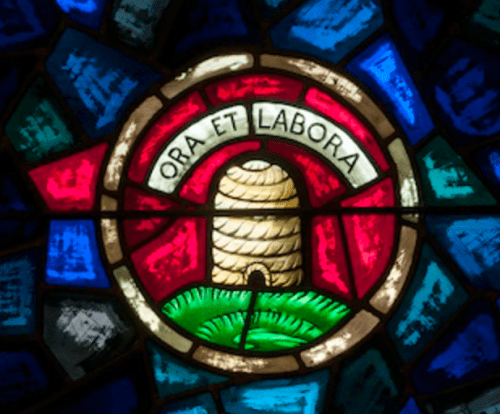
Pray and work

by chuckofish

Screen Shot 2018-06-05 at 10.46.54 AM.png

This is the gospel of labor—ring it,

Ye bells of the kirk

The Lord of Love came down from above

To live with the men who work.

This is the rose he planted, here

In the thorn-cursed soil;

Heaven is blest with perfect rest, but

The blessing of earth is toil.

–Henry Van Dyke

(found on the Three Iron Nails blog)

Screen Shot 2018-06-05 at 11.26.45 AM.png

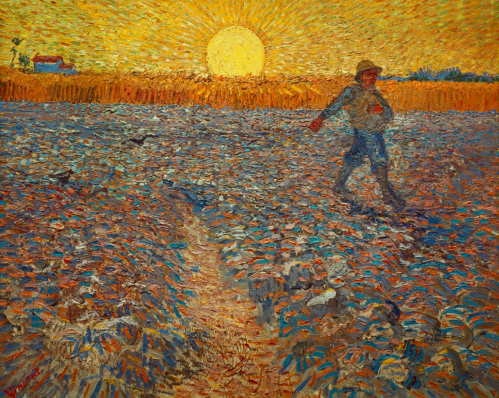
Vincent Van Gogh, The Sower (1988)

“The Christian shoemaker does his duty not by putting little crosses on the shoes, but by making good shoes, because God is interested in good craftsmanship.”

–Martin Luther

“Good human work honors God’s work. Good work uses no thing without respect, both for what it is in itself and for its origin. It uses neither tool nor material that it does not respect and that it does not love. It honors nature as a great mystery and power, as an indispensable teacher, and as the inescapable judge of all work of human hands. It does not dissociate life and work, or pleasure and work, or love and work, or usefulness and beauty. To work without pleasure or affection, to make a product that is not both useful and beautiful, is to dishonor God, nature, the thing that is made, and whomever it is made for. This is blasphemy: to make shoddy work of the work of God. But such blasphemy is not possible when the entire Creation is understood as holy and when the works of God are understood as embodying and thus revealing His spirit.”

–Wendell Berry (Christianity and the Survival of Creation)

I have a stressful day ahead at work today. Pray and work. All will be well!

Of the progress of the souls of men and women

by chuckofish

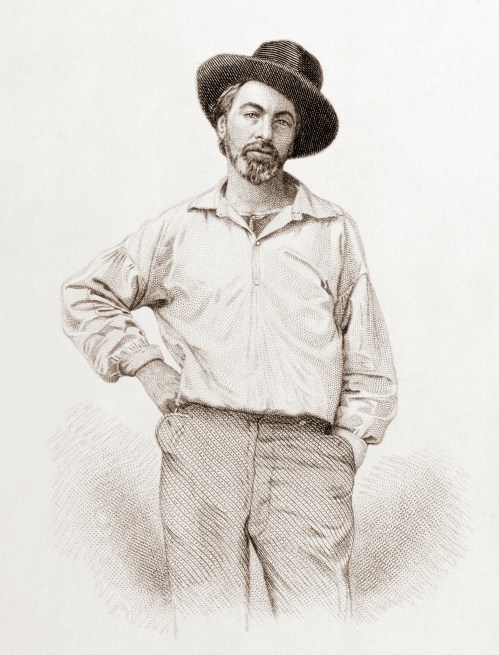
We like to say that tempus fugit, but can it really be 199 years since Walt Whitman was born?!

Walt_Whitman,_steel_engraving,_July_1854.jpg

A toast to Walt (May 31, 1819 – March 26, 1892), American poet!

Allons! the road is before us!
It is safe—I have tried it—my own feet have tried it well—be not detain’d!
Let the paper remain on the desk unwritten, and the book on the shelf unopen’d!
Let the tools remain in the workshop! let the money remain unearn’d!
Let the school stand! mind not the cry of the teacher!
Let the preacher preach in his pulpit! let the lawyer plead in the court, and the judge expound the law.
Camerado, I give you my hand!
I give you my love more precious than money,
I give you myself before preaching or law;
Will you give me yourself? will you come travel with me?
Shall we stick by each other as long as we live?
 (from Song of the Open Road)
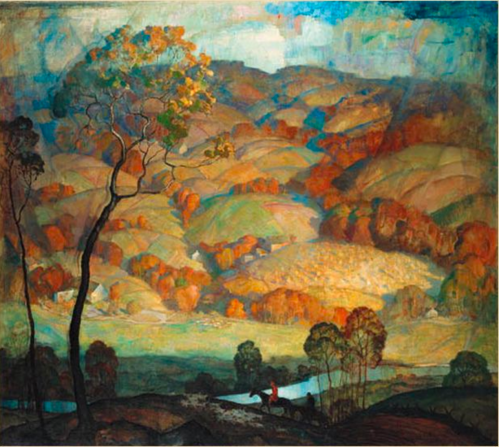
Screen Shot 2018-05-30 at 2.34.52 PM.png

Chad’s Ford Landscape by N.C. Wyeth

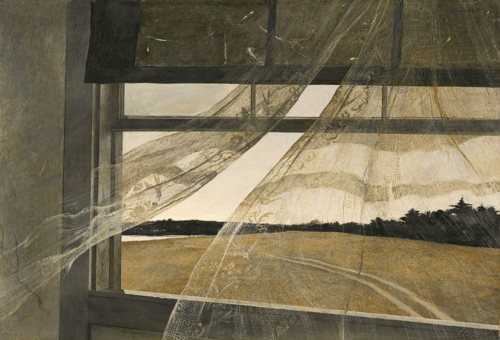
Screen Shot 2018-05-30 at 2.50.59 PM.png

Wind from the Sea by Andrew Wyeth

Screen Shot 2018-05-30 at 2.53.15 PM.png

The Winding Road by Ernest Lawson

Screen Shot 2018-05-30 at 2.55.15 PM.png

The Road Heading Home by Lee Macleod

Hey, it might  be time for a road trip. Sounds like a good idea to me!

“All is a procession, The universe is a procession with measured and perfect motion.”*

by chuckofish

Yesterday we highlighted the great James B. Eads. Well, here are a few more fun facts to know and tell about another of those great mid-19th century Americans we love–even though this one has no connection to our flyover town that we know of!

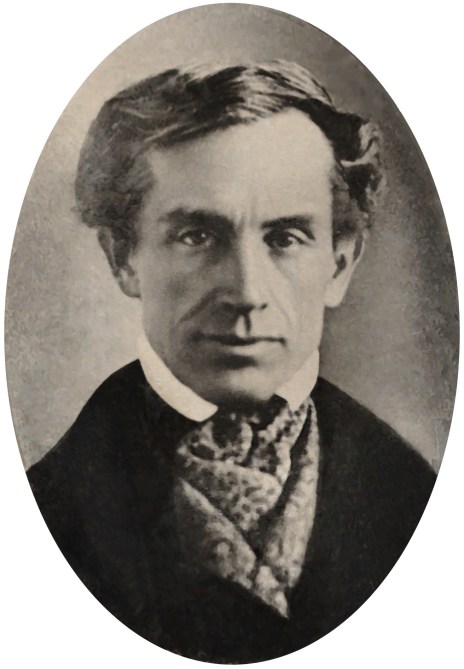
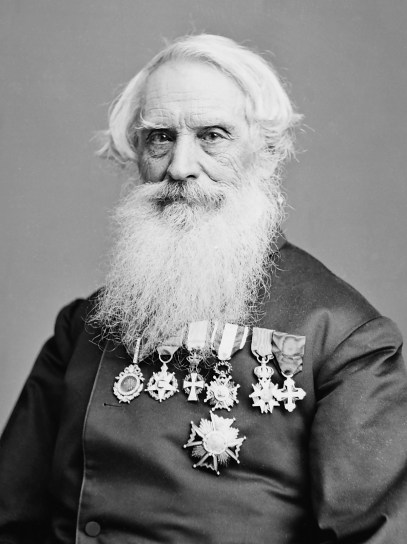
On this day in 1844 Samuel Morse sent the message “What hath God wrought” (Numbers 23:23) from the Old Supreme Court Chamber in the U.S. Capitol to his assistant, Alfred Vail, in Baltimore, Maryland to inaugurate a commercial telegraph line between Baltimore and Washington D.C.

Samuel_Morse_1840

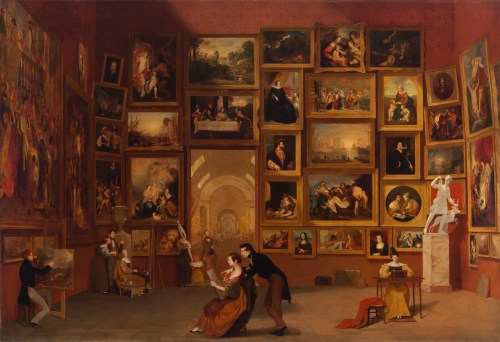
Samuel Finley Breese Morse (April 27, 1791 – April 2, 1872), American painter and inventor, was one of those guys who had it all going on. The son of a fiery Calvinist preacher, he graduated Phi Beta Kappa from Yale and became a noted portrait painter. The Marquis de Lafayette and Presidents Adams and Monroe were among his subjects.

Gallery_of_the_Louvre_1831-33_Samuel_Morse.jpg

Gallery of the Louvre, 1833–Morse selected masterpieces from the Musée du Louvre’s collection and “reinstalled” them in one of the museum’s grandest spaces, the Salon Carr, envisioning that space as a workshop in which individuals study, sketch, and copy from his imagined assemblage.

His monumental “Gallery of the Louvre” was the culmination of a three-year period of study in Europe. Morse exhibited it only twice, in New York and New Haven, where it was highly praised by critics and connoisseurs but rejected by the public. Crushed by the response, Morse soon ceased painting altogether, moving on to his more successful experiments in communications technology and the invention of the Electro-Magnetic Telegraph.

During 1843, he successfully deployed the 38-mile telegraph line along the way of Baltimore and Ohio Railroad. The first information given by the telegraph was that of the nomination of James K. Polk for the Presidency by the Baltimore convention. The official demonstration of Samuel Morse’s telegraph occurred on May 24, 1844, carrying the famous words “What hath God wrought” from the Supreme Court chamber in Washington D.C. to the B&O’s Mount Clare Station in Baltimore. This demonstration is remembered as the starting point of telegraph’s expansion across the world.

The demands for the telegraph constantly increased; they spread over every civilized country in the world, and became, by usage, “absolutely necessary for the well being of society.” Convinced of their folly in so long ignoring the invention of Prof. Morse, the nations of Europe at once vied with each other in the honors they bestowed upon the inventor. Within the next few years he received respectively the decoration of the Nishan Iflichai, set in diamonds, from the Sultan of Turkey, gold medals of scientific merit from the King of Prussia, the King of Wurtemburg, and the Emperor of Austria; a cross of Chevalier in the Legion of Honor from the Emperor of France; the cross of Knight of Dannebrog from the King of Denmark; the Cross of Knight Commander of the Order of Isabelia the Catholic, from the Queen of Spain, besides being elected member of innumerable scientific and art societies in this and other countries.

Samuel_Morse.jpg

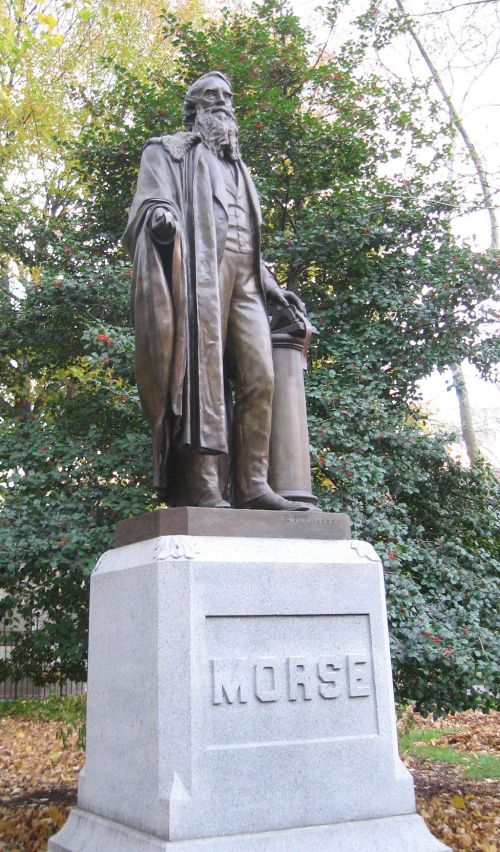
And there is a statue of him in Central Park.

1024px-Morse_statue_72_jeh.JPG

“What hath God wrought” is an exclamation of wonder, but we might ask it as a question: “What hath God wrought?”

Discuss among yourselves.

[By the way, on April 1, 2012, Google announced the release of “Gmail Tap,” an April Fool’s Day joke that allowed users to use Morse Code to send text from their mobile phones. Morse’s great-great-grandnephew Reed Morse—a Google engineer—was instrumental in the prank, which ultimately became a real product. 🙄]

*Walt Whitman, “I Sing the Body Electric”

Somebody loves us all

by chuckofish

Screen Shot 2018-05-14 at 12.02.04 PM.png
The Filling Station


Oh, but it is dirty!

—this little filling station,

oil-soaked, oil-permeated

to a disturbing, over-all

black translucency.

Be careful with that match!


Father wears a dirty,

oil-soaked monkey suit

that cuts him under the arms,

and several quick and saucy

and greasy sons assist him

(it’s a family filling station),

all quite thoroughly dirty.


Do they live in the station?

It has a cement porch

behind the pumps, and on it

a set of crushed and grease-

impregnated wickerwork;

on the wicker sofa

a dirty dog, quite comfy.


Some comic books provide

the only note of color—

of certain color. They lie

upon a big dim doily

draping a taboret

(part of the set), beside

a big hirsute begonia.


Why the extraneous plant?

Why the taboret?

Why, oh why, the doily?

(Embroidered in daisy stitch

with marguerites, I think,

and heavy with gray crochet.)


Somebody embroidered the doily.

Somebody waters the plant,

or oils it, maybe. Somebody

arranges the rows of cans

so that they softly say:

esso—so—so—so

to high-strung automobiles.

Somebody loves us all.

–Elizabeth Bishop

I kind of love this a lot. And the painting by Edward Hopper. BTW, Hopper died in his studio in New York City 51 years ago on May 15, 1967. He was buried two days later in the family’s grave at Oak Hill Cemetery in  Nyack, NY, his place of birth.

Random thoughts

by chuckofish

Unknown.jpg

“A Robin said: The Spring will never come,
And I shall never care to build again.
A Rosebush said: These frosts are wearisome,
My sap will never stir for sun or rain.
The half Moon said: These nights are fogged and slow,
I neither care to wax nor care to wane.
The Ocean said: I thirst from long ago,
Because earth’s rivers cannot fill the main. —
When Springtime came, red Robin built a nest,
And trilled a lover’s song in sheer delight.
Grey hoarfrost vanished, and the Rose with might
Clothed her in leaves and buds of crimson core.
The dim Moon brightened. Ocean sunned his crest,
Dimpled his blue, yet thirsted evermore.”
―Christina Rossetti

Never fear: spring is on the way. How do I know?

Screen Shot 2018-03-27 at 9.53.34 AM.png

The start of baseball season is just around the corner! I am no die-hard fan, but I welcome the distraction of Redbird Nation…

Screen Shot 2018-03-27 at 11.06.15 AM.png

…although I don’t look forward to the inevitable snarkiness regarding Big Mike.

Screen Shot 2018-03-27 at 11.18.26 AM.png

To the haters I say, ‘Hate stirs up trouble, but love overlooks all offenses.’ (Proverbs 10:12)

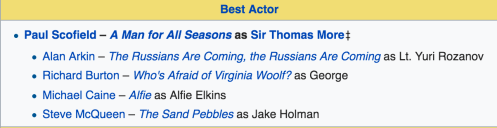
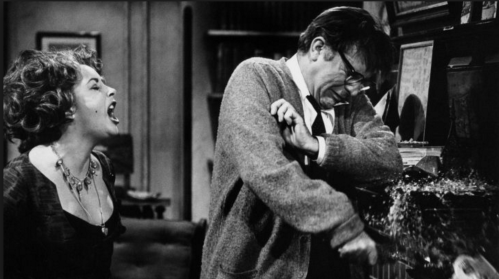
On another note, I recently watched two movies that were coincidentally both nominated for Best Picture and Best Actor in the same year–1966. This, you will recall, is the same year that Steve McQueen was robbed. But also robbed was Richard Burton for Who’s Afraid of Virginia Woolf? and Alan Arkin for The Russians Are Coming, The Russians Are Coming.

That year there was a lot of solid competition for Best Actor:

Screen Shot 2018-03-27 at 11.32.22 AM.png

and, of course, the worst performance in the worst movie won. Ye gods! Alan Arkin gave a performance of comic genius–all that fake Russian and broken English:

Very clever little boy. Very, very clever, to see that my friend and I are foreigners here, but of course not Russian, naturally. What would the Russians be doing on United States of America island, with so many animosities and hatreds between these two countries? It is too funny an idea, is it not? No, we… we are of course… Norweegans.

And, oh gee whiz, how could you give the Best Actress to Elizabeth Taylor and not the Best Actor Oscar to Richard Burton? They were both at their dramatic best as the drunken married couple, George and Martha. She was no better than he, but her competition was nowhere near as stiff. This truly was a travesty of justice.

Screen Shot 2018-03-27 at 11.42.15 AM.png

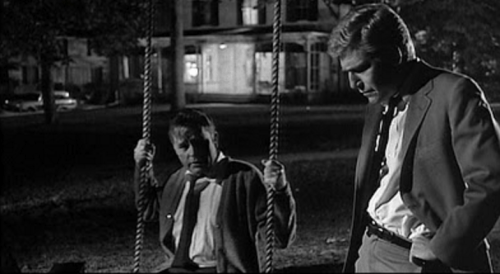
I watched this movie because I had not seen it for a very long time and because I wanted to see how much of Smith College they actually show. (They filmed the outside scenes there in 1966, eight years before I was there.)

Screen Shot 2018-03-27 at 11.48.00 AM.png

The swing was still there in 1974. I wonder if it still is?

Well, anyway, Richard Burton was certainly at the top of his game. Once again, we are reminded that awards mean nothing.

I guess I should watch Alfie–I have no doubt that Michael Caine was robbed as well.

However, there was one Academy Award given that year that was highly deserved: an honorary Oscar to the peerless Yakima Canutt for achievements as a stunt man and for “developing safety devices to protect all stunt men everywhere”. He was an amazing guy! You can read about him here. I will toast him in a few days when we watch Ben-Hur (1959)!

Screen Shot 2018-03-27 at 12.43.30 PM.png

Horse trainer Glenn Randall, stunt coordinator Yakima Canutt (standing in chariot) & Charlton Heston on the set in Rome.

Well, just another reminder, as I said, that:

Screen Shot 2018-03-27 at 5.41.32 PM.png

(photo credit of MM, the Boston Globe; painted stones by rhunt60)

“I can do all things through Christ which strengtheneth me.”*

by chuckofish

Unknown-2.jpeg

I have been super busy at work lately.

Screen Shot 2018-02-20 at 6.50.31 PM.png

Thankfully my office is a pleasant space filled with lovely things I have brought from home.

Unknown-3.jpeg

Unknown-4.jpegUnknown-5.jpeg

And thankfully I like my job.

Each day I live I thank the Lord
I do the work I love;
And in it find a rich reward,
All price and praise above.
For few may do the work they love,
The fond unique employ,
That fits them as a hand a glove,
And gives them joy.

Oh gentlefolk, do you and you
Who toil for daily hire,
Consider that the job you do
Is to your heart’s desire?
Aye, though you are to it resigned,
And will no duty shirk,
Oh do you in your private mind
Adore your work?

Twice happy man whose job is joy,
Whose hand and heart combine,
In brave and excellent employ
As radiantly as mine!
But oh the weary, dreary day,
The wear and tear and irk
Of countless souls who cannot say:
‘I love my work.’

–Robert Service

And remember: “If your daily life seems poor, do not blame it; blame yourself, tell yourself that you are not poet enough to call forth its riches; for to the creator there is no poverty and no poor indifferent place.”  (Rainer Maria Rilke, Letters to a Young Poet)

*Philippians 4:13