Happy Memorial Day. Here’s one of my favorite scenes from one of my favorite movies, She Wore a Yellow Ribbon (1948)–the funeral of Brigadier General Brougham Clay, lately of the Confederate Army and now known as trooper John Smith.
Join me in a toast to all the Americans who have died for our country, and yes, even the Confederates who died, however misguidedly. Remember what Herman Melville wrote about Stonewall Jackson:
Dead is the Man whose Cause is dead,
Vainly he died and set his seal –
Stonewall!
Earnest in error, as we feel;
True to the thing he deemed was due,
True as John Brown or steel.
And here’s a great prayer from A Prayer Book for Soldiers and Sailors (1941):
Grant, O Lord, that I may not be ashamed to confess the faith of Christ crucified, and manfully to fight under his banner against sin, the world, and the devil, and to continue Christ‘s faithful soldier and servant unto my life‘s end. Amen.
(Published for the Army and Navy Commission of the Protestant Episcopal Church)
Today is John Wayne’s birthday. It has been a long, stressful week at work and I plan to hunker down and watch some classic JW movies this weekend. This is a favorite way to chillax.
I think I will start with Stagecoach (1939), the movie that made Wayne an “overnight” star. I like to think of my mother going to see it for the first time at the age of 13. She was a fan for the rest of her life. People always think of John Wayne as a man’s actor, an action star, and he was to be sure. But people tend to forget how handsome and sexy he was and how women loved him for his whole long career.
Think of Joan Didion, who wrote in John Wayne, a Love Song:
We went three and four afternoons a week, sat on folding chairs in the darkened hut which served as a theatre, and it was there, that summer of 1943 while the hot wind blew outside, that I first saw John Wayne. Saw the walk, heard the voice. Heard him tell the girl in a picture called War of the Wildcats that he would build her a house, ‘at the bend in the river where the cottonwoods grow’. As it happened I did not grow up to be the kind of woman who is the heroine in a Western, and although the men I have known have had many virtues and have taken me to live in many places I have come to love, they have never been John Wayne, and they have never taken me to that bend in the river where the cottonwoods grow. Deep in that part of my heart where the artificial rain forever falls, that is still the line I wait to hear.
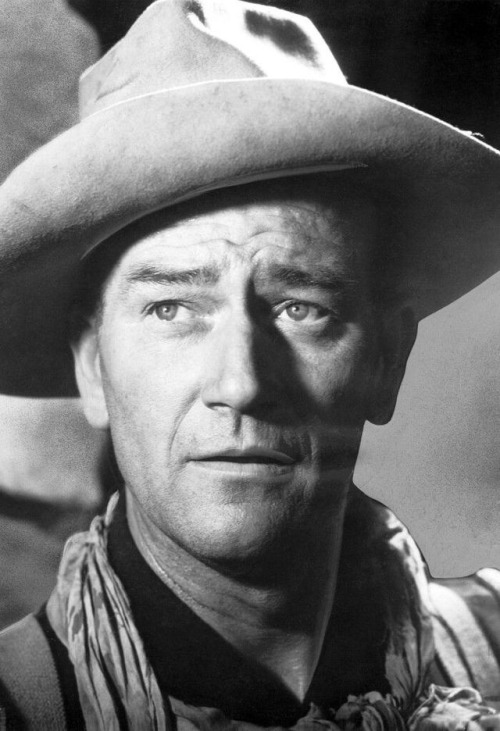
Anyway, a toast to the Duke on his 110th birthday.
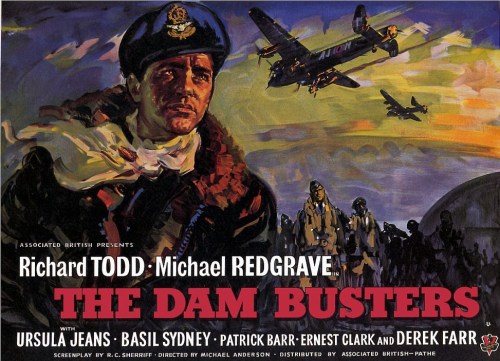
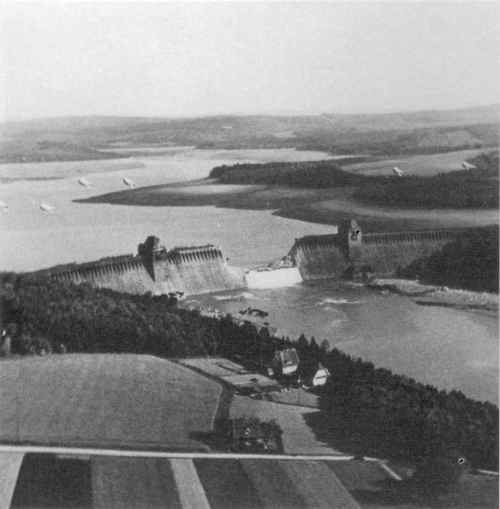
Today is the 74th anniversary of Operation Chastise, an attack on German dams during WWII, carried out by Royal Air Force No. 617 Squadron using a specially developed “bouncing bomb” invented by Barnes Wallis. The raid was subsequently publicized as the “Dam Busters” and was made into a movie called The Dam Busters (1955).
It was quite an undertaking. In total, 53 of the 133 aircrew who participated in the attack were killed, a casualty rate of almost 40 percent. In addition, later estimates put the death toll in the Möhne Valley at about 1,600, including people who drowned in the flood wave downstream from the dam.
The Mohne Dam breached
There are, of course, questions now about whether it in fact changed the course of the war by slowing down industrial production in the Rohr Valley. (Two hydroelectric power stations were destroyed and several more were damaged. Factories and mines were also either damaged or destroyed.)
But I still recommend the 1955 movie as a very good one–full of tension and heroics.
And those RAF pilots were really something, weren’t they?
So join me in a toast to “the dam busters”!
P.S. You will recall that there is a scene in the original Star Wars (1977) which is clearly inspired by the dam busters!
Did you know that both Max Steiner and Dimitri Tiomkin were born today?
Steiner (May 10, 1888 – December 28, 1971) was an Austrian-born American music composer for theatre and films. He was a child prodigy who conducted his first operetta when he was twelve and became a full-time professional, either composing, arranging, or conducting, when he was fifteen. Steiner was referred to as “the father of film music” and played a major part in creating the tradition of writing music for films. He composed over 300 film scores and was nominated for 24 Academy Awards, winning three: The Informer (1935), Now, Voyager (1942) and Since You Went Away (1944). Besides his Oscar-winning scores, you might remember King Kong (1933), Casablanca (1942), The Searchers (1956), a lot of those classic Errol Flynn movies, and Gone With the Wind (1939).
Tiomkin (May 10, 1894 – November 11, 1979) was a Russian-born American film composer and conductor. Musically trained in Russia, he was best known for his western scores, including Duel in the Sun (1946), Red River (1948), High Noon (1952), Gunfight at the O.K. Corral (1957), Rio Bravo (1959), and The Alamo (1960). He received twenty-two Academy Award nominations and won four Oscars, three for Best Original Score for High Noon, The High and the Mighty, and The Old Man and the Sea, and one for Best Original Song for “The Ballad of High Noon” from High Noon.
Well, I thinks that’s interesting–two of the all-time most famous movie composers sharing a birthday!
And, oh, what’s that you say? The Cardinals are in first place?! No kidding, you nay-sayers!
Don’t let the turkeys (and the haters) get you down, Big Mike!
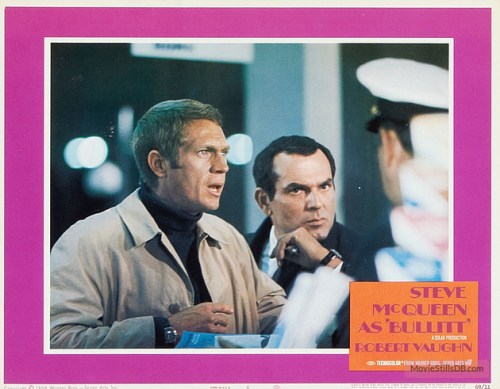
The New York Times headline reads, “Don Gordon, Steve McQueen’s Sidekick Onscreen and in Life, Dies at 90.” Kind of rude, I think. And not really true, guys.
Don enlisted in the Navy after the attack on Pearl Harbor when he was only 15, having convinced his mother to sign a statement saying he was 18. He went on to receive 11 battle stars. After the war, he went to drama school. He was never a star, but he was a working actor for many, many years–and long after Steve died in 1980.
It just seems to me that he deserves a little more respect than the brush-off designation of sidekick. And it’s not as if he were in a ton of films with Steve–he was in three. He wasn’t Gabby Hayes.
Well, “respect” is not something that is in great supply these days.
So anyway, I suggest we toast Don Gordon tonight and watch Bullitt (1968). Sounds like a plan to me.
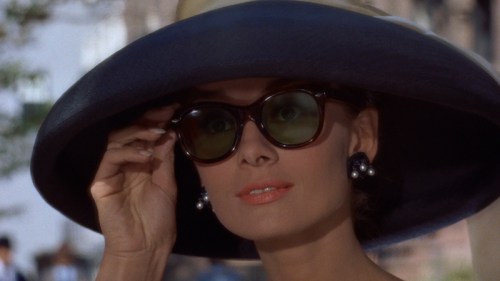
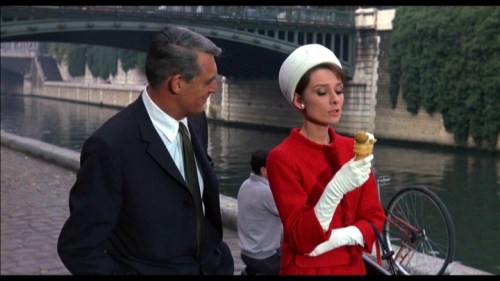
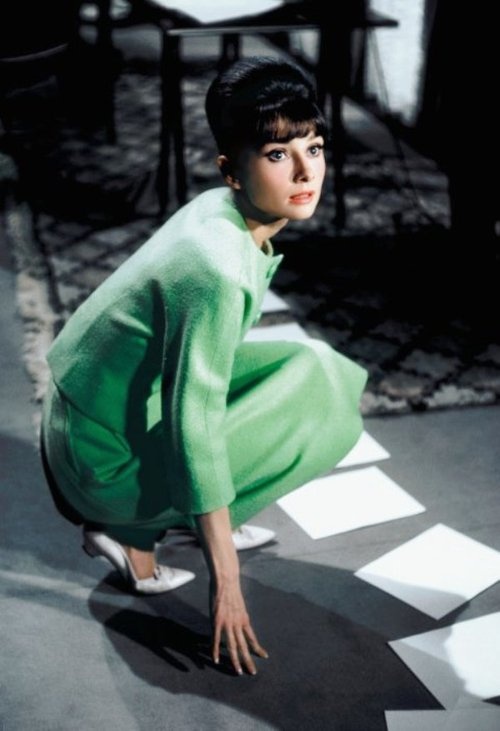
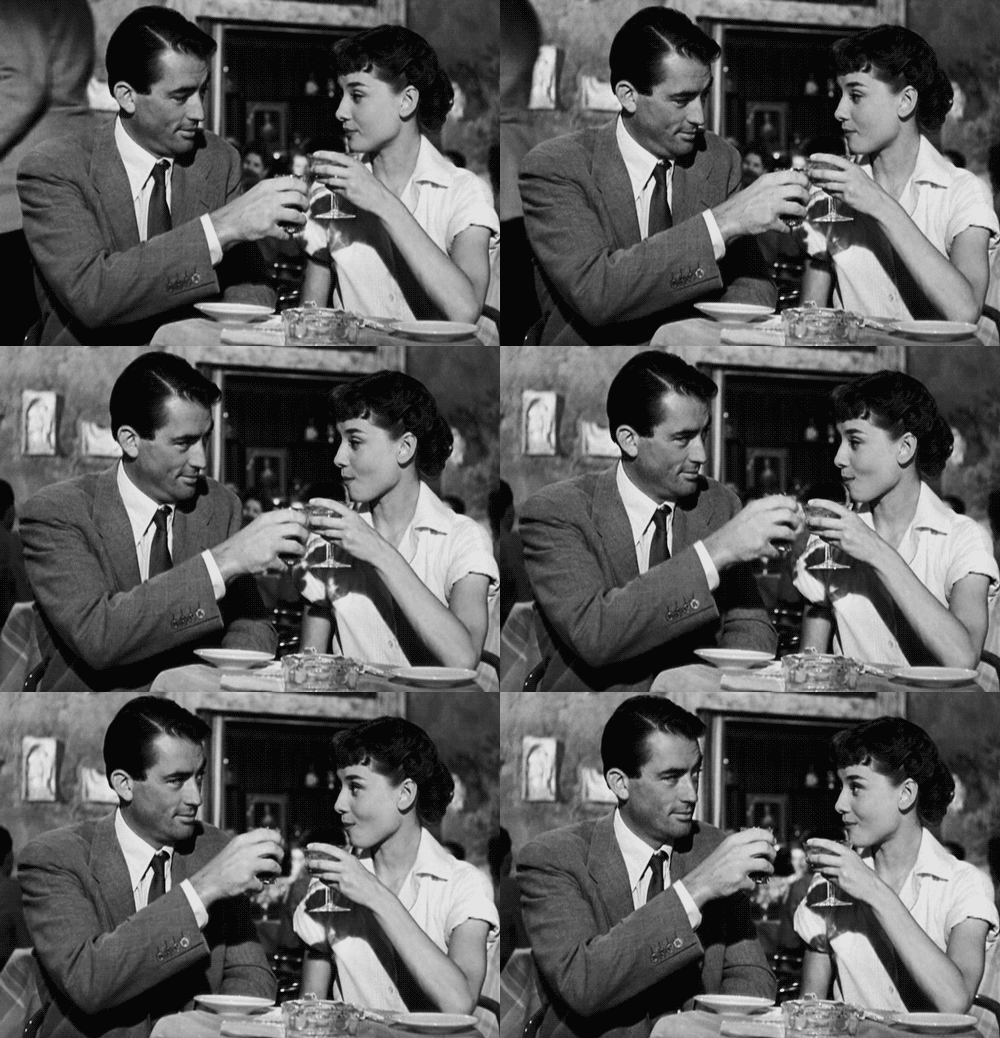
Today is the birthday of the lovely and talented Audrey Hepburn (1929–1993). I mean, who doesn’t love Audrey Hepburn? And if you don’t, what’s wrong with you?
Of course, she starred in one of my top-five favorite movies of all time–Breakfast at Tiffany’s (1961)–but I like her in anything. Indeed, she is like John Wayne in that she makes even an average movie worth watching.
She only made 20 American movies and they weren’t all Breakfast at Tiffany’s. But some of them are pretty darn good:
The Unforgiven (1960)
Charade (1963)
Paris When It Sizzles (1964)
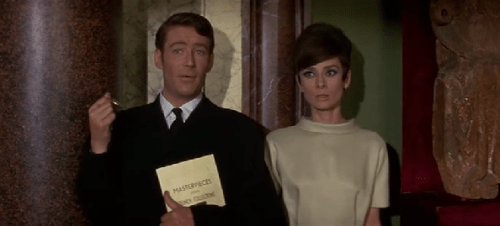
How to Steal a Million (1966)
I prefer her movies from the 1960s. The movies she made in the 1950s–when she was in her 20s–frequently match her with co-stars who are old enough to be her father. Think Humphrey Bogart, Gary Cooper, Fred Astaire–kind of creepy, don’t you think? What were they thinking?
Anyway, it’s a no-brainer what to watch tonight while toasting the wonderful Audrey.
Any one of her films will do (even those ones from the 1950s!) What’s your favorite Audrey Hepburn movie?
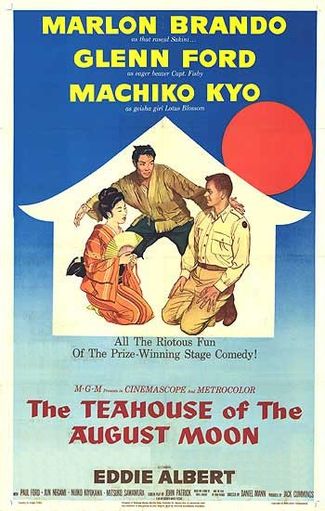
Last night I watched Teahouse of the August Moon (1956) on TCM–a comedy about postwar Japan. Marlon Brando plays Sakini in a bit of casting which these days would be considered extremely offensive.
Marlon Brando, Paul Ford and Glenn Ford
I”m sure Brando just thought he was “acting” and meant no offence.
The original play and movie satirize the U.S. occupation and Americanization of the island of Okinawa following the end of WWII in 1945. It is all pretty silly.
Daughter #1 appeared in her high school production of the play when she was in the 9th grade.
There she is, the second from the right.
Her little sister and two admiring 4th grade friends congratulate her after the play.
Heavens to Betsy! How innocent/oblivious we were in 2000.
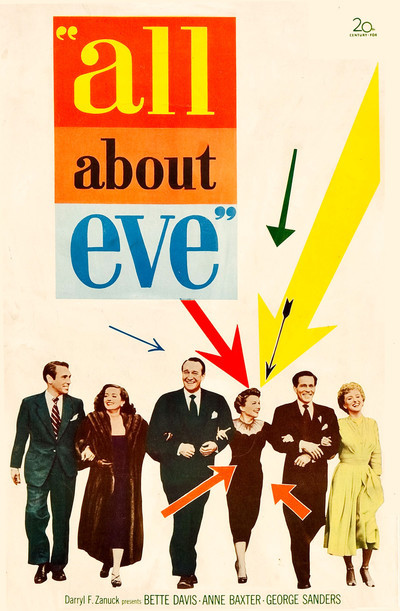
I watched All About Eve (1950) on TCM the other night.
It won Best Picture in 1950 and it is a good movie. You remember–an ingenue (Eve, played by Ann Baxter) insinuates herself into the company of an established but aging stage actress (Davis) and her circle of theater friends–the director, the writer, the columnist.
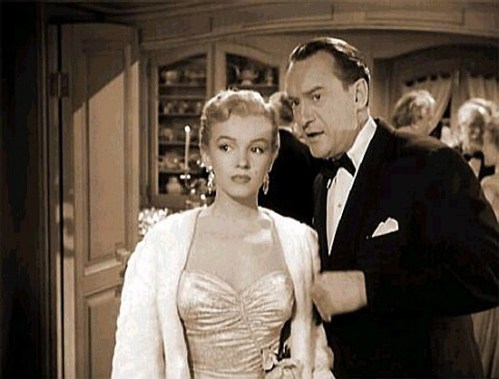
Bette Davis gives an over-the-top (but enjoyable) performance playing a Bette Davis-like star who throws off lines like, “Fasten your seat belts. It’s going to be a bumpy night!” George Sanders has the role of his life playing Addison DeWitt. He is fabulous and won a much-deserved best supporting actor Oscar.
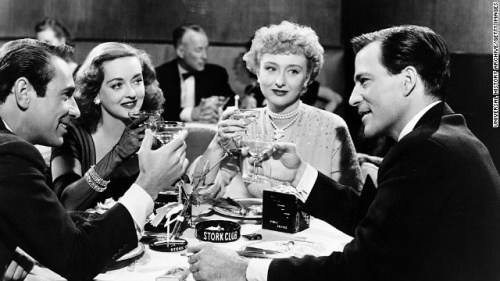
But everyone else is clearly acting and they really can’t keep up with Bette and George. Celeste Holm–playing the good girl who does a very bitchy thing (you know the type)–made me want to slap her continuously. Gary Merrill and Hugh Marlowe are just not quite good enough.
Bette with the B team.
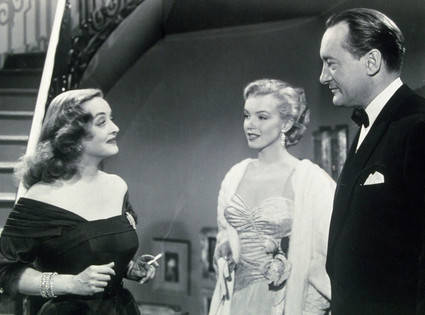
Marilyn Monroe steals her one scene and is surprisingly natural in comparison to the others. I guess she really understood her part playing “a graduate of the Copacabana School of the Dramatic Arts.”
“You have a point. An idiotic one, but a point.”
What really impressed me was the screenplay written by Joseph L. Mankiewicz. The dialogue is witty and sharp and the plot is clever and apparently very authentic. They don’t write ’em like this anymore!
Spoiler alert: Margo Channing, the Star played by Davis, is no feminist icon. Although she is brash and fearless, all she really wants is to settle down with the right man and get married…
Funny business, a woman’s career – the things you drop on your way up the ladder so you can move faster. You forget you’ll need them again when you get back to being a woman. That’s one career all females have in common, whether we like it or not: being a woman. Sooner or later, we’ve got to work at it, no matter how many other careers we’ve had or wanted. And in the last analysis, nothing’s any good unless you can look up just before dinner or turn around in bed, and there he is. Without that, you’re not a woman. You’re something with a French provincial office or a book full of clippings, but you’re not a woman. Slow curtain, the end.
Zut alors! Well, it’s dated, but it (mostly) holds up.
So I’ll recommend All About Eve as my Friday movie pic. You could also watch Sunset Boulevard from the same year– another classic about an aging star, this time played by the over-the-top Gloria Swanson (who was also nominated for Best Actress, but lost as well.)
P.S. Bette Davis did not win the Best Actress Oscar, because Ann Baxter lobbied to be nominated as well for Best Actress (as opposed to Best Supporting Actress) and they split the vote. Sigh. C’est la vie dans Hollywood.
Recently I discovered that Brenda Ueland, author of If You Want to Write, wrote an autobiography. I found a used copy online and ordered it.
Brenda Ueland was a wonderful free-spirited girl growing up in Minnesota, and she seems to have always managed to keep that inner light. Many women lose it for various reasons: anxiety, depression, responsibility…but Brenda remained true to herself and honest. I find her fascinating. Although we are very different, we see eye-to-eye on most important things.
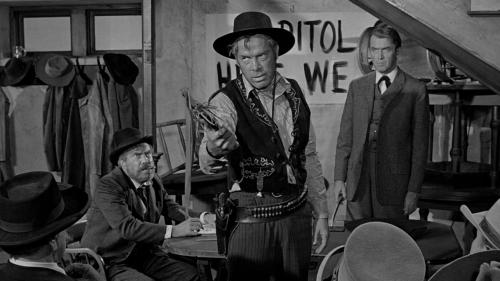
In other news, did you know that yesterday was the 55th anniversary of the release of The Man Who Shot Liberty Valance? Please note that this was the first occasion of John Wayne calling someone “Pilgrim” in a film.
Tonight would be a good occasion to watch this great, great movie. I like to think of my parents going to see it in 1962. Did my brother go? He was 11. I remember going to see it at the movies, but it must have been when it was re-released at some point. I think I was about 8 or 9 or 10, because I was really still too young. I mean I was quite traumatized by Lee Marvin who was so scary.
There is real violence in this movie–too bad beatings of James Stewart and Edmund O’Brien, you will recall. Martin Scorsese, who is a big fan of director John Ford, never learned that it’s what you don’t see that is so scary.
Anyway, it also makes for good Holy Week fare, since this movie is about personal sacrifice and all that. John Wayne gives up everything for love, (spoiler alert) shooting Liberty Valance and burning down his house.
I will also note the passing of Don Rickles the other day. He appeared in one of my favorite WWII submarine movies early in his career in a straight part. Can you spot him in this German-dubbed scene from Run Silent, Run Deep (1958)?
This would be another good movie to watch–while toasting old Don, alias Mr. Potato Head.
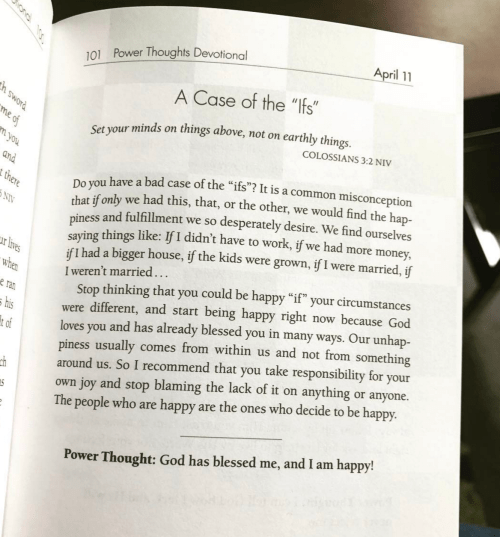
And, finally, here’s a good word from Joyce Meyer.
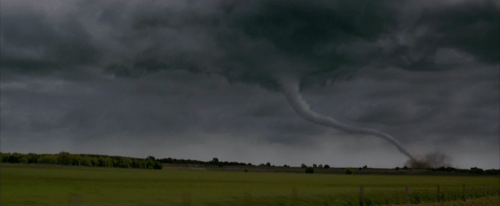
Well, spring may still be a way off officially, but severe weather season has arrived in flyover country.
I can’t even imagine what it would be like to have your house knocked down and all your possessions gone in the blink of an eye.
But the people who live through this kind of event, as in Perryville the other night, always (and rightly) say that they’re glad to be alive and possessions can be replaced.
Tornadoes are a scary reality here in our flyover state. Although we like to run outside whenever the sky turns gray and menacing and yell, “Auntie Em! Auntie Em!”, we take them very seriously.
Anyway, I thought I would recommend an appropriate movie having to do with severe weather, but there really aren’t many good ones. There’s Twister (1996) with the late Bill Paxton…
and, of course, there’s The Wizard of Oz (1939).
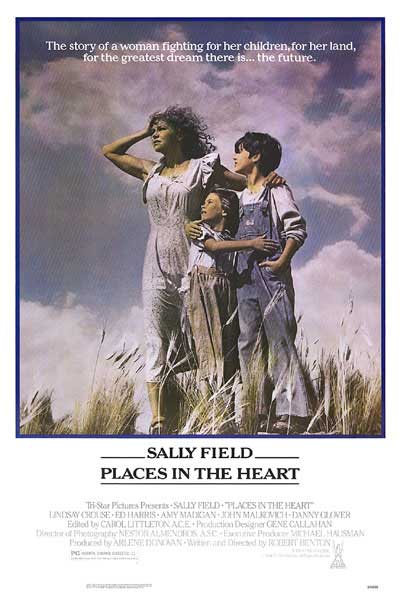
I remember there’s a scary scene in Places in the Heart (1984)…
…and who can forget the tornado in Where the Heart Is (2000)?
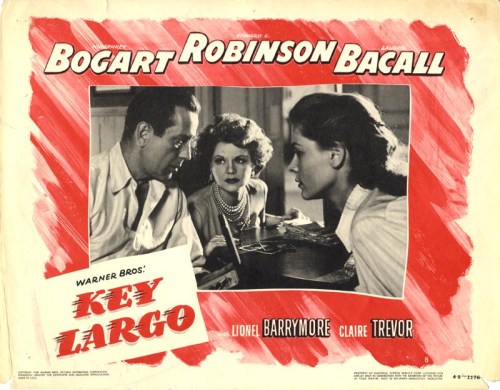
Well, it was just an idea. It might be best to veer over to hurricane movies and settle in with Key Largo (1948)–a truly great Bogey and Bacall outing directed by John Huston.
Here’s to blue skies and a tornado-free weekend.
(The first three photos are from KMOV.com, stltoday.com, and Ksdk.com.)
 Anyway, a toast to the Duke on his 110th birthday.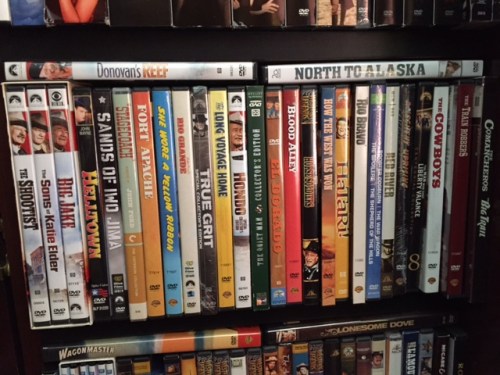


 Of course, she starred in one of my top-five favorite movies of all time–Breakfast at Tiffany’s (1961)–but I like her in anything. Indeed, she is like John Wayne in that she makes even an average movie worth watching.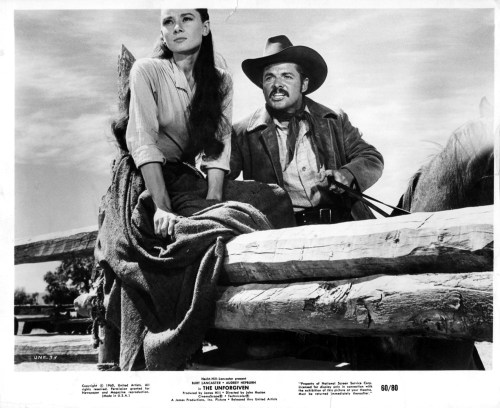









 and, of course, there’s The Wizard of Oz (1939).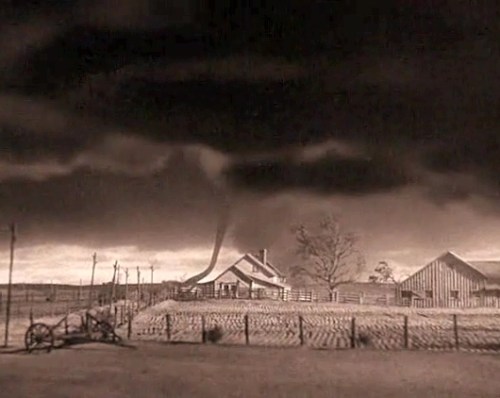
 dual personalities