dual personalities

Category: Literature

Why I love Raymond Chandler

by chuckofish

Screen Shot 2018-03-06 at 6.33.49 AM.png

“I got up on my feet and went over to the bowl in the corner and threw cold water on my face. After a little while I felt a little better, but very little. I needed a drink, I needed a lot of life insurance. I needed a vacation, I needed a home in the country. What I had was a coat, a hat and a gun. I put them on and went out of the room.”

–Farewell, My Lovely

Food for thought toward the end of winter

by chuckofish

Screen Shot 2018-02-27 at 5.45.33 PM.png

In the bitter cold of winter the trees stand bare and seem to be dead. But in the spring, they burst forth into leaf and flower, and the first fruits begin to appear. So it was with the Master’s death and resurrection, and so it is with all who faithfully bear the burden of suffering and death. Though they may seem crushed and dead, they will yet bear beautiful flowers and glorious fruits of eternal life.

–Sadhu Sundar Singh

Being means: not numbering and counting, but ripening like a tree, which doesn’t force its sap, and stands confidently in the storms of spring, not afraid that afterward summer may not come. It does come. But it comes only to those who are patient, who are there as if eternity lay before them, so unconcernedly silent and vast. I learn it every day of my life, learn it with pain I am grateful for: patience is everything!

–Rainer Maria Rilke

Screen Shot 2018-02-27 at 5.55.04 PM.png

Ah, the last day of February–it is warming up but the clouds are back. Our flyover weather guru Dave Murray tells us that the “see-saw pattern of the winter” will continue into at least the beginning of the spring season. It was ever thus. Yesterday I returned a book to our west campus library–walking the block and a half there and back without a coat. The wind whipped my hair around and I arrived back at my office with that wind-blown, right-off-the-range look–a disheveled old lady. Well, I do the best I can to stay “sheveled,” but sometimes it is a losing battle.

It seems comfortable to sink down on a sofa in a corner, to look, to listen. Then it happens that two figures standing with their backs against the window appear against the branches of a spreading tree. With a shock of emotion one feels ‘There are figures without features robed in beauty’. In the pause that follows while the ripples spread, the girl to whom one should be talking says to herself, ‘He is old’. But she is wrong. It is not age; it is that a drop has fallen; another drop. Time has given the arrangement another shake. Out we creep from the arch of the currant leaves, out into a wider world. The true order of things – this is our perpetual illusion – is now apparent. Thus in a moment, in a drawing-room, our life adjusts itself to the majestic march of day across the sky.

–Virginia Woolf, The Waves

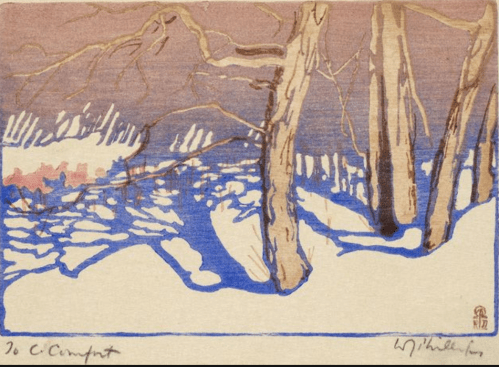
Woodcuts are by Walter J. Phillips and Erich Buchwald-Zinnwald.

“Fill your paper with the breathings of your heart.”*

by chuckofish

file16013.png

“Alexandra drew her shawl closer about her and stood leaning against the frame of the mill, looking at the stars which glittered so keenly through the frosty autumn air. She always loved to watch them, to think of their vastness and distance, and of their ordered march. It fortified her to reflect upon the great operations of nature, and when she thought of the law that lay behind them, she felt a sense of personal security. That night she had a new consciousness of the country, felt almost a new relation to it. Even her talk with the boys had not taken away the feeling that had overwhelmed her when she drove back to the Divide that afternoon. She had never known before how much the country meant to her. The chirping of the insects down in the long grass had been like the sweetest music. She had felt as if her heart were hiding down there, somewhere, with the quail and the plover and all the little wild things that crooned or buzzed in the sun. Under the long shaggy ridges, she felt the future stirring.”

–Willa Cather, O Pioneers!

Today we toast Willa Cather (1873-1947), whom we love, on her birthday.

The painting is “High Plains — Range Land,” an oil on linen painting by Raymond J. Eastwood.

*William Wordsworth

What are you reading?

by chuckofish

evening-at-home.jpg

I am reading a bunch of different things.

IMG_2983.JPG

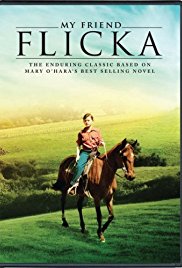
You will recall that My Friend Flicka, written by Wyomingite Mary O’Hara, was mentioned a couple of times in a Longmire mystery…so I felt I should read it since I never have. Written in 1941, it tells the story of Ken McLaughlin, the son of a a Wyoming rancher, and his horse Flicka. It was the first in a trilogy, followed by Thunderhead (1943) and Green Grass of Wyoming (1946). The popular 1943 film version featured young Roddy McDowell.

MV5BMTk3MjUzMDE2OF5BMl5BanBnXkFtZTcwOTYxODE0MQ@@._V1_UY268_CR3,0,182,268_AL_.jpg

They re-made Flicka in 2006 with a girl protagonist (of course) and Tim McGraw as the father. Oy.

Anyway, the book is very well-written and quite sophisticated for a young adult novel of that era–there is a graphic scene of yearlings being gelded which I could have lived without.  Furthermore, Ken’s mother is a Bryn Mawr graduate and they are Episcopalians! But I’m just not that interested in horses, I guess, because I’m not sure I will trudge on to the end.

I am also re-reading Mere Christianity, which–no surprise–is really good!

“I am trying here to prevent anyone saying the really foolish thing that people often say about Him: I’m ready to accept Jesus as a great moral teacher, but I don’t accept his claim to be God. That is the one thing we must not say. A man who was merely a man and said the sort of things Jesus said would not be a great moral teacher. He would either be a lunatic — on the level with the man who says he is a poached egg — or else he would be the Devil of Hell. You must make your choice. Either this man was, and is, the Son of God, or else a madman or something worse. You can shut him up for a fool, you can spit at him and kill him as a demon or you can fall at his feet and call him Lord and God, but let us not come with any patronizing nonsense about his being a great human teacher. He has not left that open to us. He did not intend to.”

When I wake up in the middle of the night and can’t get back to sleep, I read Jan Karon. So now I am reading These High, Green Hills.

Lunch at the Grill, thought Father Tim, was what kept life real. He had to confess, however, that he could hardly wait to get back to the office and finish the C.S. Lewis essay entitled “Thought, Imagination, Language.”

I also recently re-read The Free Man by Conrad Richter. It tells the story of Henry Free, a hard-working Palatine German who comes to farm in Pennsylvania but is tricked, along with many of his countrymen, by the British, and is sold as an indentured servant when he arrives in America.  He escapes and thrives and eventually fights for liberty on the battlefields of the Revolution. The book did not receive good reviews when it was published in 1943 during the height of WWII. I am not surprised, since the British–our allies!–are the bad guys. It must have been shocking and somewhat distasteful at the time. The lesson here is an important one though–the British are not always the good guys and the Germans not always the villains.

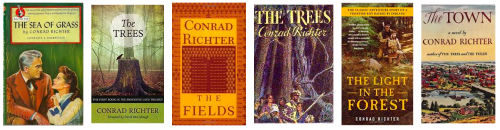
I admire Richter and his spare, but beautiful writing a lot. He is an all-but-forgotten writer these days, but I read that they are re-making the Awakening Land trilogy for television. Frances McDormand is going to play Sayward Luckett, the main character, which could be good or bad. Perhaps it will encourage someone to go back and read the books.

Screen Shot 2017-11-28 at 9.43.07 AM.png

What are you reading?

The painting at the top is “Evening at Home” by Edward John Poynter (1836-1919)

You go, Girl!

by chuckofish

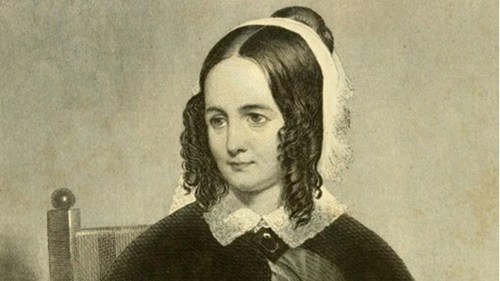
Today is the birthday of Sarah Josepha Buell Hale (October 24, 1788 – April 30, 1879) who was an American writer and an influential editor.

sarah-jodepha-hale-facebook.jpg

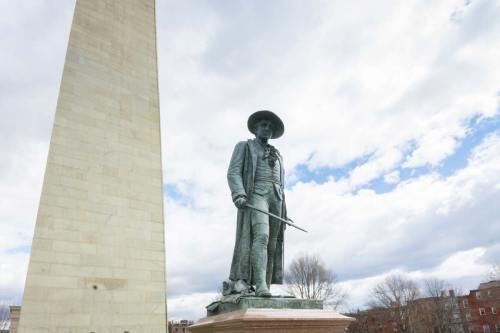
Hale wrote many novels and poems, publishing nearly fifty volumes by the end of her life, but she is probably best known as the author of “Mary Had a Little Lamb.” Hale also famously campaigned for seventeen years for the creation of Thanksgiving as a national holiday and for the completion of the Bunker Hill Monument.

bunker-hill-monument

That’s Colonel William Prescott in front of the monument.

Hale also founded the Seaman’s Aid Society in 1833 to assist the surviving families of Boston sailors who died at sea.

She is recognized on the Episcopal liturgical calendar with a lesser feast day on April 30.

Gracious God, we bless thy Name for the vision and witness of Sarah Hale, whose advocacy for the ministry of women helped to support the deaconess movement. Make us grateful for thy many blessings, that we may come closer to Christ in our own families; through Jesus Christ our Savior, who livest and reignest with thee and the Holy Spirit, one God, for ever and ever. Amen.

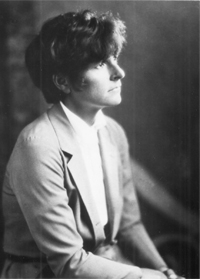
We must also note that it is the birthday as well of one of our favorite writers, Brenda Ueland (October 24, 1891 – March 5, 1985), about whom we have written many times.

620173.jpg

“Now before going to a party, I just tell myself to listen with affection to anyone who talks to me, to be in their shoes when they talk, to try to know them without my mind pressing against theirs, or arguing, or changing the subject. No. My attitude is: ‘Tell me more.’ This person is showing me his soul. It is a little dry and meager and full of grinding talk just now, but presently he will begin to think, not just automatically to talk. He will show his true self. Then he will be wonderfully alive.’ …Creative listeners are those who want you to be recklessly yourself, even at your very worst, even vituperative, bad-tempered. They are laughing and just delighted with any manifestation of yourself, bad or good. For true listeners know that if you are bad-tempered it does not mean that you are always so. They don’t love you just when you are nice; they love all of you.”

–Brenda Ueland, Strength to Your Sword Arm: Selected Writings

Join me in a toast to both ladies, won’t you?

And this struck me as mildly amusing:

Screen Shot 2017-10-23 at 11.57.46 AM.png

This and that

by chuckofish

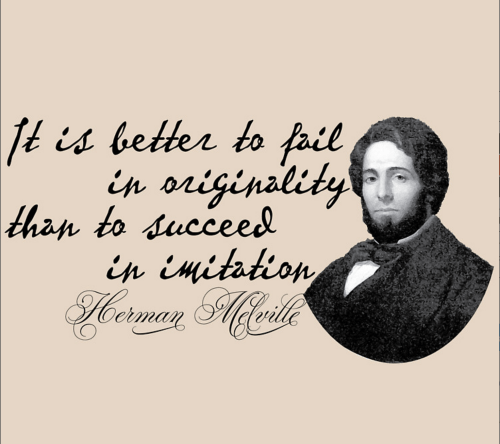
“It’s better to fail in originality than to succeed in imitation.”

–Herman Melville

This statement was quoted by House Beautiful Editor-in-Chief Sophie Donelson in her July/August column. She doesn’t say where the quote comes from, but it probably wasn’t from the book on her nightstand. Of course, she was quoting Melville in reference to home decoration and that is valid I suppose, but poor Herman was talking about something different. Sadly, he knew a lot about failure.

Today is Melville’s birthday, so let’s give some thought to how to celebrate. You could check out this website: Melville’s Marginalia Online, a virtual archive of books owned and borrowed by Melville (1819-1891). Amazing! If you are in New York City, you could take the Melville walking tour. Whatever you do, be sure to wear your Herman Melville t-shirt.

Screen Shot 2017-07-31 at 11.44.45 AM.pngAnd by that I mean, please don’t. (Maybe Ms. Donelson found the quote on a t-shirt!)

Well, moving on…we have heard a lot lately about the total solar eclipse that will occur around 1 p.m. on Monday, August 21. The last total solar eclipse here in flyover country was in 1442. As you can see, we are right in line for some great viewing!

Screen Shot 2017-07-31 at 11.02.42 AM.pngWe have, of course, been reminded ad nauseum to obtain special protective glasses if we plan to watch, so I sent off to Amazon for some of these. Am I cool or what? (Well, the OM is a scouter, so I always try to be prepared.)

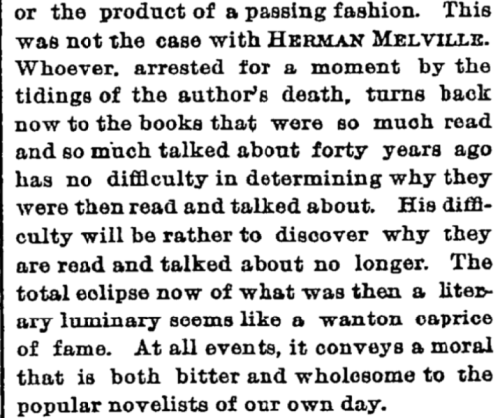
Are you wondering how I am going to tie up Herman Melville’s birthday and the total eclipse of the sun? Here is a section of his obit in the New York Times of October 2, 1891:

Screen Shot 2017-07-31 at 3.09.57 PM.png

Sad, sad, so sad.

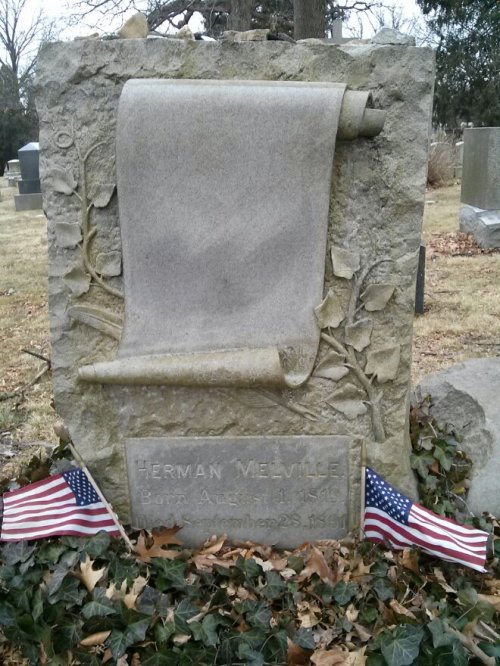
wpid-herman-melville-grave.jpg

Discuss among yourselves.

“And the moral of the story is?”

by chuckofish

“What is it with you white people and morals? Maybe it’s just a story about what happened.” He paused for a moment. “If an Indian points at a tree, you white people are always thinking, What does that mean? What does the tree stand for? What’s the lesson in this for me? Maybe it’s just a tree.” (Virgil White Buffalo in Hell Is Empty)

While waiting for cabs and resting between long walks and Big Events last weekend, I sought solace in the company of Walt Longmire in the Wyoming mountains.  Hell Is Empty is amazingly apropos reading for wiling away hours in LaGuardia Airport! (“Hell is empty and all the devils are here.”–Shakespeare, The Tempest)

Anyway, at the beginning of this novel we are told that one of Walt’s deputies, regretting a stint in higher education devoted almost exclusively to criminal justice, is attempting to fill in some of the literary gaps. Walt and his deputies, plus the dispatcher and the lady who runs the diner have all made book lists for him. Dante’s Inferno plays a big part in the rest of the story.

Craig Johnson, understanding that his readers would want to know, thoughtfully includes the different lists in an appendix to the novel.
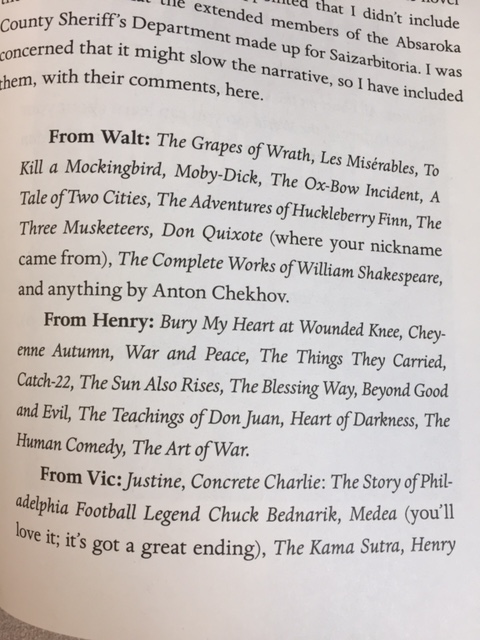
Unknown-1.jpeg

Of course, Ruby, the dispatcher and my soul sister, includes The Holy Bible (NT), The Pilgrim’s Progress, Inferno, Paradise Lost, My Antonia, The Scarlett Letter, Walden, Poems of Emily Dickinson, My Friend Flicka, and Our Town.

How great is that? I guess I’ll have to read My Friend Flicka!

I love lists.

My list would include: The Holy Bible (NT), The Book of Common Prayer, Moby-Dick, The Catcher in the Rye, O Pioneers!, The Big Sky, The Waters of Kronos, The Big Sleep, Gilead, Lonesome Dove…

I’m sure I’m forgetting something important that I really love. You know how that goes.

Here’s Frederick Buechner on a similar theme:

THE WRITERS WHO get my personal award are the ones who show exceptional promise of looking at their lives in this world as candidly and searchingly and feelingly as they know how and then of telling the rest of us what they have found there most worth finding. We need the eyes of writers like that to see through. We need the blood of writers like that in our veins.

J.D. Salinger’s The Catcher in the Rye was one of the first books I read that did it to me, that started me on the long and God knows far from finished journey on the way to becoming a human being—started making that happen. What I chiefly learned from it was that even the slobs and phonies and morons that Holden Caulfield runs into on his travels are, like Seymour Glass’s Fat Lady, “Christ Himself, buddy,” as Zooey explains it to his sister Franny in the book that bears her name Even the worst among us are precious. Even the most precious among us bear crosses. That was a word that went straight into my bloodstream and has been there ever since. Along similar lines I think also of Robertson Davies’ Deptford trilogy, Ford Madox Ford’s The Good Soldier, Rose Macaulay’s The Towers of Trebizond, George Garrett’s Death of the Fox, some of the early novels of John Updike like The Poorhouse Fair and The Centaur, John Irving’s A Prayer for Owen Meany. I think of stories like Flannery O’Connor’s “The Artificial Nigger” and Raymond Carver’s “Feathers” and works of non-fiction, to use that odd term (like calling poetry non-prose) such as Annie Dillard’s Holy the Firm and Geoffrey Wolff’s The Duke of Deception and Robert Capon’s The Supper of the Lamb or plays like Death of a Salesman or Our Town.

What 10 books would you put on your list of must-reads? Think about it.

But excuse me, I have to get back to Absaroka County…

04c3b6f656d895842ccde47daf712055.jpg

Gonna stand my ground

by chuckofish

IMG_2660.JPG

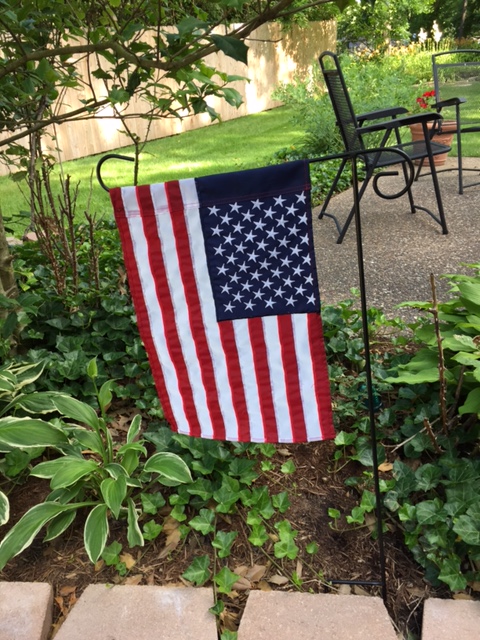
Today we celebrate Flag Day, which commemorates the adoption of the flag of the United States. You will recall that this happened on June 14, 1777, by resolution of the 2nd Continental Congress.

Huzzah!

And I thought this was interesting from Philip Roth in The New Yorker last week:

A Newark Jew—why not? But an American Jew? A Jewish American? For my generation of native-born—whose omnipresent childhood spectacle was the U.S.A.’s shifting fortunes in a prolonged global war against totalitarian evil and who came of age and matured, as high-school and college students, during the remarkable makeover of the postwar decade and the alarming onset of the Cold War—for us no such self-limiting label could ever seem commensurate with our experience of growing up altogether consciously as Americans, with all that that means, for good and for ill. After all, one is not always in raptures over this country and its prowess at nurturing, in its own distinctive manner, unsurpassable callousness, matchless greed, small-minded sectarianism, and a gruesome infatuation with firearms. The list of the country at its most malign could go on, but my point is this: I have never conceived of myself for the length of a single sentence as an American Jewish or Jewish American writer, any more than I imagine Dreiser and Hemingway and Cheever thought of themselves while at work as American Christian or Christian American or just plain Christian writers. As a novelist, I think of myself, and have from the beginning, as a free American and—though I am hardly unaware of the general prejudice that persisted here against my kind till not that long ago—as irrefutably American, fastened throughout my life to the American moment, under the spell of the country’s past, partaking of its drama and destiny, and writing in the rich native tongue by which I am possessed.

(from an acceptance speech for the National Book Foundation’s Medal for Distinguished Contribution to American Letters, delivered on November 20, 2002)

Hear, hear.

(The song is, of course, Johnny Cash covering the classic “I Won’t Back Down” by Tom Petty.)

“Grant us wisdom, grant us courage, for the facing of the hour”*

by chuckofish

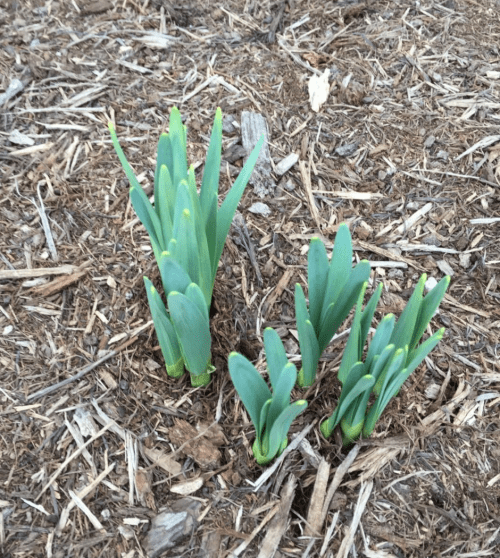
Spring seemed on the verge of arriving this weekend with temps in the 70s and new life bursting forth all over.

Screen Shot 2017-02-12 at 2.55.05 PM.pngBut this happens every year and we know not to be fooled–the cold weather will return.


The OM and I went to see the wee babes this weekend according to our new routine.

IMG_0652.jpg

The little gal thinks, “My, Pappy, what big glasses you have!”

IMG_0750.jpg

As you can see, they are making great strides and are mastering the “suck, swallow, breath” drill. Even the little guy, who is still only 4 lbs, 8 oz., is beginning to have that chubby baby look at last. They are doing fine.

I went to church and there were very few people there. (I wondered whether people thought going to Joe’s funeral on Thursday let them off the hook.) After church, I had lunch with my pals and we marveled at how busy we are. I did find time over the weekend to finish The Transit of Venus. You know, it takes longer to read a book to which you have to pay such close attention. I felt while reading it that I was just barely smart enough to appreciate it.

You might have said, What beauty. Instead Caro introduced herself. Monosyllables were planted like bollards, closing every avenue. The boy had not forgotten what to say: he had chosen a part with no lines. He was cool, and except for the wrists, unruffled. One talked as if to a child. “What’s your name, where do you go to school?” His name was Felix, and he was to go somewhere–no doubt Oxford, or doubtless Cambridge–in the autumn. When someone else came up he disappeared instantly, having somehow stuck it out till then.

Shirley Hazzard, wow.

Now it is Monday again. Take it slow. Savor the moment. Live in the now.

*Hymn #594, Harry Emerson Fosdick

Weekend update

by chuckofish

Another busy weekend has come and gone.

IMG_2385.JPG

It was a nice weekend, which combined the right balance of housework, reading, talking to family members and socializing with friends. We visited the tiny babies who have actually doubled in size (but are still tiny)

IMG_0581.jpg

and the boy and daughter #3 came over for tacos on Sunday night.

IMG_2386.JPG

I started reading The Transit of Venus by Shirley Hazzard who died last December. Reading her obituary at the time, I realized I was completely unacquainted with her. Then, when I was perusing my bookshelves recently looking, as always, for something to read, I found The Transit of Venus. So I started reading.

At first I was put off by her somewhat pretentious style:

As he went up he was ashamed by a sense of adventure that delineated the reduced scale of his adventures. After the impetuous beginning, he would puzzle them by turning out staid and cautious. In a gilt mirror near the door he surprised himself, still young.

And her overuse of clever simile:

Where they got down, wrought-iron gates were folded back like written pages.

But as I persevered, I became more and more impressed. I saw that she is the real deal and pretty terrific. The Transit of Venus, which won the 1980 National Book Critics Circle Award for fiction, is “stuffed with description so intellectually active as to be sometimes exhausting,” Thomas Mallon wrote in The Atlantic (NYT obit). This is true, but her observations are brilliant. I will keep going.

I also read the Paris Review interview with Hazzard in 2005 and I was further impressed. She made the interviewer look like a moron.

INTERVIEWER

The jar of Marmite that Rex Ivory held on to through his imprisonment in a Japanese prisoner-of-war camp seems like a symbol of the primitive human need to hold onto something, to make some sort of meaning. Has art been like that for you?

HAZZARD

There was an actual jar of Marmite, recounted to me long, long ago by a British survivor of Changi Camp near Singapore and of the camp called Outram Road. Don’t forget that it has a real and immediate significance. Men died of malnutrition in those camps, and of diseases from lack of any coherent diet. Marmite would have been a treasure, and a lifesaver. Keeping it unopened was not only symbolic; it was a possible element for a day or two’s survival in the case of escape. In the Japanese camps, British and Australian prisoners hid tiny rice cakes saved from their starvation rations for just such motives. Immediate factual truth comes before symbolic cogitations. But yes, I suppose art is a Marmite, and the conserved shred of civilized life must seem intensely so to isolated and persecuted people. I remember a heart-shaking description by Solzhenitsyn in The Gulag Archipelago about prisoners exchanging whispered remembrances of poetry, or a phrase from a Mozart opera, precious passwords of sanity and civilized life, and of the ineffable power of art; Marmite.

Here’s the whole Paris Review interview.

Have a good Monday and a good week!

He has told you, O mortal, what is good;
and what does the Lord require of you

but to do justice, and to love kindness,
and to walk humbly with your God?

–Micah 6:8, from the OT lesson on Sunday.