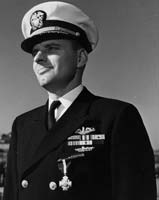
Today is the birthday of George Levick Street, III (July 27, 1913 – February 26, 2000) who was a submariner in the U.S. Navy. He received the Medal of Honor during WWII.
You can read all about him and his illustrious naval career here.
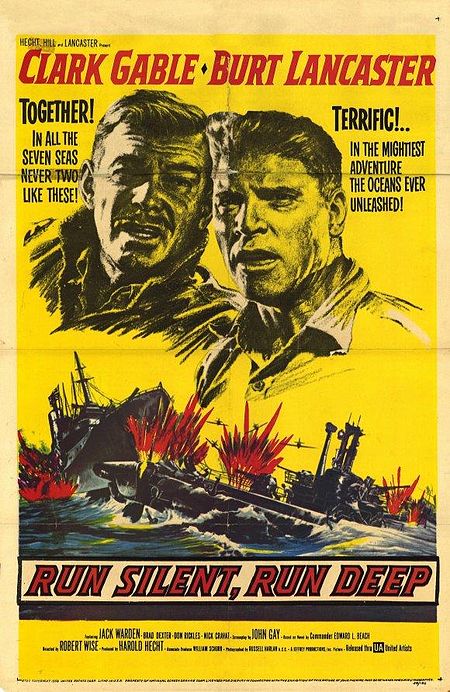
Interesting (to me anyway) is the fact that Street’s Executive Officer on the submarine Tirante on her first patrol was Edward L. Beach, who modeled his first novel, Run Silent, Run Deep (1955), on his wartime experiences. This novel was made into a movie, also titled Run Silent, Run Deep (1958), and I think it is the best of the submarine genre–at least until Das Boot (1981) was made.
Clark Gable and Burt Lancaster are in top form as the dueling Commander and Executive Officer. In fact, Gable was at his very best as the manly Commander who is coming off desk duty after losing his submarine. He is bent on revenge and obsessed with a Japanese destroyer that has sunk three US submarines in the Bungo Straits, including his previous command. Who can forget his order to “Dive! Dive!”? The supporting cast includes Jack Warden, Brad Dexter and a young Don Rickles. The movie is tense and dramatic and filled with details that feel very real–and probably are, considering who wrote the original story.
Anyway, I think I will watch Run Silent, Run Deep tonight and toast George Street on his birthday. And while I’m at it, I’ll toast Edward Latimer Beach, Jr. (April 20, 1918 – December 1, 2002) who participated in the Battle of Midway and 12 combat patrols, earning 10 decorations for gallantry, including the Navy Cross. After the war, he served as the naval aide to the President of the U.S., Dwight D. Eisenhower, and commanded the first submerged circumnavigation. Wow.
Today is the 151st anniversary of the Wild Bill Hickok–Davis Tutt shootout in the town square of Springfield, Missouri (July 21, 1865). It is reputedly the first and one of the few recorded instances in the Old West of a one-on-one pistol quick-draw duel in a public place.
Wild Bill Hickok threatens the friend of Davis Tutt after defeating Tutt in a duel, in an illustration from Harper’s New Monthly Magazine, February 1867.
What began as an argument over gambling debts, turned deadly when Tutt took a prize watch of Wild Bill’s as collateral. Warned against wearing the watch in public to humiliate Wild Bill, Tutt appeared on the square on July 21, prominently wearing the watch. The two men then unsuccessfully negotiated the debt and the watch’s return. Hickok returned to the square at 6 p.m. to find Tutt once again displaying his watch. Wild Bill gave Tutt his final warning. “Don’t you come around here with that watch.” Tutt answered by placing his hand on his pistol.
Tutt was killed and Hickok was arrested and eventually brought to trial. The judge gave the jury two apparently contradictory instructions. He first instructed the jury that a conviction was its only option under the law. He then instructed them that they could apply the unwritten law of the “fair fight” and acquit, an action known as jury nullification which allows a jury to make a finding contrary to the law. The trial ended in acquittal on August 6, 1865, after the jury deliberated for “an hour or two” before reaching a verdict of not guilty, which was not popular at the time. (Wikipedia)
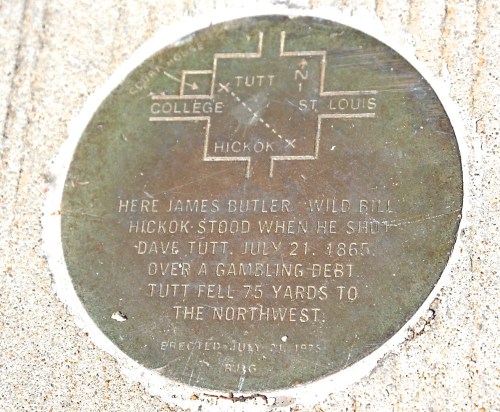
There’s a marker now on the street in Springfield where it all took place. Although the boy went to college in Springfield for a few years, I was unaware of (or had forgotten) this fun fact.
According to IMDB.com, Wild Bill Hickok has been portrayed on screen over 70 times by actors including William S. Hart, Gary Cooper, Bill Elliott, Richard Dix, Forest Tucker, Howard Keel, Guy Madison, Adam West, Robert Culp, Lloyd Bridges, Don Murray, Charles Bronson, Richard Farnsworth, Frederic Forrest, Josh Brolin, Sam Elliott, Sam Shepard, and Keith Carradine.
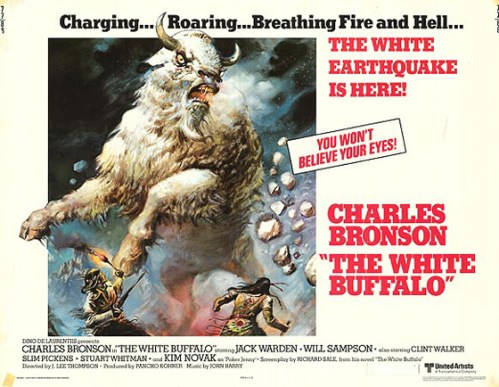
My favorite is probably Gary Cooper in The Plainsman (1936), but you have to love Charles Bronson as Wild Bill in White Buffalo (1877)–at least I do. Since I recently watched part of The Plainsman on TCM, I will watch White Buffalo (which we own!) tonight and toast Wild Bill Hickock one more time.
In case you’ve forgotten, White Buffalo is a Dino de Laurentis “disaster film/monster movie” from the 1970s–pretty darn terrible, especially the special effects–but it has its moments. Wild Bill gets to say things like,
“In the first place, the Great Spirit did not give you these hills. You took this land by force. You took it from the Cheyenne, the Shoshoni, and the Arapaho. You took it with the lance and tomahawk. Now the white man makes war on you. What’s the difference?”
and his mountain man friend, played by Jack Warden gets to say,
“Probably heard about the white buff on the moccasin telegraph.”
Political correctness had not been invented yet.
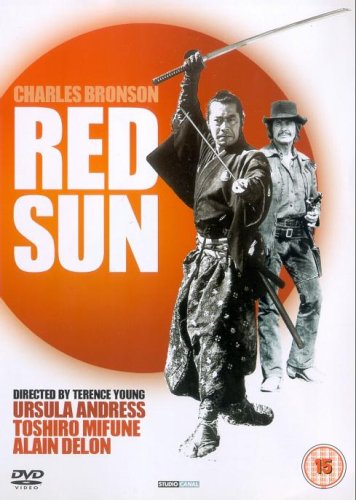
Speaking of Charles Bronson, I recently watched Red Sun (1971)–a western with an international cast: Charles Bronson, Toshiro Mifune, Alain Delon, Ursula Andress, and Capucine playing a Mexican named “Pepita”.
After a train robbery, Bronson and Mifune (the Japanese ambassador’s bodyguard) team up to find Alain Delon and get back the stolen money and a Japanese sword. “2 Desperados … 1 Hellcat … and a Samurai”–well, you can imagine. Luckily Bronson and Mifune are awesome together and Alain Delon is really handsome, so it is hardly a waste of your time. And it’s definitely more enlightening/entertaining than watching either the Republican or Democrat conventions.
I feel so sorry for anyone who misses the experience of history, the horizons of history. We think little of those who, given the chance to travel, go nowhere. We deprecate provincialism. But it is possible to be as provincial in time as it is in space. Because you were born into this particular era doesn’t mean it has to be the limit of your experience. Move about in time, go places. Why restrict your circle of acquaintances to only those who occupy the same stage we call the present?”
–David McCullough, “Recommended Itinerary” in Brave Companions
I concur.
As we approach Independence Day on July 4, why not read some history?
*Walt Whitman, “America”; the painting is by Childe Hassam.
Four-day work weeks are the best, n’est-ce pas? It is Friday already. Glory hallelujah!
I have few plans per usual. However, I am going to hear the author Nathaniel Philbrick speak about his latest book, Valiant Ambition, a “surprising account of the middle years of the American Revolution, and the tragic relationship between George Washington and Benedict Arnold.” You will recall that he is the author of In the Heart of the Sea and several other books about American History. I especially like his book Why Read Moby-Dick?
In this short book he says,
He tells us to call him Ishmael, but who is the narrator of Moby-Dick? For one thing, he has known depression, “a damp, drizzly November of the soul.” But he is also a person of genuine enthusiasms. Like Holden Caulfield in The Catcher int he Rye, he is wonderfully engaging, a vulnerable wiseass who invites us to join him on a quest to murder the blues by shipping out on a whaleship.
I love this, because it is exactly what I thought when I read Moby-Dick. I mean, don’t you just love it when you read something that is exactly what you thought already? Great minds and all that.
Beyond this intellectual outing to the Ethical Society, I am going to pursue my usual weekend activities of puttering and straightening up my house.
I may do some further planning for my trip to Kansas City next weekend. Yes, I convinced the OM to take a day off from work and drive out to the western edge of our great state and do some looking around in the Westport area.
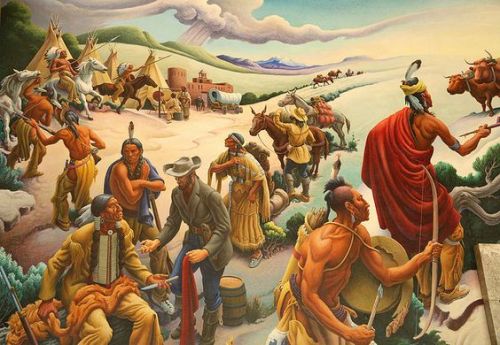
Independence and the Opening of the West by Thomas Hart Benton
Good times await. Everything’s up to date in Kansas City, or so they say.
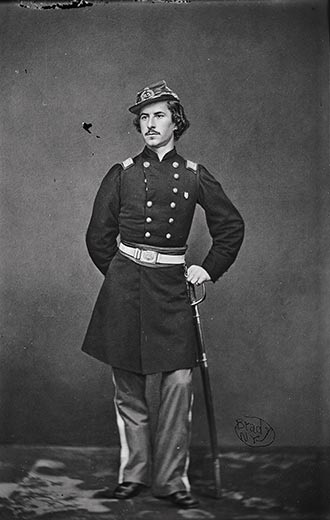
It is appropriate that on this Memorial Day we toast Col. Elmer Ellsworth, who was the first “conspicuous casualty” and Union officer killed in the Civil War.
He was killed on May 24, 1864, age 24, while removing a Confederate flag from the roof of the Marshall House Inn of Alexandria, Virginia at Lincoln’s behest, as the flag had been visible from the White House as a defiant sign of the growing rebellion.
“Remember Ellsworth” became a patriotic slogan: the 44th New York Volunteer Infantry Regiment called itself the “Ellsworth Avengers.”
President Lincoln wrote the following letter to his parents:
To the Father and Mother of Col. Elmer E. Ellsworth:
My dear Sir and Madam, In the untimely loss of your noble son, our affliction here, is scarcely less than your own. So much of promised usefulness to one’s country, and of bright hopes for one’s self and friends, have rarely been so suddenly dashed, as in his fall. In size, in years, and in youthful appearance, a boy only, his power to command men, was surpassingly great. This power, combined with a fine intellect, an indomitable energy, and a taste altogether military, constituted in him, as seemed to me, the best natural talent, in that department, I ever knew. And yet he was singularly modest and deferential in social intercourse. My acquaintance with him began less than two years ago; yet through the latter half of the intervening period, it was as intimate as the disparity of our ages, and my engrossing engagements, would permit. To me, he appeared to have no indulgences or pastimes; and I never heard him utter a profane, or intemperate word. What was conclusive of his good heart, he never forgot his parents. The honors he labored for so laudably, and, in the sad end, so gallantly gave his life, he meant for them, no less than for himself.
In the hope that it may be no intrusion upon the sacredness of your sorrow, I have ventured to address you this tribute to the memory of my young friend, and your brave and early fallen child.
May God give you that consolation which is beyond all earthly power. Sincerely your friend in a common affliction —
A. Lincoln
Ellsworth’s funeral was the first of three held in the East Room of the White House during the war. The second, in 1862, was a service for the president’s 11-year-old son Willie. The third was Lincoln’s own.
Sigh. I’m not sure why Elmer Ellsworth came to mind, but he did, and he seems a worthy example of the American soldier whom we honor today.
Here’s Lee Greenwood singing “God Bless the U.S.A,” which kind of says it all:
I hope I am never too blasé or jaded that this song doesn’t prompt a tear.
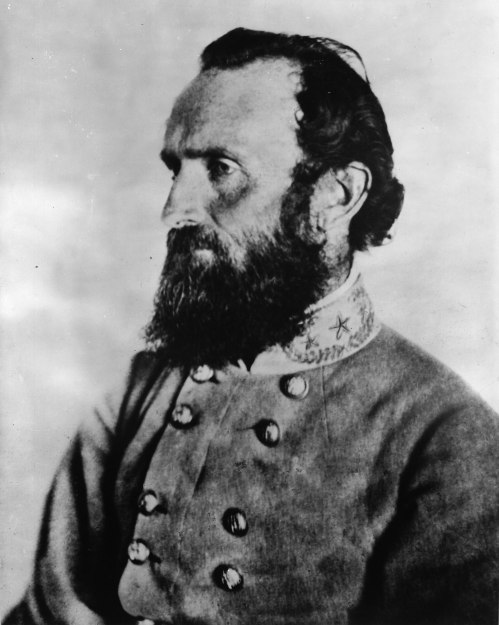
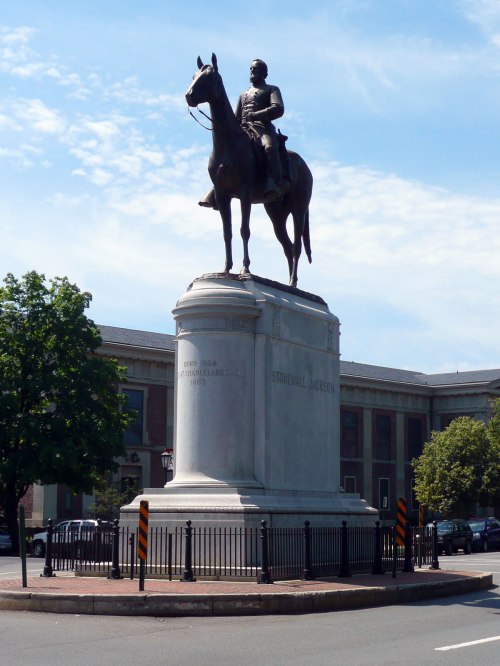
Today is the 153rd anniversary of the death of General Thomas “Stonewall” Jackson (age 39) following the Battle of Chancellorsville, when he was shot by friendly fire on the moonlit night of May 2, 1863.
“Chancellorsville” portrait, taken at a Spotsylvania County farm on April 26, 1863, seven days before he was wounded. What a face!
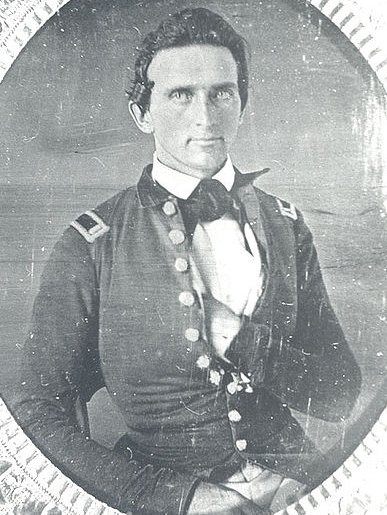
Here he is younger and beardless. Pretty dreamy.
I have always admired Stonewall Jackson as an exemplar of the Scotch-Irish Protestants who came to this country in the eighteenth century, many of them as indentured servants, and worked and fought hard to make a home here. In fact his paternal great-grandparents (John Jackson and Elizabeth Cummins) met on the prison ship from London and fell in love. They married six years later when they gained their freedom.
The family migrated west across the Blue Ridge Mountains to settle near Moorefield, Virginia in 1758. In 1770, they moved farther west to the Tygart Valley. They began to acquire large parcels of virgin farming land near the present-day town of Buckhannon, including 3,000 acres in Elizabeth’s name. John and his two teenage sons fought in the Revolutionary War; John finished the war as a captain. While the men were in the army, Elizabeth converted their home to a haven for refugees from Indian attacks known as “Jackson’s Fort.”
Yes, the Jacksons were awesome.
Furthermore, Stonewall was a profoundly religious man and a deacon in the Presbyterian Church. One of his many nicknames was “Old Blue Lights,” a term applied to a military man whose evangelical zeal burned with the intensity of the blue light used for night-time display. He disliked fighting on Sunday, although that did not stop him from doing so after much personal debate.
Here is a poem by Herman Melville that pretty well sums up my feelings about the great Stonewall:
Mortally Wounded at Chancellorsville
The Man who fiercest charged in fight,
Whose sword and prayer were long –
Stonewall!
Even him who stoutly stood for Wrong,
How can we praise? Yet coming days
Shall not forget him with this song.
Dead is the Man whose Cause is dead,
Vainly he died and set his seal –
Stonewall!
Earnest in error, as we feel;
True to the thing he deemed was due,
True as John Brown or steel.
Relentlessly he routed us;
But we relent, for he is low –
Stonewall!
Justly his fame we outlaw; so
We drop a tear on the bold Virginian’s bier,
Because no wreath we owe.
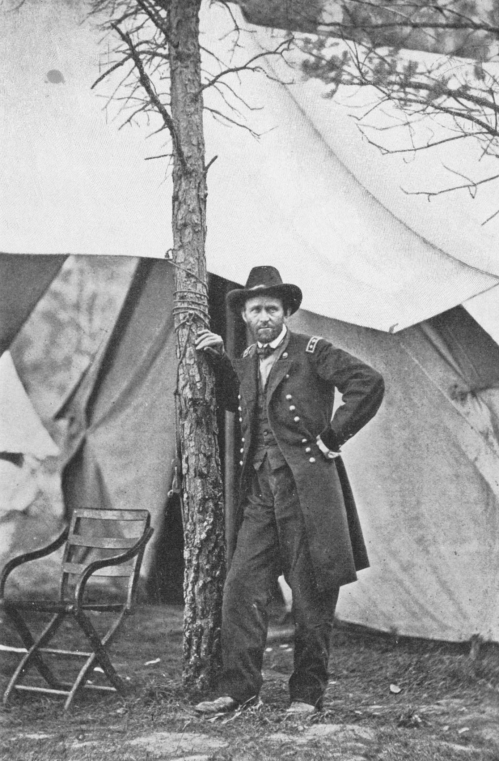
Today we note the birthday of Ulysses S. Grant (April 27, 1822 – July 23, 1885) who was the 18th President of the United States (1869–77) and the Commanding General of the U.S. (1864–69). He is certainly a favorite of mine.
“In four years he had risen, without political favor, from the bottom to the very highest command, — not second to any living commander in all the world! His plans were large, his undiscouraged will was patient to obduracy… In all this career he never lost courage or equanimity. With a million men, for whose movements he was responsible, he yet carried a tranquil mind, neither depressed by disasters nor elated by success. Gentle of heart, familiar with all, never boasting, always modest, Grant came of the old, self-contained stock, men of a sublime force of being, which allied his genius to the great elemental forces of nature, — silent, invisible, irresistible. When his work was done, and the defeat of Confederate armies was final, this dreadful man of blood was tender toward his late adversaries as a woman toward her son. He imposed no humiliating conditions, spared the feelings of his antagonists, sent home the disbanded Southern men with food and with horses for working their crops.”
– Henry Ward Beecher, Eulogy on Grant
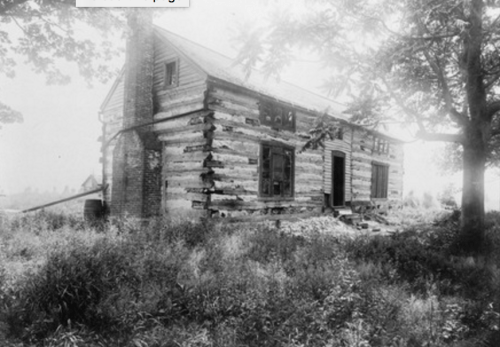
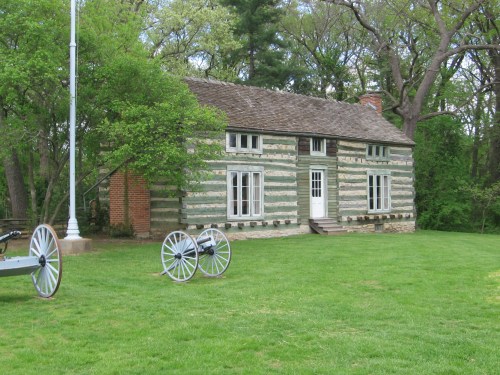
Makes me want to go visit his home “Hardscrabble,”
which is down the road a bit here in flyover country.
I like a president who has built a home with his own hands. Cheers and huzzah to Cousin Lyss.
I am now, by the way, reading The March by E.L. Doctorow, which is a novel about General Sherman’s March to the Sea (November 15 to December 21, 1864). I am enjoying it very much and am pleasantly surprised, having never read anything by Doctorow and having assumed that I wouldn’t like anything he had written. The author has a good historical grasp of the period and his characters act appropriately. This is certainly not always the case with historical fiction. Authors make stupid mistakes which can drive me crazy.
Curious, I went back and read the review in 2005 by John Updike in The New Yorker, and funnily enough, he says just that.
His splendid new novel, “The March”…pretty well cures my Doctorow problem. A many-faceted recounting of General William Tecumseh Sherman’s famous, and in some quarters still infamous, march of sixty-two thousand Union soldiers, in 1864-65, through Georgia and then the Carolinas, it combines the author’s saturnine strengths with an elegiac compassion and prose of a glittering, swift-moving economy. The novel shares with “Ragtime” a texture of terse episodes and dialogue shorn, in avant-garde fashion, of quotation marks, but has little of the older book’s distancing jazz, its impudent, mocking shuffle of facts; it celebrates its epic war with the stirring music of a brass marching band heard from afar, then loud and up close, and finally receding over the horizon. Reading historical fiction, we often itch, our curiosity piqued, to consult a book of straight history, to get to the facts without the fiction. But “The March” stimulates little such itch; it offers an illumination, fitful and flickering, of a historic upheaval that only fiction could provide. Doctorow here appears not so much a reconstructor of history as a visionary who seeks in time past occasions for poetry.
“Once, during the Siege of Boston, when almost nothing was going right and General Schuyler had written from Albany to bemoan his troubles, Washington had replied that he understood but that ‘we must bear up against them, and make the best of mankind as they are, since we cannot have them as we wish.’ It was such resolve and an acceptance of mankind and circumstances as they were, not as he wished them to be, that continued to carry Washington through. ‘I will not however despair,’ he now wrote to Governor William Livingston.”
―David McCullough, 1776
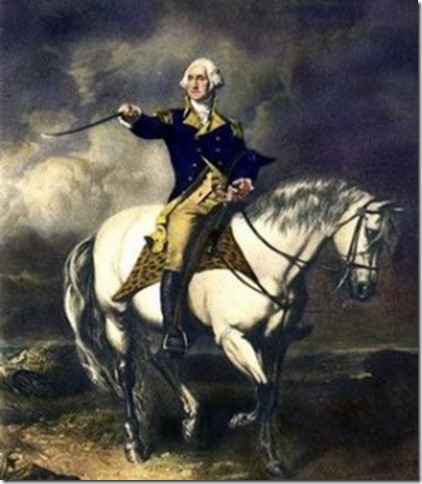
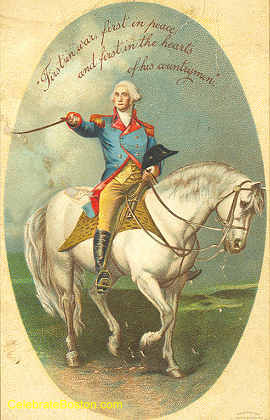
Old George Washington certainly was the Man. And check out that leopard skin saddle blanket. Do you think he really had one like that? Here’s another look.
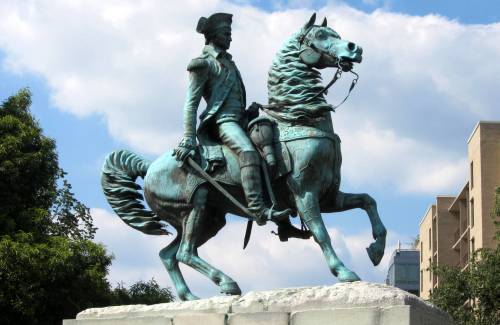
Well, he certainly looked great on a horse. Thomas Jefferson called Washington “the best horseman of his age, and the most graceful figure to ever be seen on horseback.”
Statue of Gen. Washington on horseback in Washington D.C., executed by sculptor Clark Mills, and dedicated on February 22, 1860 by President Buchanan.
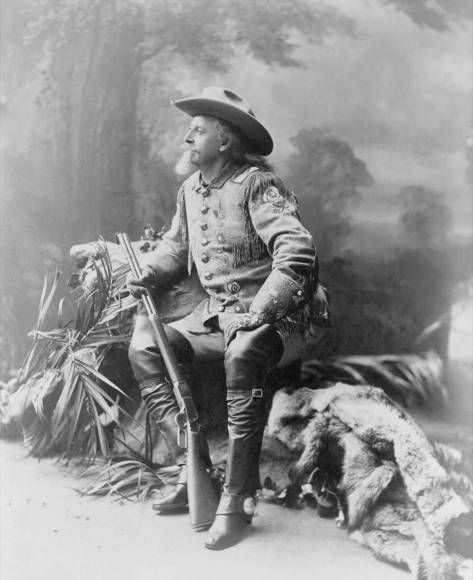
As we look into the open fire for our fancies, so we are apt to study the dim past for the wonderful and sublime, forgetful of the fact that the present is a constant romance, and that the happenings of to-day which we count of little importance are sure to startle somebody in the future, and engage the pen of the historian, philosopher, and poet.
–William “Buffalo Bill” Cody, preface to The Old Santa Fe Trail by Colonel Henry Inman
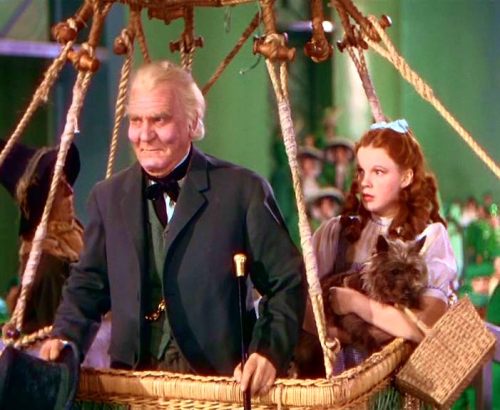
The title of today’s post refers, of course, to…the Wizard of Oz, who you will remember was from Kansas.
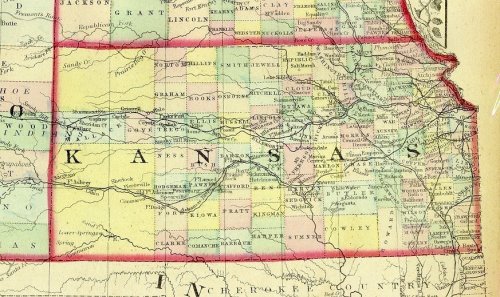
Well, today is the 155th anniversary of the day Kansas was admitted as our 34th state in 1861.
Abolitionist Free-staters from New England and pro-slavery settlers from Missouri had rushed to the territory when it was officially opened to settlement by the U.S. government in 1854 in order to determine whether Kansas would become a free state or a slave state. The area became a hotbed of violence and chaos in its early days as these forces collided, thus earning it the name Bleeding Kansas. The abolitionists eventually prevailed. Kansas entered the Union as a free state and the Civil War followed.
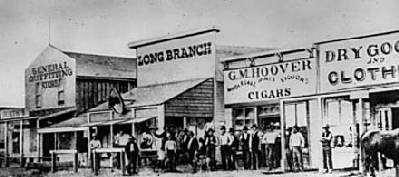
After the Civil War the population of Kansas grew rapidly when waves of immigrants turned the prairie into farmland. It also became the center of what we think of as “the Wild West,” what with cattle drives on the Chisholm Trail moving through the state to railheads there. Cattle towns like Abilene, Wichita and Dodge City, flourished between 1866 and 1890 as railroads reached towns suitable for gathering and shipping cattle. All the famous gunslingers and lawmen like Wild Bill Hickok, Bat Masterson and Wyatt Earp worked on one side of the law or another in Kansas.
Things eventually calmed down in the state and since the turn of the 20th century people have generally regarded it as one of those states where not much happens.
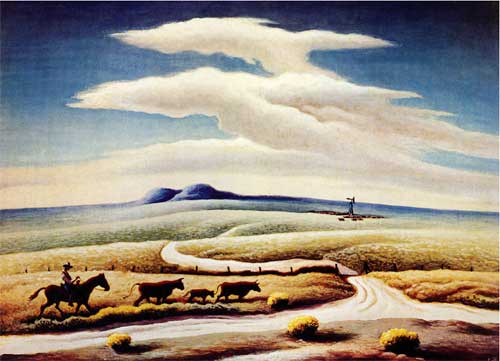
We who live here in flyover country know that is decidedly not true. Kansas is a big, beautiful state where the weather can be quite severe and the sky is large.
“The High Plains” by Thomas Hart Benton, 1958
Lots of famous (and infamous) people have started out life in Kansas. For instance, did you know that Mabel Walker Willebrandt (1889-1963) was from Kansas? She was the U.S. Assistant Attorney General from 1921-1929 and the highest-ranking woman in the federal government at the time and first woman to head the Tax Division.
She vigorously prosecuted bootleggers during Prohibition–in fact, she was the one who came up with the idea that illegally earned income was subject to income tax. That’s how they got Capone, you know. She is one of those amazing women who nobody knows about–probably because she was a Republican and campaigned vigorously for Herbert Hoover.
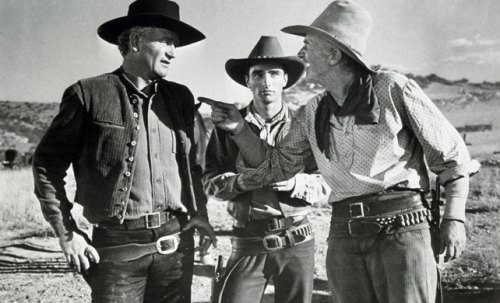
Anyway, I watched the movie Dodge City (1939) with Errol Flynn and Olivia de Havilland fairly recently, so I will recommend instead watching Red River (1948)–a movie about a cattle drive on the Chisholm Trail which ends dramatically in Abilene, Kansas. It is not one of my favorite westerns, but it is well worth watching for John Wayne, Walter Brennan and Montgomery Clift, who is surprisingly effective as a cowboy.
Well, as you know, that is how my mind works.
P.S. Did you know that Home On the Range is the state song of Kansas? How freaking awesome is that?!






 dual personalities