“There was something about her that seemed deeply—almost fundamentally—comfortable inside herself, the way I think a person is when they have been loved by their parents”*
by chuckofish
Daughter #2 is checking in to ask: What are you reading? Or rather, to answer that question.
When Ida was born, I was thrown back into the newborn nursing stage — an activity that requires at least one arm but not much brainpower. If anything, you need a distraction to keep you awake, especially in those early days. As you might imagine, I found myself aimlessly scrolling Instagram for hours per day (and night). It was honestly disturbing: the “algorithm” kept feeding me modern mom content to which I didn’t relate, or information that I didn’t want. The more you know, the more you stress. This second time around, I’ve gotten much better at trusting my instincts! At a certain point, I realized I needed to do something else with all that time.
Well I charged up my Kindle, which I had acquired during a particularly bad bout of insomnia during my first pregnancy. Yes, I am staunchly pro-book, but a Kindle can be read in the dark, and importantly, with one hand. Once I finally downloaded the Libby app, which connects your public library card to your Kindle, I could access endless eBooks for free. Hello!!
Without further ado, a round-up.
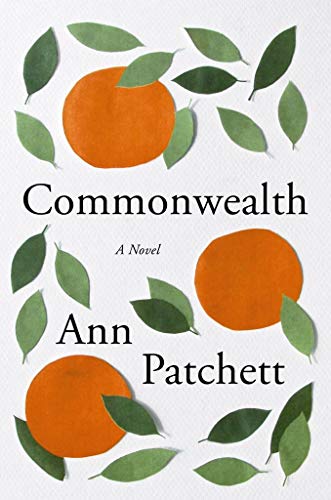
I went through an Ann Patchett phase, despite having largely disliked The Dutch House (2019) when I read it last year. Commonwealth (2016) and Bel Canto (2001) were better novels, I thought — at least, I was more invested in finishing them, and in the case of Bel Canto, I actually liked the characters. Too many characters in The Dutch House were actively terrible, and I just really don’t stand for “a mother leaves her children for selfish reasons” as a narrative basis. But Commonwealth begins with what I thought was a truly unreasonable act (read: plot device) of infidelity with consequences that I basically couldn’t get past.
Bel Canto, based on the true story of a hostage crisis in Lima, Peru, drew me in. It reminded me of the concept that appealed to me when I was a middle school-aged aspiring author: all your characters are stuck in the same place. For my part, I wanted to write a novel set in a retirement community. (Yes, I was special.) But Bel Canto had a bizarrely abrupt ending and an epilogue that, again, felt truly unreasonable. I don’t know why I kept reading Ann Patchett novels except that the sentences are well written, which is hard to come by in contemporary fiction?
Elizabeth Strout, I think, is a far better contemporary woman writer focusing on somewhat similar domestic themes. My sister gave me My Name is Lucy Barton (2016) last year, and in the past few months, I “binged” the rest of the series: Anything is Possible (2017), Oh William! (2021), and Lucy By the Sea (2022). The last in the series took me total surprise from the first page, when I realized it was set in 2020. Are we reading pandemic novels now?! Authors have already managed to pen and publish novels* about COVID?! I found that jarring, but I thought Strout lived up to her own standard and her characters meaningfully developed in that new “setting,” even if I hardly needed to relive quarantine dynamics.
*Please note that I also tried to read Ann Patchett’s recent book of essays, but didn’t get past the introduction, when she basically said “Haha! I have pandemic brain and can’t write novels. I’m going to write essays instead. Haha!”
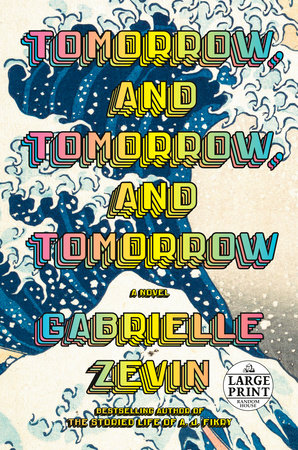
I also read a buzzy novel, Tomorrow and Tomorrow and Tomorrow (2022) by Gabrielle Zevin. It revolves around characters who play and design video games, so I was surprised to like it. It is smartly written (see: Macbeth reference, which was deftly woven in) and had some depth to it. The characters, for the most part, loved one another more than they hated one another. Not a given, these days.
That said, I described to DN recently how all fiction now seems so needlessly tragic. Car accidents, gun violence, fatal bee stings (I’m serious), and so much mental trauma. Am I a deeply sheltered and privileged person to have evaded such hardships? Probably. But as DN said, contemporary authors seem to think literature has to be dark to be deep.
Tomorrow, and tomorrow, and tomorrow,
Creeps in this petty pace from day to day,
To the last syllable of recorded time;
And all our yesterdays have lighted fools
The way to dusty death. Out, out, brief candle!
Life’s but a walking shadow, a poor player,
That struts and frets his hour upon the stage,
And then is heard no more. It is a tale
Told by an idiot, full of sound and fury,
Signifying nothing.
Shakespeare, from Macbeth, spoken by Macbeth
And how’s this for a deftly-woven Shakespeare reference? “Out, damned spot!”
*from Oh William! by Elizabeth Strout
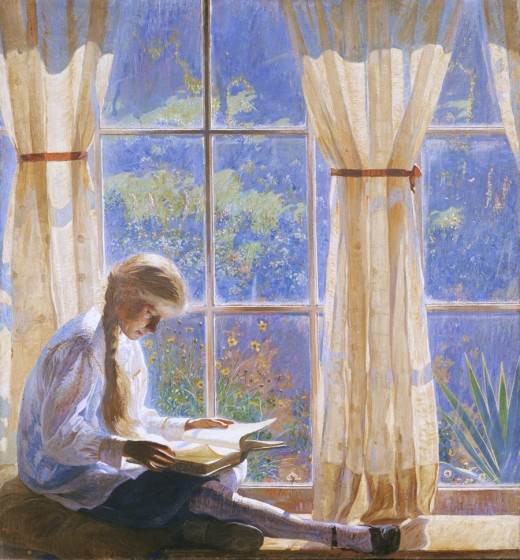
The painting is The Orchard Window by Daniel Garber (1918)
 dual personalities