
Fishermen will stand along the shore; from En Gedi to En Eglaim there will be places for spreading nets*
by chuckofish
Well, I made it through the first week of class without anything remarkable happening, although I did make an interesting discovery. Did you know that the ancients not only fly-fished but tied flies in order to do it? I did not. Here’s what Aelian, a Roman author and teacher of rhetoric who lived in the 2nd century AD, had to say about it:
I have heard and can tell of a way of catching fish in Macedonia, and it is this. Between Beroea and Thessalonica there flows a river called the Astraeus. Now there are in it fishes of a speckled hue…(and) these fish feed upon the flies of the country which flit about the river and which are quite unlike flies elsewhere… These flies settle on the stream and seek the food that they like; they cannot however escape the observation of the fishes that swim below. So, when a fish observes a Hippurus (fly) on the surface it swims up noiselessly under water for fear of disturbing the surface and to avoid scaring its prey. Then when close at hand in the fly’s shadow it opens its jaws and swallows the fly, just as a wolf snatches a sheep from the flock, or as an eagle seizes a goose from the farmyard. Having done this, it plunges beneath the ripple. Now although fishermen know of these happenings, they do not in fact make any use of these flies as baits for fish, because if the human hand touches them it destroys the natural bloom; their wings wither and the fish refuse to eat them, and for that reason will not go near them, because by some mysterious instinct they detest flies that have been caught. And so, with the skill of anglers the men circumvent the fish by the following artful contrivance. They wrap the hook in scarlet wool, and to the wool they attach two feathers that grow beneath a cock’s wattles and are the color of wax. The fishing-rod is six feet long, and so is the line. So, they let down this lure, and the fish attracted and excited by the color, comes to meet it, and fancying from the beauty of the sight that he is going to have a wonderful banquet, opens wide his mouth, is entangled with the hook, and gains a bitter feast, for he is caught.
Aelian, On the Nature of Animals 15.1
Though not an angler myself, I was pleased to make this discovery, and it got me thinking about fishing in the ancient world. And, of course, that got me thinking about fishing art. There’s actually quite a lot of it.
Wall paintings in various Egyptian tombs depict fishing scenes. Here’s a relief from the tomb of Kigemi, the vizier of Djoser who reigned during the Old Kingdom’s 3rd Dynasty, c. 2686 BC.
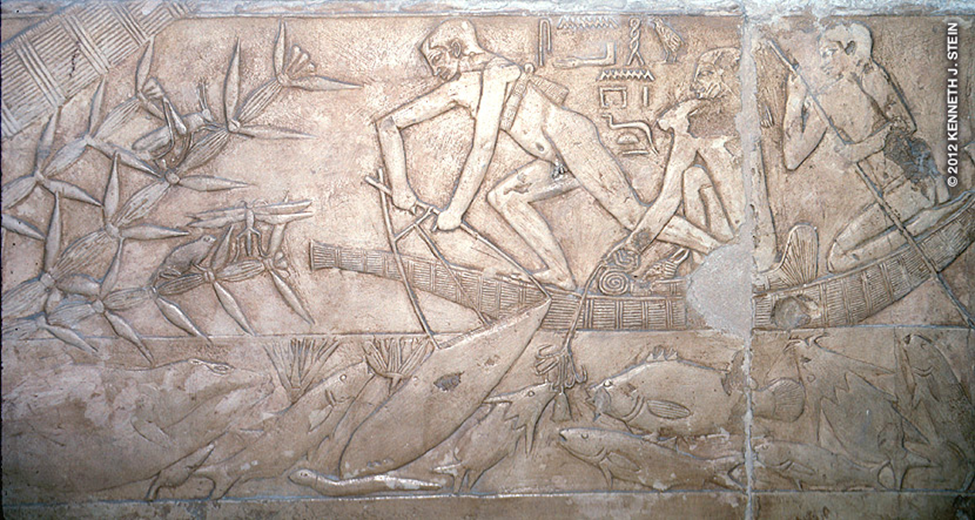
The Nile was full of scary looking fish! I like everything about that relief: the frog sitting on the branch to the left of the boat; the basket/net? the front man is using to lift the fish from the water and the multi-hooked line the man in squatting in the center of the boat is using.
They fished in ancient Assyria as well. Here’s a relief from the 7th century BC showing a man fishing at a pool teeming with fish.
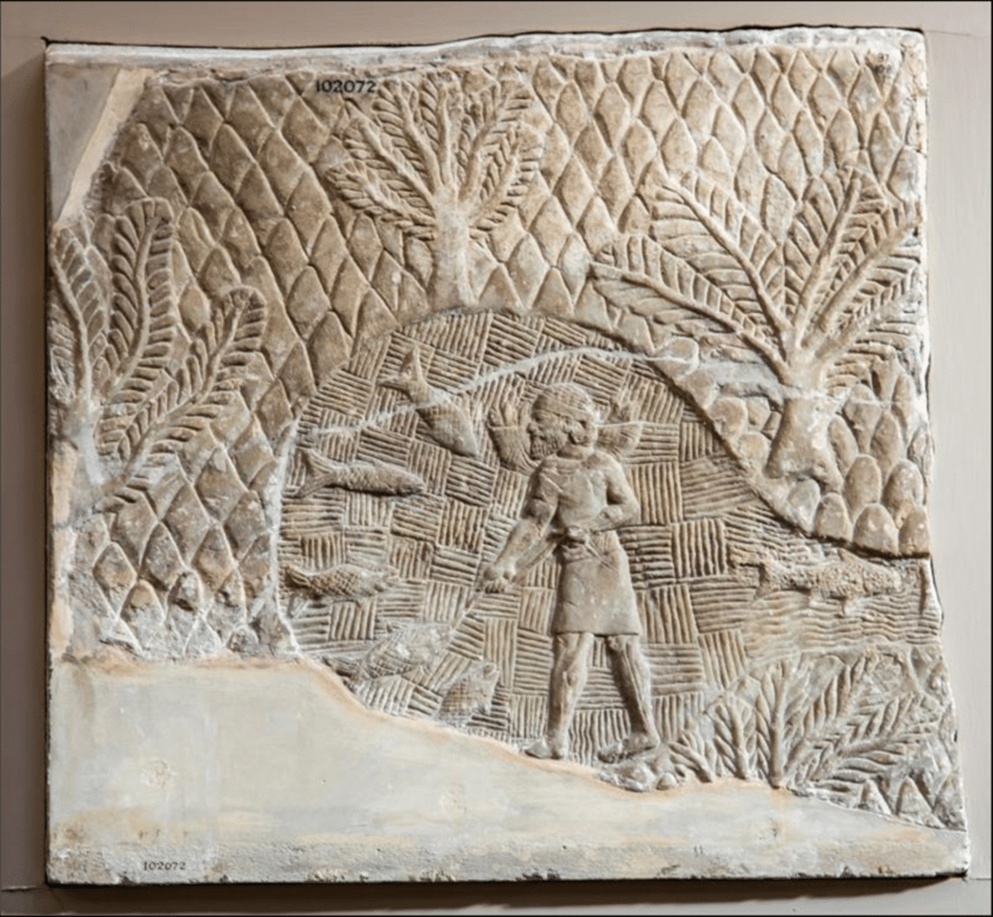
Notice the creel on the man’s shoulders to carry the day’s catch. (And, yes, the perspective is a little odd, but that’s ancient art for you.)
Here’s a Roman mosaic depicting a couple of guys fishing. I like the sun hat that one on the left wears and the net he uses to scoop the fish out of the water. The man sitting on the bank seems to be attaching a fly to the line.
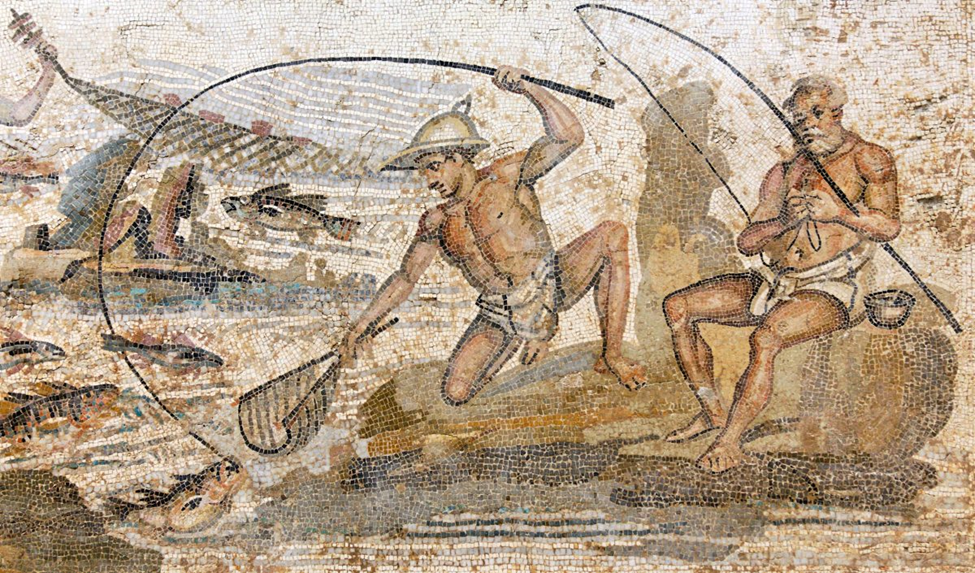
We may live in a crazy world but not everything has changed. People still enjoy activities like fishing. Why not unplug this weekend, and if you don’t like to fish, try painting or making a mosaic instead!
Finally — a shout out to Chris and Nicole who are beginning the long, heavy task of moving into a new house this weekend. Good luck and take care of your backs!
*Ezekiel 47:10
 dual personalities