
Fall down seven times, stand up eight*
by chuckofish
Memorial Day is coming up, but these days the meaning seems to get lost among the barbeques and long-weekend festivities. This excerpt from the famous speech that Douglas MacArthur made to graduating cadets at West Point in 1962 is a fitting reminder of what we fight for.
“Duty, Honor, Country: Those three hallowed words reverently dictate what you ought to be, what you can be, what you will be. They are your rallying points: to build courage when courage seems to fail; to regain faith when there seems to be little cause for faith; to create hope when hope becomes forlorn. Unhappily, I possess neither that eloquence of diction, that poetry of imagination, nor that brilliance of metaphor to tell you all that they mean.
The unbelievers will say they are but words, but a slogan, but a flamboyant phrase. Every pedant, every demagogue, every cynic, every hypocrite, every troublemaker, and, I am sorry to say, some others of an entirely different character, will try to downgrade them even to the extent of mockery and ridicule.
But these are some of the things they do. They build your basic character. They mold you for your future roles as the custodians of the nation’s defense. They make you strong enough to know when you are weak, and brave enough to face yourself when you are afraid.
They teach you to be proud and unbending in honest failure, but humble and gentle in success; not to substitute words for action; not to seek the path of comfort, but to face the stress and spur of difficulty and challenge; to learn to stand up in the storm, but to have compassion on those who fall; to master yourself before you seek to master others; to have a heart that is clean, a goal that is high; to learn to laugh, yet never forget how to weep; to reach into the future, yet never neglect the past; to be serious, yet never take yourself too seriously; to be modest so that you will remember the simplicity of true greatness; the open mind of true wisdom, the meekness of true strength.
They give you a temperate will, a quality of imagination, a vigor of the emotions, a freshness of the deep springs of life, a temperamental predominance of courage over timidity, an appetite for adventure over love of ease. They create in your heart the sense of wonder, the unfailing hope of what next, and the joy and inspiration of life. They teach you in this way to be an officer and a gentleman.”
Whole speech
No one uses words like duty and honor much these days, and patriotism is very out of fashion, which is a pity because it’s important.
Equally absent from public discourse is any recognition of how difficult life was for our predecessors. Recently, in an effort to amuse myself and avoid doing anything useful I started looking into our Tukey and Stanley ancestors who settled in Portland, Maine in the 18th century. I haven’t found much new information yet, but during my search I was struck by how few old buildings there are in Portland. One of the oldest is the Wadsworth-Longfellow house built in 1785 by Peleg Wadsworth, the grandfather of Henry Wadsworth Longfellow.

It’s a beautiful house, but considering that Portland was first settled in 1632, not very old. Being curious, I investigated, and now I know what happened to the early settlements.
As previously mentioned, Portland was first settled in 1632. An Abenaki raid during King Philip’s War in 1676 destroyed it, so the survivors rebuilt. In 1690, when a combined French and Indian army attacked, the inhabitants took cover in a purpose-built fort. The French and Indians burned the town, and eventually set fire to the fort. When at last the settlers agreed to surrender to the French and opened the gates, the perfidious French stood by while the Indians slaughtered everyone. Portland was wiped out. Ten years later, new settlers arrived, and by 1716 they had established a thriving port. It got burned again during the Revolutionary War and was rebuilt in 1786. In 1808, perhaps anticipating the upcoming war with England, the inhabitants built Fort Scammel on House Island in Portland Harbor.
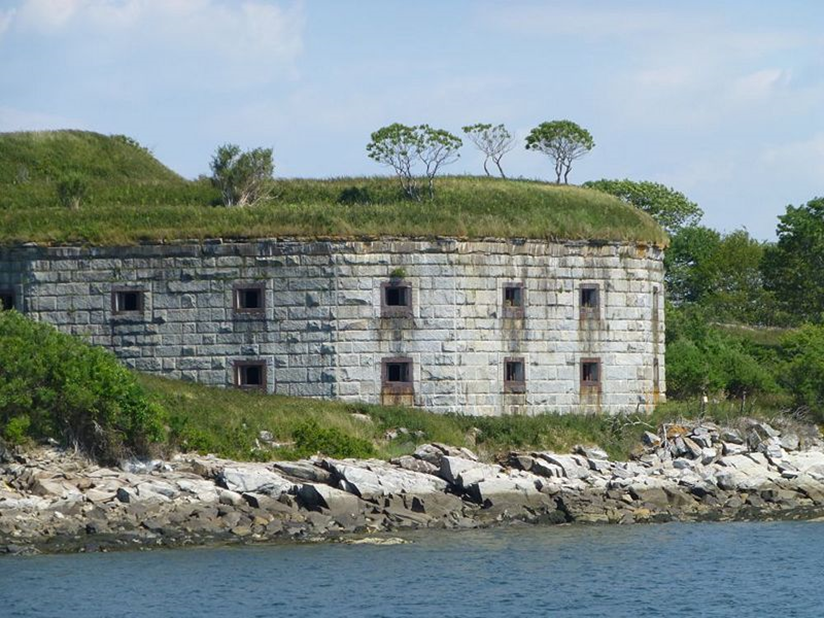
The city survived the war unscathed, though many citizens served in the navy and army. Tragedy struck once more on July 4, 1866 when a great fire destroyed much of the city. Its citizens rebuilt.
By now, the recurring theme is obvious. Despite repeated disasters and incredibly difficult conditions, the early settlers of Maine did not give up. When they got knocked down, they stood back up and rebuilt; they worked incredibly hard and they did not expect to be perfectly safe, happy, and thriving all the time. No one owed them anything but a chance. This Memorial Day let’s remember the people who came to this country before it was one and somehow managed to build what we now enjoy. That is worth remembering. (I should add that I don’t mean this as some political screed. EVERYONE had to struggle and had a hard time. As I’ve said before, to acknowledge one group isn’t to deny the others.)
*Japanese proverb
 dual personalities