“Insight was a kind of gift”
by chuckofish
Several weeks ago, I (still daughter #2 here) read a New Yorker interview with Min Jin Lee, linked previously by my mom. Many moments stood out to me; I was particularly impressed by Lee’s years of commitment to research and self-training in writing. She did not just think, “Anyone can write a novel!” I appreciated that she noted the good fortune of winding up in a $200 workshop taught by a not-quite-famous Jhumpa Lahiri while also admitting that plenty of those workshops are not so rigorous. Her point, I think, is about making the most out of both versions of study. (Of course, the interviewer had asked a condescending question about “dreamers” in such workshops.) And I really cringed when reading her anecdote about getting into a week-long workshop that required a hefty tuition fee, only to realize that everyone there was sponsored by a university. Someone makes a snide comment about “housewives” who pay their own way. Having spent years processing travel reimbursements for creative writers, I could picture this scene a little too vividly.
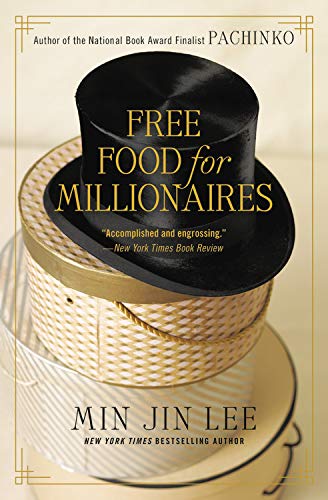
I decided to read Min Jin Lee’s first novel, Free Food for Millionaires (2007), because I thought the plot sounded more approachable: it centers on Casey, a Korean-American girl from Queens who has just graduated from Princeton and returned to New York City without a clear plan. Over the course of several years, Casey’s career trajectory zig zags and her relationships evolve. We follow some of her loved ones on their own evolutions, and learn a lot about the different ways that different kinds of Americans pursue love and money.
I thought the best part of the novel was the fullness of the characters. Casey cares deeply about her sister and her friends, and vice versa — even across chasms wrought by conflict, the novel’s women, in particular, are loyal to one another.
She wanted to give Ella something, and insight was a kind of gift. But Casey wanted to tell her something good, something true.
“You’re an incredibly kind person–you make me feel loved. Like I’m all right. Like”–Casey took a breath–“I’m forgiven.” The thought had taken her by surprise. “No one else does that.”
But bad things happen to everyone, and the sheer amount of forgiveness needed was exhausting by the end. You keep wondering if there will be justice served, and if the characters deserve this or that outcome. In the end, Lee suggests, no one deserves anything — certainly not wealth, or even a life without pain — and seeking fairness is a losing battle. A legitimate argument, to be sure, but a difficult one to endure as a reader, at times.
There is plenty more to say — this novel didn’t waste a single moment, and it isn’t exactly short! But there is only so much one can discuss in a blog post. I’ll end here with another quote, a description of Casey, a character I really loved in spite of all her flaws and poor choices:
Casey believed that she could draw a person to her. It was the simplest thing in the world for her because she did it by doing one thing perfectly: She paid attention, the kind of attention that almost didn’t exist anymore. This was her gift. So few people did this for each other. Giving someone your attention–with the greatest amount of care she could could muster in whatever allotted time period–was far more precious than any kind of commodity.”
 dual personalities
I am looking forward to reading this book!
I can send you my copy in your b-day package, if you’d like!
Great post! The book sounds worthwhile and the author interesting, although my tolerance for characters who make bad decisions that require others’ forgiveness is at an all time low. Know what I mean?
Absolutely. It’s also largely about people in their twenties (though the parents’ generation gets plenty of attention) and I realized that I am thoroughly *not* in that mode anymore. So I did not have a ton of patience for the “finding yourself” bad-decision rite-of-passage thing. That said, the book is so well done and there are so many other pay-offs and subtle arguments that it is worth it, I think.