“I keep an inventory of wonders”*
by chuckofish
We think a lot about the passing of time and this was a shocker:

Yes, the album was released on May 26, 1967–54 years ago. And WWI was only 50 years before that. Western culture had changed a lot in those 50 years, but think about how much it’s changed in the past 54 years.
As usual, I am trying to escape our crumbling culture by reading something uplifting. Currently I am re-reading Hannah Coulter by Wendell Berry. This novel has much to say about the passage of time and people living in community.
As I have told it over, the past visible again in the present, the dead living still in their absence, this dream of time seems to come to rest in eternity. My mind, I think, has started to become, it is close to being, the room of love where the absent are present, the dead are alive, time is eternal, and all the creatures prosperous. The room of love is the love that holds us all, and it is not ours. It goes back before we were born. It goes all the way back. It is Heaven’s. Or it is Heaven, and we are in it only by willingness. By whose love, Andy Catlett, do we love this world and ourselves and one another? Do you think we invented it ourselves? I ask with confidence, for I know you know we didn’t.
Frederick Buechner calls it “the Room called Remember.”
The past and the future. Memory and expectation. Remember and hope. Remember and wait. Wait for him whose face we all of us know because somewhere in the past we have faintly seen it, whose life we all of us thirst for because somewhere in the past we have seen it lived, have maybe even had moments of living it ourselves. Remember him who himself remembers us as he promised to remember the thief who died beside him. To have faith is to remember and wait, and to wait in hope is to have what we hope for already begin to come true in us through our hoping. Praise him.
Anyway, I highly recommend both Wendell Berry and Frederick Buechner.
And, of course, there’s always Jorge Luis Borges…
In the golden afternoon, or in
June, 1968
a serenity the gold of afternoon
might symbolize,
a man arranges books
on waiting shelves
and feels the parchment, the leather, the cloth,
and the pleasure bestowed
by looking forward to a habit
and establishing an order.
Here Stevenson and Andrew Lang, the other Scot,
will magically resume
their slow discussion
which seas and death cut short,
and surely Reyes will not be displeased
by the closeness of Virgil.
(In a modest, silent way,
by ranging books on shelves
we ply the critic’s art.)
The man is blind, and knows
he won’t be able to decode
the handsome volumes he is handling,
and that they will never help him write
the book that will justify his life in others’ eyes;
but in the afternoon that might be gold
he smiles at his curious fate
and feels that peculiar happiness
which comes from loved old things.
*Wendell Berry, Sabbaths 2016
 dual personalities
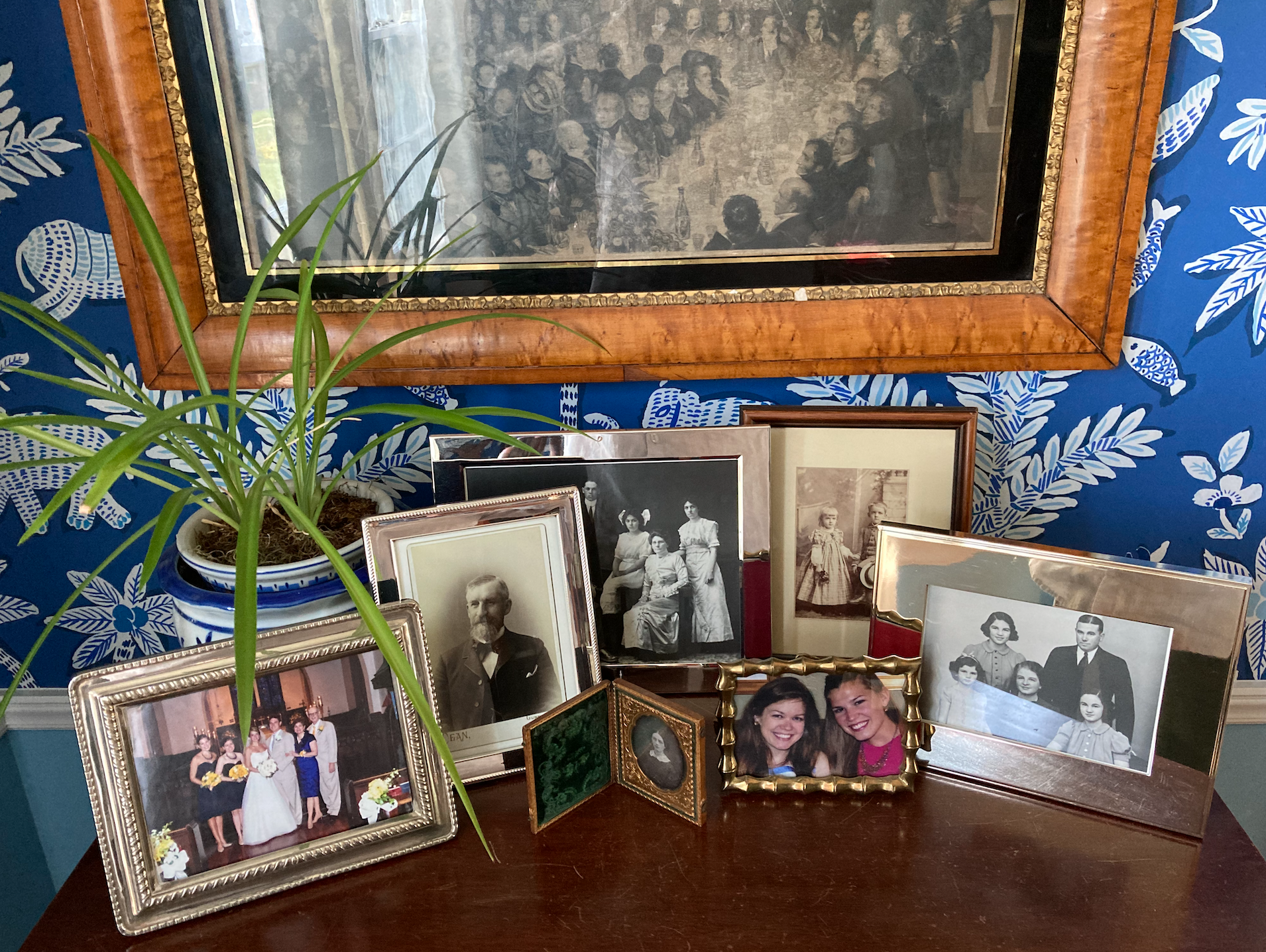
More great reading to add to my ever-growing list. And I love the photo of photos in your dining room!
Lots of good food for thought – I especially like the Borges!