There is no end, but addition: the trailing Consequence of further days and hours…
by chuckofish
Well, I made it through my first day of classes and it went much as expected, which is to say that I experienced a lot of technical difficulties. It wasn’t too bad teaching in a mask and the students weren’t too grumpy about wearing them, but I wonder how much they will learn. C’est la vie.
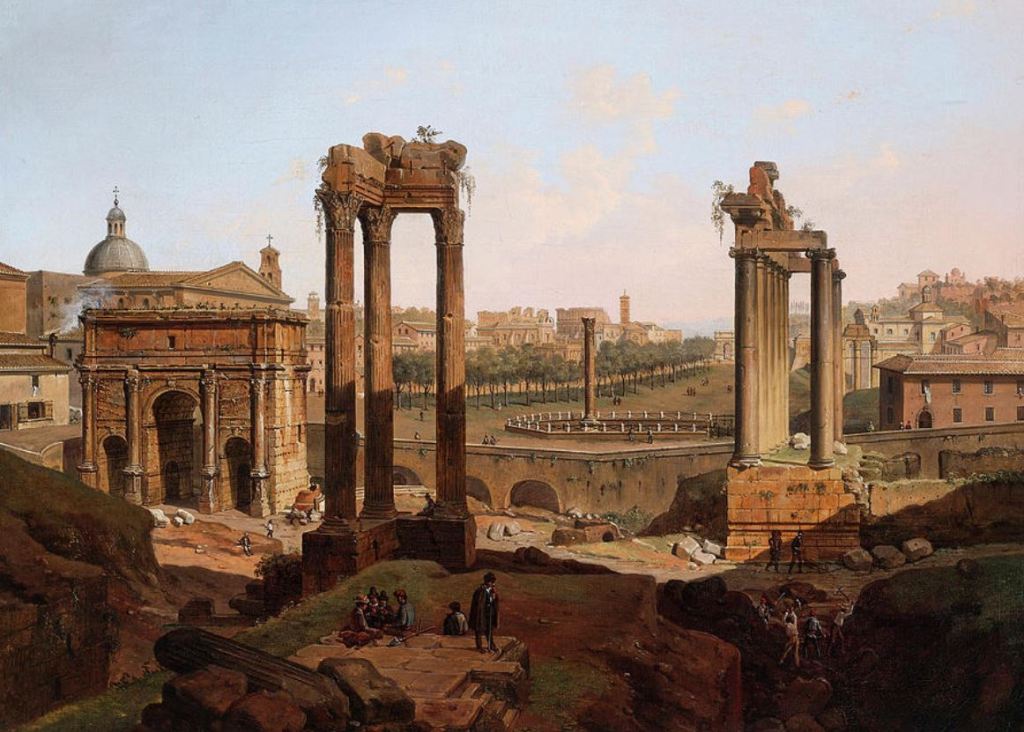
When not attempting to get classroom computers to work, I rediscovered T.S. Eliot’s Four Quartets, particularly concentrating on the Dry Salvages which really appeals to the historian in me. Isn’t “the trailing consequences of further days and hours” a great line? It evokes images of layer upon layer of human experience rather like this 19th century painting of the Roman Forum.
I don’t know if Eliot is still fashionable among literary types, but I think that he has much to teach. Take this passage:
It seems, as one becomes older, That the past has another pattern, and ceases to be a mere sequence—
Or even development: the latter a partial fallacy
Encouraged by superficial notions of evolution,
Which becomes, in the popular mind, a means of disowning the past.
How apt! Nowadays people seem determined to disown the past and shake off its lingering consequences. That will be harder to do than they imagine, for the past has a way of sticking with us. In fact, the past may not be past at all.
Fare forward, travellers! not escaping from the past
Into different lives, or into any future;
You are not the same people who left that station
Or who will arrive at any terminus,
While the narrowing rails slide together behind you;
And on the deck of the drumming liner
Watching the furrow that widens behind you,
You shall not think ‘the past is finished’
Or ‘the future is before us’.
The Dry Salvages is a good reminder (as if we need one!) that we aren’t in control of our lives, and no manipulation of past, present and future will lend us the control we seek. It may seem odd, but I find Eliot curiously comforting. In taking favorite passages out of context, I have done the poem an injustice. There’s much more to it than I suggest. Read it again for yourselves here and fare forward! Also, check out DN’s recent post on Eliot — he knows whereof he speaks.
Have a relaxing weekend — I intend to do the impossible!
 dual personalities