“Come now,” said Yousef. “Everyone fights an American War.”*
by chuckofish
Recently, a friend lent me a book that she particularly wanted me to read so we could talk about it. She told me that Rochester, NY chose it as an all-city read (is that a thing?) and she heard about it on NPR. “Hmmm,” thought I, “those are not very good recommendations. But I’ll give it a try.” So I read Omar el Akkad’s American War.
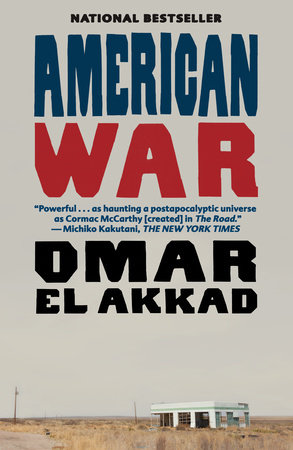
The book is set in a near future America in which climate change has caused the seas to flood the coasts, fossil fuels have been banned, and the south has seceded from the union as a result. The ensuing civil war has caused widespread depredation throughout the south, and many people, including our main character, a young girl named Sarat, have ended up living in refugee camps. Sound familiar? You can see where this is going. Sarat’s family gets killed, she is manipulated into becoming a terrorist, gets captured and tortured for years, and ends up committing a terrible war crime. Betrayed at every turn, by nearly everyone she meets, she becomes a soulless killer.
The book is aimed at making Americans understand how an average person can become a terrorist. In an interview, the author claimed that he did not want his readers to sympathize or empathize with the characters; he wanted them to understand. That sounds like a reasonable goal and the book accomplishes it, though I learned nothing new. It is full of pithy statements that sound insightful until you think about them:
“And what she understood… was that the misery of war represented the world’s only truly universal language. Its native speakers occupied different ends of the world, and the prayers they recited were not the same and the empty superstitions to which they clung so dearly were not the same – and yet they were. War broke them the same way, made them scared and angry and vengeful the same way. In times of peace and good fortune they were nothing alike, but stripped of these things they were kin. The universal slogan of war, she’d learned, was simple: If it had been you, you’d have done no different.”
The cynical view that all governments will do anything to keep power, that people will always put self-interest ahead of duty or morality, and that most people are powerless victims is understandable these days and therefore forgivable. We see the same thing all over TV and the news can sure make it look that way. But is it true? Maybe for some, but not for most Americans (and, indeed, Canadians, Brits, etc..). Nor has it ever been.
Didn’t we just celebrate the 75th anniversary of D-Day?

Reflect on that for a moment and consider the remark quoted above, “If it had been you, you’d have done no different.” Isn’t that the point? We fought WWII because we did not believe that in the Nazis’s place we would have done no different, and we fought to defend our way of life. Yes, people get swept up in global movements against their will and some of them will do bad things as a result, but the majority will not. That’s what American War leaves out.
Humans are much more complex and certainly better than el Akkad would have us believe. Moreover, while American War paints a very dark picture, it offers no solutions other than the implied ‘do the opposite of what was done to Sarat.” That is, governments should not use the weak, torture, kill or engage in Game-of-throne type political games (indeed, they should not). But it seems too easy to blame governments, for we know that terrible experiences do not uniformly produce terrorists. There is nothing in the book about fanatical religious or political beliefs; there is no moral dimension and no suggestion that the perpetrator take responsibility for her actions.
I cannot recommend American War. It left me dissatisfied, although perhaps that was its goal.
Next time I blog about a book it will be one that I truly enjoyed!!
*el Akkad, American War
 dual personalities