What are you reading? (DN edition!)
by chuckofish
At some point during our courtship, Daughter #2 and I dropped into one of Dupont Circle’s famous bookstores. We had just toured the Phillips Collection, and after strolling past Daughter #1’s former D.C. apartment—reminiscing about that great old apartment is mandatory for any trip to Dupont Circle—we decided to pop in at one of my favorites.
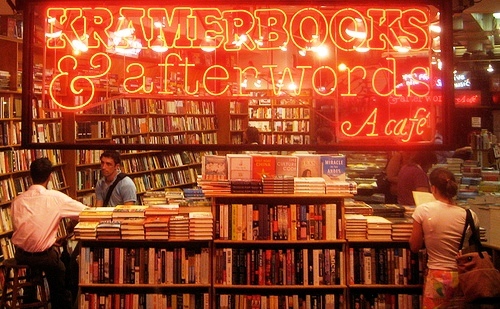
No, not Kramerbooks. Kramerbooks is a great independent bookstore. And they have a good café, where you can sit with your purchase in public. But are you reading? While I approve of book buying, of course, I am more a fan of book reading. At Kramerbooks, all the books are new, and they are perfect if you want to be seen reading. You get the feeling that the life of the books at Kramerbooks entails nothing more than a move from store shelf to home shelf. Indeed, there is an apocryphal story about former Washington Post editor Ben Bradlee’s cynicism of D.C. book culture: he slipped his business card into the top dozen copies of a stack of the latest political tell-all—around page 200 or so—with his home phone number written on the back. He scrawled the following note: “Call me upon seeing this—$100.” No one did. An acquaintance of mine even recently held her wedding at Kramerbooks, and this fact couldn’t be more Kramerbooks if it tried.
Weddings #atKramers 👰🤵 Congratulations to the beautiful bookish Bride & Groom, Kelsey & Jerrod! #BookstoreWedding #DC pic.twitter.com/ITljmhnWb3
— Kramerbooks (@kramerbooks) October 19, 2018
This looks like a lovely time, but notice those stacks of crisp hardbacks behind the groom. Will they ever be read? Daughter #2 and I are all in favor of book-themed weddings, as you know, but the books should be there to be read.
No, the bookstore that we stopped at was Second Story Books. Second Story Books is where Kramerbooks go after the grandchildren liberate them from the home shelf. It is an excellent used bookstore. Every morning Second Story Books trundles out a series of library reshelving carts that lure readers inside to their squirrely stacks.

On this occasion, I found a copy of an out-of-print paperback by one of my favorite authors, Henry Green. This Penguin edition features three of Green’s best novels: Loving, Living, and Party Going. (Yes, nearly all of Green’s titles are participles.) It’s a difficult copy to find affordably, so I snatched it up. I gave it to Daughter #2, who has not read a word of it to this day.
This lack is entirely my fault; I gave the gift incorrectly. I should have annotated that copy of Henry Green. One of the best Christmas gifts I ever received was a copy of Moby-Dick with Daughter #2’s personal annotations. You might argue that Moby-Dick recommends itself, but really, even the best reader wants occasional motivation. Slipped into the text at regular intervals, the personalized notes kept me reading into the wee hours. Only a handful of pages before uncovering another treasure!
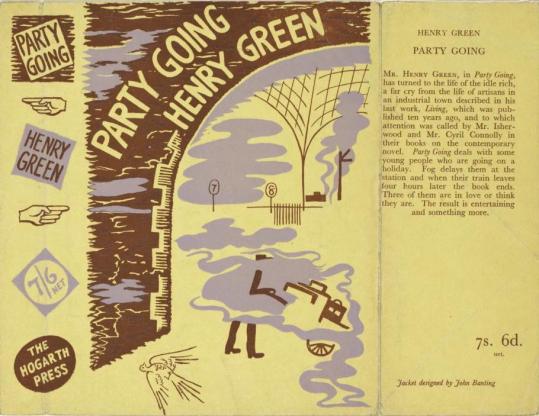
I may annotate that Green this Christmas. Party Going (1939), my favorite novel of Green’s, would be an apt choice, since the coming December weeks are often themselves a season of party going. Yet Green’s novel is more specifically appropriate for its lack of a party: the novel takes place primarily in the hotel adjacent to a London railway station as a group of wealthy Bright Young People await a train to the continent for a summer holiday. They wait; tension grows; they wait some more. For Green, this is a metaphor for the political tension of the ineffectual 1930s. If we want to stretch it, perhaps the novel could also be a little metaphor for Advent. But then you would have to ignore Green’s contempt for his peer group as he directs his sinuous sentences against them:
Amabel’s flat had been decorated by the same people Max had his flat done by, her furniture was like his, his walls like hers, their chair coverings were alike and even their ash trays were the same. There were in London at this time more than one hundred rooms identical with these. Even what few books there were bore the same titles and these were dummies. But if one said here are two rooms alike in every way so their two owners must have similar tastes like twins, one stood no greater chance of being right than if one were to argue their two minds, their hearts even must beat as one when their books, even if they were only bindings, bore identical titles. … These people avoided any sort of trouble over what might bother them, such as doing up their rooms themselves, and by so doing they proclaimed their service to the kind of way they lived or rather to the kind of way they passed their time.
Ouch. Tell us what you really think, Henry. I guess the only thing worse than a book as status symbol is a binding symbolic of one’s vacuous inattention to even the trappings of culture. The thirties really were, in the words of W. H. Auden, a low dishonest decade.
All of this is to say: when you give a book, give also of yourself—consider annotating it, even if only a little. Your recipient is far more likely to read it.
 dual personalities
What a delightful post! You have piqued my curiosity and I am determined to track down a novel by Henry Green, although I worry that perhaps he has too much contempt for his characters?
While Green was admired in the midcentury as one of the foremost authors of late modernist fiction, he was overlooked in the academy in subsequent decades, and so his work had been in and out of print. However, the NYRB has recently released new editions of his novels! He is readily available again! Each spine is a different shade of green 🙂
I think that anyone would find Party Going worthwhile. It captures what I find formally interesting about Green’s work, and the novel is not *too* negative toward his cohort. Indeed, Party Going has more going on than just Green’s peer group: there are characters of different classes and ages. It’s my favorite snapshot of the 30s (Green wrote the novel between 1931 and 1939).
Finally, I can’t recommend all of Green’s novels: beyond Party Going, I would seek out (in this order) Loving, Caught, Living, Concluding, and his memoir Pack My Bag.
I do hope you seek him out!
Thanks for the info!
Yes, we have a long history of giving used book “homework” as gifts… I’m sure some will see more of this at Christmas…!
I used to live around the corner from Second Story Books!
I have fond memories of perusing the library carts outside Second Story Books in the sweltering DC summer. I will say this for Kramer books, though: they had Chandler when I needed him, and their cocktails aren’t half bad either.