
#youthinkthingsarebadnow
by chuckofish
If I stopped random individuals in the street and asked them what they knew about ancient Athens, at least some would mention democracy. Indeed, we still revere Athenian democracy for its shining moment in the 5th century BC when it produced the likes of Pericles, Socrates, Aeschylus, Sophocles, Euripides, Polycleitus and Phidias — to name only a few. But the sad fact is that if you look beyond the beautiful monuments and brilliant individuals, you’ll find something dark and violent. Let’s look at a couple of choice examples.
1. Miltiades, the hero of the Battle of Marathon (490 BC). Miltiades managed to pull the Athenians and their allies, The Plataeans, together long enough to defeat the entire Persian army at Marathon. That they won the battle was nothing short of a miracle, even if it happened more or less by accident. The victory validated the new democracy in Athens (it was about twenty years old at this point). It was a big deal.
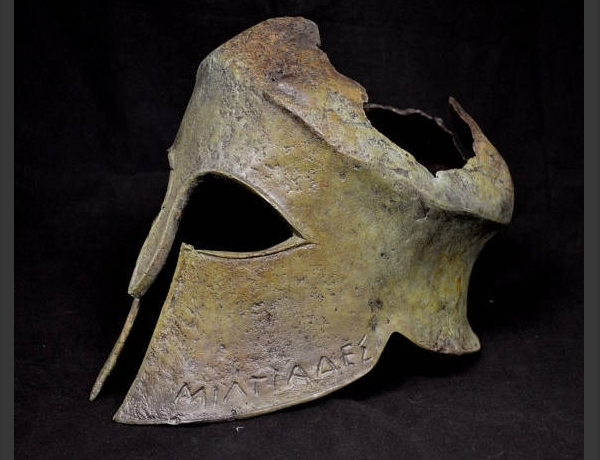
the helmet Miltiades dedicated at Olympia after the battle
But Miltiades had enemies and perhaps an inflated belief in himself. At the height of his post-war popularity, he convinced the Athenian people that he would make them rich if they gave him an army to campaign against the island of Paros. The greedy mob acquiesced. When the expedition failed and Miltiades came home with a gangrenous wound, the grateful Athenians put him on trial for his life. Only the pleas of his friends and the fact that he was dying anyway saved him from execution. Instead, they fined his family 50 talents of silver (each talent weighed about 57 lbs. so that’s a lot of silver!) and sent him to prison to die. His crime? Depending on how one interprets events, either being too successful for his enemies to tolerate, or failing to keep the mob happy. Probably both. The mob has a short memory; enemies have long ones.
2. The Athenian navy was victorious at the battle of Arginusae (406 BC),
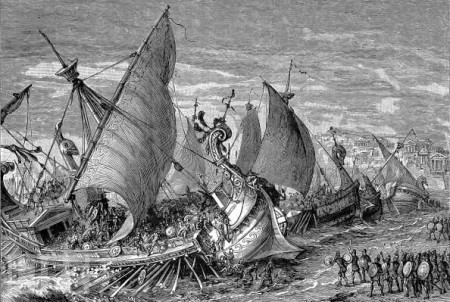
but when a storm blew up before the victors could rescue those sailors whose ships had sunk, the commanders withdrew to a safe harbor, rather than risk the remaining ships to stay in the heaving waters. When informed of these events, the outraged Athenian assembly voted to execute its generals. After lengthy debate over a period of weeks, they executed six of the eight generals involved. Two had had the presence of mind to flee before trial. Soon after the executions, the assembly regretted its actions, charging in turn the men who had prosecuted the generals. The accused also fled before trial. The mob is fickle, given to emotion, vindictive, and easily swayed.
Do you see a pattern here? To be fair, it wasn’t only democratic Athens that behaved badly, although no other city-state achieved the levels of caprice that Athens did (at least not that I recall).
Here’s a bonus, non-Athenian example of extreme partisan politics. In 431 BC, the oligarchic faction in the city of Plataea opened the gates one night to a Theban army with the expectation that the Thebans would kill the democrats in control of Plataea and bring the oligarchs to power. The Thebans took over in a bloodless coup, but the Plataeans fought back and eventually took the Theban force prisoner. Rather than negotiate a peace with Thebes, the democratic Plataeans killed all of their prisoners. In response, Theban and Spartan armies laid siege to Plataea.
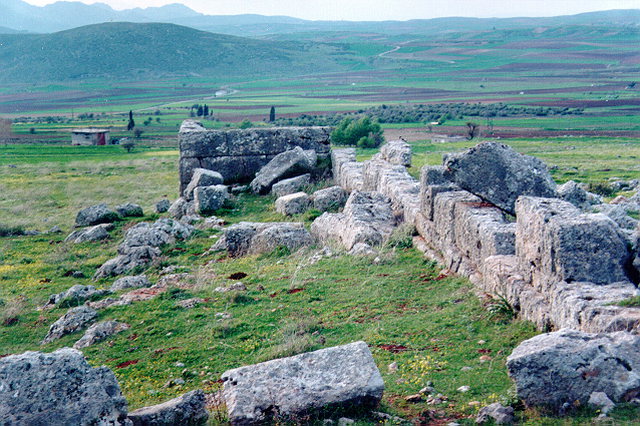
ruins of Plataea
When the city finally fell, the Spartans tried the surviving Plataeans, executed them, and destroyed the city. Remember, internal treachery started the whole thing. When people put their own political faction before the welfare of their country, only the enemy wins.
You see, the partisanship and vindictive politics that prevail in the U.S. today are not new. To be sure, we are (for the present) less violent. Rather than kill people outright, we resort to character assassination. Nevertheless, we still encourage emotion to take precedence over reason and evidence, and we allow half-baked rumors and slanted news stories to control our opinions. We enjoy a good dose of outrage; it makes us feel alive and purposeful. Argument and competition made the Greeks great, but when people started to manipulate the system for personal gain, they destroyed it and their country. Let’s hope we don’t allow that to happen here.
 dual personalities