The wise man celebrates what he can*
by chuckofish
I have spent a lovely week reading, writing and puttering. We’re making such great progress sifting through the attic that I am now the happy owner of a large quantity of empty plastic tubs. If I’m patient and work hard, I’m sure they’ll fill up again. Amid all the sorting, I found time to read.
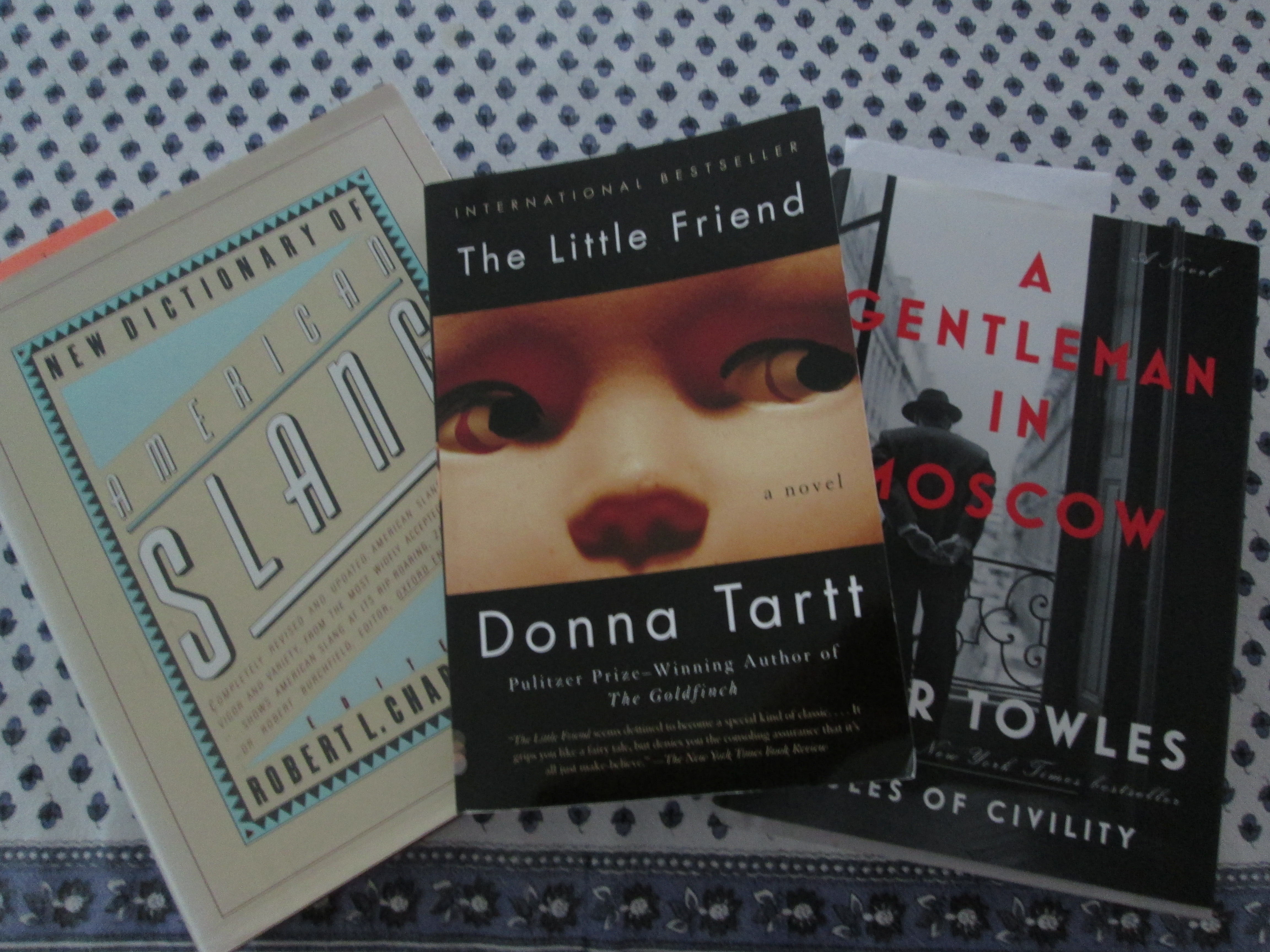
I finished Donna Tartt’s wonderful, wonderful The Little Friend. The cover is creepy, but the book is right up there with the Goldfinch — in some ways I thought it was better. Part murder-mystery, part coming of age story, part southern Gothic with a twist of acute social observation, The Little Friend held me spellbound. Most of all, the book is about the stories we tell ourselves about our lives, and it reminds us that although those stories are all fiction, they give us the means to navigate this world.
“How Robin would have loved this!’ the aunts used to say fondly. ‘How Robin would have laughed!’ In truth, Robin had been a giddy, fickle child – somber at odd moments, practically hysterical at others – and in life, this unpredictability had been a great part of his charm. But his younger sisters, who had never in any proper sense known him at all, nonetheless grew up certain of their dead brother’s favorite color (red); his favorite book (The Wind in the Willows) and his favorite character in it (Mr. Today); his favorite flavor of ice cream (chocolate) and his favorite baseball team (the Cardinals) and a thousand other things which they – being living children, and preferring chocolate ice cream one week and peach the next – were not even sure they knew about themselves. Consequently their relationship with their dead brother was of the most intimate sort, his strong, bright, immutable character shining changelessly against the vagueness and vacillation of their own characters, and the characters of people that they knew; and they grew up believing that this was due to some rare, angelic incandescence of nature on Robin’s part, and not at all to the fact that he was dead.”
The main character, Harriet, is an 11 year old girl (or thereabouts), whose reading habit and singular view of the world set her apart from her contemporaries. She doesn’t fit in. I relate to Harriet; we share, among other traits, a similar taste in reading material. Unfortunately, I don’t share Tartt’s facility with words, so I can’t give the book the eloquent praise it deserves. Read it!
When was the last time that you finished one fabulous book and immediately started another? Having begun Amor Towles’ exquisite A Gentleman in Moscow, I am amazed to discover that I have accomplished that feat. I hate to put the book down, but it is so good that I am trying to read it slowly. It begins in Moscow in 1922 at the Metropol, a grand hotel near the Kremlin. Count Alexander Rostov, barely redeemed by a poem he once wrote that the Bolsheviks took up, is sentenced to life imprisonment at the hotel. If he steps outside, he will be shot. The premise may sound a bit contrived but the execution is beautiful and the author has a lot to say about life. The following passage resonated particularly:
“As we age, we are bound to find comfort from the notion that it takes generations for a way of life to fade. We are familiar with the songs our grandparents favored, after all, even though we never dance to them ourselves. At festive holidays, the recipes we pull from the drawer are routinely decades old, and in some cases even written in the hand of a relative long since dead. And the objects in our homes? The oriental coffee tables and well-worn desks that have been handed down from generation to generation? Despite being “out of fashion,” not only do they add beauty to our daily lives, they lend material credibility to our presumption that the passing of an era will be glacial.
But under certain circumstance, the Count finally acknowledged, this process can occur in the comparative blink of an eye. Popular upheaval, political turmoil, industrial progress – any combination of these can cause the evolution of a society to leapfrog generations, sweeping aside aspects of the past that might otherwise have lingered for decades. And this must be especially so, when those wit newfound power are men who distrust any form of hesitation or nuance, and who prize self-assurance above all.” (p. 144)
Alas, we seem to be experiencing one of those popular upheavals right now. What can we do? Keep reading, champion nuance and always be polite.
Finally, I rescued the Dictionary of American Slang from a colleague’s cast-off pile. This is the 2nd edition published in 1985, and it is a real hoot. I gave it to son #2, who enjoys such things. I meant to post some bon mots from it, but got carried away with my novels, so I’ll save this book for another time. By way of a preview, I leave you with the hope that you remain “cool as a Christian with aces wired” — whatever that means.
*Towles, A Gentleman in Moscow
 dual personalities