“All is a procession, The universe is a procession with measured and perfect motion.”*
by chuckofish
Yesterday we highlighted the great James B. Eads. Well, here are a few more fun facts to know and tell about another of those great mid-19th century Americans we love–even though this one has no connection to our flyover town that we know of!
On this day in 1844 Samuel Morse sent the message “What hath God wrought” (Numbers 23:23) from the Old Supreme Court Chamber in the U.S. Capitol to his assistant, Alfred Vail, in Baltimore, Maryland to inaugurate a commercial telegraph line between Baltimore and Washington D.C.
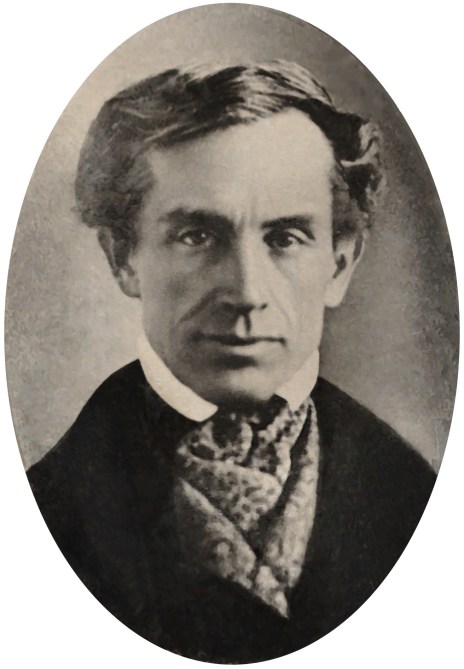
Samuel Finley Breese Morse (April 27, 1791 – April 2, 1872), American painter and inventor, was one of those guys who had it all going on. The son of a fiery Calvinist preacher, he graduated Phi Beta Kappa from Yale and became a noted portrait painter. The Marquis de Lafayette and Presidents Adams and Monroe were among his subjects.
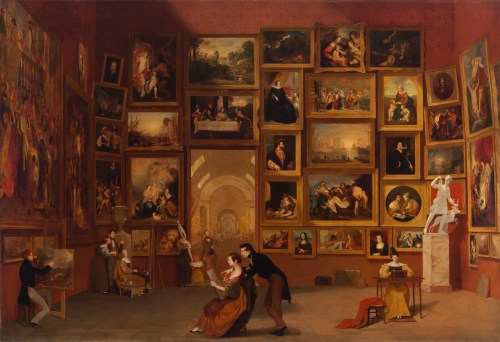
Gallery of the Louvre, 1833–Morse selected masterpieces from the Musée du Louvre’s collection and “reinstalled” them in one of the museum’s grandest spaces, the Salon Carr, envisioning that space as a workshop in which individuals study, sketch, and copy from his imagined assemblage.
His monumental “Gallery of the Louvre” was the culmination of a three-year period of study in Europe. Morse exhibited it only twice, in New York and New Haven, where it was highly praised by critics and connoisseurs but rejected by the public. Crushed by the response, Morse soon ceased painting altogether, moving on to his more successful experiments in communications technology and the invention of the Electro-Magnetic Telegraph.
During 1843, he successfully deployed the 38-mile telegraph line along the way of Baltimore and Ohio Railroad. The first information given by the telegraph was that of the nomination of James K. Polk for the Presidency by the Baltimore convention. The official demonstration of Samuel Morse’s telegraph occurred on May 24, 1844, carrying the famous words “What hath God wrought” from the Supreme Court chamber in Washington D.C. to the B&O’s Mount Clare Station in Baltimore. This demonstration is remembered as the starting point of telegraph’s expansion across the world.
The demands for the telegraph constantly increased; they spread over every civilized country in the world, and became, by usage, “absolutely necessary for the well being of society.” Convinced of their folly in so long ignoring the invention of Prof. Morse, the nations of Europe at once vied with each other in the honors they bestowed upon the inventor. Within the next few years he received respectively the decoration of the Nishan Iflichai, set in diamonds, from the Sultan of Turkey, gold medals of scientific merit from the King of Prussia, the King of Wurtemburg, and the Emperor of Austria; a cross of Chevalier in the Legion of Honor from the Emperor of France; the cross of Knight of Dannebrog from the King of Denmark; the Cross of Knight Commander of the Order of Isabelia the Catholic, from the Queen of Spain, besides being elected member of innumerable scientific and art societies in this and other countries.
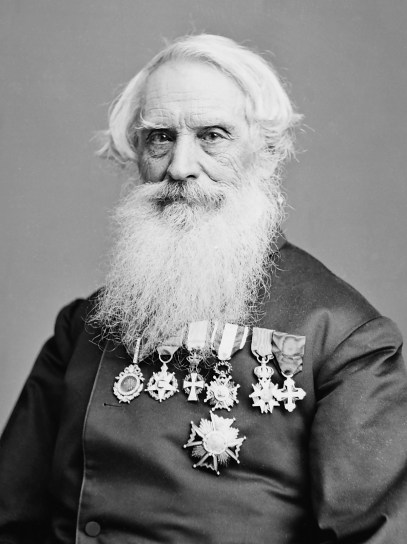
And there is a statue of him in Central Park.
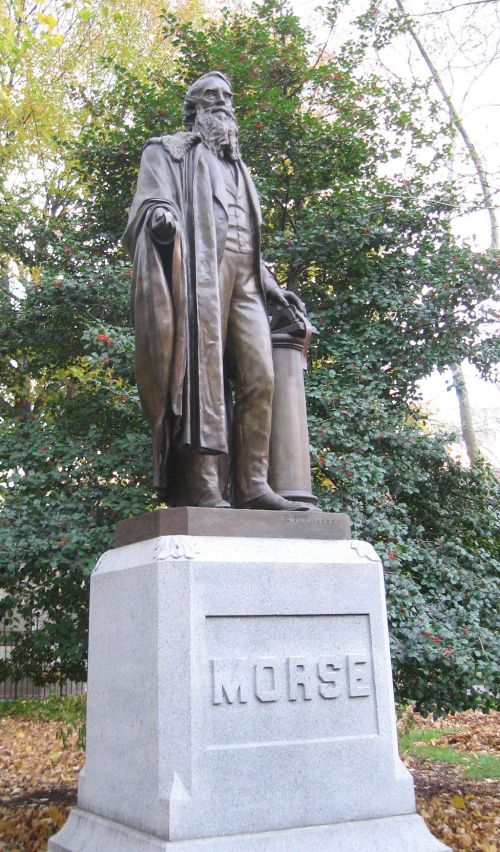
“What hath God wrought” is an exclamation of wonder, but we might ask it as a question: “What hath God wrought?”
Discuss among yourselves.
[By the way, on April 1, 2012, Google announced the release of “Gmail Tap,” an April Fool’s Day joke that allowed users to use Morse Code to send text from their mobile phones. Morse’s great-great-grandnephew Reed Morse—a Google engineer—was instrumental in the prank, which ultimately became a real product. 🙄]
*Walt Whitman, “I Sing the Body Electric”
 dual personalities
Interesting! I wonder what he’d think of the world now [insert emojis]