Running on divine momentum
by chuckofish

Somewhere in my reading recently I ran across the book Morte d’Urban by J.F. Powers, which won the National Book Award in 1963. (It was re-issued in 2000 by the New York Review of Books Classics series.) I had never heard of “this comic masterpiece” or its author. Upon doing a little research, I discovered that he was an American novelist and short-story writer “who often drew his inspiration from developments in the Catholic Church, and was known for his studies of Catholic priests in the Midwest. Although not a priest himself, he [was] known for having captured a “clerical idiom” in postwar North America.” I found it in my university library and checked it out.
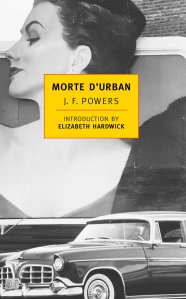
This cover art makes no sense.
It seemed to him that the Order of St Clement labored under the curse of mediocrity, and had done so almost from the beginning. In Europe, the Clementines hadn’t (it was always said) recovered from the French Revolution. It was certain that they hadn’t ever really got going in the New World. Their history revealed little to brag about-one saint (the Holy Founder) and a few bishops of missionary sees, no theologians worthy of the name, no original thinkers, not even a scientist. The Clementines were unique in that they were noted for nothing at all. They were in bad shape all over the world. The Chicago province was probably better off than the others, but that wasn’t saying much. Their college was failing, their high schools were a breakeven proposition at best, and their parishes, except for a few, were in unsettled parts of Texas and New Mexico where no order in its right mind would go. The latest white elephant was an abandoned sanitarium in rural Minnesota! But that was typical of Father Boniface and the rest of them. They just didn’t know a bad thing when they saw it-or a good one.
A book about such an Order has possibilities. It could be hilarious. But unfortunately, Morte d’Urban is merely excruciating. The minor characters are not lovable, they are just annoying, and the hero–a priest with actual talent, but no real spiritual life–is not likable enough. I am not sure what to make of him. The irony of a talented, misused man laboring in a two-bit Order is lost when you realize that as a Christian, he shouldn’t care. And what is he good at really? Fund-raising? Indeed, we never really understand what motivates the hero. He does not seem to do anything out of religious fervor, love of the church or God. He seems to be driven by self-esteem. He makes one hanker for a priest like the one in Graham Greene’s The Power and the Glory, who knows he is a bad priest:
“What an unbearable creature he must have been in those days–and yet in those days he had been comparatively innocent. That was another mystery: it sometimes seemed to him that venial sins–impatience, an unimportant lie, pride, a neglected opportunity–cut you off from grace more completely than the worst sins of all. Then, in his innocence, he had felt no love for anyone; now in his corruption he had learnt.”
Powers appears to have been too good a Catholic to really let go and be critical. He lays it all out–the priests who are not “called” to their work, who just want to get through the day with the least output of effort and then watch television; and their superiors who desire the same (just in a nicer setting) and seem to want to punish any priest who might outshine them. But he never asks why this is the situation. One feels that there should be at least one character who is not afraid to be openly critical of the Powers That Be.
I can’t help seeing this as a movie–starring, you know, Bing Crosby as the go-getting priest, and Barry Fitzgerald, Regis Toomey and Pat O’Brien in supporting parts. There doesn’t seem to be more to it and those actors’ participation would add some likability to the characters.
Am I missing something? Well, I am going to finish it, because I am curious to see where it is going. To call it a comic masterpiece is really over-selling it. Has anyone read it?
You might be interested in reading this about J.F. Powers and his obit in the NYT.
The painting at the top is “Woman Reading on a Settee” by William W. Churchill (American, 1858-1926)
 dual personalities
Maybe you have to be Catholic to find the book funny? I admire you for finishing it. I read most of the New Yorker article — it was all extremely alien to me — and boo to Powers for being a (political) conscientious objector during WWII.
He did have a strong connection with Ireland and eventually moved there, so that probably explains his WWII objections–and, yes, boo to him. I think (as with a lot of things) my expectations are all off with this book. It is ridiculous that it won the National Book Award. Without that, it would be a well-written, mildly amusing book on the level of Going My Way. I keep expecting something that isn’t there.
That is a really odd cover… Sargent’s “Portrait of Madame X” and a 1950’s Cadillac land-yacht?!? Weird.