Beside the big river
by chuckofish
On this day in 1888 Thomas Stearns Eliot was born in St. Louis, Missouri.

His family had its roots in New England, but his paternal grandfather, William Greenleaf Eliot moved to St. Louis soon after finishing his graduate studies at Harvard Divinity School in 1834. He established a Unitarian Christian church there, the Church of the Messiah, which was the first Unitarian church west of the Mississippi River. Today it is called the First Unitarian Church of Saint Louis. When Ralph Waldo Emerson visited St. Louis, he met Eliot and called him “the Saint of the West.”
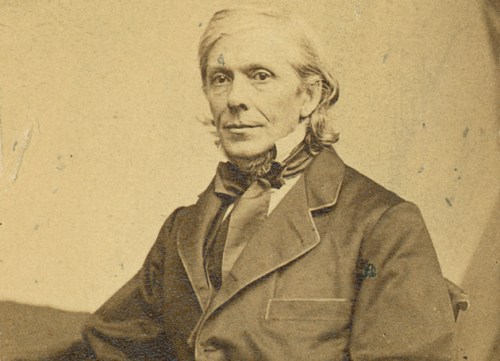
It is good to take a moment to remember that the 1830s in St. Louis were the early days. For years Protestants had been conducting services in their homes, but it was not until after the Louisiana Purchase that Protestant churches were built. In 1818 Baptist missionary John Mason Peck organized the First Baptist Church. This was followed by a Methodist, Presbyterian, and Episcopal church (founded in 1825 when Thomas Horrell became the first rector of the Christ Church Episcopal Church). So Eliot was quite a pioneer.
William Greenleaf Eliot was also a benefactor of educational institutions in St. Louis and co-founded my flyover university with his good friend Wayman Crow in 1853. Originally named Eliot Seminary, the name was eventually changed to Washington University.
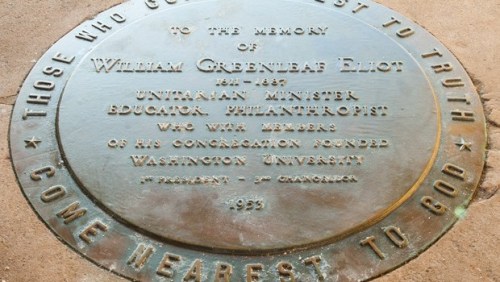
Eliot became chancellor in 1871 and was associated with the university for the rest of his life.
I have fond memories of growing up next to Washington University back in the days when small children were free to roam and even cross big streets without adult supervision. In the early sixties my siblings and I used to walk up to the campus and play “army” heavily armed with toy guns. (We were big fans of the television show Combat! and so we were continually fighting the Battle of the Bulge.) I’m sure this would be considered quite inappropriate these days–small gun-toting children wandering on campus–but, boy, did we have fun. My older brother was the captain, I was the lieutenant and our little sister (and DP) was the sargeant. (Her middle name is Sargent, so it seemed especially appropriate.)
We knew (or should I say, our brother) knew our way around campus. We also knew where all the candy machines were.
Eliot also founded my Alma Mater Mary Institute in 1859, a school for girls which he named after his daughter, Mary Rhodes Eliot, who died at age 17.
T.S. Eliot spoke at Mary Institute’s centennial in 1959. Our father was a teacher there at the time and so he met the great man. ANC III also wrote the centennial history of Mary Institute.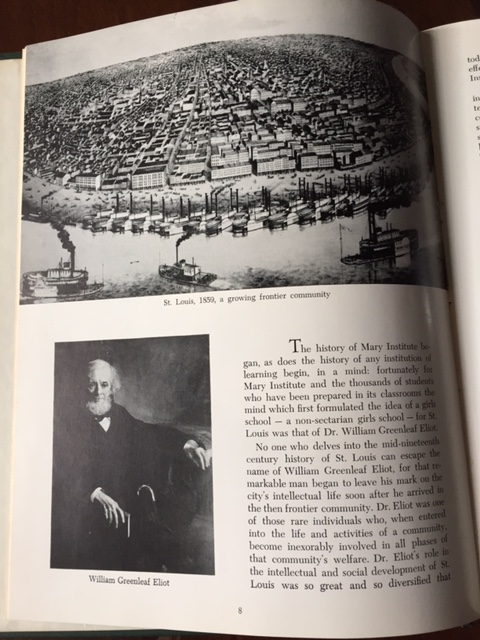
Well, I digress.
T.S. Eliot once said:
It is self-evident that St. Louis affected me more deeply than any other environment has ever done. I feel that there is something in having passed one’s childhood beside the big river, which is incommunicable to those people who have not. I consider myself fortunate to have been born here, rather than in Boston, or New York, or London.
I have to agree. I have probably mentioned already that there is something about growing up in a town on a river that is different. You always have your bearings for one thing. You know North and South because you know where the river is.
When Eliot visited M.I. in 1959, he gave a lecture and at the end he read “The Dry Salvages” (one of the Four Quartets) in its entirety. Here is the first stanza.
I do not know much about gods; but I think that the river
Is a strong brown god – sullen, untamed and intractable,
Patient to some degree, at first recognised as a frontier;
Useful, untrustworthy, as a conveyor of commerce;
Then only a problem confronting the builder of bridges.
The problem once solved, the brown god is almost forgotten
By the dwellers in cities – ever, however, implacable.
Keeping his seasons, and rages, destroyer, reminder
Of what men choose to forget. Unhonoured, unpropitiated
By worshippers of the machine, but waiting, watching and waiting.
His rhythm was present in the nursery bedroom,
In the rank ailanthus of the April dooryard,
In the smell of grapes on the autumn table,
And the evening circle in the winter gaslight.
 dual personalities