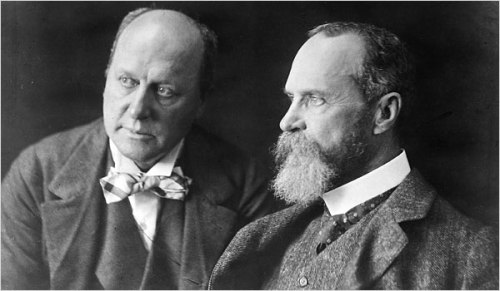
“Now, my dear little girl, you have come to an age when the inward life develops and when some people (and on the whole those who have most of a destiny) find that all is not a bed of roses. Among other things there will be waves of terrible sadness, which last sometimes for days; irritation, insensibility, etc., etc., which taken together form a melancholy. Now, painful as it is, this is sent to us for an enlightenment. It always passes off, and we learn about life from it, and we ought to learn a great many good things if we react on it right. (For instance, you learn how good a thing your home is, and your country, and your brothers, and you may learn to be more considerate of other people, who, you now learn, may have their inner weaknesses and sufferings, too.) Many persons take a kind of sickly delight in hugging it; and some sentimental ones may even be proud of it, as showing a fine sorrowful kind of sensibility. Such persons make a regular habit of the luxury of woe. That is the worst possible reaction on it. It is usually a sort of disease, when we get it strong, arising from the organism having generated some poison in the blood; and we mustn’t submit to it an hour longer than we can help, but jump at every chance to attend to anything cheerful or comic or take part in anything active that will divert us from our mean, pining inward state of feeling. When it passes off, as I said, we know more than we did before. And we must try to make it last as short a time as possible. The worst of it often is that, while we are in it, we don’t want to get out of it. We hate it, and yet we prefer staying in it—that is a part of the disease. If we find ourselves like that, we must make something ourselves to some hard work, make ourselves sweat, etc.; and that is the good way of reacting that makes of us a valuable character. The disease makes you think of yourself all the time; and the way out of it is to keep as busy as we can thinking of things and of other people—no matter what’s the matter with our self.”
–William James, (January 11, 1842 – August 26, 1910), American philosopher and psychologist
“For some of us, books are as important as almost anything else on earth. What a miracle it is that out of these small, flat, rigid squares of paper unfolds world after world after world, worlds that sing to you, comfort and quiet or excite you. Books help us understand who we are and how we are to behave. They show us what community and friendship mean; they show us how to live and die.”
―Anne Lamott, Bird by Bird: Some Instructions on Writing and Life
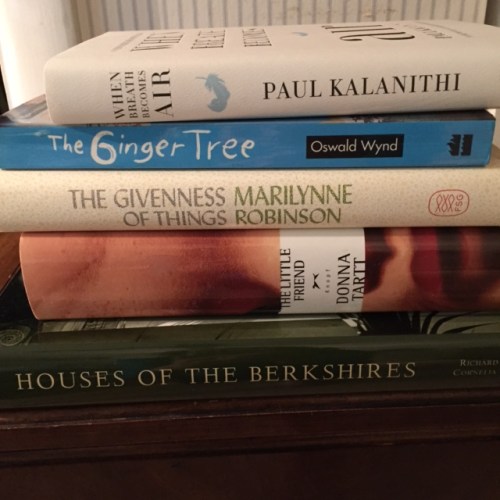
I have a pile of new and vintage books to read.
What is better than that? A window with a nice view. Maybe someone bringing you a cup of tea or making dinner for you?
I guess I am getting old, but that sounds very good to me.
…Till the beloved Master come…”
How was your weekend? Mine was quiet and restorative, but also a little sad, since I was thinking always of the weekend before when so many people were visiting. C’est la vie.
I finished E.L. Doctorow’s The March, which, again I say, is so good and wise and well-written.
I did a little yard work, but it was pretty wet and rainy. It is certainly looking lush in flyover land.

I watched a few movies: Sands of Iwo Jima (1949), which I finally got my hands on…
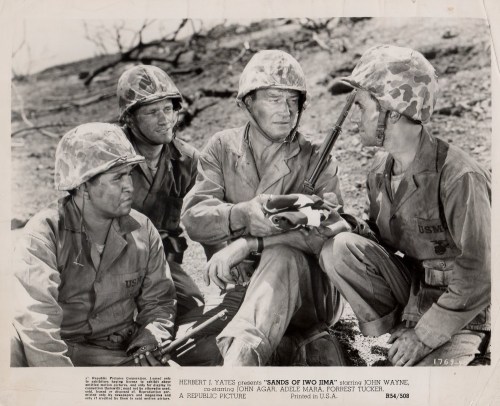
(This film recreates the famous raising of the flag on Iwo Jima scene, taken on Feb. 23, 1945, by photographer Joe Rosenthal. The three surviving flag raisers make a cameo appearance during this scene . Rene A. Gagnon, Ira H. Hayes and John H. Bradley are seen with John Wayne as he instructs them to hoist the flag (Wayne gives the folded flag to Gagnon). The flag used to recreate the incident is the actual flag that was raised on Mount Suribachi.)
and Learning to Drive (2014), a little film starring Ben Kingsley as a Sikh taxi driver/driving instructor and Patricia Clarkson as a book critic whose marriage is falling apart.
Both supplied an entertaining diversion, but were not super great, if you know what I mean. Sands of Iwo Jima features John Wayne saying “Saddle Up!” continuously, so it wins as far as I’m concerned.
I went to church and was a reader–my passage was from Revelation 21 by John, the Revelator, so that was fun. The first lesson was from the book of Acts where Paul goes to Philippi in Macedonia and goes down to the river to pray and meets Lydia. All this made me want to watch O Brother, Where Art Thou? (2000) which I did.
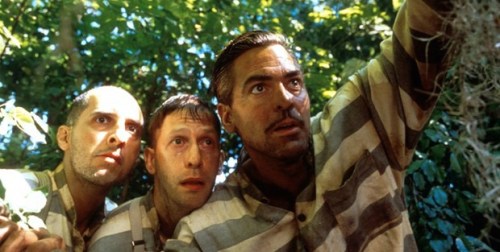
It was a good choice. (And the last good movie George Clooney made.)
(This is how my mind works.)
*Gerald Near, Christ Has a Garden Walled Around